Illustrated guide · Assisi
Stone, light
and the Middle Ages
Ten places through which to read the city of today and recognise the communal, Franciscan and fortified Assisi of the Middle Ages.
Explore the placesPreface
This journey had to begin here.
This is the city of Saint Francis: a place where the history of Christianity and the Middle Ages does not belong only to the past, but remains alive in its stone, churches, streets and landscape. For centuries Assisi has drawn pilgrims, travellers and visitors from every part of the world, attracted by its beauty and by a spiritual atmosphere that is difficult to find elsewhere.
Umbria is the region where fate brought me to live forty-two years ago, and a meaningful part of my life has been tied to it ever since. That is why I wanted the journey through the destinations of this new section to begin in Assisi.
Many more pages will follow. I have worked as a travel agent since 1990 and, over the years, I have been fortunate enough to discover very different places, cultures and itineraries. But this story could not begin anywhere else.
It had to begin here: in Assisi.

One destination
Assisi,
layer by layer.
The story begins with what visitors can still encounter directly: façades, squares, walls, woods, paths and accessible spaces. Each place is then connected to its medieval history, keeping documented evidence distinct from religious tradition.
The selection
Ten places,
one story
From the Basilica to the valley floor, following historical importance and visual character rather than a rigid itinerary.
Where the story begins
Basilica of Saint Francis and the Sacred Convent
Two superimposed churches, a tomb and a cycle of images that changed European painting.
The place today
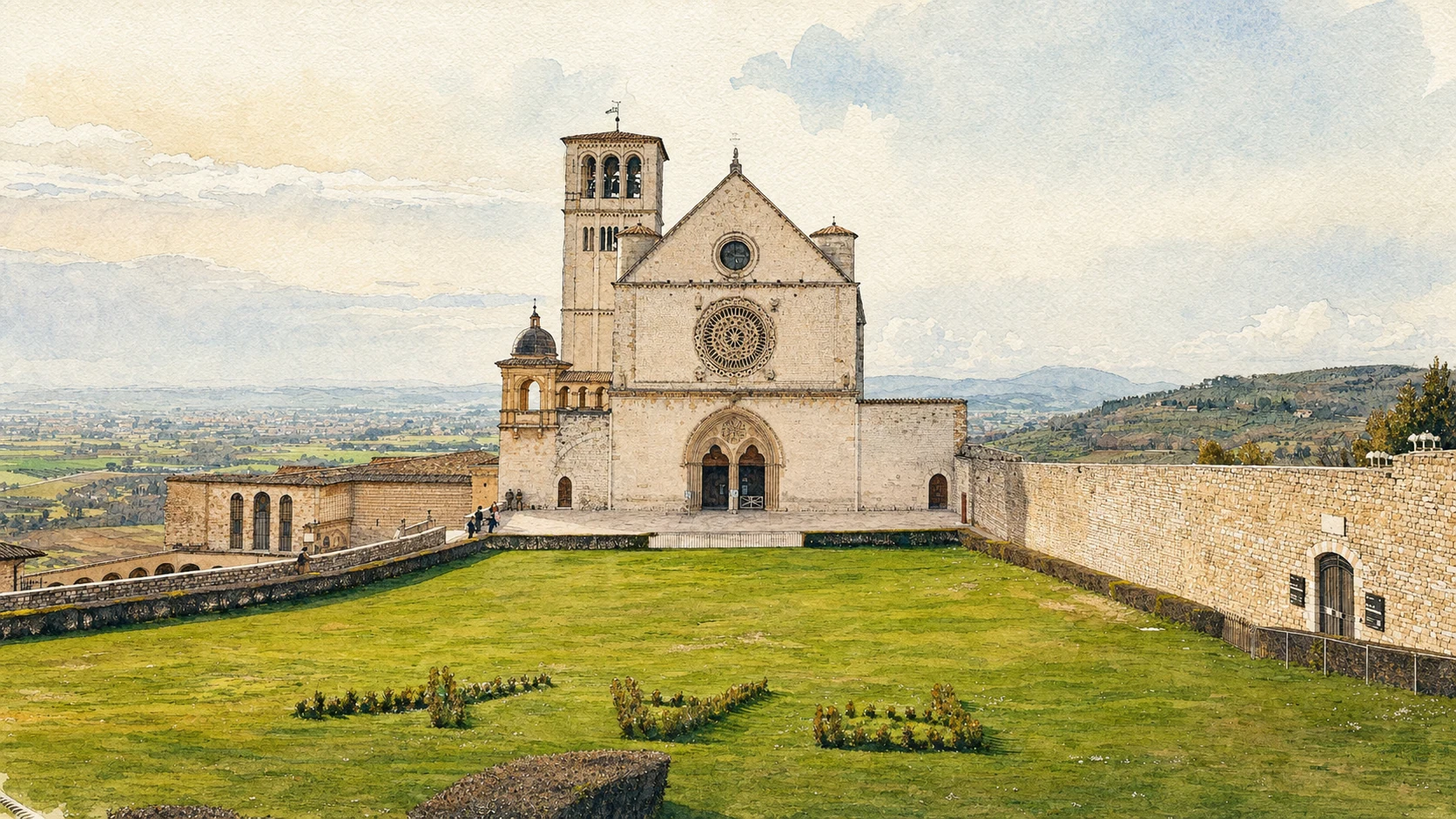
The complex occupies the western edge of the city and unfolds on several levels: the bright, soaring Upper Basilica; the more intimate Lower Basilica; the crypt containing the tomb of Francis; and the Sacred Convent extending along the hillside. A visit deserves time: this is not a single church, but an ensemble of architecture, painting, liturgy and landscape.
The medieval chapter
Construction began in 1228, two years after the death of Francis. His body was placed in the Lower Basilica in 1230; the Upper Basilica, intended for solemn celebrations, was built between 1230 and 1253. During the thirteenth and fourteenth centuries Cimabue, Giotto and his workshop, Simone Martini and Pietro Lorenzetti worked here. The two superimposed basilicas and their pictorial programme made Assisi a decisive reference point for medieval European art.
What to notice
- The rose window and Gothic portal of the Upper Basilica
- The passage from the light of the upper church to the half-light below
- The relationship between the complex, the lawn and the valley

The city of power
Rocca Maggiore
A fortress that reveals imperial, communal and papal Assisi, far beyond the familiar image of a religious city.
The place today
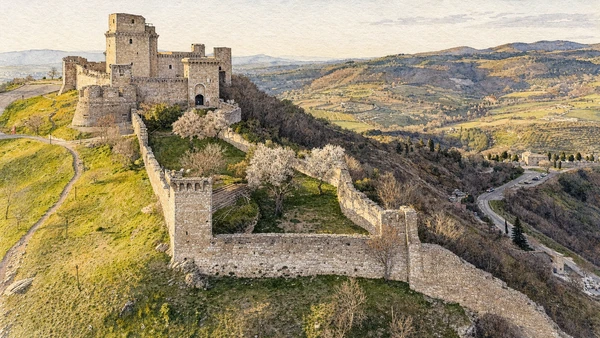
From the summit of Colle Asio, the Rocca dominates Assisi and the Umbrian plain. The visitor route crosses courtyards, military rooms, towers and wall walks; the panorama makes the strategic value of this position immediately clear. The climb is part of the experience, and the complex is not easily accessible to visitors with reduced mobility.
The medieval chapter
The first certain record of a fortification dates to 1174, during Swabian rule. In 1198, after the city rebelled against imperial power, the fortress was demolished. What is visible today derives mainly from the fourteenth-century rebuilding promoted by Cardinal Egidio Albornoz and from later additions: the raising of the keep and the long passage to the polygonal tower. The Rocca makes visible the struggle between communal autonomy, the Empire and papal authority.
What to notice
- The central keep and sequence of bastions
- The defensive wall descending along the slope
- The view of the Basilica and the urban fabric of Assisi

Ancient Rome within the medieval commune
Piazza del Comune
Within a few metres stand the Roman forum, the medieval assembly space, the civic palaces and the tower that symbolised the commune.
The place today
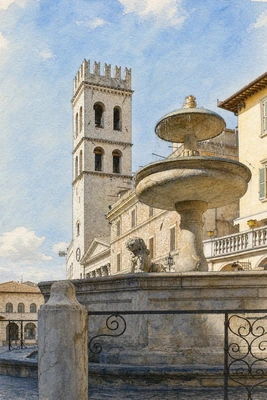
This is Assisi’s civic centre and the place where the city reveals its layers most clearly. The façade of the Temple of Minerva now leads into the church of Santa Maria sopra Minerva; beside it stand the Palazzo del Capitano del Popolo and the Torre del Popolo. Beneath the square, the Roman forum can be visited, with paving and structures from ancient Asisium.
The medieval chapter
In 1228 the commune bought buildings in front of the ancient temple to enlarge the public space and cleared the vestibule between the columns, using it for civic assemblies. The Palazzo del Capitano del Popolo belongs to the thirteenth century; the tower, begun around 1257, was completed in 1305. The Palazzo dei Priori took shape in the fourteenth century. The square is therefore where medieval communal government appropriated the Roman inheritance without erasing it.
What to notice
- The Roman columns incorporated into the church façade
- The 47-metre Torre del Popolo and its battlements
- The Fountain of the Three Lions as the square’s visual focus

Pink stone and the memory of Clare
Basilica of Saint Clare
An instantly recognisable façade and an interior preserving the Crucifix brought here from San Damiano.
The place today
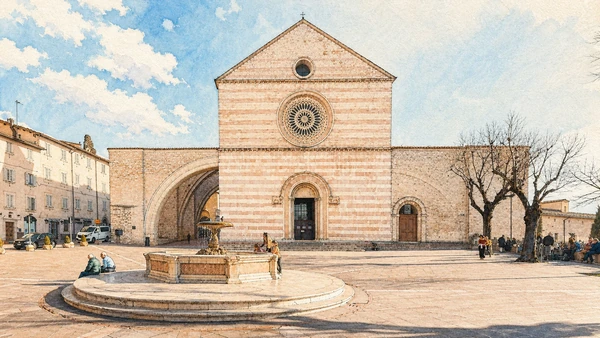
The basilica opens onto an urban terrace overlooking the valley. Its façade alternates white and pink stone from Mount Subasio and is dominated by the great rose window. Inside are works from the thirteenth and fourteenth centuries, the crypt containing the remains of Clare and the Crucifix of San Damiano, transferred here by the Poor Clares.
The medieval chapter
Construction began in 1257 above the earlier church of San Giorgio, where the bodies of Francis and Clare had each been kept for a time. The building was completed in the thirteenth century; during the fourteenth, the left side was reinforced with great flying buttresses. The basilica connects the memory of the founder of the Poor Ladies with the monumental growth of Assisi after the deaths of the two saints.
What to notice
- The alternating white and pink stone
- The rose window and upper oculus in perfect alignment
- The great flying buttress visible on the left side

The most intimate place
San Damiano Sanctuary
Outside the walls, among olive trees, the stories of Francis and Clare meet in spaces that still feel intimate.
The place today
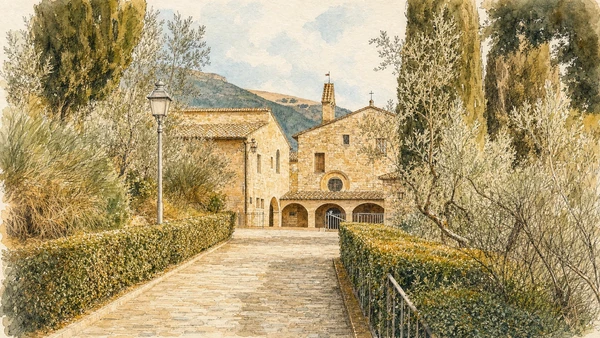
The sanctuary is reached by descending from Porta Nuova. The path through olive trees and cypresses leads to a small-scale complex: portico, church, choir, oratory, dormitory and refectory. These spaces preserve the essential character of communal life and reveal San Damiano more fully than an exterior view alone.
The medieval chapter
Tradition places here the episode in which the Crucifix invited Francis to “repair my house”. Clare and her companions settled at San Damiano; the community of the Poor Ladies took shape here, and Clare lived here until her death in 1253. Fourteenth-century frescoes and traces of decoration that once covered the rooms survive. These devotional memories should be read with a clear distinction between religious tradition and the material evidence still visible.
What to notice
- The three-arched portico and small rose window
- The modest scale of the communal spaces
- The relationship between stone, olive grove and the slopes of Mount Subasio

Silence on Mount Subasio
Eremo delle Carceri
At an altitude of about 800 metres, the architecture adapts to caves and slopes instead of dominating them.
The place today
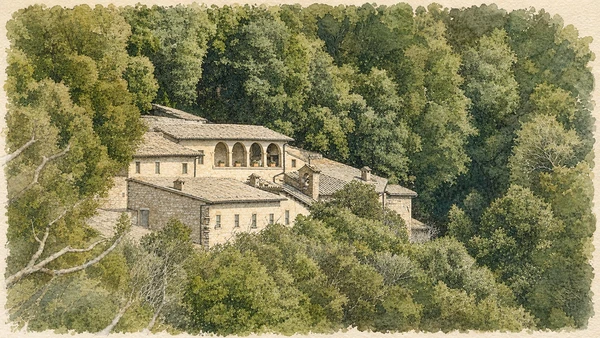
The hermitage lies about four kilometres above the historic centre, in the holm-oak woods of Mount Subasio. Cloister, church, refectory, cells and caves are connected by narrow passages and changes in level. A path from the complex reaches the cavities associated with the earliest companions of Francis.
The medieval chapter
In the time of Francis, the place was essentially a small chapel surrounded by caves used for retreat. In the fourteenth century the area was entrusted to the Franciscans, and between 1370 and 1373 Paoluccio Trinci built the first cells around the church of Santa Maria. In the fifteenth century Bernardino of Siena encouraged further expansion. The present complex is therefore the result of gradual growth, always shaped by the terrain.
What to notice
- The four-arched loggia embedded in the complex
- The continuity between natural rock and masonry
- The caves and woods as an integral part of the visit

The small church inside the great basilica
Saint Mary of the Angels and the Porziuncola
The immense later basilica protects a tiny building at the heart of the earliest Franciscan experience.
The place today
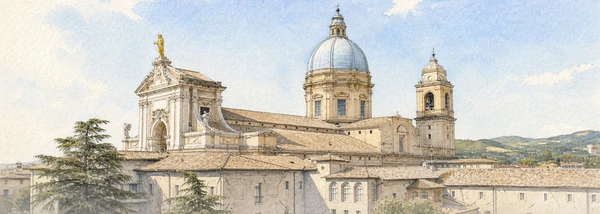
At the foot of Assisi, the dome of Saint Mary of the Angels marks the sanctuary from afar. The great basilica, built between 1569 and 1679, encloses the Porziuncola and the Chapel of the Transitus. The contrast in scale is essential: the monumental shell protects medieval places of the smallest dimensions.
The medieval chapter
The Porziuncola was a small church entrusted to the Benedictines and later restored by Francis. Franciscan tradition places here the birth of the Order of Friars Minor in 1209 and, on Palm Sunday in 1211 or 1212, the beginning of Clare’s religious life. Nearby, in the place now called the Chapel of the Transitus, Francis died on 3 October 1226. The basilica visible from outside is not medieval; the memories preserved within it are.
What to notice
- The dome and bell tower of the later basilica
- The simple proportions of the Porziuncola at the centre of the nave
- The Chapel of the Transitus, recalling the medieval infirmary

Assisi before the Basilica
Cathedral of San Rufino
The Romanesque cathedral returns the story to the episcopal city in which Francis and Clare were born.
The place today
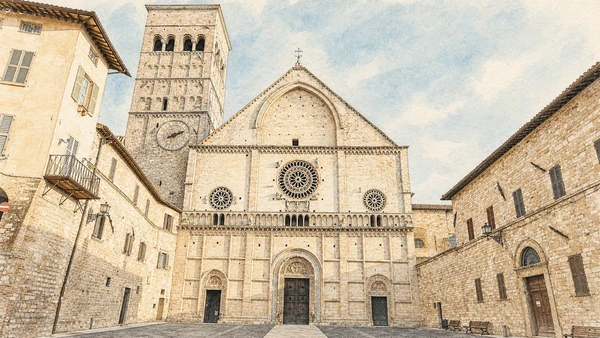
Climbing from Piazza del Comune brings visitors to one of Umbria’s most important Romanesque façades. Three portals, a blind-arcade gallery and three rose windows organise the front; the bell tower preserves earlier fabric. Below ground, visitors can see the crypt, a Roman cistern and the Diocesan Museum.
The medieval chapter
An earlier church already held the relics of Saint Rufinus. In 1029 Bishop Ugone enlarged the building and raised it to cathedral status. Construction of the larger church began in the twelfth century and is traditionally associated with Giovanni da Gubbio; it was consecrated in 1253. According to tradition, the baptismal font is linked to the baptisms of Francis and Clare.
What to notice
- The central rose window flanked by two smaller ones
- The carved portals and blind-arcade gallery
- The bell tower, crypt and different building phases

The lived-in city
Via San Francesco and the medieval lanes
Between the civic square and the Basilica, history is not confined to one monument: it lies in the fabric of the streets.
The place today
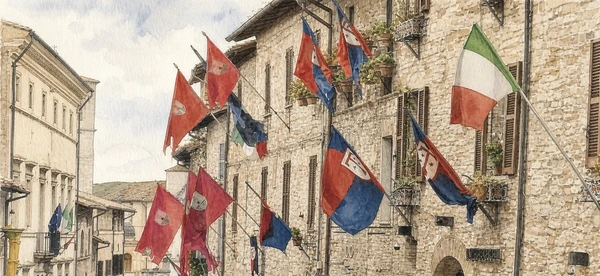
Via San Francesco connects the civic centre with the basilica complex. Along the route are Palazzo Vallemani, the Oratorio dei Pellegrini, the Monte Frumentario, fountains, arches and stone houses. Side streets reveal stairways, covered passages and views that follow the hillside rather than a regular grid.
The medieval chapter
The Monte Frumentario dates from the thirteenth century and bears witness to the charitable institutions of the communal city; the Casa dei Maestri Comacini recalls the craftsmen active in medieval building. The Oratorio dei Pellegrini, decorated in the fifteenth century, evokes the constant stream of travellers heading to the tomb of Francis. The street thus became an urban, economic and devotional axis.
What to notice
- The gradient and façades built along the hillside
- Portals, arches and traces of medieval functions
- The gradual approach to the Basilica

The other half of Assisi
The Wood of Saint Francis
Below the Basilica survives a landscape of woods, fields, water and buildings that served pilgrims and religious communities.
The place today
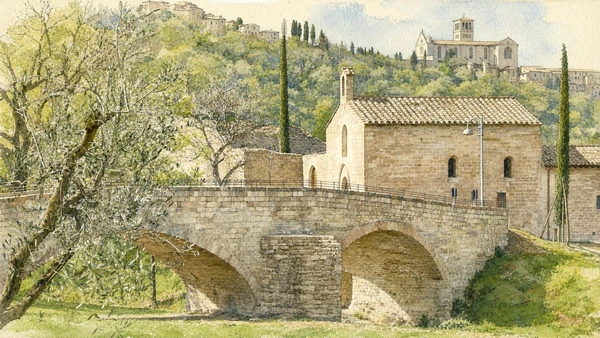
A path descends from the square of the Upper Basilica towards the Tescio valley. The FAI property covers about 64 hectares of woodland, clearings, olive groves and fields. The route reaches the Ponte dei Galli, the Santa Croce complex and Michelangelo Pistoletto’s Third Paradise, a contemporary work formed by 121 olive trees.
The medieval chapter
By the mid-thirteenth century, a hospital for pilgrims, the poor and the sick was already active near the bridge; by the end of the century it had passed to Benedictine nuns. The Romanesque church of Santa Croce, parts of the monastery, a mill of medieval origin and a fourteenth-century tower connected with the defence of a workshop survive. The Wood reveals the productive and charitable territory that sustained the city and its pilgrimage.
What to notice
- The two arches of the Ponte dei Galli
- Santa Croce and the structures of the Benedictine complex
- The Basilica visible above, connected to the valley floor

The city through time
Eight dates for orientation
An essential chronology: it does not replace the history of each place, but shows how their stories overlap.
Bishop Ugone enlarges San Rufino and strengthens its role as the cathedral.
A Swabian fortification is documented on the hill of the future Rocca Maggiore.
A civic revolt demolishes the fortress, a symbol of imperial rule.
Franciscan tradition places the birth of the Friars Minor at the Porziuncola.
Francis dies near the Porziuncola, in the place now known as the Transitus.
Construction begins on the Basilica of Saint Francis, while Piazza del Comune undergoes its medieval transformation.
The Upper Basilica and the new Cathedral of San Rufino are consecrated.
The Rocca, Torre del Popolo, civic palaces and hermitage establish new patterns of power and devotion.
Before your visit
Practical information,
without turning it into promises
Historic centre
Much of the centre is a restricted-traffic zone. The main car parks are outside the walls; from there, Assisi is explored primarily on foot.
Changes in level
Climbs, stone paving and steps are part of the city. The Rocca, the hermitage and the Wood require a specific assessment of accessibility.
Places of worship
Visitor hours and religious services may overlap. Silence, appropriate clothing and staff instructions take precedence over sightseeing plans.
Final check
Opening hours, tickets and access can change. Before setting out, always consult the official pages linked in each section.
Sources
Texts and visual comparisons were checked against institutional sources or organisations directly responsible for the sites. When devotional tradition does not coincide with material historical evidence, it is explicitly identified as tradition.
- UNESCO · Assisi, the Basilica of Saint Francis and other Franciscan sites ↗
- Visit Assisi · official tourism portal of the City of Assisi ↗
- Porziuncola Sanctuary · official website ↗
- FAI · The Wood of Saint Francis ↗
The images are illustrations, not photographs. They were produced as watercolour interpretations of verified views; Piazza del Comune and Via San Francesco also use public-domain or CC0 reference compositions.