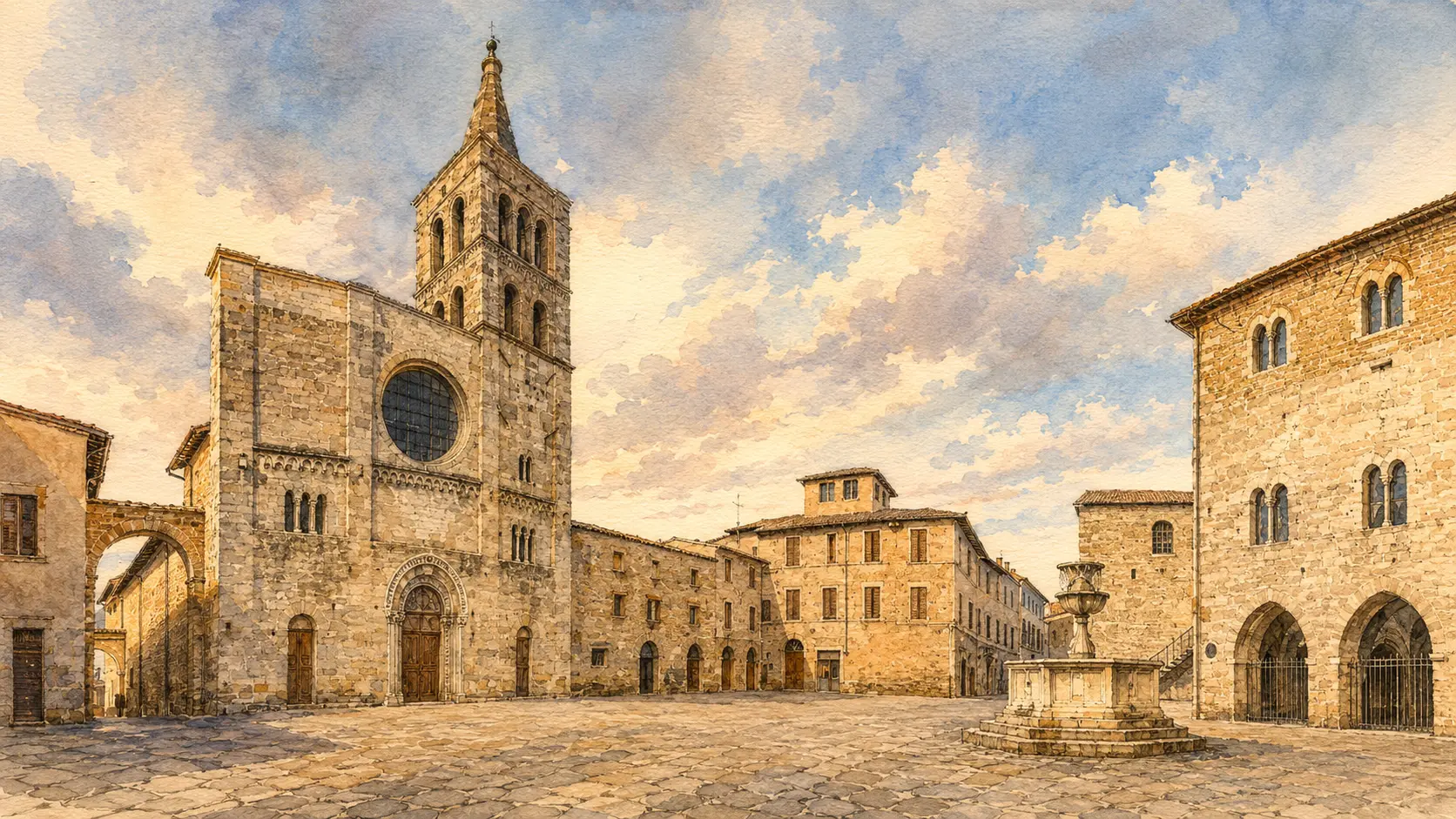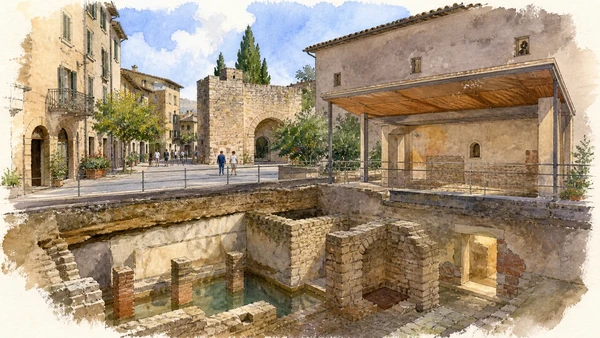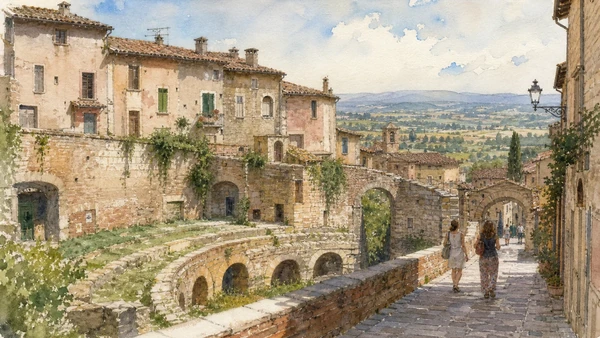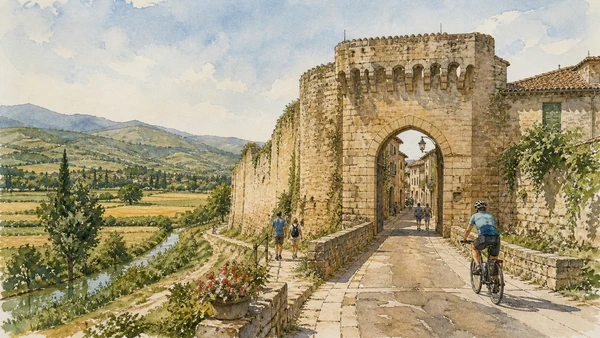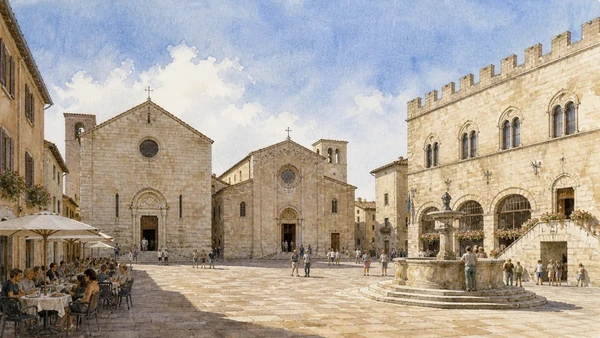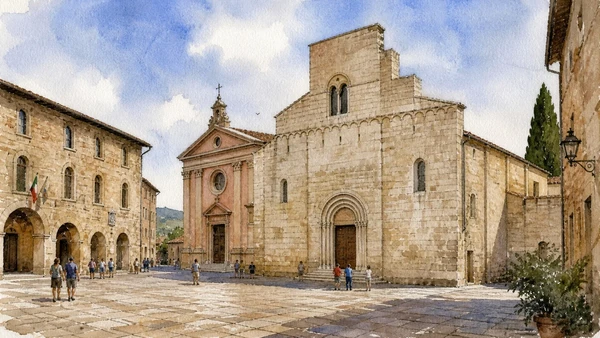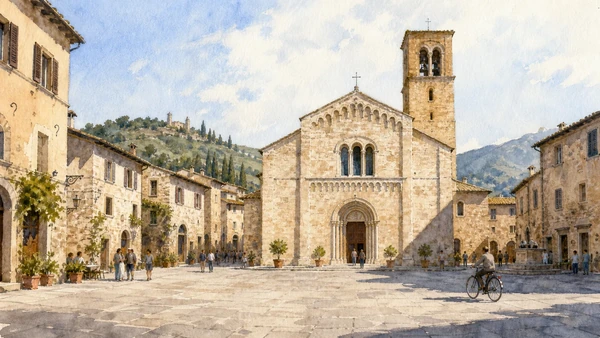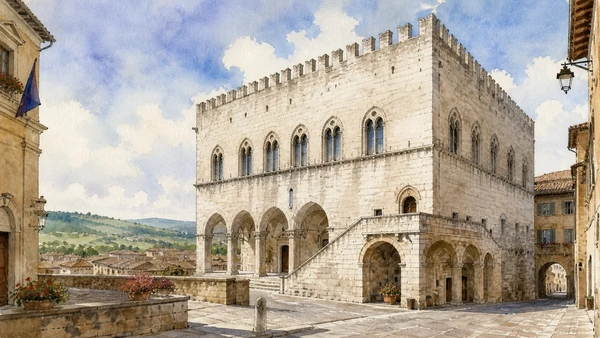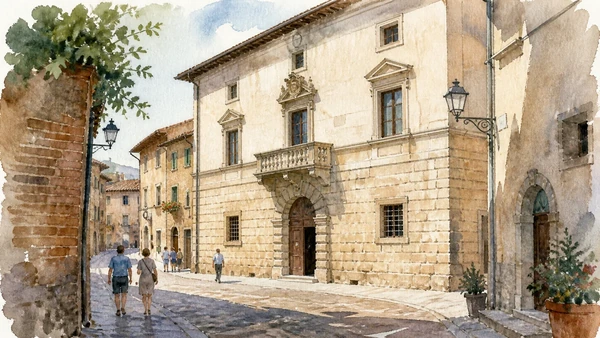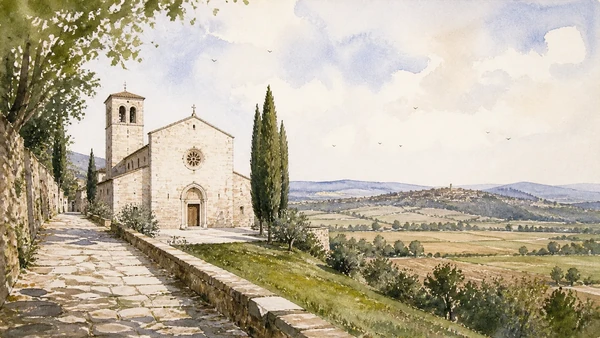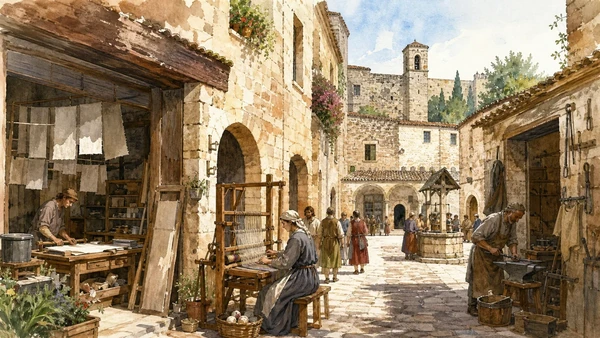
Documentary watercolour panorama of Bevagna with medieval roofs, walls and the Umbrian plain

Illustrated guide · Bevagna

Water, craft
and Roman streets

Ten places through which to read Roman Mevania, an unusually intact medieval town and the living reconstruction of its guilds and workshops.

Explore the places
Ancient Mevania · Valle Umbra

Preface

Bevagna is a town of continuity rather than spectacle.

Its main square is among Umbria's finest, but the deeper story lies in how Roman streets, medieval churches, watercourses and craft traditions remain close to one another at ground level.

After forty-two years in Umbria, I value Bevagna precisely because it does not depend on a distant hilltop silhouette. It belongs to the plain, to the old Via Flaminia and to productive activities that shaped its houses and neighbourhoods.

This guide follows that lived scale, beginning with Roman Mevania, gathering the principal buildings of Piazza Silvestri and ending with the Gaite and the surrounding Franciscan landscape.

Bevagna tells history at the scale of a street, a workshop and a square.

One destination

Bevagna,
street by street.

The route combines archaeology, Romanesque architecture, communal institutions and living craft interpretation. The Mercato delle Gaite is described as carefully researched modern re-enactment, not as an unchanged medieval survival.

The selection

Ten places,
one story

A level walking route from Roman domestic spaces to the medieval square, then outward to walls, Franciscan memory and the craft neighbourhoods of the Gaite.

  1. 01Roman Baths and marine mosaic
  2. 02Roman Theatre remains
  3. 03Medieval walls, gates and Via Flaminia
  4. 04Piazza Silvestri
  5. 05Church of San Silvestro
  6. 06Church of San Michele Arcangelo
  7. 07Palazzo dei Consoli and Teatro Torti
  8. 08Palazzo Lepri and Civic Museum
  9. 09San Francesco and Piandarca
  10. 10The Gaite and medieval craft workshops
01

Mevania below the houses

Roman Baths and marine mosaic

A black-and-white mosaic of sea creatures preserves the decorative floor of an important Roman bathing complex.

Original documentary watercolour showing Roman Baths and marine mosaic in its Bevagna urban or landscape context
Roman Baths and marine mosaicRoman Baths and marine mosaic · original Merlintravel watercolour

The place today

The archaeological space is entered within the modern town and centres on a large mosaic floor populated by dolphins, octopus, lobsters and fantastic marine creatures. Walls and service areas help reconstruct the heated rooms, while interpretation connects the fragment to the broader Roman settlement.

The historical chapter

The baths developed during the Roman imperial period, when Mevania benefited from its position on the Via Flaminia and river routes. The mosaic probably decorated a room associated with bathing and water. Later buildings covered the complex, preserving it within the dense urban fabric rather than outside the town.

What to notice

  • The movement created by black figures on a white ground
  • Real and fantastic marine animals mixed together
  • Roman wall lines continuing beneath later property boundaries
Umbria Tourism · Bevagna city guide
02

A theatre absorbed by the town

Roman Theatre remains

Houses and workshops follow the curve of an ancient entertainment building whose form survives through reuse.

Original documentary watercolour showing Roman Theatre remains in its Bevagna urban or landscape context
Roman Theatre remainsRoman Theatre remains · original Merlintravel watercolour

The place today

The theatre is not an open monument like Gubbio's. Portions of its radial walls, passages and curved perimeter appear within later buildings and a visitable archaeological area. Reading it requires attention to street lines and interior structures rather than expecting a complete cavea.

The historical chapter

The theatre was constructed in Roman Mevania, probably during the early imperial period. As its original function ended, medieval and later inhabitants reused the strong masonry as foundations, cellars and property divisions. This process preserved the plan while making it part of the ordinary town.

What to notice

  • Curved street and building lines following the cavea
  • Radial Roman walls incorporated into later rooms
  • The difference between structural survival and visual completeness
Umbria Tourism · Bevagna city guide
03

Road and enclosure

Medieval walls, gates and Via Flaminia

The wall circuit and long street axis preserve Bevagna's relation to an ancient regional road.

Original documentary watercolour showing Medieval walls, gates and Via Flaminia in its Bevagna urban or landscape context
Medieval walls, gates and Via FlaminiaMedieval walls, gates and Via Flaminia · original Merlintravel watercolour

The place today

Walls and gates remain visible around much of the flat historic centre. The principal internal streets broadly inherit the route of the Roman town and Via Flaminia. Water channels and the nearby Topino system help explain both prosperity and vulnerability in the plain.

The historical chapter

Roman Mevania grew along the Flaminian route. After periods of contraction and conflict, medieval Bevagna fortified a smaller area within and around the ancient settlement. Rebuilt walls controlled commerce and defence while preserving the long north-south movement through the town.

What to notice

  • The unusual flat circuit compared with Umbrian hill towns
  • Gate alignments continuing into straight urban streets
  • Watercourses as infrastructure near the defences
Umbria Tourism · Bevagna city guide
04

The medieval ensemble

Piazza Silvestri

Two Romanesque churches and a communal palace face one another in an asymmetrical square of exceptional unity.

Original documentary watercolour showing Piazza Silvestri in its Bevagna urban or landscape context
Piazza SilvestriPiazza Silvestri · original Merlintravel watercolour

The place today

San Silvestro and San Michele stand at different angles, while Palazzo dei Consoli closes another side with its broad upper loggia. The fountain and changing levels organise movement through the space. Because the square is irregular, every approach reveals a different composition.

The historical chapter

The ensemble took shape mainly between the late twelfth and thirteenth centuries, when Bevagna's commune and religious institutions asserted their presence. The buildings were not designed as one formal project, yet shared local stone, Romanesque construction and continuous use created the remarkable coherence visible today.

What to notice

  • The deliberate-looking unity produced by independent buildings
  • Different church orientations
  • The upper loggia of Palazzo dei Consoli overlooking the square
Umbria Tourism · Bevagna city guide
05

Romanesque clarity

Church of San Silvestro

A compact twelfth-century church whose restrained stone geometry is among the purest expressions of Umbrian Romanesque architecture.

Original documentary watercolour showing Church of San Silvestro in its Bevagna urban or landscape context
Church of San SilvestroChurch of San Silvestro · original Merlintravel watercolour

The place today

The façade is divided by pilasters and a central portal, with a three-light window above; its upper portion was never completed as originally intended. Inside, robust columns and rounded arches lead to a raised presbytery above the crypt.

The historical chapter

An inscription dates the church to 1195 and names Binello as master builder. Its unfinished façade and carefully proportioned interior reveal both ambition and material limits. The crypt and use of local stone connect the building to wider Romanesque practice in the Spoleto valley.

What to notice

  • The incomplete upper façade
  • The signed and dated building inscription
  • The raised presbytery and crypt organising two levels
Umbria Tourism · Bevagna city guide
06

The larger Romanesque church

Church of San Michele Arcangelo

A monumental façade and crypt show how Bevagna adapted classical material and local craftsmanship to a major medieval church.

Original documentary watercolour showing Church of San Michele Arcangelo in its Bevagna urban or landscape context
Church of San Michele ArcangeloChurch of San Michele Arcangelo · original Merlintravel watercolour

The place today

San Michele faces the square with a richly carved central portal and broad façade. The interior has been altered and restored over time, while the crypt preserves columns and capitals at a more intimate scale. The bell tower anchors the church in Bevagna's skyline.

The historical chapter

The church was built around the turn of the thirteenth century by masters associated with San Silvestro. Reused Roman stone appears alongside medieval carving. Later changes, including Baroque interventions and modern restoration, shaped the present interior without removing the Romanesque structure.

What to notice

  • Carved portal with classical and medieval motifs
  • Reused stone within the façade and crypt
  • The relationship between larger scale and San Silvestro across the piazza
Umbria Tourism · Bevagna city guide
07

The communal palace becomes a theatre

Palazzo dei Consoli and Teatro Torti

A medieval civic building contains an intimate nineteenth-century theatre, placing two forms of public life within one structure.

Original documentary watercolour showing Palazzo dei Consoli and Teatro Torti in its Bevagna urban or landscape context
Palazzo dei Consoli and Teatro TortiPalazzo dei Consoli and Teatro Torti · original Merlintravel watercolour

The place today

The palace is recognised by the large arched loggia above the square. Inside, Teatro Torti is a small horseshoe-shaped theatre with boxes, painted decoration and a close relationship between audience and stage. Access depends on performances and guided openings.

The historical chapter

Palazzo dei Consoli was built in the thirteenth century as the seat of communal government. In the nineteenth century, part of the interior was transformed into a theatre named for the local poet Francesco Torti. The adaptation preserved the public role of the building while changing its form of assembly.

What to notice

  • The loggia as a civic balcony over the piazza
  • Theatre boxes fitted inside medieval walls
  • The contrast between exterior stone mass and decorated interior
Umbria Tourism · Bevagna city guide
08

The town collects its memory

Palazzo Lepri and Civic Museum

Archaeology and painting in a historic palace connect Roman Mevania with the art of the later town.

Original documentary watercolour showing Palazzo Lepri and Civic Museum in its Bevagna urban or landscape context
Palazzo Lepri and Civic MuseumPalazzo Lepri and Civic Museum · original Merlintravel watercolour

The place today

The museum presents archaeological finds, inscriptions and works of art from churches and collections in Bevagna's territory. Its rooms help place the Roman baths and theatre within a broader material history and preserve paintings that cannot remain safely in their original settings.

The historical chapter

The palace was designed in the eighteenth century for the Lepri family and later assumed civic uses. The museum's collections grew through local discoveries, religious suppressions and conservation needs. It functions as the interpretive bridge between monuments scattered across the town.

What to notice

  • Roman inscriptions explaining Mevania's public life
  • Paintings connected to local religious institutions
  • The later palace reused as a civic repository
Umbria Tourism · Bevagna city guide
09

Francis at the edge of the plain

San Francesco and Piandarca

A church inside Bevagna and a rural sanctuary landscape preserve distinct layers of Franciscan memory.

Original documentary watercolour showing San Francesco and Piandarca in its Bevagna urban or landscape context
San Francesco and PiandarcaSan Francesco and Piandarca · original Merlintravel watercolour

The place today

San Francesco stands near the upper side of the town and contains artworks and a stone traditionally associated with Francis. Outside Bevagna, Piandarca is connected by tradition to the sermon to the birds and has been shaped as a devotional and landscape itinerary.

The historical chapter

The church developed after the spread of the Franciscan order in the thirteenth century. The Piandarca episode belongs to Franciscan tradition and should be distinguished from the material chronology of surviving buildings. Together, the sites show how narrative, pilgrimage and rural space entered Bevagna's identity.

What to notice

  • The church's position near the edge of the medieval centre
  • Traditional objects interpreted within devotional context
  • The open agricultural setting of Piandarca
Umbria Tourism · Bevagna city guide
10

The town reconstructed through work

The Gaite and medieval craft workshops

Four neighbourhoods use archival research and experimental archaeology to recreate trades, food and civic competition.

Original documentary watercolour showing The Gaite and medieval craft workshops in its Bevagna urban or landscape context
The Gaite and medieval craft workshopsThe Gaite and medieval craft workshops · original Merlintravel watercolour

The place today

During the Mercato delle Gaite, workshops demonstrate paper, silk, wax, metal, food and other activities within the four historic neighbourhoods. Outside festival dates, some spaces and educational experiences may remain visitable by arrangement. The quality lies in process and research, not costume alone.

The historical chapter

The modern event was established in the late twentieth century and draws its framework from medieval documents describing Bevagna's administrative districts and economic life. It is a researched re-enactment, not an uninterrupted festival from the Middle Ages. Its success has helped restore workshops and deepen local knowledge of historical techniques.

What to notice

  • Tools and raw materials used in complete production sequences
  • The four gaite as real urban districts
  • Clear distinction between documented technique and theatrical interpretation
Mercato delle Gaite · official website

The city through time

Eight dates for orientation

An essential chronology showing how ancient foundations, medieval institutions and later transformations overlap.

  1. Mevania enters Roman control and develops along the Via Flaminia.

  2. Baths, theatre and public infrastructure reflect the prosperity of Roman Mevania.

  3. The medieval commune consolidates within its wall circuit.

  4. San Silvestro is dated by its building inscription.

  5. San Michele and Palazzo dei Consoli complete the principal civic ensemble.

  6. Churches and palaces receive new interiors while preserving the medieval town plan.

  7. Teatro Torti is created within Palazzo dei Consoli.

  8. The Mercato delle Gaite develops a research-based interpretation of medieval crafts.

Before your visit

Practical information,
without turning it into promises

01

A level centre

Bevagna is easier to walk than most Umbrian hill towns, though stone paving and limited-traffic streets remain. Parking lies near the walls.

02

Archaeological sites

The baths and theatre have specific guided or ticketed access. Check the town museum network before arriving.

03

Churches

San Silvestro, San Michele and San Francesco may close around services or conservation activity. Official local information takes precedence.

04

Gaite period

The festival transforms the town and brings large crowds. Reserve demonstrations or dining where required and respect the working craft spaces.

Sources

The guide was checked against the official regional portal, municipal tourism information and the Mercato delle Gaite organisation. Roman remains are described according to what is materially accessible, and modern historical re-enactment is kept distinct from continuous medieval tradition.

The hero image and all ten attraction images are original Merlintravel watercolours, not photographs. Opening hours, tickets, worship schedules, restoration works and path access can change; always consult the linked official pages shortly before visiting.