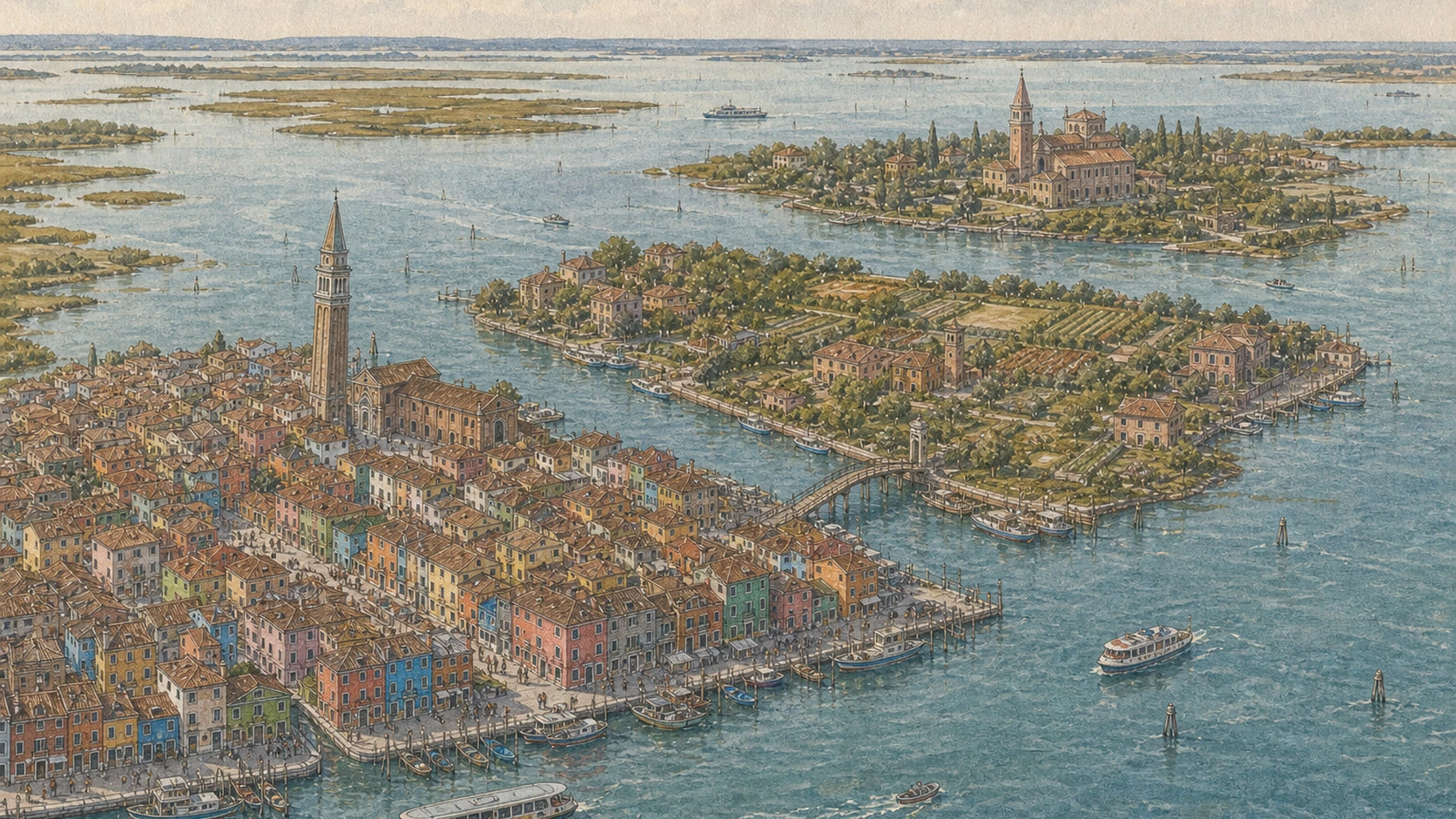
Original documentary watercolour panorama of Burano, Mazzorbo, Torcello and the northern Venetian lagoon

Venice Guide 09 · Inhabited colour, lace labour, cultivated lagoon and medieval mosaics

Burano, Mazzorbo
& Torcello

A documented northern-lagoon route from Burano’s resident canals and lace museum across cultivated Mazzorbo to Torcello’s archaeological collections, basilica complex and layered mosaics.

Plan the route
Burano · Mazzorbo · Torcello10 chapters · one long day

Why these three islands belong to one route

These islands are not three decorative stops: they form one inhabited and cultivated lagoon landscape whose colour, craft, archaeology and sacred art depend on water, labour and continual maintenance.

Burano’s painted houses are real homes arranged along narrow canals, not an open-air colour chart. Their surfaces are repaired within a regulated urban fabric while doors, bridges and fondamenta carry groceries, school journeys, waste, boats and visitors. Lace belongs to the same lived history. Needle lace demanded time, skill and distributed labour, and its museum record is more precise than the romantic image of every resident making an entire masterpiece alone.

The footbridge to Mazzorbo changes the pace but not the human history. Fields, gardens, embankments, drainage and a surviving church occupy land continually negotiated with salt water. Torcello then reveals an early and important settlement of the Venetian lagoon without supporting the simplistic claim that one empty island single-handedly gave birth to Venice. Archaeology records several phases, shifting channels, institutions and population movement.

The route ends in two different forms of evidence. The Torcello Museum gathers material remains inside the Palazzo del Consiglio and Palazzo dell’Archivio; Santa Maria Assunta and Santa Fosca preserve architecture, worship and mosaics in place. Legends such as Attila’s throne can be enjoyed as later storytelling only when they are not mistaken for archaeological proof. A full day should therefore move from resident present to documented past, not from photo to photo.

Travel early, keep bridges and thresholds clear, and read the lagoon between the islands as part of the monument rather than empty space between attractions.

The route

Plan your visit

Begin in Burano before its busiest period, use the museum to establish lace evidence, cross Mazzorbo on foot, then reserve the later afternoon for Torcello’s collections and churches. Live boat times and last admissions govern the sequence.

Early morning

Burano canals and Piazza Galuppi

Read colour as inhabited fabric before the main routes fill; keep thresholds and bridges clear.

Late morning

Lace Museum and documented craft

Establish technique, labour and provenance before entering retail spaces.

Early afternoon

Mazzorbo on foot

Cross the step-free bridge and read gardens, drainage, Santa Caterina and cultivated lagoon land.

Mid-to-late afternoon

Torcello museum and basilica complex

Use line 9, visit material evidence first, then compare church exteriors and end with the mosaic programme before last admission.

Ten chapters

Explore the places

The route moves from Burano’s inhabited colour and lace labour across cultivated Mazzorbo to Torcello’s archaeology, churches and mosaics, keeping transport, access and lagoon ecology visible throughout.

  1. 01Burano’s colour begins with resident space
  2. 02Lace Museum: establish evidence before shopping
  3. 03Read lace as labour, then ask where it was made
  4. 04Piazza Galuppi and San Martino: read the island’s centre
  5. 05Fishing edges: read the lagoon as productive water
  6. 06Mazzorbo: cross from density into cultivation
  7. 07Torcello arrival: landscape before origin myth
  8. 08Torcello Museum: let material evidence lead
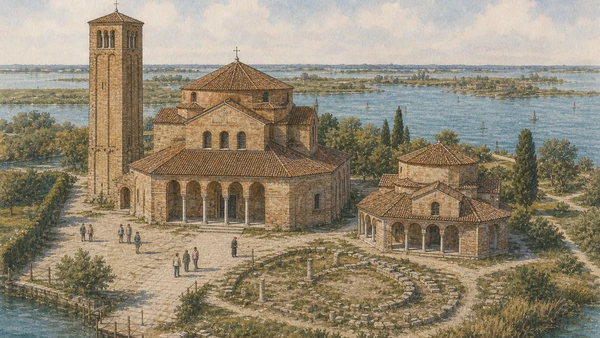
  9. 09The basilica complex outside: compare, do not merge
  10. 10Inside Santa Maria Assunta: read the mosaics as a programme
01

Paint is a maintained surface on occupied buildings, not permission to turn private thresholds into a photographic set

Burano’s colour begins with resident space

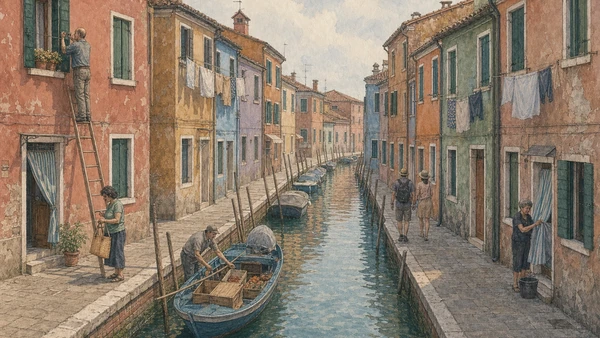
Canal fronts, small houses and bright plaster form a legible neighbourhood whose maintenance and daily movement continue beneath the celebrated palette.

Today

Burano receives intense day-visitor flows around the main landings, Via Galuppi and the best-known canals. The houses remain private residences. Doorsteps, laundry, windows, moorings and boats are not public props, and narrow bridges must stay passable. Exterior changes belong to an urban fabric governed by municipal planning rather than an unrestricted tradition of choosing any colour at will.

History

The island’s compact settlement grew through fishing, boat access, parish organisation and small domestic plots. Painted lime and plaster required recurrent repair in a wet, saline environment. The now-famous chromatic identity emerged through layers of maintenance and twentieth-century representation; no single origin story about fishermen identifying homes in fog explains every façade or period.

How to read this place

Choose one canal and compare recent repainting with faded, patched or salt-marked walls. Notice how colour helps distinguish volumes while shutters, gutters, steps and utility lines reveal use. Stand on the side of a fondamenta rather than in a doorway. The most honest image includes a delivery, resident boat or repaired surface instead of isolating a perfect postcard row.

What to notice

  • Private thresholds within heavily visited canals
  • Fresh paint beside salt wear and repaired plaster
  • Bridges and moorings serving daily movement
Comune di Venezia · Burano, Mazzorbo and Torcello planning framework
Original documentary watercolour of inhabited coloured houses, residents and working boats on a Burano canal
Burano’s colour begins with resident spaceOriginal Merlintravel documentary watercolour · 2026
02

A public collection replaces generic nostalgia with dated objects, designs, techniques and the institutional history of Burano lace

Lace Museum: establish evidence before shopping

The former lace-school building makes technique and chronology visible while separating historic Burano production from a broad commercial label.

Today

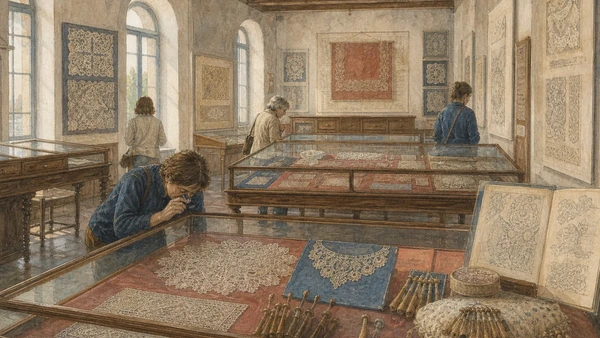
The Museo del Merletto occupies the historic palace of the podestà beside Piazza Galuppi. Displays combine significant Venetian and Burano lace, drawings, documents and the story of the school. Opening times are shorter than a typical mainland museum and Monday closure changes itineraries. Current tickets should be checked directly; demonstrations or the presence of lace-makers can vary and should not be assumed on every visit.

History

A lace school was created in Burano in the 1870s during a period of economic hardship and revival interest in historic Venetian lace. It organised training, designs and commercial distribution, preserving skills while also shaping a new market. After the school closed in the twentieth century, its archive and collections supported the museum, inaugurated in 1981 and later restored and reorganised.

How to read this place

Follow the display chronologically and identify whether each object is needle lace, bobbin lace or another technique. Look for pattern transfer, repeated motifs, repairs and unfinished stages. Read labels for maker, workshop, date and provenance instead of treating fineness alone as evidence of Burano origin. The school was both a social institution and a producer within changing markets.

What to notice

  • Needle and bobbin techniques identified separately
  • Design drawings linked to finished objects
  • School archives connecting craft to organised labour
Lace Museum · Official layout and collections
Original documentary watercolour of historic lace, pattern drawings and display cases inside Burano's Lace Museum
Lace Museum: establish evidence before shoppingOriginal Merlintravel documentary watercolour · 2026
03

A convincing piece of lace begins with hours, hands, thread and an identifiable technique rather than a souvenir label

Read lace as labour, then ask where it was made

Needle lace grows through repeated stitches and specialised stages; price and provenance should reflect the time and skill claimed for the object.

Today

Burano shops sell historic pieces, contemporary handmade work and inexpensive textiles from many origins. A buyer should ask whether an item is handmade, which technique was used, who made it, when and where, and whether documentation accompanies older work. Machine-made or imported lace can be attractive and affordable when honestly labelled; the problem is an unsupported claim of local hand production.

History

Venetian needle lace achieved international prestige in the early modern period. Production could be divided among specialised workers, while designs and fashions moved between courts, convents, workshops and merchants. The nineteenth-century Burano revival codified teaching and marketed a local identity. That revival preserved knowledge but did not recreate an unchanged medieval household practice.

How to read this place

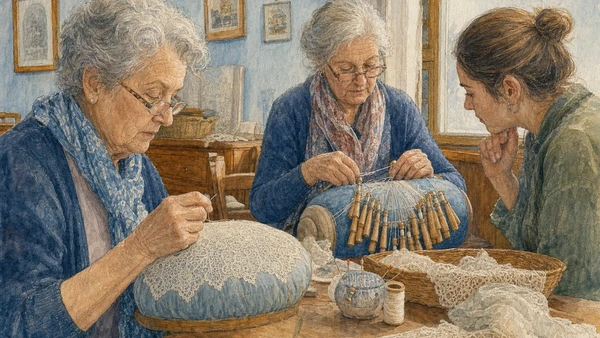
Watch the working sequence if a maker welcomes observation: preparation, outline, filling stitches, joining and finishing. Ask how many hours a small motif requires. Examine the reverse, thread continuity and regularity without assuming that irregular always means handmade. A respectful purchase conversation gives the maker time to explain rather than demanding a performance for a photograph.

What to notice

  • Technique named more precisely than handmade
  • Time and division of labour reflected in the explanation
  • Invoice or provenance accompanying valuable pieces
Lace Museum · Official history and collections
Original documentary watercolour of a Burano lace-maker working with thread, pattern and needle beside a window
Read lace as labour, then ask where it was madeOriginal Merlintravel documentary watercolour · 2026
04

The island’s civic and parish centre is organised by an elongated square and a visibly leaning campanile, not by colour alone

Piazza Galuppi and San Martino: read the island’s centre

Church, museum, civic buildings, wells and street commerce meet in a public space whose tower records structural movement and continual care.

Today

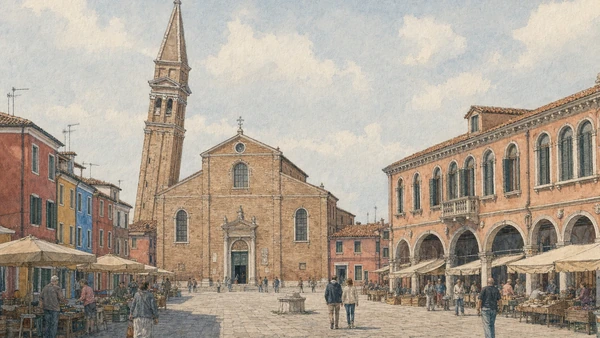
Piazza Galuppi concentrates visitor flows, museum access, local services and the entrance to San Martino. The church remains active and interior access follows worship and local conditions. Its campanile is conspicuously inclined; perspective exaggeration makes dramatic photographs easy, but the lean belongs to long-term structural behaviour on lagoon ground rather than a picturesque joke.

History

San Martino developed through several building phases and later rebuilding, with a detached bell tower that became one of Burano’s defining vertical markers. The square took shape as the community’s principal civic and religious axis. Its name recalls Baldassare Galuppi, the eighteenth-century composer born on the island, while the former podestà’s palace later housed the lace school and museum.

How to read this place

Stand far enough back to relate tower, church façade and museum rather than isolating the lean with a tilted camera. Compare the paved axis with side passages that return immediately to canals and homes. Inside the church, if open, read the whole liturgical space before searching for attributed paintings. Leave doorways and the central pedestrian line clear.

What to notice

  • Campanile inclination visible against stable verticals
  • Former civic building reused for lace education and museum display
  • Parish, services and tourism sharing one long public square
Lace Museum · Building and institutional setting
Original documentary watercolour of Piazza Galuppi, San Martino and Burano's leaning bell tower
Piazza Galuppi and San Martino: read the island’s centreOriginal Merlintravel documentary watercolour · 2026
05

The island’s working identity was built through shallow water, tides, fish, boats and market exchange rather than façades alone

Fishing edges: read the lagoon as productive water

Moorings, nets, service boats and wetland horizons connect household economies to a regulated and environmentally stressed lagoon.

Today

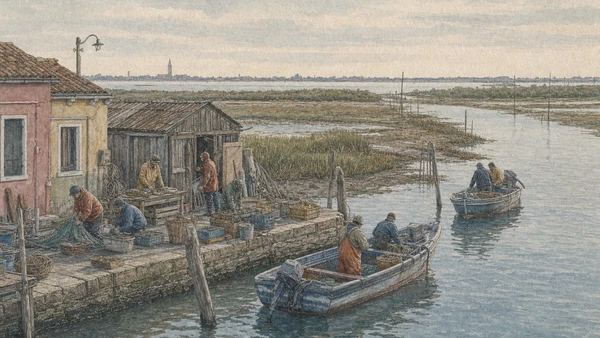
Fishing remains part of the northern lagoon’s economy and memory, although employment, species, regulation and markets have changed. Visitors encounter working moorings and equipment at island edges. These are not display areas: routes must remain clear and gear should never be handled. Wake, wash, high water, erosion, water quality and extreme heat affect both habitats and built margins.

History

Burano’s settlement depended on lagoon navigation and fishing alongside other trades. Knowledge of channels, seasons and shallow-water habitats shaped work more directly than a land-based map suggests. Embankments and channel maintenance modified the same environment. Modern industrial change, motor traffic and ecological pressures transformed catches and practices without erasing their importance to island identity.

How to read this place

At a quieter edge, look from boat draft to channel markers, mudflats, reed margins and distant barene. Notice which craft carry people and which carry equipment or goods. Work and habitat extend beyond the most immediately visible features. The water is managed, inhabited and ecologically active even where no building occupies the horizon.

What to notice

  • Working moorings distinguished from passenger landings
  • Channel markers and shallow-water vegetation
  • Erosion and wash visible along built edges
UNESCO World Heritage Centre · Venice and its Lagoon
Original documentary watercolour of Burano fishers, working boats, nets and the shallow northern lagoon
Fishing edges: read the lagoon as productive waterOriginal Merlintravel documentary watercolour · 2026
06

A long footbridge reveals Mazzorbo as managed ground: gardens, vines, drainage and a modest medieval church within embanked lagoon land

Mazzorbo: cross from density into cultivation

Santa Caterina and the island’s green interior show that quiet landscape is also designed, drained, worked and continually defended from salt water.

Today

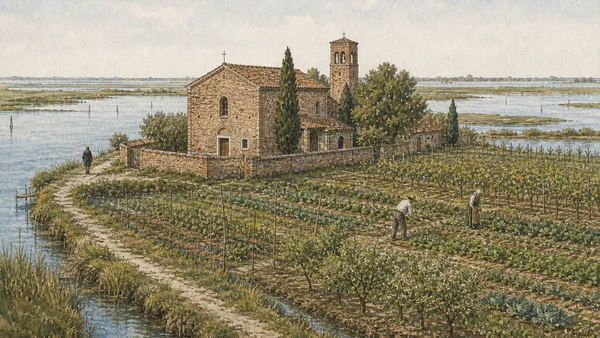
The at-grade bridge from Burano gives step-free access to Mazzorbo, whose public paths pass housing, gardens and cultivated areas. Some land and hospitality spaces are private. Santa Caterina is an active small church with variable access, not a large monument guaranteed to be open. Visitors should stay on recognised routes and avoid entering fields, gardens or residential courts for a view.

History

Mazzorbo belonged to the northern lagoon’s medieval settlement network and once supported several religious institutions. Santa Caterina, with later modifications, is the principal surviving church. Cultivation depended on embankment, soil management and drainage in a brackish environment. Present vineyards and gardens continue a human relationship with the land but should not be projected unchanged into every historical period.

How to read this place

Use the bridge as a transition in scale: compare Burano’s dense façades with Mazzorbo’s longer plots and lower horizon. At Santa Caterina, notice the church’s modest proportions, brick surfaces and relation to vegetation. Look for ditches, walls and raised ground that make cultivation possible. Silence here is produced partly by land use and access patterns, not by the absence of history.

What to notice

  • Step-free bridge linking two differently settled islands
  • Modest Santa Caterina within fields and gardens
  • Embankment and drainage sustaining cultivated ground
Comune di Venezia · Accessible route for Burano, Mazzorbo and Torcello
Original documentary watercolour of modest Santa Caterina, vines, gardens and managed lagoon land on Mazzorbo
Mazzorbo: cross from density into cultivationOriginal Merlintravel documentary watercolour · 2026
07

The canal walk from the landing makes distance, drainage and sparse settlement visible before any monument appears

Torcello arrival: landscape before origin myth

Ponte del Diavolo, canals and low ground introduce an archaeological island shaped by water routes and population change.

Today

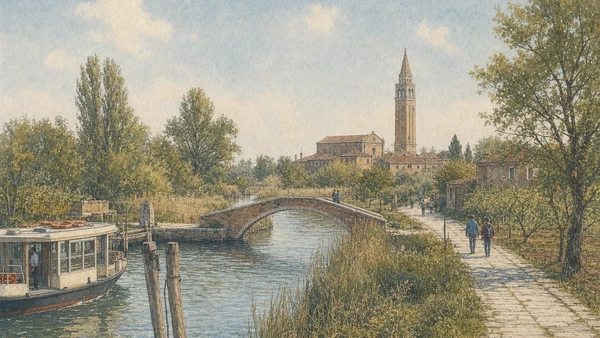
Line 9 links Burano and Torcello, subject to the live timetable. From the landing, a mostly level path follows the canal toward the monumental area and crosses or passes historic bridges. The Ponte del Diavolo has no parapets and requires care. The municipality’s accessible-route information notes conditions at the landing, path and monuments; individual museum buildings still have specific limitations.

History

Torcello was one of several important early lagoon settlements, connected to mainland and maritime networks. Ecclesiastical, administrative and commercial activity grew in the early medieval period. Later environmental, political and economic shifts contributed to population decline and movement toward other lagoon centres. This layered process is more accurate than treating Torcello as a single abandoned birthplace of Venice.

How to read this place

Walk slowly enough to register canal width, ground level, drainage and cultivated plots. At the Ponte del Diavolo, examine construction and setting without inventing one definitive explanation for its name. Compare the long approach with the concentrated basilica complex ahead. The apparent emptiness between landing and churches is part of the evidence for settlement change.

What to notice

  • Level canal path from landing toward the monuments
  • Unparapeted Ponte del Diavolo requiring practical care
  • Sparse present landscape over a more extensive archaeological settlement
Comune di Venezia · Official accessible island route
Original documentary watercolour of Torcello's canal path, Ponte del Diavolo, visitors and low lagoon landscape
Torcello arrival: landscape before origin mythOriginal Merlintravel documentary watercolour · 2026
08

Stone fragments, ceramics and excavation records make the island’s long transformation more reliable than the objects named by legend outside

Torcello Museum: let material evidence lead

Archaeological and medieval collections occupy two historic civic buildings and connect the monumental square to a much wider settlement history.

Today

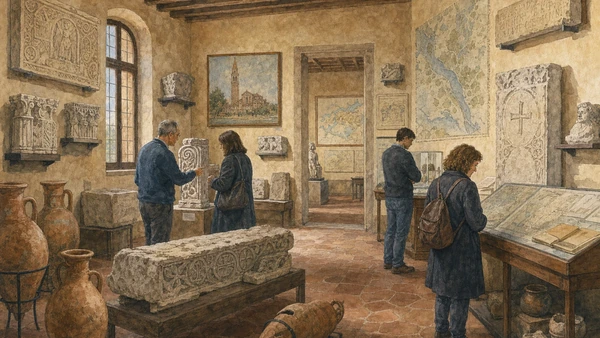
The Museo di Torcello uses the Palazzo del Consiglio and Palazzo dell’Archivio in the monumental area. Its archaeological and medieval-modern sections have separate physical conditions, and accessibility is not identical in both buildings. Opening days and last admission should be checked on the official site, especially because Monday and holiday closures may alter a combined-island itinerary.

History

The collection brings together finds from Torcello and the lagoon with objects that explain ancient precedents, early medieval settlement, ecclesiastical power and later civic memory. The museum developed through local collecting, excavations and institutional reorganisation. Its buildings themselves reflect Torcello’s administrative importance after the settlement’s greatest demographic period had passed.

How to read this place

Start with object labels and findspots. Separate material recovered on Torcello from comparative pieces of other origin. Relate architectural fragments to the churches outside without assuming every loose stone has one certain original position. The so-called Throne of Attila in the square is a powerful legend and image; the museum’s dated material is the stronger basis for historical reconstruction.

What to notice

  • Findspots linking objects to lagoon settlement layers
  • Two historic buildings with different access conditions
  • Archaeological evidence distinguished from popular legends
Torcello Museum · Official practical information
Original documentary watercolour of archaeological displays and architectural fragments inside the Torcello Museum
Torcello Museum: let material evidence leadOriginal Merlintravel documentary watercolour · 2026
09

Santa Maria Assunta, Santa Fosca and the campanile form a sacred ensemble whose different plans and dates resist one postcard label

The basilica complex outside: compare, do not merge

Basilican, centralised and vertical forms gather in one campo while active worship, museum access and conservation follow different rules.

Today

Santa Maria Assunta is a ticketed historic church with published seasonal hours; Santa Fosca remains a separate active church, and the campanile has its own access and closing time. Appropriate dress and quiet conduct apply. Guided groups are subject to current city rules, and the basilica requires audio systems for guided explanations. Weather or worship can modify access.

History

The traditional foundation inscription connects the first cathedral to 639, while the present basilica preserves major rebuilding associated with 1008 and later work. Santa Fosca developed as a separate centralised church, generally associated with the eleventh and twelfth centuries. The complex reflects Torcello’s former episcopal importance and Adriatic connections rather than an isolated rustic survival.

How to read this place

Circle the exterior before entering. Compare Santa Maria’s long basilican body with Santa Fosca’s Greek-cross organisation and surrounding portico. Read reused stone, brick repairs and changing ground levels. The campanile makes the lagoon horizon legible, but a climb is optional; the essential comparison occurs at ground level between plan, façade, threshold and shared sacred space.

What to notice

  • Long basilica beside the centralised Santa Fosca
  • Reused stone and brick carrying multiple building phases
  • Separate access rules for church, campanile and museum
Patriarchate of Venice · Basilica of Santa Maria Assunta at Torcello
Original documentary watercolour of Santa Maria Assunta, Santa Fosca and the campanile on Torcello
The basilica complex outside: compare, do not mergeOriginal Merlintravel documentary watercolour · 2026
10

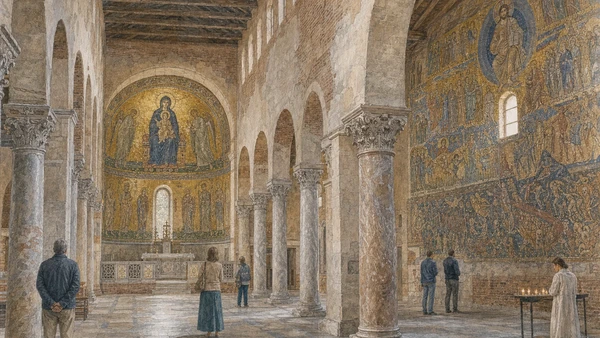
Gold, glass and stone organise theology across apse and counter-façade through campaigns separated by centuries and altered by restoration

Inside Santa Maria Assunta: read the mosaics as a programme

The Virgin in the apse and the Last Judgement opposite structure movement, time and attention within a living church.

Today

The interior is both monument and sacred space. Tickets, respectful clothing and quiet movement are required; flash, tripods and uncontrolled group explanations are inappropriate. The official site publishes current admission, combined-ticket and campanile information. Visitors should never touch walls or barriers and should allow worshippers to use the church without becoming part of a viewing queue.

History

The basilica’s mosaics were created in more than one campaign and experienced later repairs and restorations. Their imagery belongs to Byzantine and Adriatic artistic networks while responding to the building’s liturgical route. The apse Virgin, apostles and Last Judgement cannot all be reduced to one date, one workshop or an untouched original surface.

How to read this place

Stand first near the centre and turn between east and west: the apse draws attention forward while the Last Judgement confronts departure. Observe how gold changes with light and position. Then look for seams, losses and tonal variation that may reveal campaign or restoration. Use the official chronology instead of assigning every tessera to the earliest church foundation.

What to notice

  • Apse and counter-façade creating an east–west programme
  • Gold ground changing with viewpoint and available light
  • Different campaigns and restorations visible within the whole
Patriarchate of Venice · Official basilica history and visitor information
Original documentary watercolour of the apse and Last Judgement mosaics inside Torcello's Santa Maria Assunta
Inside Santa Maria Assunta: read the mosaics as a programmeOriginal Merlintravel documentary watercolour · 2026

Burano, Mazzorbo and Torcello through time

A short chronology

From early settlement and medieval churches to lace schools, museums, conservation and the visitor pressures of the contemporary northern lagoon.

  1. Material remains document mainland and lagoon exchange before the medieval island institutions.

  2. A traditional foundation inscription associates Torcello’s first cathedral with the seventh century.

  3. Torcello grows as one important settlement within a wider lagoon network.

  4. Major rebuilding gives Santa Maria Assunta much of the structure through which it is read today.

  5. Santa Fosca and major mosaic campaigns strengthen Torcello’s sacred ensemble.

  6. Changing channels, institutions and trade contribute to demographic movement away from Torcello.

  7. Venetian needle lace achieves major international prestige and commercial circulation.

  8. Burano’s parish and civic centre develops through rebuilding and continued island life.

  9. Composer Baldassare Galuppi is born on Burano, later lending his name to the principal square.

  10. The fall of the Republic begins institutional suppressions and economic change across the lagoon.

  11. Burano’s lace school is established to organise training, revive techniques and support local employment.

  12. Collections and archaeological interest give Torcello a new museum and heritage role.

  13. The Lace Museum opens in the former school building on Piazza Galuppi.

  14. The renewed Lace Museum reopens after restoration with reorganised displays and collections.

  15. Extended museum hours and regulated group visits coexist with resident pressure, conservation and lagoon vulnerability.

Before your visit

Practical information

01

Start early and confirm the live boats

Use the official Actv service for connections and leave a buffer before Torcello’s last admissions.

02

Treat Burano as a neighbourhood

Keep doorways, bridges, moorings and narrow fondamenta clear; never arrange private laundry or objects for photographs.

03

Verify lace claims calmly

Ask technique, maker, place, time and documentation; do not equate a Burano shop address with local hand production.

04

Use recognised paths on Mazzorbo

Gardens, vineyards, fields and residential courts may be private even when visible from the public route.

05

Check individual accessibility

The inter-island route is relatively accessible, but landings, museum buildings, bridges, campanile and churches have different conditions.

06

Separate evidence from legend

Use the museum and building chronology for history; treat Attila’s throne and bridge stories as later cultural narratives.

Method and sources

Sources and image credits

This guide uses current official information from Fondazione Musei Civici di Venezia, Comune di Venezia, the Patriarchate of Venice, AVM/Actv and UNESCO, checked on 28 August 2026. It distinguishes maintained residential colour from a visitor set; historic lace from generic retail stock; needle work from machine production; Mazzorbo’s managed land from untouched nature; early Torcello settlement from a single-origin myth; archaeological evidence from legend; separate museum, basilica, church and campanile access; and medieval mosaic campaigns from later restoration.

All ten images are original Merlintravel editorial watercolours based on documented present-day conditions. They are illustrations, not substitutes for archaeological plans. Opening hours, tickets, accessible routes, temporary exhibitions and conservation work can change; consult the linked official pages shortly before visiting.