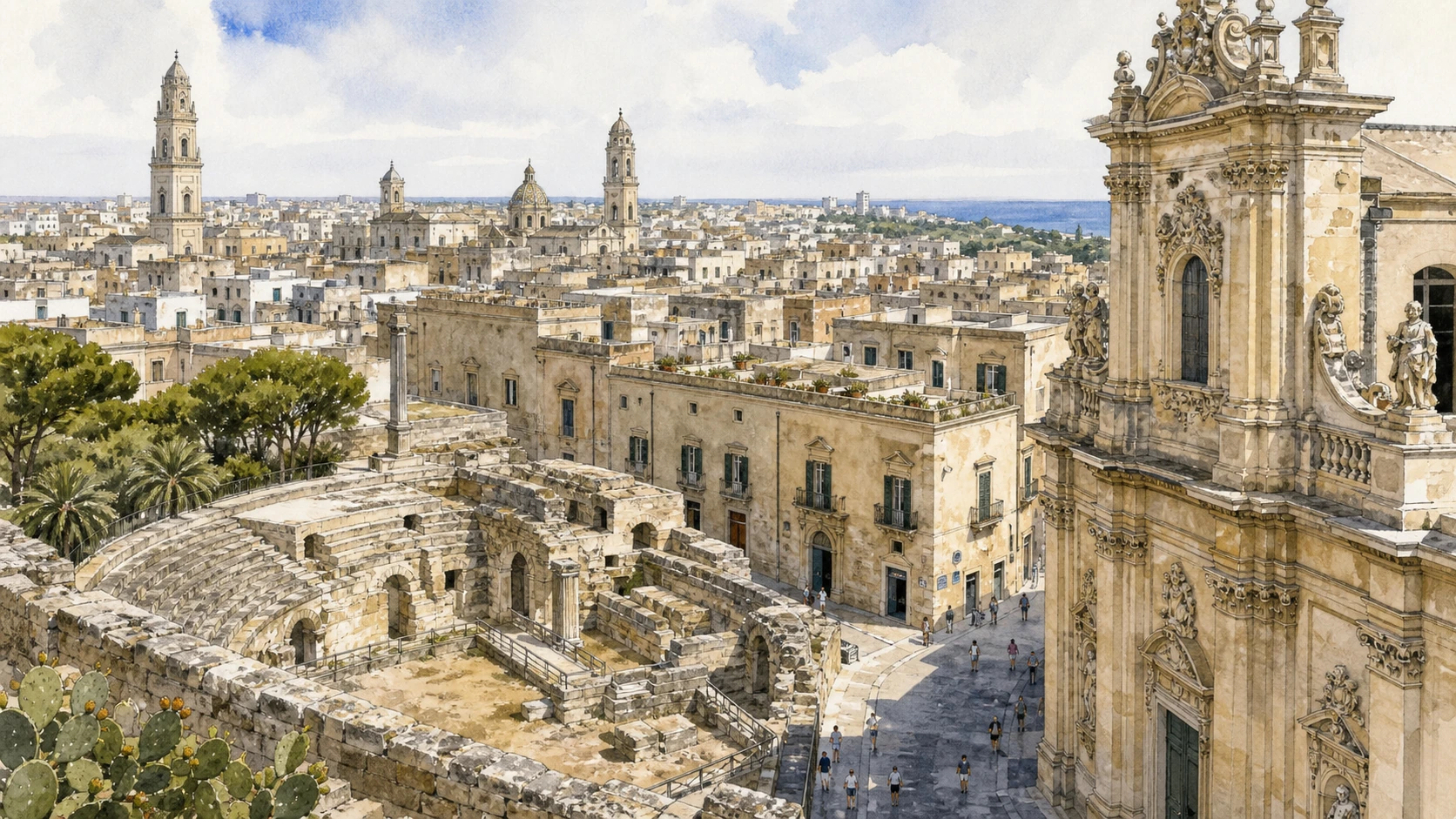
Original documentary watercolour panorama for Lecce: Roman City and Baroque Stone — Complete Guide, with accurate Puglian architecture, landscape and lived context

Puglia Guide 02 · Archaeology, architecture, working landscapes and contemporary access

Lecce
carves time in stone

A two-day route from Roman Lupiae to the civic and religious building campaigns that transformed soft local limestone into an urban language.

Plan the route
Lecce · Puglia10 chapters · one complete route

Why this route must be read in layers

Lecce’s Baroque is a later layer over a Roman and medieval city, not a timeless decorative surface detached from institutions and labour.

The route begins with documented fabric and institutional collections rather than a list of photogenic surfaces. Each chapter separates what survives, what was rebuilt and what remains in use.

Puglia’s ports, pilgrimage sites, farms, forests, archaeological parks and inhabited centres operate under different access conditions. Current notices therefore belong to the route rather than an appendix.

Each chapter includes an illustration of the place described. The images are watercolours rather than photographs.

A two-day route from Roman Lupiae to the civic and religious building campaigns that transformed soft local limestone into an urban language.

The route

Plan your visit

A two-day route from Roman Lupiae to the civic and religious building campaigns that transformed soft local limestone into an urban language.

Early morning

Roman Amphitheatre · Roman Theatre · Santa Croce

Move in the documented order: Roman Amphitheatre: Lupiae beneath Piazza Sant’Oronzo; then Roman Theatre: performance inside the inhabited centre; then Santa Croce: facade, order and carved abundance. Recheck live access and transport before entering a controlled site.

Late morning

Palazzo dei Celestini · Piazza Duomo · Castle of Charles V

Move in the documented order: Palazzo dei Celestini: monastery transformed into government; then Piazza Duomo: a controlled sacred enclosure; then Castle of Charles V: fortification beneath cultural reuse. Recheck live access and transport before entering a controlled site.

Afternoon

Museo Castromediano · Porta Napoli and the city thresholds · San Matteo

Move in the documented order: Museo Castromediano: Salento before the Baroque; then Porta Napoli and the city thresholds; then San Matteo: a curved Baroque facade in an active parish. Recheck live access and transport before entering a controlled site.

Late afternoon

Rudiae

Move in the documented order: Rudiae: Messapian and Roman territory beyond the centre. Recheck live access and transport before entering a controlled site.

Ten chapters

Explore the places

The order follows terrain, institutions and present-day movement. Use the index to return to a chapter without reducing the route to isolated monuments.

  1. 01Roman Amphitheatre: Lupiae beneath Piazza Sant’Oronzo
  2. 02Roman Theatre: performance inside the inhabited centre
  3. 03Santa Croce: facade, order and carved abundance
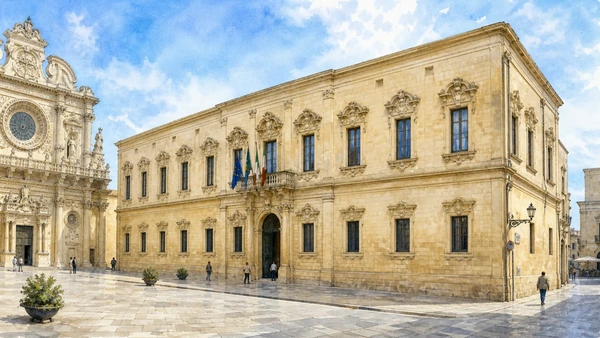
  4. 04Palazzo dei Celestini: monastery transformed into government
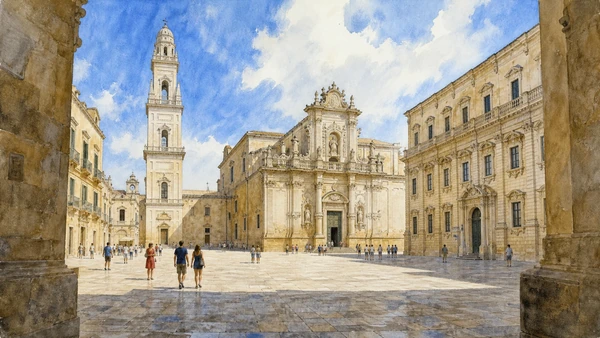
  5. 05Piazza Duomo: a controlled sacred enclosure
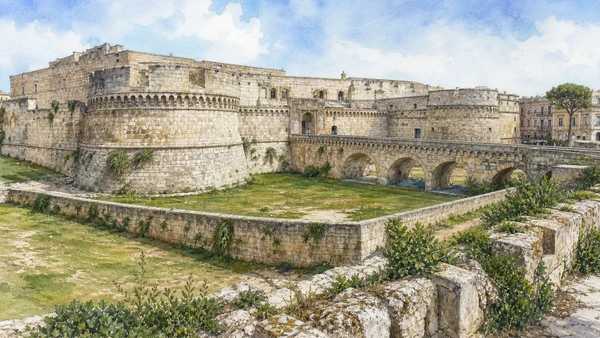
  6. 06Castle of Charles V: fortification beneath cultural reuse
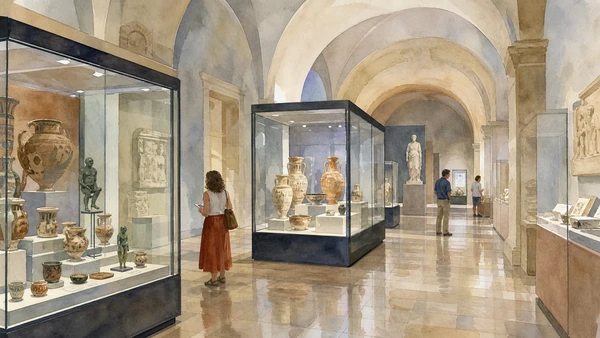
  7. 07Museo Castromediano: Salento before the Baroque
  8. 08Porta Napoli and the city thresholds
  9. 09San Matteo: a curved Baroque facade in an active parish
  10. 10Rudiae: Messapian and Roman territory beyond the centre
01

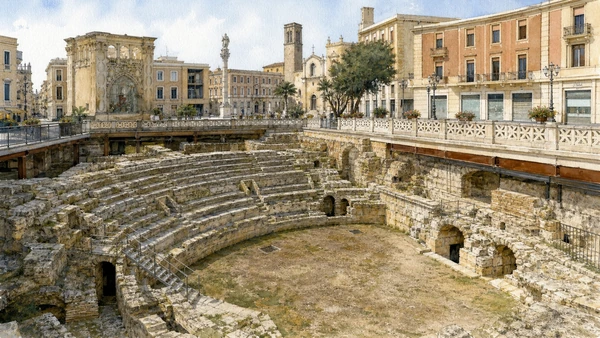
Only part of the imperial venue is exposed; the rest survives beneath the modern square and surrounding buildings.

Roman Amphitheatre: Lupiae beneath Piazza Sant’Oronzo

Only part of the imperial venue is exposed; the rest survives beneath the modern square and surrounding buildings. The place becomes clearer when surviving fabric, later change and present use are read together.

Today

Archaeological access can change because of conservation, excavation, weather or staffing. Stay outside barriers and verify the official opening notice.

History

Excavations begun in 1900 revealed part of an arena probably founded in the Augustan age and later modified.

How to read this place

Compare the visible cavea with the modern square edge and remember that the monument continues below today’s city.

What to notice

  • original masonry and later support work
  • the relation between excavation and modern surroundings
  • areas intentionally left unexcavated
Direzione regionale Musei Puglia · Anfiteatro di Lecce
Original documentary watercolour of Roman Amphitheatre: Lupiae beneath Piazza Sant'Oronzo in Lecce · Puglia, showing accurate architecture, landscape and present-day use
Roman Amphitheatre: Lupiae beneath Piazza Sant’OronzoOriginal Merlintravel documentary watercolour · 2026
02

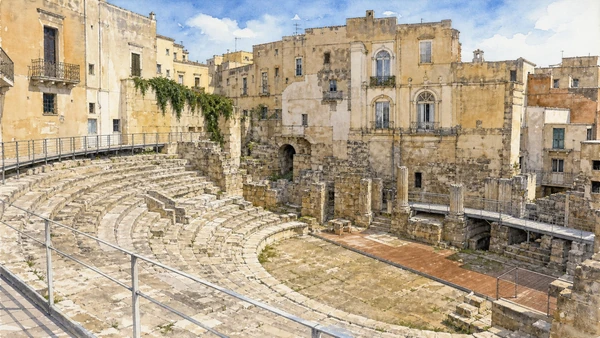
A smaller performance building survives among later houses, revealing a second Roman public venue.

Roman Theatre: performance inside the inhabited centre

A smaller performance building survives among later houses, revealing a second Roman public venue. The place becomes clearer when surviving fabric, later change and present use are read together.

Today

Archaeological access can change because of conservation, excavation, weather or staffing. Stay outside barriers and verify the official opening notice.

History

The theatre emerged through twentieth-century discoveries inside the historic fabric; its date and phases are read through masonry and finds.

How to read this place

Notice the constrained relationship between cavea, stage remains and private buildings rather than imagining an isolated archaeological park.

What to notice

  • original masonry and later support work
  • the relation between excavation and modern surroundings
  • areas intentionally left unexcavated
Direzione regionale Musei Puglia · Teatro romano
Original documentary watercolour of Roman Theatre: performance inside the inhabited centre in Lecce · Puglia, showing accurate architecture, landscape and present-day use
Roman Theatre: performance inside the inhabited centreOriginal Merlintravel documentary watercolour · 2026
03

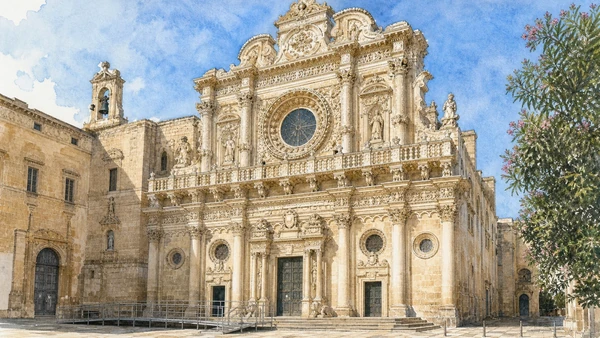
The basilica’s famous surface is organised architecture shaped by several campaigns, patrons and specialist stone carving.

Santa Croce: facade, order and carved abundance

The basilica’s famous surface is organised architecture shaped by several campaigns, patrons and specialist stone carving. The place becomes clearer when surviving fabric, later change and present use are read together.

Today

This is an active religious place. Services, ceremonies and conservation can interrupt tourist access; dress appropriately, remain quiet and verify the official notice.

History

Construction and decoration developed between the sixteenth and seventeenth centuries within the Celestine complex.

How to read this place

Read structural bays and orders before individual figures; weathering, restoration and replacement matter as much as exuberant detail.

What to notice

  • the relationship between worship and visitor circulation
  • older fabric and later rebuilding
  • objects still used in liturgy
Comune di Lecce
Original documentary watercolour of Santa Croce: facade, order and carved abundance in Lecce · Puglia, showing accurate architecture, landscape and present-day use
Santa Croce: facade, order and carved abundanceOriginal Merlintravel documentary watercolour · 2026
04

The former monastic complex pairs an elaborate facade with continuing public administration.

Palazzo dei Celestini: monastery transformed into government

The former monastic complex pairs an elaborate facade with continuing public administration. The place becomes clearer when surviving fabric, later change and present use are read together.

Today

Public use, traffic, events and works can change circulation. Keep access routes open and verify any controlled interior with the responsible institution.

History

Built and rebuilt beside Santa Croce, the palace later changed function after suppression of religious orders.

How to read this place

Compare the church facade and palace rhythms, then observe how offices and civic movement occupy the historic complex today.

What to notice

  • the relation between public space and movement
  • historic fabric beside later additions
  • present-day work and residence
Provincia di Lecce
Original documentary watercolour of Palazzo dei Celestini: monastery transformed into government in Lecce · Puglia, showing accurate architecture, landscape and present-day use
Palazzo dei Celestini: monastery transformed into governmentOriginal Merlintravel documentary watercolour · 2026
05

Cathedral, campanile, episcopal palace and seminary shape a near-enclosed Baroque civic-religious space.

Piazza Duomo: a controlled sacred enclosure

Cathedral, campanile, episcopal palace and seminary shape a near-enclosed Baroque civic-religious space. The place becomes clearer when surviving fabric, later change and present use are read together.

Today

This is an active religious place. Services, ceremonies and conservation can interrupt tourist access; dress appropriately, remain quiet and verify the official notice.

History

Medieval foundations were extensively reworked in the seventeenth century as church institutions reshaped the square.

How to read this place

Enter through the narrow approach and compare the cathedral’s two facades; perspective and ceremony organise the space.

What to notice

  • the relationship between worship and visitor circulation
  • older fabric and later rebuilding
  • objects still used in liturgy
Arcidiocesi di Lecce
Original documentary watercolour of Piazza Duomo: a controlled sacred enclosure in Lecce · Puglia, showing accurate architecture, landscape and present-day use
Piazza Duomo: a controlled sacred enclosureOriginal Merlintravel documentary watercolour · 2026
06

Massive sixteenth-century defences surround earlier phases now used for exhibitions and controlled visits.

Castle of Charles V: fortification beneath cultural reuse

Massive sixteenth-century defences surround earlier phases now used for exhibitions and controlled visits. The place becomes clearer when surviving fabric, later change and present use are read together.

Today

Interior routes, exhibitions and controlled areas can change. Check the managing institution, respect barriers and distinguish surviving fabric from restoration.

History

The fortress was enlarged under Charles V and imperial viceroyal administration in response to changing artillery and coastal threat.

How to read this place

Follow bastions, moat lines and later openings; temporary exhibitions should not obscure the defensive structure.

What to notice

  • defensive geometry and controlled approaches
  • different masonry phases
  • present cultural or civic use
Direzione regionale Musei Puglia · Castello Carlo V
Original documentary watercolour of Castle of Charles V: fortification beneath cultural reuse in Lecce · Puglia, showing accurate architecture, landscape and present-day use
Castle of Charles V: fortification beneath cultural reuseOriginal Merlintravel documentary watercolour · 2026
07

Regional collections restore Messapian, Roman and medieval contexts often overshadowed by the city’s later architecture.

Museo Castromediano: Salento before the Baroque

Regional collections restore Messapian, Roman and medieval contexts often overshadowed by the city’s later architecture. The place becomes clearer when surviving fabric, later change and present use are read together.

Today

Opening, ticketing, room access and temporary displays can change. Check the museum’s official notice shortly before visiting and allow for security or conservation controls.

History

Founded in the nineteenth century, the museum has repeatedly changed display and now links objects to archaeological territories across Salento.

How to read this place

Follow provenance and chronology; distinguish historic collecting from finds recovered through modern archaeological methods.

What to notice

  • the chronological order of the displays
  • finds tied to documented excavation contexts
  • modern conservation and interpretation
Museo Castromediano
Original documentary watercolour of Museo Castromediano: Salento before the Baroque in Lecce · Puglia, showing accurate architecture, landscape and present-day use
Museo Castromediano: Salento before the BaroqueOriginal Merlintravel documentary watercolour · 2026
08

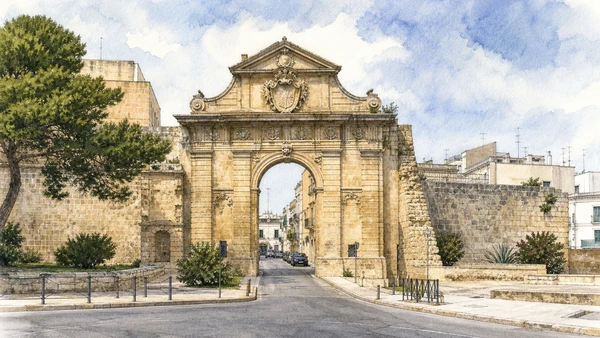
The triumphal gate and surviving wall fragments mark a controlled entrance later absorbed by urban expansion.

Porta Napoli and the city thresholds

The triumphal gate and surviving wall fragments mark a controlled entrance later absorbed by urban expansion. The place becomes clearer when surviving fabric, later change and present use are read together.

Today

Interior routes, exhibitions and controlled areas can change. Check the managing institution, respect barriers and distinguish surviving fabric from restoration.

History

The gate was erected in the sixteenth century within a fortified system whose other sections were altered or removed.

How to read this place

Read the gate with road alignment and missing walls; the open space around it is part of later urban change.

What to notice

  • defensive geometry and controlled approaches
  • different masonry phases
  • present cultural or civic use
Comune di Lecce
Original documentary watercolour of Porta Napoli and the city thresholds in Lecce · Puglia, showing accurate architecture, landscape and present-day use
Porta Napoli and the city thresholdsOriginal Merlintravel documentary watercolour · 2026
09

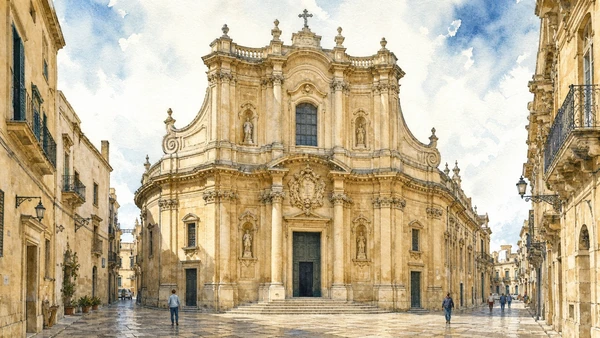
The church demonstrates how Roman Baroque models were translated into local stone and a compact Lecce street.

San Matteo: a curved Baroque facade in an active parish

The church demonstrates how Roman Baroque models were translated into local stone and a compact Lecce street. The place becomes clearer when surviving fabric, later change and present use are read together.

Today

This is an active religious place. Services, ceremonies and conservation can interrupt tourist access; dress appropriately, remain quiet and verify the official notice.

History

Built in the later seventeenth century, the facade and interior belong to a mature phase of Lecce’s Baroque culture.

How to read this place

Compare convex and concave movement outside with the interior chapels, while respecting worship and the narrow residential setting.

What to notice

  • the relationship between worship and visitor circulation
  • older fabric and later rebuilding
  • objects still used in liturgy
Arcidiocesi di Lecce
Original documentary watercolour of San Matteo: a curved Baroque facade in an active parish in Lecce · Puglia, showing accurate architecture, landscape and present-day use
San Matteo: a curved Baroque facade in an active parishOriginal Merlintravel documentary watercolour · 2026
10

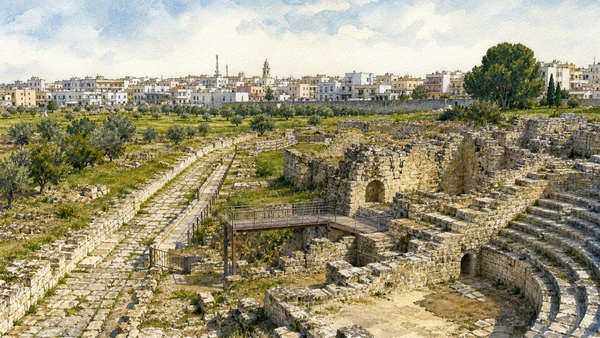
The archaeological park preserves part of the settlement associated with Lecce’s wider ancient landscape.

Rudiae: Messapian and Roman territory beyond the centre

The archaeological park preserves part of the settlement associated with Lecce’s wider ancient landscape. The place becomes clearer when surviving fabric, later change and present use are read together.

Today

Archaeological access can change because of conservation, excavation, weather or staffing. Stay outside barriers and verify the official opening notice.

History

Rudiae developed before and through Roman incorporation; visible remains include phases that cannot be reduced to one ethnic label.

How to read this place

Compare fortification, streets and amphitheatre evidence with cultivated land and the modern edge of Lecce.

What to notice

  • original masonry and later support work
  • the relation between excavation and modern surroundings
  • areas intentionally left unexcavated
Parco Archeologico di Rudiae
Original documentary watercolour of Rudiae: Messapian and Roman territory beyond the centre in Lecce · Puglia, showing accurate architecture, landscape and present-day use
Rudiae: Messapian and Roman territory beyond the centreOriginal Merlintravel documentary watercolour · 2026

Puglia through time

A short chronology

From Daunian, Peucetian and Messapian landscapes to Greek Taras, Roman roads, medieval ports, modern cities, protected parks and contemporary cultural recovery.

  1. Coastal landings, cave occupation and Bronze Age communities connect Adriatic, Ionian and inland routes.

  2. Daunian, Peucetian and Messapian societies develop distinct settlements, funerary customs and material cultures.

  3. Greek Taras expands on the Ionian coast while Indigenous centres negotiate trade and conflict across the region.

  4. Fortified towns, sanctuaries and rural systems change under pressure from Taranto, neighbouring peoples and Roman expansion.

  5. Roman colonies, estates, ports and the Via Appia and Via Traiana reorganise Apulia’s movement and production.

  6. Byzantine, Lombard and local powers contest a frontier shaped by ports, cave settlements, bishoprics and monastic networks.

  7. Norman rule, pilgrimage and maritime commerce support cathedrals, castles and new Latin institutions.

  8. Frederick II and his administration reshape castles, towns and royal landscapes across the region.

  9. Angevin and Aragonese power changes fortified towns, estates and relations with the Adriatic and Balkan coasts.

  10. The Ottoman capture of Otranto and its aftermath become a lasting element of Salento’s civic and religious memory.

  11. Coastal towers, masserie, olive estates and urban rebuilding respond to insecurity, trade and landholding systems.

  12. Feudal abolition, Bourbon reforms and Italian unification alter institutions without resolving rural inequality.

  13. Ports, railways, industry, war and migration transform cities while archaeology and heritage protection acquire new public roles.

  14. Land reform, industrial development, tourism and mass mobility reshape plains, coastlines and historic centres.

  15. UNESCO sites, national parks and museum networks expand while overtourism, industrial transition, olive disease and climate risk demand new care.

Before your visit

Practical information

01

Check the live page

Opening hours, reservations, restoration, worship and seasonal services can change. Recheck the linked institution shortly before departure.

02

Plan the long geography

Puglia is a long region. Do not compress distant cities, headlands and archaeological parks into an unsafe or superficial day.

03

Separate worship and tourism

Basilicas, cathedrals, sanctuaries and chapels remain religious places. Services and community use take priority.

04

Protect inhabited centres

Old towns, trulli districts, fishing quarters and working ports are not stage sets. Keep access, homes and deliveries clear.

05

Use current environmental notices

Heat, fire risk, sea state, coastal erosion, forest restrictions and protected habitats can alter a route at short notice.

06

Read reconstruction honestly

Restoration, adaptive reuse, modern infrastructure and contemporary art are part of the documented landscape, not defects to hide.

Method and sources

Sources and image credits

This guide uses official museum, ministry, municipal, park, UNESCO and regional-tourism documentation checked on 1 September 2026. It distinguishes Daunian, Peucetian, Messapian, Greek, Roman, Byzantine, Lombard, Norman, Swabian and later phases rather than treating Puglia as one timeless Mediterranean image. Every chapter links its principal institutional source; tickets, services, worship, closures, heat, fire risk, sea conditions and transport must always be verified again on the day of the visit.

All ten images are original Merlintravel editorial watercolours based on documented present-day conditions. They are illustrations, not substitutes for archaeological plans. Opening hours, tickets, accessible routes, temporary exhibitions and conservation work can change; consult the linked official pages shortly before visiting.