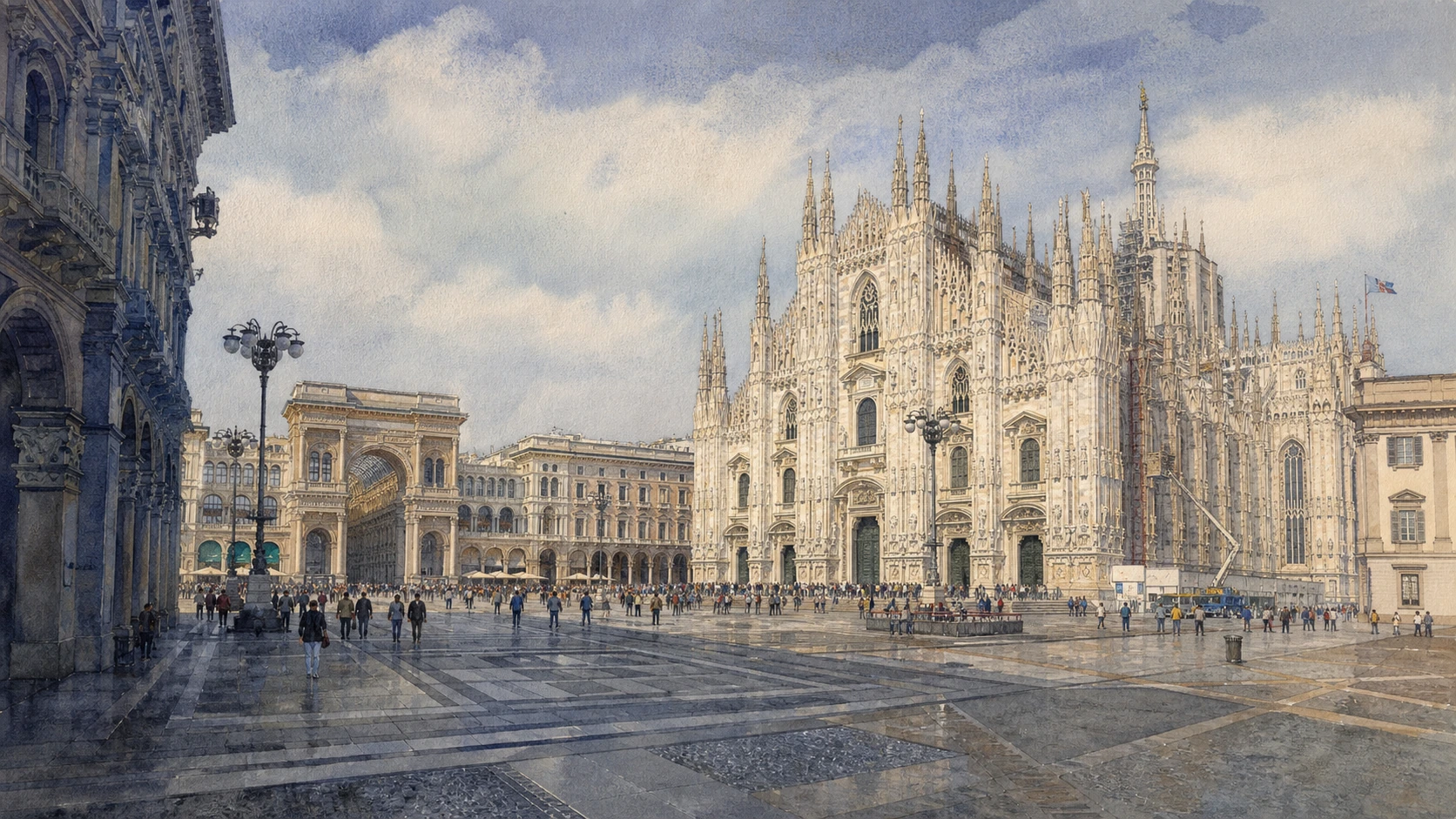
Original documentary watercolour panorama for Milan Duomo, Galleria and Civic Centre: Complete Guide, with accurate Lombardy architecture, landscape and lived context

Milan Guide 01 · Cathedral works, archaeology, royal palace, modern art and the commercial-civic centre

Duomo, Galleria
& the Civic Centre

A complete urban reading of Piazza del Duomo, following the cathedral as a centuries-long construction site before crossing archaeology, royal and municipal institutions, twentieth-century collections, commerce and the surviving medieval civic core.

Plan the route
Milan · Lombardy10 chapters · one complete route

Why this route must be read in layers

Milan’s centre is not one finished postcard: marble production, worship, excavation, state ceremony, municipal government, shopping and everyday crossings continually occupy the same compact ground.

The Duomo is both monument and active institution. Its structure, roof, sculpture and stained glass record successive technical and devotional decisions, while the Veneranda Fabbrica continues maintenance and access management.

Piazza del Duomo also covers earlier sacred and civic levels. Archaeology below the parvis, Palazzo Reale, the Arengario and the Galleria demonstrate that centrality was repeatedly rebuilt rather than inherited unchanged.

A responsible route separates the cathedral’s liturgical use from visitor products, and monumental public space from commercial spectacle. Piazza Mercanti and San Satiro restore scales that the main square tends to overpower.

Begin before the square fills, read construction and ground levels first, then follow the civic and commercial passages without mistaking grandeur for a single historical period.

The route

Plan your visit

Start with the cathedral exterior, roof and interior, descend to the archaeological layer, then move through royal, artistic, commercial and municipal spaces toward the smaller medieval centre.

Early morning

Duomo exterior · Duomo rooftops · Duomo interior

Move in the documented order: Duomo exterior: a cathedral still under construction; then Duomo rooftops: structure, sculpture and the city horizon; then Duomo interior: worship inside a vast construction history. Recheck live access and transport before entering a controlled site.

Late morning

The archaeological area · Palazzo Reale · Museo del Novecento

Move in the documented order: The archaeological area: baptistery and earlier cathedral levels; then Palazzo Reale: court, government and exhibition reuse; then Museo del Novecento: modern art in the Arengario. Recheck live access and transport before entering a controlled site.

Afternoon

Galleria Vittorio Emanuele II · Piazza Mercanti · Piazza della Scala and Palazzo Marino

Move in the documented order: Galleria Vittorio Emanuele II: commerce as civic theatre; then Piazza Mercanti: the smaller medieval civic centre; then Piazza della Scala and Palazzo Marino: municipal power. Recheck live access and transport before entering a controlled site.

Late afternoon

Santa Maria presso San Satiro

Move in the documented order: Santa Maria presso San Satiro: perspective within a constrained block. Recheck live access and transport before entering a controlled site.

Ten chapters

Explore the places

The order follows terrain, institutions and present-day movement. Use the index to return to a chapter without reducing the route to isolated monuments.

  1. 01Duomo exterior: a cathedral still under construction
  2. 02Duomo rooftops: structure, sculpture and the city horizon
  3. 03Duomo interior: worship inside a vast construction history
  4. 04The archaeological area: baptistery and earlier cathedral levels
  5. 05Palazzo Reale: court, government and exhibition reuse
  6. 06Museo del Novecento: modern art in the Arengario
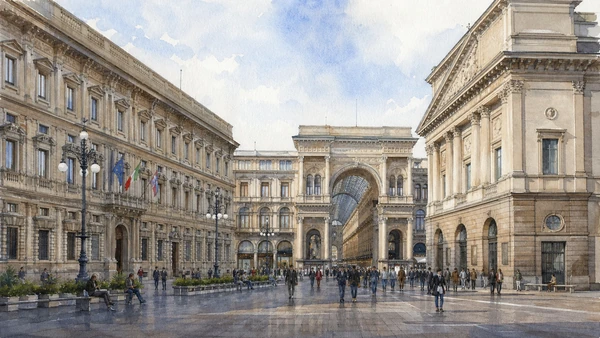
  7. 07Galleria Vittorio Emanuele II: commerce as civic theatre
  8. 08Piazza Mercanti: the smaller medieval civic centre
  9. 09Piazza della Scala and Palazzo Marino: municipal power
  10. 10Santa Maria presso San Satiro: perspective within a constrained block
01

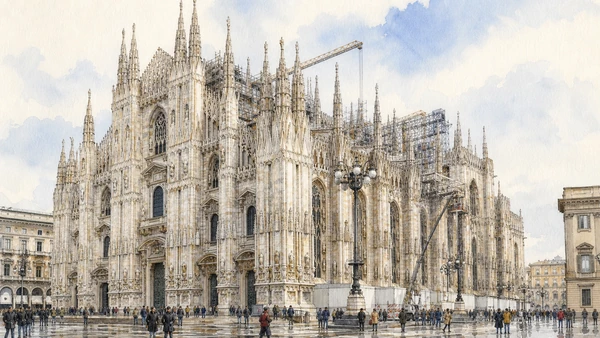
Candoglia marble, Gothic structure and later façade campaigns form a building maintained through continuous specialist work.

Duomo exterior: a cathedral still under construction

Candoglia marble, Gothic structure and later façade campaigns form a building maintained through continuous specialist work. The site becomes clearer when its surviving fabric, later alterations and present use are read together.

Today

This is an active religious place as well as a historic building. Services, ceremonies and conservation can interrupt tourist access; dress appropriately, remain quiet and never treat a booked visit as priority over worship.

History

Construction began in 1386 under ducal and archiepiscopal patronage. Design, quarry supply, engineering, façade completion and restoration extended across centuries.

How to read this place

Begin with the structural rhythm of buttresses and pinnacles. Then compare sculpture exposed to weather with the working systems used for present conservation; the differences are evidence, not visual noise.

What to notice

  • the structural rhythm of buttresses and pinnacles
  • sculpture exposed to weather
  • the working systems used for present conservation
Veneranda Fabbrica del Duomo · Official site
Original documentary watercolour of Duomo exterior: a cathedral still under construction in Milan · Lombardy, showing accurate architecture, landscape, people and present-day use
Duomo exterior: a cathedral still under constructionOriginal Merlintravel documentary watercolour · 2026
02

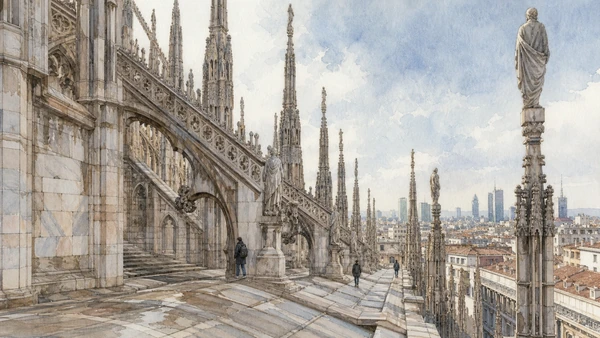
The terraces reveal the cathedral as load-bearing masonry and metal support as well as an elevated sculpture field.

Duomo rooftops: structure, sculpture and the city horizon

The terraces reveal the cathedral as load-bearing masonry and metal support as well as an elevated sculpture field. The site becomes clearer when its surviving fabric, later alterations and present use are read together.

Today

Opening, ticketing, room access and temporary displays can change. Check the institution’s official notice shortly before visiting, use the designated entrance and allow for security or conservation controls.

History

Access routes created for works and maintenance later became a controlled visitor circuit. Views now place the historic roof against successive metropolitan skylines.

How to read this place

Begin with flying buttresses and roof drainage. Then compare nearby carved figures with the distant modern city; the differences are evidence, not visual noise.

What to notice

  • flying buttresses and roof drainage
  • nearby carved figures
  • the distant modern city
Veneranda Fabbrica del Duomo · Official site
Original documentary watercolour of Duomo rooftops: structure, sculpture and the city horizon in Milan · Lombardy, showing accurate architecture, landscape, people and present-day use
Duomo rooftops: structure, sculpture and the city horizonOriginal Merlintravel documentary watercolour · 2026
03

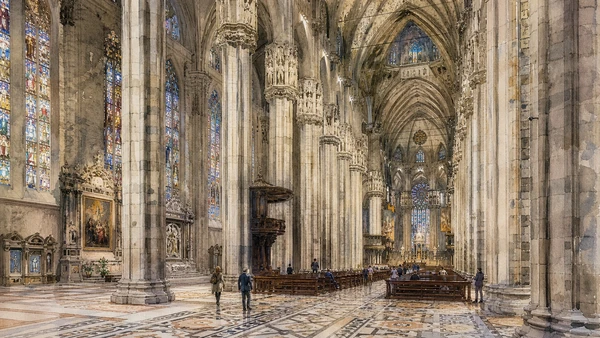
Nave, choir, stained glass, monuments and liturgical zones preserve different periods within an active cathedral.

Duomo interior: worship inside a vast construction history

Nave, choir, stained glass, monuments and liturgical zones preserve different periods within an active cathedral. The site becomes clearer when its surviving fabric, later alterations and present use are read together.

Today

This is an active religious place as well as a historic building. Services, ceremonies and conservation can interrupt tourist access; dress appropriately, remain quiet and never treat a booked visit as priority over worship.

History

Successive archbishops, chapters, rulers, artists and engineers altered the interior while retaining its long basilican organisation and ritual focus.

How to read this place

Begin with the scale established by piers and vaults. Then compare coloured light from the windows with controlled areas around the sanctuary; the differences are evidence, not visual noise.

What to notice

  • the scale established by piers and vaults
  • coloured light from the windows
  • controlled areas around the sanctuary
Veneranda Fabbrica del Duomo · Official site
Original documentary watercolour of Duomo interior: worship inside a vast construction history in Milan · Lombardy, showing accurate architecture, landscape, people and present-day use
Duomo interior: worship inside a vast construction historyOriginal Merlintravel documentary watercolour · 2026
04

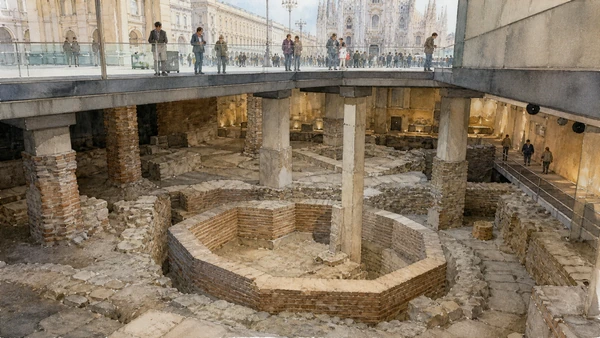
Protected remains below the square connect the present Duomo to the late-antique episcopal complex.

The archaeological area: baptistery and earlier cathedral levels

Protected remains below the square connect the present Duomo to the late-antique episcopal complex. The site becomes clearer when its surviving fabric, later alterations and present use are read together.

Today

Archaeological access may be limited to protected viewpoints, scheduled openings or guided routes. Stay outside barriers, distinguish original material from supports and reconstruction, and verify the official opening notice.

History

Excavation revealed structures associated with Santa Tecla and the baptistery of San Giovanni alle Fonti, clarifying how the Christian centre changed before the current cathedral.

How to read this place

Begin with the difference between present pavement and ancient level. Then compare baptistery geometry with later foundations crossing earlier fabric; the differences are evidence, not visual noise.

What to notice

  • the difference between present pavement and ancient level
  • baptistery geometry
  • later foundations crossing earlier fabric
Veneranda Fabbrica del Duomo · Official site
Original documentary watercolour of The archaeological area: baptistery and earlier cathedral levels in Milan · Lombardy, showing accurate architecture, landscape, people and present-day use
The archaeological area: baptistery and earlier cathedral levelsOriginal Merlintravel documentary watercolour · 2026
05

The former seat of government retains an urban relationship with the cathedral despite repeated remodelling and wartime loss.

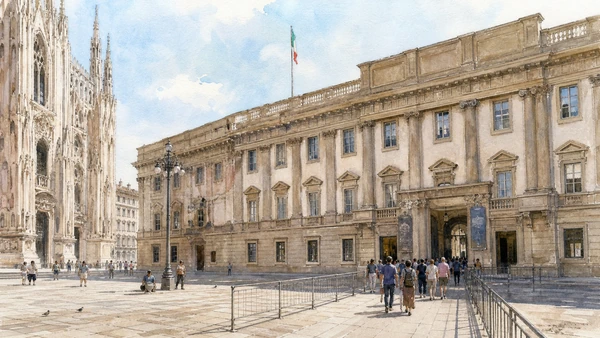
Palazzo Reale: court, government and exhibition reuse

The former seat of government retains an urban relationship with the cathedral despite repeated remodelling and wartime loss. The site becomes clearer when its surviving fabric, later alterations and present use are read together.

Today

Opening, ticketing, room access and temporary displays can change. Check the institution’s official notice shortly before visiting, use the designated entrance and allow for security or conservation controls.

History

Medieval and ducal structures were transformed under Spanish and Austrian government, then by Piermarini; bombing damaged the palace before its modern cultural reuse.

How to read this place

Begin with the palace’s restrained frontage. Then compare courtyards and circulation with traces of reconstruction and gallery adaptation; the differences are evidence, not visual noise.

What to notice

  • the palace’s restrained frontage
  • courtyards and circulation
  • traces of reconstruction and gallery adaptation
Comune di Milano · Civic museums and exhibition spaces
Original documentary watercolour of Palazzo Reale: court, government and exhibition reuse in Milan · Lombardy, showing accurate architecture, landscape, people and present-day use
Palazzo Reale: court, government and exhibition reuseOriginal Merlintravel documentary watercolour · 2026
06

A Fascist-period civic building now frames twentieth-century Italian art and a panoramic view toward the cathedral.

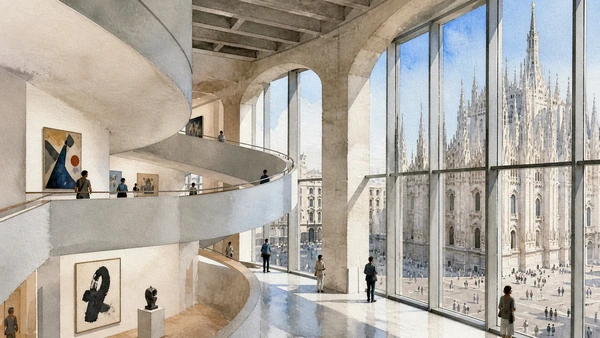
Museo del Novecento: modern art in the Arengario

A Fascist-period civic building now frames twentieth-century Italian art and a panoramic view toward the cathedral. The site becomes clearer when its surviving fabric, later alterations and present use are read together.

Today

Opening, ticketing, room access and temporary displays can change. Check the institution’s official notice shortly before visiting, use the designated entrance and allow for security or conservation controls.

History

The Arengario was planned as a ceremonial counterpart within the reshaped piazza. Its conversion into a museum created new ramps, galleries and visual links.

How to read this place

Begin with the arengario’s exterior mass. Then compare the internal spiral route with artworks seen against the duomo; the differences are evidence, not visual noise.

What to notice

  • the Arengario’s exterior mass
  • the internal spiral route
  • artworks seen against the Duomo
Comune di Milano · Civic museums and exhibition spaces
Original documentary watercolour of Museo del Novecento: modern art in the Arengario in Milan · Lombardy, showing accurate architecture, landscape, people and present-day use
Museo del Novecento: modern art in the ArengarioOriginal Merlintravel documentary watercolour · 2026
07

Iron, glass, mosaics and aligned entrances join cathedral square to Piazza della Scala through a monumental commercial passage.

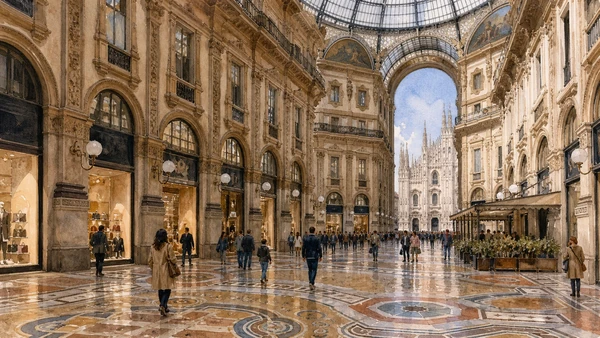
Galleria Vittorio Emanuele II: commerce as civic theatre

Iron, glass, mosaics and aligned entrances join cathedral square to Piazza della Scala through a monumental commercial passage. The site becomes clearer when its surviving fabric, later alterations and present use are read together.

Today

The area is inhabited and worked, not staged for visitors. Keep doorways, pavements, cycle lanes and deliveries clear, ask before photographing people and use current municipal mobility information.

History

Built in the 1860s and 1870s during national unification, the Galleria combined new engineering, speculation and civic representation. Restoration continues around active businesses.

How to read this place

Begin with the long cross-axes. Then compare iron-and-glass roof structure with shop fronts and public movement at ground level; the differences are evidence, not visual noise.

What to notice

  • the long cross-axes
  • iron-and-glass roof structure
  • shop fronts and public movement at ground level
Comune di Milano · Official city portal
Original documentary watercolour of Galleria Vittorio Emanuele II: commerce as civic theatre in Milan · Lombardy, showing accurate architecture, landscape, people and present-day use
Galleria Vittorio Emanuele II: commerce as civic theatreOriginal Merlintravel documentary watercolour · 2026
08

A compact group of public buildings preserves the scale of communal and mercantile government behind the modern piazza.

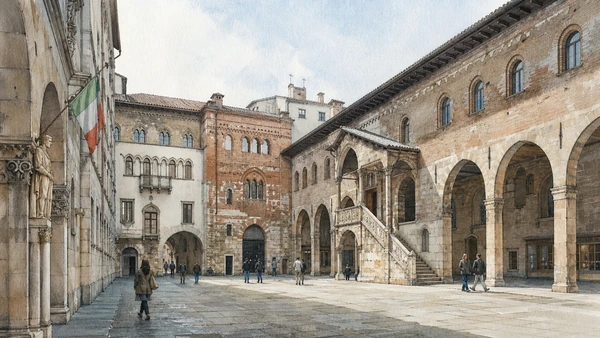
Piazza Mercanti: the smaller medieval civic centre

A compact group of public buildings preserves the scale of communal and mercantile government behind the modern piazza. The site becomes clearer when its surviving fabric, later alterations and present use are read together.

Today

The exterior can usually be read from public space, but events, works and crowd management may change circulation. Keep access routes open and verify any interior visit with the responsible institution.

History

The Broletto Nuovo, Loggia degli Osii and associated palaces organised medieval administration, justice and commerce before the city’s centre expanded and was opened by later streets.

How to read this place

Begin with the raised speaking loggia. Then compare varied public façades with the enclosed proportions of the square; the differences are evidence, not visual noise.

What to notice

  • the raised speaking loggia
  • varied public façades
  • the enclosed proportions of the square
Comune di Milano · Official city portal
Original documentary watercolour of Piazza Mercanti: the smaller medieval civic centre in Milan · Lombardy, showing accurate architecture, landscape, people and present-day use
Piazza Mercanti: the smaller medieval civic centreOriginal Merlintravel documentary watercolour · 2026
09

The Galleria opens onto a square joining theatre, banking, art and Milan’s city hall.

Piazza della Scala and Palazzo Marino: municipal power

The Galleria opens onto a square joining theatre, banking, art and Milan’s city hall. The site becomes clearer when its surviving fabric, later alterations and present use are read together.

Today

The exterior can usually be read from public space, but events, works and crowd management may change circulation. Keep access routes open and verify any interior visit with the responsible institution.

History

Palazzo Marino began as a sixteenth-century private palace and later became the municipal seat. Nineteenth- and twentieth-century interventions produced the current civic ensemble.

How to read this place

Begin with the façade of palazzo marino. Then compare the galleria entrance opposite with the relationship between theatre and public square; the differences are evidence, not visual noise.

What to notice

  • the façade of Palazzo Marino
  • the Galleria entrance opposite
  • the relationship between theatre and public square
Comune di Milano · Official city portal
Original documentary watercolour of Piazza della Scala and Palazzo Marino: municipal power in Milan · Lombardy, showing accurate architecture, landscape, people and present-day use
Piazza della Scala and Palazzo Marino: municipal powerOriginal Merlintravel documentary watercolour · 2026
10

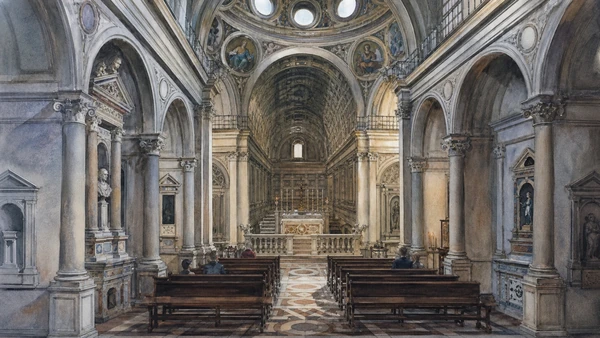
Bramante’s celebrated illusion answers the shortage of physical depth behind the church’s crossing.

Santa Maria presso San Satiro: perspective within a constrained block

Bramante’s celebrated illusion answers the shortage of physical depth behind the church’s crossing. The site becomes clearer when its surviving fabric, later alterations and present use are read together.

Today

This is an active religious place as well as a historic building. Services, ceremonies and conservation can interrupt tourist access; dress appropriately, remain quiet and never treat a booked visit as priority over worship.

History

The late-fifteenth-century rebuilding incorporated an older sacellum and used architecture, relief and painted perspective to create a monumental choir where the street left little space.

How to read this place

Begin with the view from the nave toward the false choir. Then compare the older sacellum with the tight urban perimeter outside; the differences are evidence, not visual noise.

What to notice

  • the view from the nave toward the false choir
  • the older sacellum
  • the tight urban perimeter outside
Comune di Milano · Official city portal
Original documentary watercolour of Santa Maria presso San Satiro: perspective within a constrained block in Milan · Lombardy, showing accurate architecture, landscape, people and present-day use
Santa Maria presso San Satiro: perspective within a constrained blockOriginal Merlintravel documentary watercolour · 2026

Milan through time

A short chronology

From Insubrian settlement and imperial Mediolanum to the ducal court, industrial metropolis, wartime rupture and contemporary redevelopment.

  1. An Insubrian settlement develops on the plain at the crossing of routes later absorbed by Roman Mediolanum.

  2. Roman forces take Mediolanum, which grows into a major Cisalpine administrative and commercial centre.

  3. Milan becomes an imperial residence in the western Roman Empire and gains palace, circus, baths and monumental infrastructure.

  4. The agreement associated with Constantine and Licinius establishes religious toleration and becomes inseparable from Milan’s Christian memory.

  5. Ambrose serves as bishop; basilicas, burial places and episcopal authority reshape the late-antique city.

  6. Frederick Barbarossa’s forces destroy much of Milan; reconstruction and communal institutions subsequently re-form the city.

  7. Visconti power becomes dominant, beginning a long phase of ducal patronage, fortification and territorial government.

  8. Construction of the Duomo begins, creating a building site and civic-religious institution that continue across centuries.

  9. Sforza rule renews the castle and court while artists, engineers and scholars, including Leonardo, work within ducal networks.

  10. Spanish Habsburg administration reshapes government, defence, religion and the social geography of the city.

  11. French and Napoleonic rule reorganises institutions, collections, ceremonial space and Milan’s role in northern Italy.

  12. Austrian rule ends and Milan enters the Kingdom of Italy, accelerating railway, industrial and civic expansion.

  13. The present Milano Centrale opens as a monumental transport complex within a rapidly expanding metropolis.

  14. Bombing, occupation, resistance and liberation damage monuments, housing and industry and leave a difficult memorial landscape.

  15. Post-war migration, design and manufacturing, deindustrialisation, Expo 2015 and metropolitan redevelopment repeatedly transform the city.

Before your visit

Practical information

01

Check the live page

Opening hours, reservation systems, restoration, exhibitions and transport can change. Recheck the linked official institution shortly before departure.

02

Separate worship and tourism

Churches and sanctuaries remain religious spaces. Services, funerals and community use take priority over visitor itineraries.

03

Plan real distances

Milan · Lombardy combines dense urban routes with lakes, valleys and dispersed towns. Do not compress distant chapters into an unsafe or superficial day.

04

Keep thresholds open

Arcades, station halls, markets, courtyards, workshops and residential streets must continue to function while you observe or photograph them.

05

Use current mobility data

Check the responsible rail, navigation, bus, road or park operator on the day; replacement services and weather can change an otherwise sound route.

06

Read change honestly

Restoration, reconstruction, adaptive reuse and new development have all shaped the landscape visible today.

Method and sources

Sources and image credits

This guide uses official museum, ministry, municipal, transport, park and UNESCO documentation checked on 29 August 2026. It separates durable historical interpretation from access details that can change, distinguishes surviving fabric from restoration or reconstruction, and treats worship, work, residence and public movement as part of the evidence. Every chapter links its principal institutional source; tickets, closures, weather and transport must always be verified again on the day of the visit.

All ten images are original Merlintravel editorial watercolours based on documented present-day conditions. They are illustrations, not substitutes for archaeological plans. Opening hours, tickets, accessible routes, temporary exhibitions and conservation work can change; consult the linked official pages shortly before visiting.