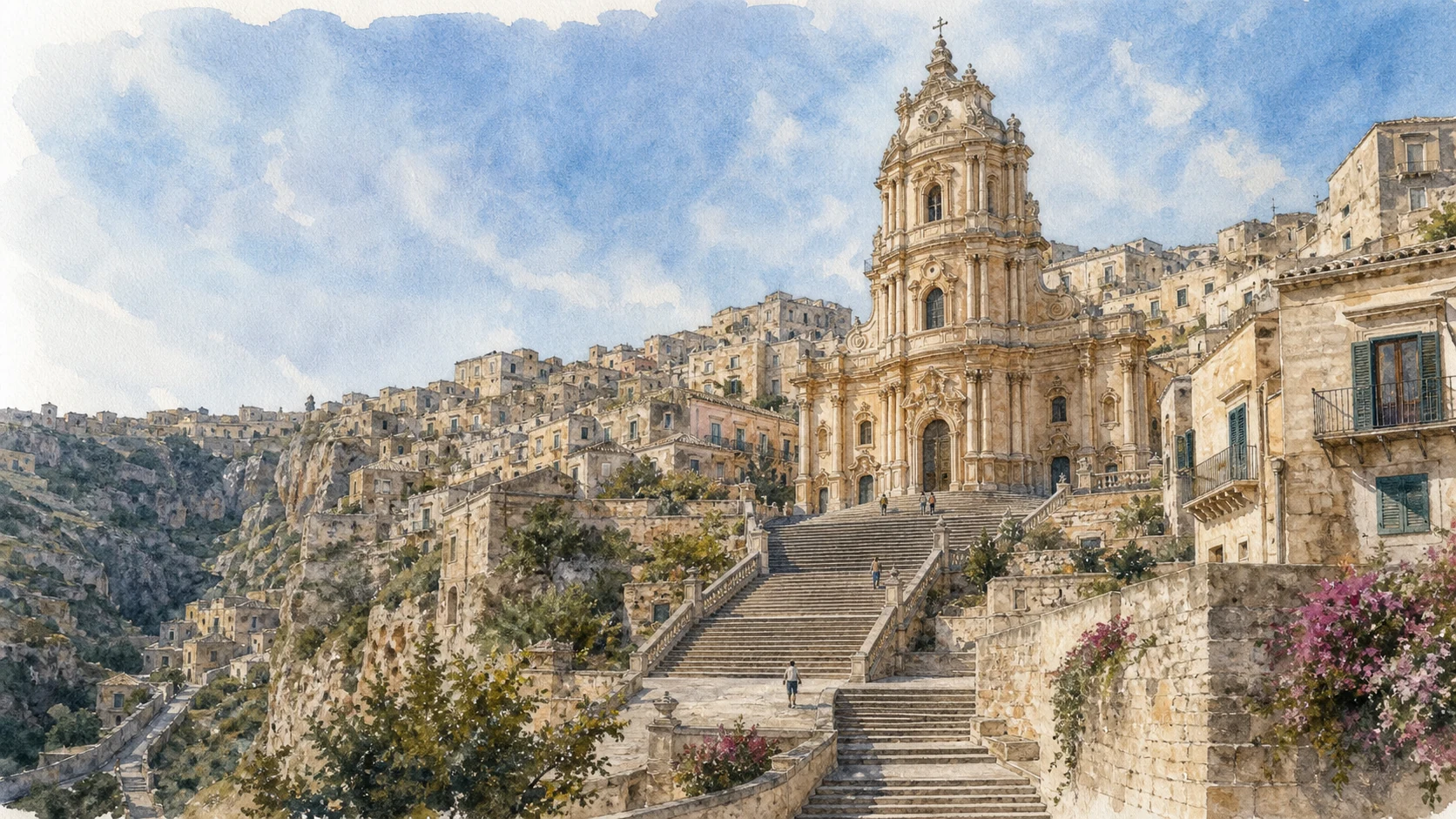
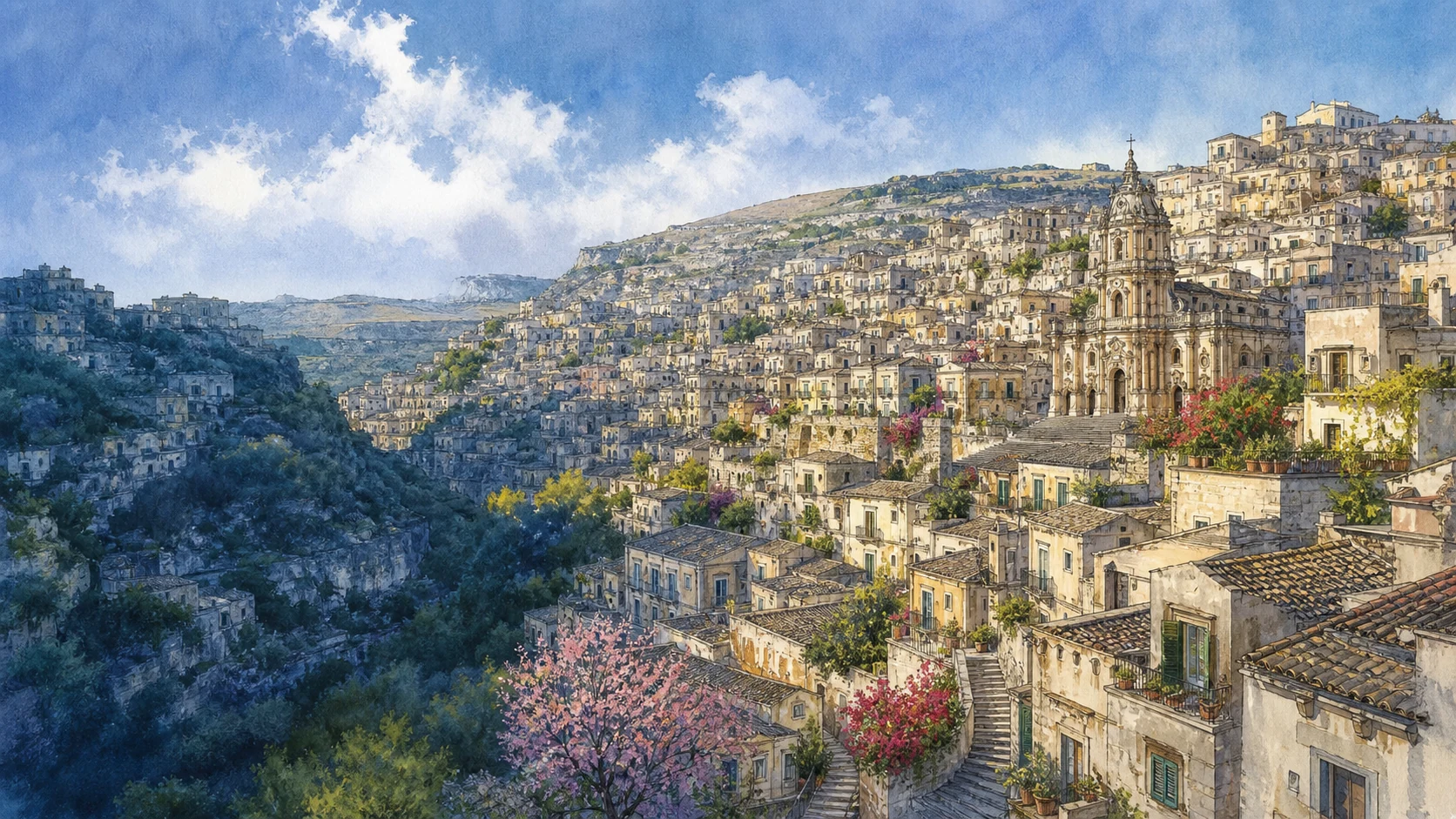
Documentary watercolour panorama of Modica rising on limestone slopes, with San Giorgio, dense pale houses, stairs, terraces and the Hyblaean ravines

Illustrated guide · Sicily

A city written
on two hills

Ten places through which to read Modica as a vertical city: medieval county, post-earthquake churches, cave neighbourhoods, poetry, living craft and the long landscape of Cava d’Ispica.

Explore the places
Modica · Alta, Bassa, churches and caves

A Baroque city that kept its older ground

Modica does not reveal itself in a single piazza.

Its houses climb two limestone slopes above the channels where streams once met. Churches appear at different heights; stairways continue where roads stop; caves, retaining walls and later façades belong to the same inhabited landscape.

After the earthquake of 1693, the community rebuilt substantially on this difficult ground. The old rivalry between the parishes of San Giorgio and San Pietro survived, while noble residences, convents and ordinary homes adapted the inherited urban fabric rather than replacing it with one ideal plan.

To understand Modica, the visitor must move between Alta and Bassa and then look beyond both: toward poetry, an officially protected food tradition and the long archaeological valley of Cava d’Ispica.

One destination

Modica,
a city made by ascent.

UNESCO includes Modica in the serial property of the Late Baroque Towns of the Val di Noto. Unlike Noto, which was transferred to a new site after 1693, Modica was rebuilt slowly within and across its earlier topography. The Italian Ministry of Culture's study emphasises the resulting continuity of its intricate urban fabric and the persistence of the two principal parishes.

The city extends from Modica Bassa along Corso Umberto I to Modica Alta around the castle ridge and the Pizzo. Monumental stairways connect those levels, but the complete story also includes smaller lanes, rock-cut rooms, nineteenth- and twentieth-century transformations, and the countryside whose settlements long predate the Baroque city.

The selection

Ten places,
one vertical history

The route begins with the geology that created Alta and Bassa, climbs the county's political ridge, follows the parish landscape from San Giorgio to San Pietro, and then widens toward Quasimodo, Modica chocolate and Cava d’Ispica.

  1. 01Modica Alta, Modica Bassa and the Ravine City
  2. 02The Counts' Castle and the Political Ridge
  3. 03The Duomo of San Giorgio
  4. 04Santa Maria del Gesù and the Pre-Baroque City
  5. 05San Giovanni Evangelista and the Pizzo
  6. 06Corso Umberto I and the Former Watercourses
  7. 07The Duomo of San Pietro and the Lower Parish
  8. 08Salvatore Quasimodo's Birthplace and the Civic Collections
  9. 09Cioccolato di Modica PGI and the Living Workshops
  10. 10Cava d’Ispica
01

Geology is the first chapter of the urban plan

Modica Alta, Modica Bassa and the Ravine City

Two hills, former stream beds and hundreds of stairways explain why Modica must be read vertically rather than as one historic centre.

Documentary watercolour of the Duomo of San Giorgio in Modica above its long divided staircase and the houses climbing the surrounding slope
A CHURCH, A STAIR AND THE VERTICAL CITY

The place today

Modica Bassa follows the broad commercial axis of Corso Umberto I, while Modica Alta rises through narrow streets, flights of steps and terraces around the castle ridge. From intermediate landings, façades appear stacked above roofs and rock walls. The apparent disorder has a physical logic: construction occupies spurs and slopes cut by the Pozzo dei Pruni and Janni Mauro watercourses, now largely incorporated beneath modern streets.

The historical chapter

Settlement used defensible limestone ridges and natural cavities long before the Baroque rebuilding. Medieval Modica became the centre of a powerful county whose jurisdiction extended far beyond the present municipality. After 1693, rebuilding did not erase that topography. Churches and palaces gained monumental fronts, but ordinary houses and passages continued to negotiate steep ground. Nineteenth- and twentieth-century works covered or channelled streams and improved roads, creating today's more continuous lower avenue without turning the city into a flat grid.

What to notice

  • Stairs and lanes continuing above or below the streets shown on a road map
  • Rock faces and former cave rooms absorbed into later houses
  • How San Giorgio, the castle ridge and San Pietro command different urban levels
Italian Ministry of Culture · Late Baroque towns study
02

The former centre of a county survives as layered ground

The Counts' Castle and the Political Ridge

Ruins, later buildings and the clock tower mark the site from which the County of Modica was governed.

Documentary watercolour of the Duomo of San Giorgio in Modica above its long divided staircase and the houses climbing the surrounding slope
A CHURCH, A STAIR AND THE VERTICAL CITY

The place today

The castle area occupies a long rocky spur between the upper and lower districts. What survives is not an intact storybook fortress: walls, rock-cut spaces, altered buildings, archaeological traces and modern restoration zones record repeated change. The clock tower, built on an older watch structure and carrying a nineteenth-century mechanism, has become the ridge's most visible landmark. Terraces open broad views across San Giorgio and the opposite slopes.

The historical chapter

A fortified and administrative complex developed here through medieval phases and served the Counts of Modica, whose feudal state became one of Sicily's most influential. The site included defensive, residential, judicial and carceral functions. Earthquakes, rebuilding and later civic reuse transformed the complex; substantial fabric was lost or absorbed. Reading the ridge therefore requires distinguishing the political importance of the historic castle from the fragmentary condition visible today.

What to notice

  • The narrow spur controlling several valleys rather than one ceremonial approach
  • Rock-cut rooms and masonry belonging to different periods
  • The clock tower as a later civic marker above a much older seat of power
Italia.it · Modica cultural itinerary
Documentary watercolour of the Duomo of San Giorgio in Modica above its long divided staircase and the houses climbing the surrounding slope
A CHURCH, A STAIR AND THE VERTICAL CITYSan Giorgio's long ascent and the houses of Modica Alta translate the ravine city's steep geography into architecture.
03

A parish, a façade-tower and a garden staircase

The Duomo of San Giorgio

Modica's most imposing church turns a steep connection between Alta and Bassa into a long architectural sequence.

Documentary watercolour of the Duomo of San Giorgio in Modica above its long divided staircase and the houses climbing the surrounding slope
A CHURCH, A STAIR AND THE VERTICAL CITY

The place today

San Giorgio stands between the upper and lower city behind a monumental stair of roughly 260 steps, broadened by terraces and gardens. The façade rises in five bays and successive levels, using free columns and alternating curves to create depth and movement. Five portals correspond to an unusually wide interior of five naves; a high dome marks the crossing farther behind the tower front.

The historical chapter

The church's origins precede the Norman period and the building was repeatedly damaged, rebuilt and enlarged. Work following the earthquakes of 1542 and 1693 produced the present late-Baroque complex over a long period. The UNESCO south-east consortium associates the design with Rosario Gagliardi, while the Ministry of Culture notes that the façade's chronology and authorship remain subjects of scholarly discussion, with important work continuing into the early nineteenth century. The church was also the mother parish of one of Modica's two historically rival communities.

What to notice

  • The stair, garden terraces and façade working as one extended approach
  • Concave and convex surfaces changing as the sun moves across the tower
  • The dome set behind the façade rather than forming its uppermost level
Siti UNESCO Sicilia Sud Est · Duomo di San Giorgio
04

A late-Gothic cloister complicates the image of total destruction

Santa Maria del Gesù and the Pre-Baroque City

Church and Franciscan convent preserve a major architectural voice from before the 1693 reconstruction.

Documentary watercolour of the Duomo of San Giorgio in Modica above its long divided staircase and the houses climbing the surrounding slope
A CHURCH, A STAIR AND THE VERTICAL CITY

The place today

On the northern side of Modica Alta, the Santa Maria del Gesù complex is more secluded than the principal Baroque churches. Its church front, pointed and moulded openings, cloister arcades and sculpted details belong to a late-medieval and Renaissance language. Access has varied with restoration and institutional use, so the exterior and setting should be treated as meaningful even when interiors are unavailable.

The historical chapter

The Franciscan Observants established the complex in the later fifteenth century with support traditionally connected to the Counts of Modica. Unlike many city monuments, important portions survived the earthquakes that reshaped south-eastern Sicily. Later alterations did not erase the cloister and late-Gothic fabric. The site is therefore essential evidence that Modica's heritage is not exclusively Baroque and that survival, repair and reuse accompanied post-seismic reconstruction.

What to notice

  • Pointed arches and carved stone distinct from the eighteenth-century façade-towers
  • The cloister's measured rhythm compared with the steep streets outside
  • Changes of masonry and blocked openings revealing long adaptation
Italian Ministry of Culture · Late Baroque towns study
05

The upper city ends in a church, a viewpoint and a dense domestic maze

San Giovanni Evangelista and the Pizzo

At Modica Alta's high edge, a monumental church and belvedere make the entire two-hill structure legible.

Documentary watercolour of the Duomo of San Giorgio in Modica above its long divided staircase and the houses climbing the surrounding slope
A CHURCH, A STAIR AND THE VERTICAL CITY

The place today

The church of San Giovanni Evangelista rises at the end of a broad stair in the upper city. Its tall façade and spire command the Pizzo district, whose lanes pass closely packed houses before reaching belvederes over Modica Bassa, San Giorgio and the facing slopes. The viewpoint is most useful when read as geography: it reveals why walking distances and visual distances are so different here.

The historical chapter

A church existed in this area before 1693, but the present appearance reflects prolonged rebuilding and later completion. As Modica Alta developed around the castle and upper parishes, San Giovanni served a neighbourhood whose relationship to the lower commercial axis was always mediated by height. The Pizzo also preserves the scale of ordinary urban life around major institutions: small plots, shared walls and stepped routes rather than a sequence of freestanding monuments.

What to notice

  • The church's vertical silhouette continuing the steep rise of the street
  • San Giorgio seen from above as part of the slope rather than an isolated façade
  • Domestic roofs, retaining walls and stair lanes filling the spaces between landmarks
Italia.it · Modica
06

The apparent main street is a modern layer over a valley floor

Corso Umberto I and the Former Watercourses

Palaces, churches, bridges and buried streams explain how Modica Bassa became the city's continuous public axis.

Documentary watercolour of the Duomo of San Giorgio in Modica above its long divided staircase and the houses climbing the surrounding slope
A CHURCH, A STAIR AND THE VERTICAL CITY

The place today

Corso Umberto I carries daily commerce, civic buildings, churches and evening movement through Modica Bassa. Side streets climb sharply toward both hills, making the avenue feel like the floor of an urban canyon. Façades from different periods sit beside twentieth-century infill; the lower city is not a preserved Baroque corridor but a working centre produced by repeated hydraulic and transport interventions.

The historical chapter

The lower settlement developed around converging watercourses that could support activity but also brought destructive floods. Bridges once joined streets above the channels. Major works progressively contained and covered the streams, especially after damaging flood events, turning former river space into roads and public ground. Corso Umberto's present breadth therefore belongs to the modern history of risk management as much as to eighteenth-century rebuilding.

What to notice

  • Side lanes rising almost immediately from the relatively level corso
  • Changes in street width and building line where waterways and crossings once conditioned movement
  • Civic, religious and commercial uses sharing one valley-floor axis
Italian Ministry of Culture · Late Baroque towns study
07

Twelve apostles introduce the other historic mother church

The Duomo of San Pietro and the Lower Parish

San Pietro anchors Modica Bassa and makes the old rivalry with San Giorgio visible in the city plan.

Documentary watercolour of the Duomo of San Giorgio in Modica above its long divided staircase and the houses climbing the surrounding slope
A CHURCH, A STAIR AND THE VERTICAL CITY

The place today

A broad stair lined with statues of the twelve apostles rises from Corso Umberto to San Pietro. The façade has three portals at its lower level and a sculptural upper composition; the interior is divided into three naves by fourteen columns. Its position is less elevated than San Giorgio's but more directly connected to the lower commercial city, giving the church a distinct urban authority.

The historical chapter

San Pietro has medieval origins and was rebuilt after repeated earthquakes, including the disaster of 1693. Work extended across the eighteenth century and later decorative phases. More important than a single construction date is the church's institutional role: it remained the principal parish of Modica Bassa while San Giorgio represented another part of the community. Proposals to unify the city under one post-earthquake mother church did not prevail, so the two monumental fronts preserve an old social and jurisdictional division.

What to notice

  • The apostles creating a human-scale processional line before the façade
  • Three entrance portals corresponding to the interior's three naves
  • The direct relationship between the church stair and everyday life on Corso Umberto
Siti UNESCO Sicilia Sud Est · Duomo di San Pietro
08

A small house opens Modica toward poetry and modern memory

Salvatore Quasimodo's Birthplace and the Civic Collections

The Nobel laureate's birthplace and the city's archaeological collections connect the monumental centre to individual and material histories.

Documentary watercolour of the Duomo of San Giorgio in Modica above its long divided staircase and the houses climbing the surrounding slope
A CHURCH, A STAIR AND THE VERTICAL CITY

The place today

Salvatore Quasimodo's birthplace occupies modest rooms reached through the stepped fabric near the castle district. The museum presents the room of his birth, a reconstruction using furnishings from his Milan study, personal objects, editions and recordings of the poet's voice. In Modica Bassa, the Franco Libero Belgiorno Civic Museum brings together archaeology from prehistoric to medieval phases and collections related to Quasimodo, including the Hellenistic bronze figure known as the Eracle di Cafeo.

The historical chapter

Quasimodo was born in Modica on 20 August 1901 and received the Nobel Prize in Literature in 1959. The house museum resists turning that biography into a grand residence: its scale reflects a brief family presence and later acts of collection and reconstruction. The civic museum, founded through Franco Libero Belgiorno's collecting and research, adds a longer local chronology. Together the institutions show how a city remembers both a world-famous writer and objects recovered from its territory.

What to notice

  • The domestic scale of the birthplace within a much denser neighbourhood
  • Recorded voice and books extending interpretation beyond preserved furniture
  • Archaeological objects reconnecting the Baroque city to much earlier settlement
Casa Natale Salvatore Quasimodo · Official museum
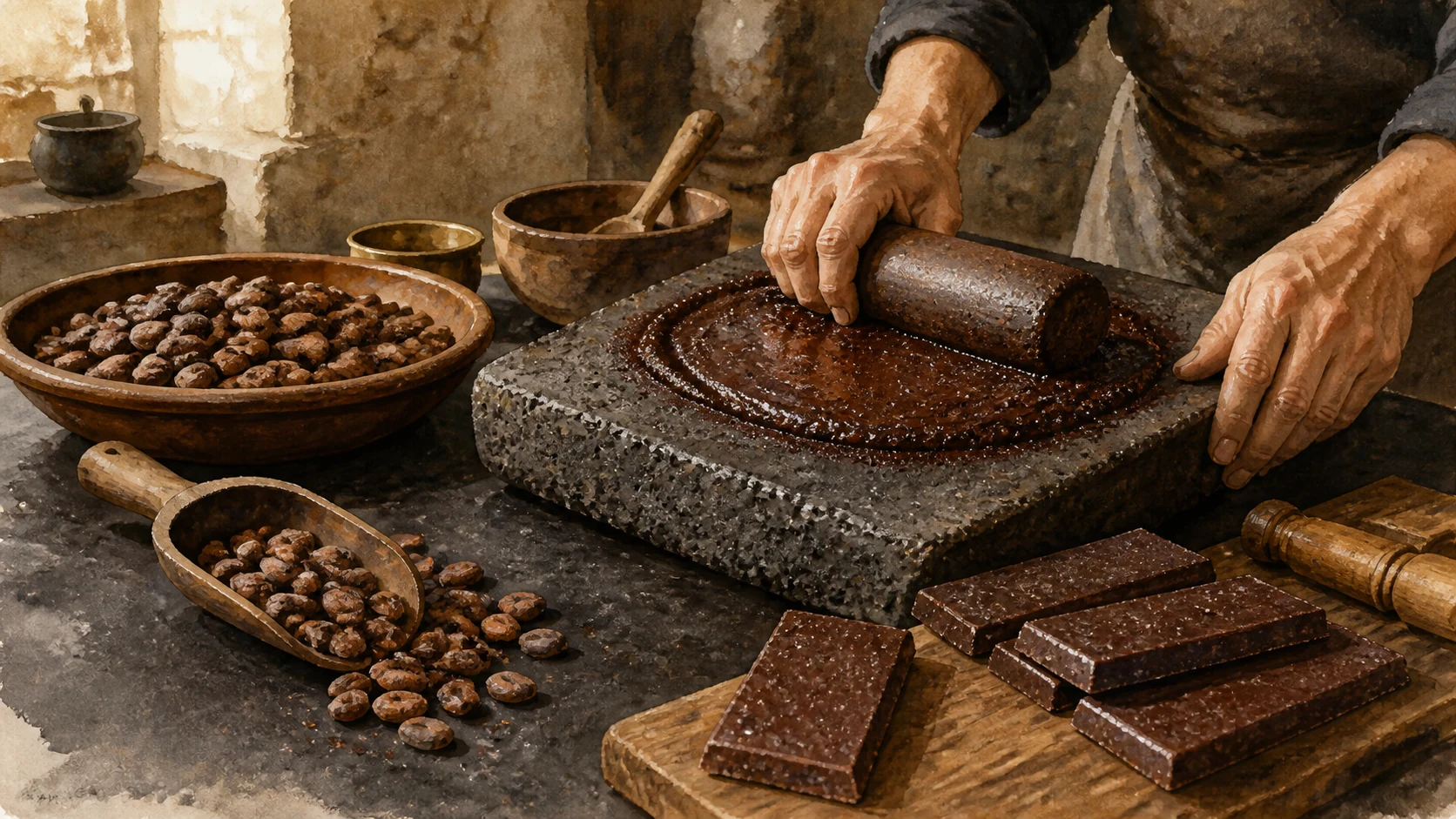
Documentary watercolour of a Modica chocolate workshop with cocoa beans, stone grinding surface, artisan hands and grainy unwrapped chocolate bars
CHOCOLATE AS A LIVING MATERIAL PRACTICECocoa, stone, hand tools and the bar's characteristic grain place Modica chocolate within a continuing workshop tradition instead of a shop-window cliché.
09

A protected food tradition is a process, not a decorative souvenir

Cioccolato di Modica PGI and the Living Workshops

The chocolate's granular texture comes from a defined production method now protected by European registration.

Documentary watercolour of a Modica chocolate workshop with cocoa beans, stone grinding surface, artisan hands and grainy unwrapped chocolate bars
CHOCOLATE AS A LIVING MATERIAL PRACTICE

The place today

Cioccolato di Modica is sold in many flavour combinations, but the protected identity rests on the base process and territory. Cocoa mass and sugar are worked without the prolonged high-temperature homogenisation typical of many smooth chocolates, so sugar crystals remain perceptible. Workshops, museums and shops make the tradition visible, yet a labelled product should be distinguished from any chocolate merely sold in Modica.

The historical chapter

Chocolate making became associated with Modica during the long Spanish period, while later family businesses and confectioners maintained and adapted the technique. In 2018, Commission Implementing Regulation (EU) 2018/1529 entered 'Cioccolato di Modica' in the register of protected geographical indications. The official specification defines the production area and method; protection concerns a documented contemporary product, not an unverifiable claim that today's recipe is unchanged from a single ancient source.

What to notice

  • The deliberately granular rather than fully smooth texture
  • The PGI name and required labelling on the finished product
  • How flavour additions remain secondary to cocoa mass, sugar and controlled processing
European Union · Regulation registering Cioccolato di Modica PGI
10

Thirteen kilometres of archaeology inside a living limestone valley

Cava d’Ispica

Rock-cut settlements, tombs, churches and water systems place Modica within a landscape occupied across millennia.

Documentary watercolour of a Modica chocolate workshop with cocoa beans, stone grinding surface, artisan hands and grainy unwrapped chocolate bars
CHOCOLATE AS A LIVING MATERIAL PRACTICE

The place today

Cava d’Ispica stretches for roughly thirteen kilometres between the territories of Modica and Ispica. Separate access areas lead to rock-cut dwellings, necropolises, catacombs, sanctuaries and traces of agricultural life rather than one compact monument. Among the best-known complexes are the Larderia catacombs, rock churches, the Spezieria, prehistoric tombs and the so-called Gymnasium. Vegetation, cliffs and paths are part of the visit, and conditions differ across sectors.

The historical chapter

The valley's caves and defensible walls supported use from prehistoric periods through Greek, Roman, late-antique, Byzantine and medieval phases, with later rural occupation. Names assigned to individual spaces do not always describe their original function with certainty, so the archaeological park presents them within broader evidence. Cava d’Ispica changes the scale of Modica's story: the city is one concentrated chapter in a territory where settlement repeatedly moved between open ground, rock shelters and fortified positions.

What to notice

  • Cut marks and altered entrances showing that caves changed function over time
  • Burial, worship, water management and habitation occupying different parts of the valley
  • The distance between sectors, which prevents treating the cava as a short urban stop
Regione Siciliana · Archaeological Park of Kamarina and Cava d’Ispica

The city through time

Ten thresholds
in Modica's long ascent

The city cannot be reduced to the earthquake. Its decisive moments include prehistoric settlement, a powerful medieval county, prolonged rebuilding, hydraulic transformation, modern poetry and the legal protection of a living craft.

  1. Communities occupy the Hyblaean valleys and rock-cut sites of the future Modica territory, including the long landscape of Cava d’Ispica.

  2. Norman, Swabian, Angevin and Aragonese phases reshape the fortified centre; the County of Modica develops into a major feudal jurisdiction.

  3. The Franciscan complex of Santa Maria del Gesù takes form, preserving a major pre-Baroque architectural layer in the upper city.

  4. The earthquake devastates Modica and the wider south-east, killing inhabitants and severely damaging churches, houses and institutions.

  5. Modica rebuilds substantially on its inherited site; San Giorgio and San Pietro continue as competing parish centres rather than being replaced by one new mother church.

  6. Work on San Giorgio, San Pietro, convents and palaces gives the city its mature late-Baroque and post-Baroque monumental profile.

  7. Road, bridge and hydraulic projects transform Modica Bassa as former watercourses are progressively contained and covered.

  8. Salvatore Quasimodo is born in Modica; his poetry later receives the 1959 Nobel Prize in Literature.

  9. UNESCO inscribes the Late Baroque Towns of the Val di Noto, including Modica, as a serial World Heritage property.

  10. EU registration of Cioccolato di Modica as a protected geographical indication is published, defining the name through an official product specification.

Before your visit

Practical information,
without turning it into promises

01

Plan by height, not kilometres

Alta and Bassa may look close on a map, but stairs, heat and return climbs change the visit. Build the day around one ascent or use local transport rather than repeatedly crossing levels.

02

Verify each interior

Churches, the castle area, house museums and civic collections have separate access conditions and may close for worship, restoration or staffing. Check the exact official venue shortly before arrival.

03

Treat the cava as another journey

Cava d’Ispica is outside the urban circuit and extends across multiple sectors. Confirm the archaeological park entrance, open route, footwear needs and transport rather than adding it as an improvised final stop.

04

Read labels, not legends

For chocolate, distinguish the PGI specification from broad historical marketing. For monuments, allow for debated dates and authorship; Modica's value lies partly in those long, layered construction histories.

Sources

This guide cross-checks the UNESCO serial-property record and ICOMOS evaluation against the Italian Ministry of Culture's architectural study, official regional archaeology, the south-east UNESCO consortium, the European PGI regulation and official museum information. Current opening hours are deliberately not frozen into the narrative. Where dates or attributions remain debated, the text states the uncertainty instead of choosing the most marketable version.

The hero image is an illustration, not a photograph. Opening hours, tickets, restoration works, worship and access conditions can change; always consult the linked official pages shortly before visiting. Cava d’Ispica has separate sectors and should not be approached as one continuously open urban monument.