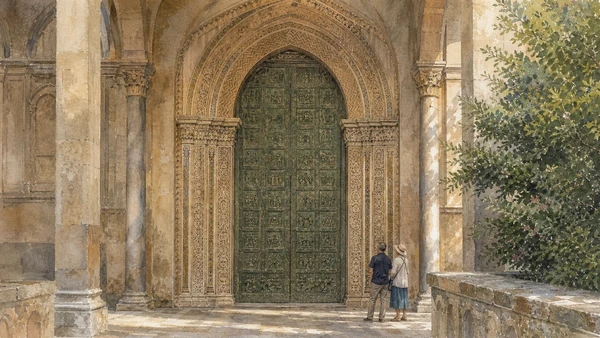
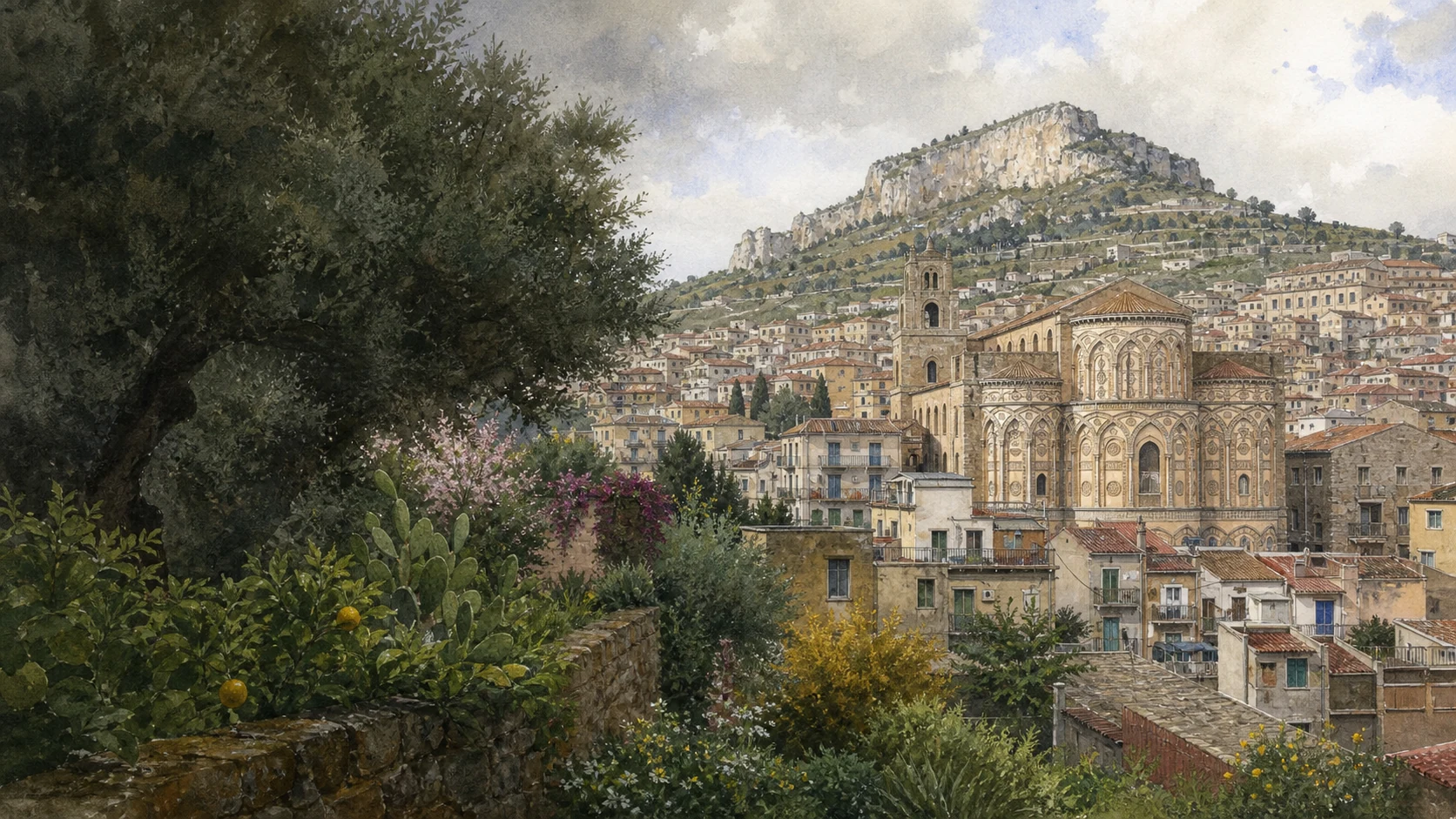
Documentary watercolour of Monreale Cathedral on its hill above the Conca d'Oro, with the decorated apses, ordinary town roofs, citrus gardens and Monte Caputo

ILLUSTRATED GUIDE · SICILY

A golden church,
a royal foundation
and a city beyond it

Twenty-two substantial chapters follow Monreale from cultivated hill and royal foundation through bronze doors, mosaics, cloister, living town, Monte Caputo and the wider territory.

Explore the places
MONREALE · CATHEDRAL, CLOISTER, CITY, MOUNTAINS AND LIVING TERRITORY

A CITY OF MORE THAN ONE MONUMENT

Monreale is often compressed into a hurried excursion from Palermo: coach, gold mosaics, cloister, departure.

This guide restores the missing scale. The cathedral was a royal and ecclesiastical project planted in a cultivated mountain landscape; a town, an archdiocese and a vast territory developed around it.

The monument remains a living church and the cloister a distinct managed site. Their separate entrances, institutions and opening conditions should not hide the unity of the twelfth-century project.

Monreale is also a community whose streets, institutions, festivals, uplands and fractions deserve time of their own. The guide therefore leaves the gold and follows the territory behind it.

One destination

Twenty-two chapters from cultivated hill to golden cathedral

The route begins outside the cathedral because the hill, the apses and the relation with Palermo explain the foundation before a visitor enters the glittering nave.

Inside, the mosaics are followed as an ordered theological and political programme rather than a single decorative surface. Biblical narrative, royal imagery, liturgy and the organisation of the sanctuary are read together.

The cloister is treated as architecture, workshop culture and monastic space rather than a picturesque garden detached from the Benedictine institution.

The final chapters move into the episcopal town and the enormous municipal territory, where Monte Caputo, the Castellaccio, San Martino delle Scale, agricultural settlements and woodland prevent Monreale from being reduced to one extraordinary interior.

The selection

Twenty-two chapters,
more than a field of gold

The route consolidates related scenes and structures while keeping institution, architecture, mosaics, cloister, living town, craft and mountain territory visible in their own right.

  1. 01The Hill above the Conca d'Oro before the Gold
  2. 02William II's Dream and the Foundation of 1174
  3. 03Benedictines, Archbishopric and the Royal Ensemble
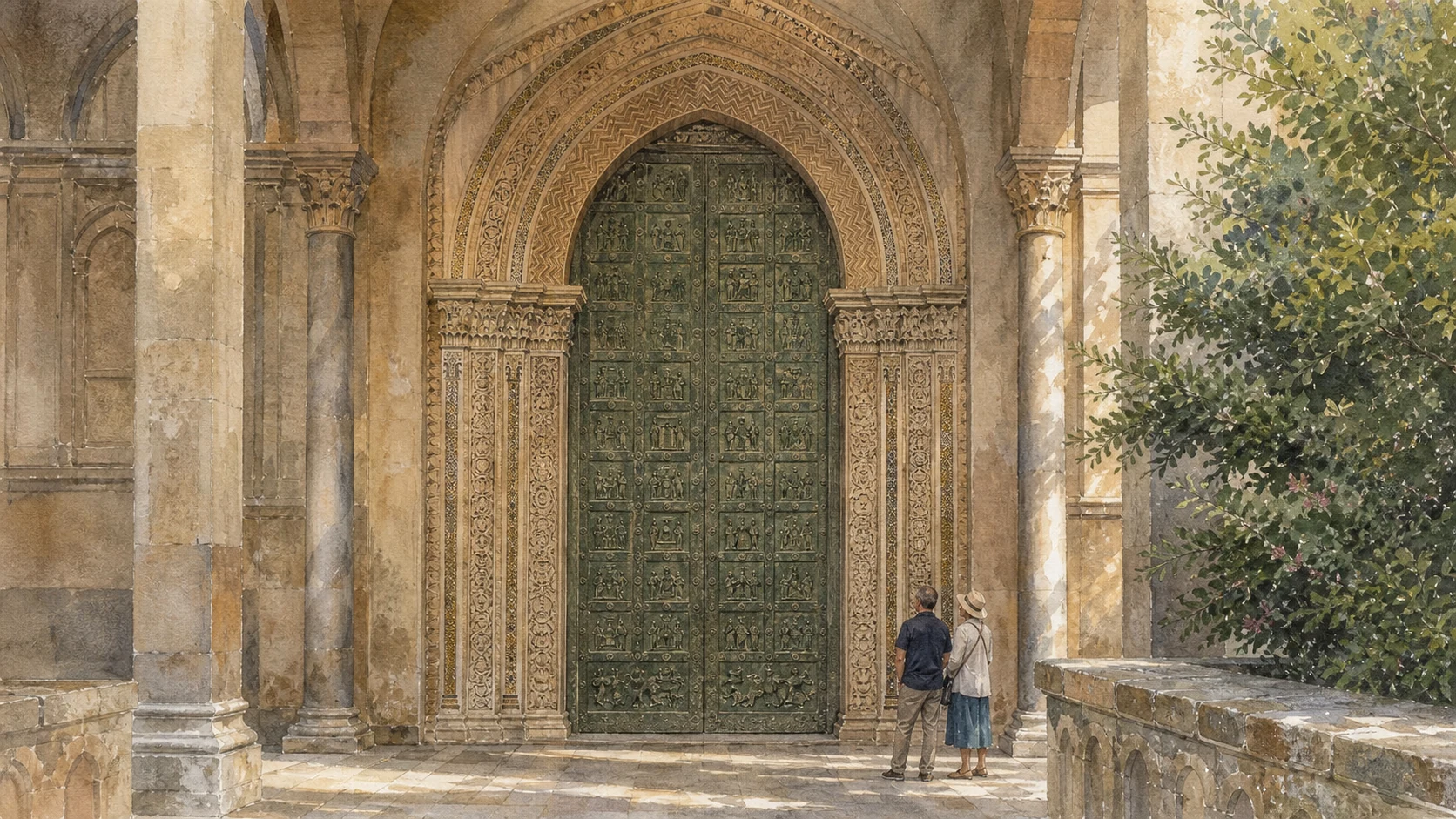
  4. 04The West Front and Bonanno of Pisa's Bronze Door
  5. 05Barisano's North Door and the Decorated Apses
  6. 06Basilica, Ancient Columns and the Rebuilt Wooden Roof
  7. 07The Mosaic Programme and Christ Pantocrator
  8. 08Virgin, Angels and the Genesis Cycle
  9. 09The Life of Christ and the Parallel Cycles of Peter and Paul
  10. 10William Offers the Cathedral, Christ Crowns the King and Two Thrones Face the Altar
  11. 11Royal Tombs and the Chapel of San Castrense
  12. 12The Roano Crucifix Chapel and San Benedetto
  13. 13The Benedictine Cloister: Repetition without Sameness
  14. 14Fountain Corner and Benedictine Dormitory
  15. 15Diocesan Museum, Torres Library and Archives
  16. 16Piazzas, Belvedere, Quarters, Walls and Gates
  17. 17The Collegiata, Town Churches and the Feast of the Holy Crucifix
  18. 18Mosaic Workshops, Bread, Biscuits and Wine
  19. 19Monte Caputo and the Castellaccio
  20. 20San Martino delle Scale
  21. 21Pioppo, Grisi, Villaciambra, Aquino and the Wider Territory
  22. 22World Heritage and a Living Cathedral
01

FARMS, WATER AND A ROYAL LANDSCAPE PRECEDED WILLIAM II'S MONUMENTAL FOUNDATION

The Hill above the Conca d'Oro before the Gold

Monreale begins with cultivated slopes and Monte Caputo, where power already organised land before cathedral and abbey transformed the hill.

Documentary watercolour of Bonanno of Pisa's tall green-brown bronze door at Monreale with many small relief panels beneath the warm stone pointed portal
THE ROYAL THRESHOLD

The place today

The urban centre rises above Palermo but remains tied to it by roads, views, employment and metropolitan expansion. Belvedere terraces reveal the Conca d'Oro as a densely built basin with surviving citrus, garden and mountain fragments rather than an untouched orchard. Monte Caputo stands immediately behind the town, while the wider municipality extends far beyond what is visible from the cathedral square. Fragments associated with the former royal and episcopal complex survive within later institutions near the cathedral.

The historical chapter

Water, cultivable slopes, defensible high ground and proximity to the royal capital made the area strategically useful before William II's complex. Medieval Monreale controlled sightlines and movement between Palermo's plain and inland western Sicily. The elevated site also made the new cathedral and archbishopric visibly distinct from, yet deliberately related to, Palermo and its powerful archbishop. The diocesan history of the Torres Library recalls a royal site known in a twelfth-century chronicle before William II's foundation.

What to notice

  • Do not describe Monreale as a detached mountain village; it is part of a metropolitan landscape and a very large municipality.
  • The royal landscape is a documented context, not proof of every detail in the foundation legend.
Municipality of Monreale · city history and territorial setting
02

LEGEND GIVES THE KING A SACRED CALLING WHILE DOCUMENTS REVEAL A DELIBERATE POLITICAL PROJECT

William II's Dream and the Foundation of 1174

The remembered dream and the founding of Santa Maria Nuova must be read together without turning royal strategy into a miracle alone.

Documentary watercolour of Bonanno of Pisa's tall green-brown bronze door at Monreale with many small relief panels beneath the warm stone pointed portal
THE ROYAL THRESHOLD

The place today

The dream appears in local interpretation, religious storytelling and modern imagery. It is meaningful evidence of how the community understood royal devotion, but visitors should encounter it alongside the cathedral's papal privileges, Benedictine organisation and territorial endowment. Monreale becomes more compelling when legend and institutional history are allowed to coexist without being confused. The cathedral, cloister and fragments of palace and monastic fabric still reveal a planned ensemble rather than unrelated monuments.

The historical chapter

According to tradition, Mary appeared to William II while he rested after hunting and directed him to treasure for a church. The archdiocesan account explicitly separates this narrative from the conflict of authority involving the king, papacy and Walter of the Mill, archbishop of Palermo. The complex asserted royal patronage and helped create a new ecclesiastical counterweight close to the capital. Papal documents and the monument's building history place the beginning of the campaign around 1174.

What to notice

  • Label the dream as tradition or legend; do not give it an archaeological date or location.
  • The present complex includes later rebuilding, additions and restorations; not every visible surface belongs to William II's first campaign.
Archdiocese of Monreale · official history of the cathedral
03

MONASTERY, CHURCH AND PALACE JOINED LITURGY, GOVERNMENT AND LANDED POWER

Benedictines, Archbishopric and the Royal Ensemble

The monks from Cava, elevation to archbishopric and connected plan explain Monreale as an institution as well as an architectural masterpiece.

Documentary watercolour of Bonanno of Pisa's tall green-brown bronze door at Monreale with many small relief panels beneath the warm stone pointed portal
THE ROYAL THRESHOLD

The place today

The cloister and surviving monastic ranges are visited principally as art and architecture, yet their proportions came from regulated communal life: prayer, reading, procession, work, hospitality and administration. The archdiocese remains a living ecclesiastical institution, while the municipality still has an unusually extensive and dispersed territory. Later boundaries, ticketing systems, institutional ownership and street changes make the ensemble feel fragmented.

The historical chapter

William II entrusted Santa Maria Nuova to Benedictines led by Abbot Theobald. Pope Lucius III elevated Monreale to an archbishopric in 1183. The royal and archiepiscopal thrones near the sanctuary, routes linking church to residence and convent, and the great cloister beside the basilica embodied negotiated power.

What to notice

  • Do not call every surviving room of the complex medieval; long phases of rebuilding followed the Norman foundation.
  • Do not infer that present doorways and circulation reproduce the twelfth-century route exactly.
Sicilian Region · Monastery and cloister of Monreale
Documentary watercolour of Bonanno of Pisa's tall green-brown bronze door at Monreale with many small relief panels beneath the warm stone pointed portal
THE ROYAL THRESHOLDBonanno's ordered field of bronze reliefs remains a door at architectural scale, not a wall of enlarged scenes.
04

UNEQUAL TOWERS AND FORTY-TWO BRONZE PANELS MARKED THE ROYAL ENTRANCE

The West Front and Bonanno of Pisa's Bronze Door

Facade, later portico and narrative door form a layered threshold whose materials and chronology should not be flattened into one Norman moment.

Documentary watercolour of Bonanno of Pisa's tall green-brown bronze door at Monreale with many small relief panels beneath the warm stone pointed portal
THE ROYAL THRESHOLD

The place today

Piazza Guglielmo II gives the frontal view most visitors remember. One tower is lower after damage associated with an 1807 lightning strike; the three-arched portico dates from the eighteenth century and replaced an earlier structure. The composition is therefore asymmetrical and historically layered, not an unfinished modern restoration. The door is protected by the western portico and is not always read easily from a crowded square.

The historical chapter

The Norman facade used paired towers and interlaced pointed-arch ornament to establish a fortified and ceremonial face. After the former portico collapsed, a new one was erected in 1770. Repeated repairs, clocks and surface changes turned the facade into a record of use rather than a frozen twelfth-century elevation. Bonanno da Pisa, already associated with major bronze work, dated the Monreale portal 1186.

What to notice

  • Do not digitally complete the lower tower or remove the later portico in a documentary image.
  • Photography and proximity may be restricted by worship or conservation arrangements.
Archdiocese of Monreale · exterior history
05

A SECOND BRONZE ENTRANCE AND INTERLACED LAVA-STONE PATTERNS TURN THE EXTERIOR INTO A CIRCUIT

Barisano's North Door and the Decorated Apses

North portico and eastern volumes reveal changing frames and Mediterranean masonry without placing every famous feature in one viewpoint.

Documentary watercolour of Bonanno of Pisa's tall green-brown bronze door at Monreale with many small relief panels beneath the warm stone pointed portal
THE ROYAL THRESHOLD

The place today

The northern side is quieter than the main facade and rewards slow comparison. The portico was created between the mid-sixteenth century and 1562, while the bronze door is usually dated around 1190. Its panels mix scenes from Christ's life, saints, conflict, animals and vegetal forms rather than copying Bonanno's programme. The east end is best seen from roads and terraces below or beside the complex, where the polygonal volumes and dense ornament remain legible.

The historical chapter

The pairing of medieval bronze and Renaissance stone demonstrates how later patrons protected and reframed Norman-period prestige. Barisano's relief language differs from Bonanno's, revealing that the cathedral employed more than one artistic network. The two portals should be read together without treating one as a reduced duplicate. Intersecting pointed arches and horizontal bands transformed structural masses into a woven architectural skin.

What to notice

  • Use the north side's own chronology; the Gagini portico and Barisano door are not one campaign.
  • Roadside viewpoints require care; do not step into traffic for an unobstructed photograph.
Archdiocese of Monreale · northern portico and Barisano door
06

A LONG NAVE LEADS TOWARD GOLD THROUGH REUSED STONE AND A CEILING SHAPED BY FIRE AND REPAIR

Basilica, Ancient Columns and the Rebuilt Wooden Roof

Interior space, spolia and roof history expose construction, supply and restoration before the mosaics take over the visual field.

Documentary watercolour of Bonanno of Pisa's tall green-brown bronze door at Monreale with many small relief panels beneath the warm stone pointed portal
THE ROYAL THRESHOLD

The place today

Entering from the west, the eye is drawn through repeated columns to the immense Pantocrator. The rows appear uniform from a distance, but close observation reveals variations in stone, shaft and capital. The polychrome wooden covering contributes warmth and rhythm above the gold mosaics.

The historical chapter

The plan joins western basilical organisation to a strongly articulated sanctuary and transept. Spolia connected Norman patronage to the material authority of antiquity and solved the practical problem of obtaining monumental monolithic supports. The 1811 fire was the most destructive recorded event in the cathedral's later history.

What to notice

  • This remains a cathedral, not a museum hall; silence, dress and liturgical priority matter.
  • Current conservation campaigns may close portions of the interior; verify shortly before visiting.
Archdiocese of Monreale · cathedral dimensions and plan
Documentary watercolour of Monreale's monumental Christ Pantocrator on gold tesserae with blessing hand, open unlettered book and the smaller Virgin-and-angels register below
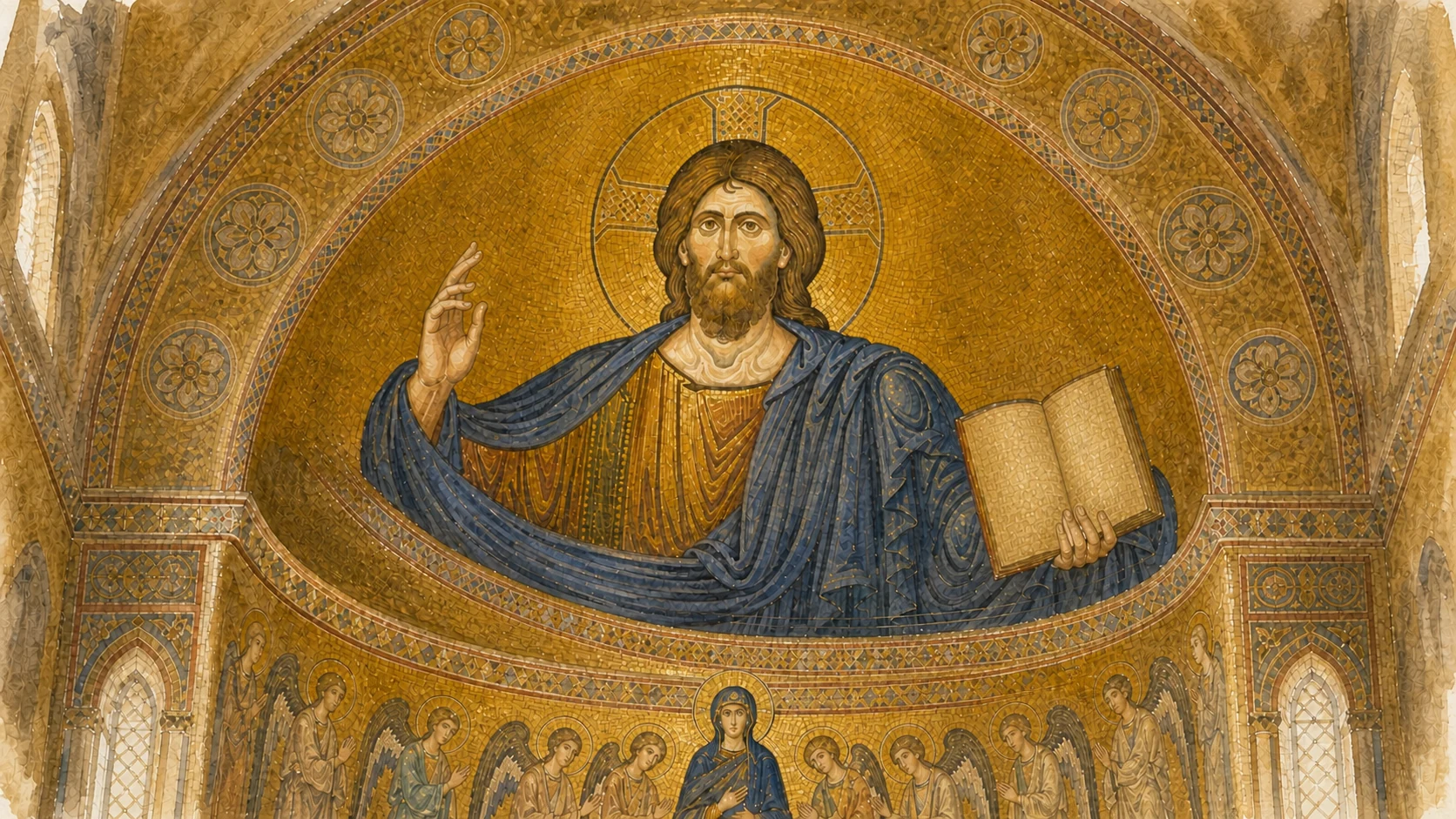
THE GOLDEN EASTPantocrator dominates the main apse; the illustration preserves gesture and hierarchy while suppressing any invented lettering.
07

MORE THAN SIX THOUSAND SQUARE METRES OF TESSERAE ARE ORDERED AROUND ONE DOMINANT APSE IMAGE

The Mosaic Programme and Christ Pantocrator

Pantocrator, workshops and programme belong together, preserving both the unity of the iconographic project and the evidence of many hands.

Documentary watercolour of Monreale's monumental Christ Pantocrator on gold tesserae with blessing hand, open unlettered book and the smaller Virgin-and-angels register below
THE GOLDEN EAST

The place today

From the floor, the mosaics appear continuous, but changes of scale, placement, inscription and viewing angle organise the programme. Binoculars or magnified official imagery reveal tesserae and gestures while the nave preserves the architectural whole. Conservation differences can alter colour and brilliance from one zone to another. The figure changes with distance: from the entrance it commands the whole nave; from the crossing, the face, hand and book become legible; from too close, the curve of the apse distorts easy photography.

The historical chapter

The archdiocese places much of the campaign between roughly 1180 and 1190 and gives an area of about 6,340 square metres. Byzantine-trained mosaicists worked within a Norman royal commission and alongside other workshops. Unity of theological design does not require a single artist, and stylistic variation should not be turned into unsupported lists of nationalities. Pantocrator imagery comes from eastern Christian monumental tradition, here adapted to the cathedral's scale and royal setting.

What to notice

  • Use approximately 6,300 or the institution's 6,340 square metres; measurements vary slightly among sources.
  • Tripods, flashes and prolonged central positioning may be restricted; follow current church rules.
Archdiocese of Monreale · mosaic programme
08

THE SANCTUARY HIERARCHY OPENS INTO A NARRATIVE OF CREATION, FALL AND HUMAN DIVISION

Virgin, Angels and the Genesis Cycle

Apse and nave communicate through scale and sequence rather than as separate collections of golden scenes.

Documentary watercolour of Monreale's monumental Christ Pantocrator on gold tesserae with blessing hand, open unlettered book and the smaller Virgin-and-angels register below
THE GOLDEN EAST

The place today

The dedication to Santa Maria Nuova becomes visible in the Marian centre of the apse. Named figures extend across curved surfaces and adjacent zones, so a quick photograph rarely communicates their arrangement. Official diagrams or patient reading help distinguish apostles, church fathers, martyrs and local devotions. The scenes are high and may be difficult to read during busy visiting hours.

The historical chapter

The hierarchy linked Monreale's Marian dedication to apostolic succession and universal church. Figures such as Thomas Becket show how contemporary Latin political and devotional concerns entered a Byzantine-derived visual language. The selection is therefore theological, institutional and historical rather than a generic crowd of saints. Genesis established the condition of humanity before the New Testament story presented nearer the sanctuary.

What to notice

  • Do not identify figures only by clothing; use inscriptions and official interpretation.
  • High scenes need optical help, but devices should not block aisles or services.
Archdiocese of Monreale · figures of the main apse
09

MIRACLES AND APOSTOLIC AUTHORITY MOVE THROUGH NAVE AND MINOR APSES

The Life of Christ and the Parallel Cycles of Peter and Paul

Narrative location, sightlines and liturgical direction matter as much as identifying individual scenes.

Documentary watercolour of Monreale's monumental Christ Pantocrator on gold tesserae with blessing hand, open unlettered book and the smaller Virgin-and-angels register below
THE GOLDEN EAST

The place today

The programme cannot be understood from the apse alone. Moving slowly through the aisles reveals healing, encounter and movement at a more intimate scale than the monumental Pantocrator. Some scenes are partially obscured by furnishings, chapels or visitor circulation. The side apses can be overlooked because the central image is so dominant.

The historical chapter

The distribution of episodes coordinated biblical time with liturgical space. Christ's life approached the altar and sanctuary, while miracles accompanied movement along the aisles. Eastern iconographic traditions were adapted to a Latin cathedral and Norman court, producing continuity without simple copying from one model. Peter and Paul provided complementary models of church leadership, mission and martyrdom.

What to notice

  • A single published diagram may simplify restorations and later architectural changes; compare it with the actual building.
  • Use inscriptions and official plans before assigning a scene seen at a steep angle.
Archdiocese of Monreale · catechetical order of the mosaics
10

MOSAIC AND FURNITURE PLACE ROYAL AND ARCHIEPISCOPAL POWER WITHIN SACRED SPACE

William Offers the Cathedral, Christ Crowns the King and Two Thrones Face the Altar

The two royal images and neighbouring thrones articulate authority without proving a simple programme of conflict or harmony.

Documentary watercolour of Monreale's monumental Christ Pantocrator on gold tesserae with blessing hand, open unlettered book and the smaller Virgin-and-angels register below
THE GOLDEN EAST

The place today

This mosaic is one of Monreale's most reproduced images and often stands in for the entire foundation story. The scene is frequently paired with the donation mosaic, and the comparison matters: in one, the king receives authority; in the other, he gives the church. Later interventions and liturgical reordering complicate a simple medieval reconstruction, but the paired authority remains central to interpretation.

The historical chapter

Donor imagery placed William within a long Christian language of pious foundation while making his authorship unmistakable. Norman rulers in Sicily drew on Byzantine, western and local political languages. The cathedral joined a king who founded and endowed, an archbishop who governed, and monks who served the liturgy.

What to notice

  • Do not reconstruct missing medieval architecture directly from the model held by William.
  • Modern sanctuary arrangements may not preserve every medieval position exactly.
UNESCO · royal images and monument attributes
11

DYNASTIC MEMORY AND LOCAL PATRONAGE SURVIVED FIRE, REORDERING AND CHANGING DEVOTION

Royal Tombs and the Chapel of San Castrense

Tombs and patronal chapel extend the cathedral beyond William II's mosaic age while demanding attention to later reconstruction.

Documentary watercolour of Monreale's monumental Christ Pantocrator on gold tesserae with blessing hand, open unlettered book and the smaller Virgin-and-angels register below
THE GOLDEN EAST

The place today

The cathedral preserves the tombs or remains associated with William I, William II, Margaret of Navarre and royal children, as well as the remembered relic history of Louis IX of France. Labels and modern arrangements should guide identification because the 1811 fire damaged several monuments. The silver reliquary and chapel belong to active devotion, not only an art-historical itinerary.

The historical chapter

Dynastic burial tied memory of the founding family to daily prayer and the cathedral's sacred prestige. Louis IX died near Tunis in 1270; medieval treatment of his remains produced a complex trans-Mediterranean relic and burial history, not a simple full tomb of the French king at Monreale. Nineteenth-century repairs reshaped presentation after the fire. The chapel dates from the end of the sixteenth century, during an important period of diocesan reform and cultural investment.

What to notice

  • Do not say Louis IX's complete body remains at Monreale; the history concerns temporary burial and retained viscera.
  • Relics and liturgical furnishings require respectful language and may not always be on display.
Archdiocese of Monreale · royal burials and the 1811 fire
12

BAROQUE THEATRE AND EIGHTEENTH-CENTURY PATRONAGE ENTER A MEDIEVAL GOLDEN INTERIOR

The Roano Crucifix Chapel and San Benedetto

Two later interventions show continuity and competition in sacred display rather than a decline from a pure Norman monument.

Documentary watercolour of Monreale's monumental Christ Pantocrator on gold tesserae with blessing hand, open unlettered book and the smaller Virgin-and-angels register below
THE GOLDEN EAST

The place today

The chapel's polychrome surfaces, sculpture and devotional focus reward independent attention after the overwhelming nave. It is often treated as a footnote because visitors hurry toward the cloister. The museum and cathedral itinerary may connect it with later episcopal patronage and Grand Tour accounts. The altar belongs visually to the sanctuary while differing in material and date from the surrounding mosaics.

The historical chapter

Designed in the late seventeenth century, the chapel responded to contemporary Catholic devotion and the representational ambitions of its patron. Its richness does not imitate the Norman mosaics; it creates a different language of sacred material and staged encounter. Monreale's history continued through such deliberate additions. Archbishop Francesco Testa sponsored restorations and major furnishings during a period remembered locally as a golden age.

What to notice

  • Do not call the chapel Norman or Byzantine because it stands inside a Norman cathedral.
  • Separate the chronology of the San Benedetto chapel, Testa's patronage and Valadier's altar.
Archdiocese of Monreale · Chapel of the Crucifix
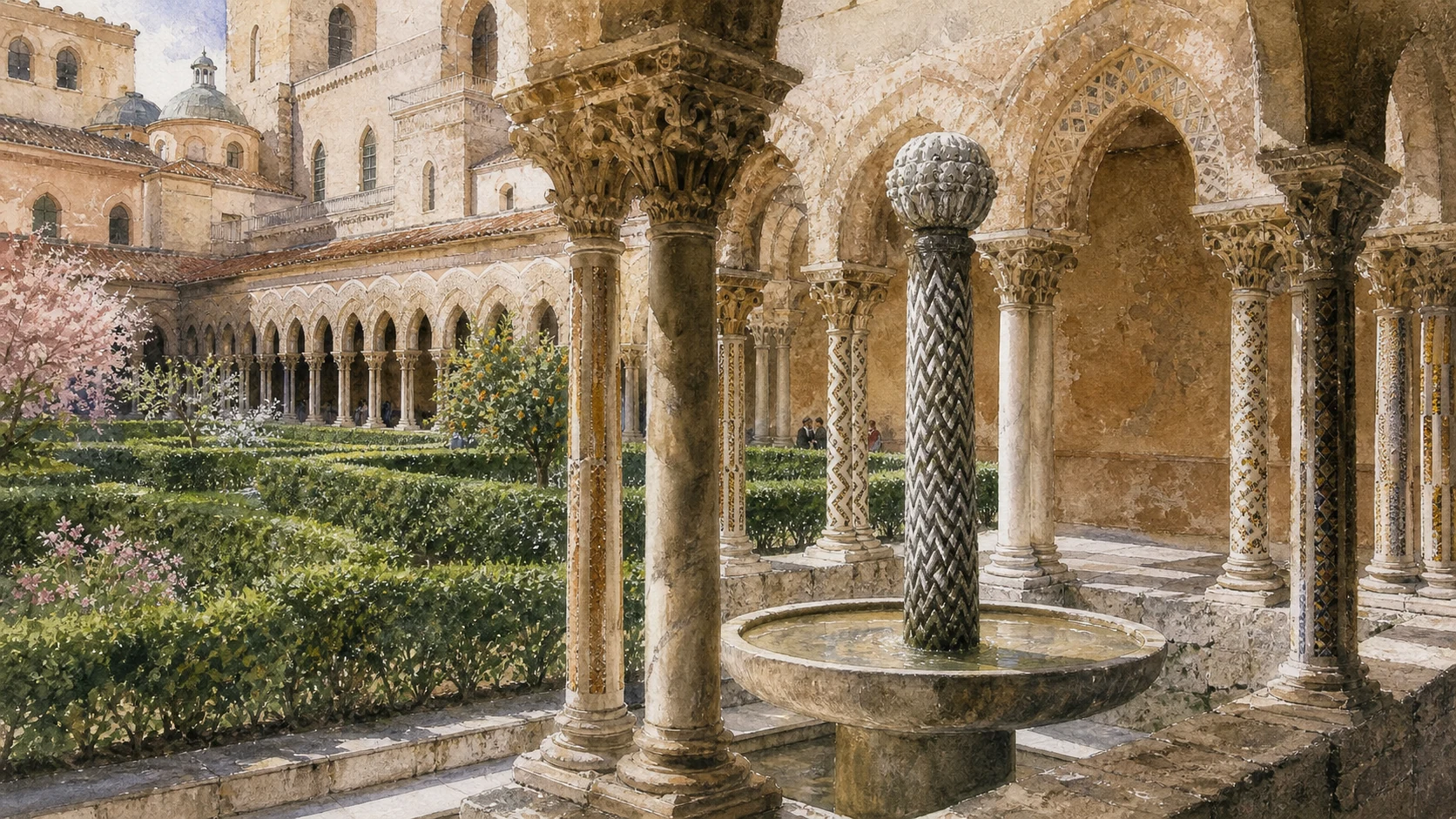
Documentary watercolour of Monreale's cloister fountain corner with paired mosaic-inlaid columns, carved capitals, circular basin and green monastic garden
THE BENEDICTINE CLOISTERPaired columns, carved capitals, garden and modest water architecture create repetition without sameness.
13

PAIRED COLUMNS AND CARVED CAPITALS TURN SCRIPTURE, LABOUR AND MONSTERS INTO A WALKING ARCHIVE

The Benedictine Cloister: Repetition without Sameness

Plan, rhythm and sculpture make the cloister a monastic environment rather than a decorative annex to the cathedral.

Documentary watercolour of Monreale's cloister fountain corner with paired mosaic-inlaid columns, carved capitals, circular basin and green monastic garden
THE BENEDICTINE CLOISTER

The place today

The cloister has a separate cultural-site visit from the cathedral and should receive its own hour rather than a ten-minute circuit. Column shafts alternate plain stone, mosaic inlay and carved detail; capitals vary continuously. The garden and arcades change with light, weather and maintenance, while visitor flow can concentrate near the fountain corner. Each capital must be read from several sides, and many scenes sit above eye level.

The historical chapter

Created for the Benedictine community, the cloister joined circulation, reading, ritual and access to monastic spaces. Its scale and ornament draw on Romanesque sculpture, Mediterranean garden traditions and Islamic-derived surface geometry without becoming a direct copy of one model. Repetition provided architectural order; variation displayed workshop invention. Sculptors adapted international Romanesque forms to the specific programme and mixed materials of Monreale.

What to notice

  • Cathedral admission does not automatically guarantee the same access regime for the cloister.
  • Use a plan to avoid crowding one celebrated capital while ignoring the surrounding sequence.
Sicilian Region · Monastery and cloister guide
14

WATER, CARVED LEAVES AND REUSED MONASTIC FABRIC REVEAL DAILY LIFE BEYOND THE ARCADES

Fountain Corner and Benedictine Dormitory

The fountain and former dormitory connect the garden's symbolic centre to the practical spaces now adapted for exhibitions.

Documentary watercolour of Monreale's cloister fountain corner with paired mosaic-inlaid columns, carved capitals, circular basin and green monastic garden
THE BENEDICTINE CLOISTER

The place today

The fountain is among the most photographed parts of the complex and may become congested. Its value lies in the relationship among water, shade, vegetation, enclosure and the surrounding arcades, not in treating it as an isolated exotic object. Flow and planting can vary with maintenance. Exhibition schedules are temporary, and access to the dormitory should never be promised from an old announcement.

The historical chapter

Water supported monastic life practically and symbolically. The fountain's clustered basin and carved vegetal form transform hydraulic provision into architectural focus. Comparisons with Islamic courtyard traditions are illuminating at the level of garden, water and surface, but the cloister's Benedictine function remains specific. The dormitory formed part of the monks' daily architecture rather than the cathedral's public ceremonial core.

What to notice

  • Do not move the fountain into the cathedral square in illustrations or describe it as a surviving palace fountain.
  • Objects in a temporary show may come from other institutions and are not permanent furnishings of the monastery.
Sicilian Region · cloister architecture and fountain
15

OBJECTS, BOOKS AND DOCUMENTS TRACE PATRONAGE AND GOVERNMENT AFTER THE NORMAN FOUNDATION

Diocesan Museum, Torres Library and Archives

The cathedral complex remains an intellectual and administrative archive whose collections require separate access and context.

Documentary watercolour of Monreale's cloister fountain corner with paired mosaic-inlaid columns, carved capitals, circular basin and green monastic garden
THE BENEDICTINE CLOISTER

The place today

Museum access and exhibition rooms can differ from the cathedral route. Collections include liturgical metalwork, vestments, paintings, sculpture and materials connected with later archbishops and the monument. A dedicated visit corrects the impression that artistic production stopped once the mosaics were completed. The modern library has public service hours, while the Fondo Antico requires qualifications, presentation and advance arrangement.

The historical chapter

Archbishops such as Ludovico II de Torres, Giovanni Roano and Francesco Testa commissioned buildings, furnishings and collections in response to reform, devotion and representation. The museum gathers works displaced from churches or treasuries and interprets those networks. Provenance matters: a museum object may illuminate the cathedral without having stood in its current gallery originally. Ludovico II de Torres founded the seminary in 1590 and its library in 1591, donating books and a portrait collection.

What to notice

  • Verify opening directly with the museum; diocesan institutions may use appointment or seasonal schedules.
  • Library, diocesan archive and municipal archive are distinct institutions with separate contacts.
Archdiocese of Monreale · Diocesan Museum
16

A LIVING HILL TOWN GREW AROUND THE ABBEY THROUGH STREETS, VIEWS AND PARTLY LOST DEFENCES

Piazzas, Belvedere, Quarters, Walls and Gates

Civic space and neighbourhood fabric prevent Monreale from becoming only an exterior platform for the cathedral.

Documentary watercolour of Monreale's cloister fountain corner with paired mosaic-inlaid columns, carved capitals, circular basin and green monastic garden
THE BENEDICTINE CLOISTER

The place today

Piazza Vittorio Emanuele II and Piazza Guglielmo II carry traffic, ceremonies, cafés, residents and visitor groups. The public Belvedere opens a broad view over the Conca d'Oro and Palermo. Municipal offices and access routes can change during restoration or events, so the square should be treated as active urban infrastructure. Stepped lanes and dense housing descend from the cathedral zone, while modern roads and metropolitan expansion have altered older boundaries.

The historical chapter

The town expanded around the royal-ecclesiastical precinct and acquired civic institutions, fountains and public spaces through later centuries. Reused and adapted buildings demonstrate the transfer from seigneurial and episcopal governance toward modern municipal life. The view itself became part of Monreale's Grand Tour identity. The settlement developed around the twelfth-century abbey and was enclosed by walls and towers by the later medieval period.

What to notice

  • Do not photograph residents and ceremonies as anonymous tourist colour without consent and context.
  • Use ordinary residential streets respectfully; not every doorway is a visitor attraction.
Municipality of Monreale · civic monuments and Belvedere
17

DEVOTION LEAVES THE CATHEDRAL AND CLAIMS THE STREETS THROUGH A LIVING CALENDAR

The Collegiata, Town Churches and the Feast of the Holy Crucifix

Churches and procession reveal local institutions and current practice whose route and access must be verified each year.

Documentary watercolour of Monreale's cloister fountain corner with paired mosaic-inlaid columns, carved capitals, circular basin and green monastic garden
THE BENEDICTINE CLOISTER

The place today

Many churches open primarily for worship, festivals or arranged visits. Their façades may be easily seen while interiors remain closed. The Collegiata, Carmine, Agonizzanti, San Francesco and other foundations should be approached through current parish or municipal information rather than assumed museum hours. Festival dates, routes, crowd controls and liturgical schedules require current checking.

The historical chapter

From the sixteenth through eighteenth centuries, archbishops, orders, confraternities and local patrons added churches and institutions around the older core. These buildings record social groups and devotional practices less visible in royal mosaics. The urban sacred landscape made Monreale a functioning town rather than a monastery with houses attached. The cult developed through confraternal and urban history after the Norman foundation, demonstrating how Monreale's religious identity continued to grow.

What to notice

  • Do not enter during services solely for photography or insist on access to normally closed interiors.
  • Respect barriers, bearers, worship and local precedence during the procession.
Municipality of Monreale · churches and cultural places
18

HERITAGE CONTINUES THROUGH MAKERS, OVENS, VINEYARDS AND EVERYDAY EXCHANGE

Mosaic Workshops, Bread, Biscuits and Wine

Craft and food connect monumental skill to present livelihoods without turning contemporary Monreale into souvenir theatre.

Documentary watercolour of Monreale's cloister fountain corner with paired mosaic-inlaid columns, carved capitals, circular basin and green monastic garden
THE BENEDICTINE CLOISTER

The place today

Workshops range from serious craft and conservation practice to souvenir production; quality and provenance should be evaluated rather than assumed. Food names identify living local traditions, not museum exhibits. The large territory supports different agricultural zones, especially around inland fractions, so 'Monreale product' does not mean everything is made beside the cathedral.

The historical chapter

Mosaic skills were renewed, taught and commercialised over centuries after the medieval workshops disappeared. Bread, vines, orchard fruits and vegetables emerged from the productive landscapes that supported town and estates. Modern denominations and tourism promotion reorganise those traditions again, connecting local identity to markets beyond the municipality.

What to notice

  • Ask where and how a mosaic object was made; do not equate gold colour with traditional technique.
  • Verify producer, denomination and ingredients instead of treating every locally sold item as protected Monreale heritage.
Municipality of Monreale · products, craft and food traditions
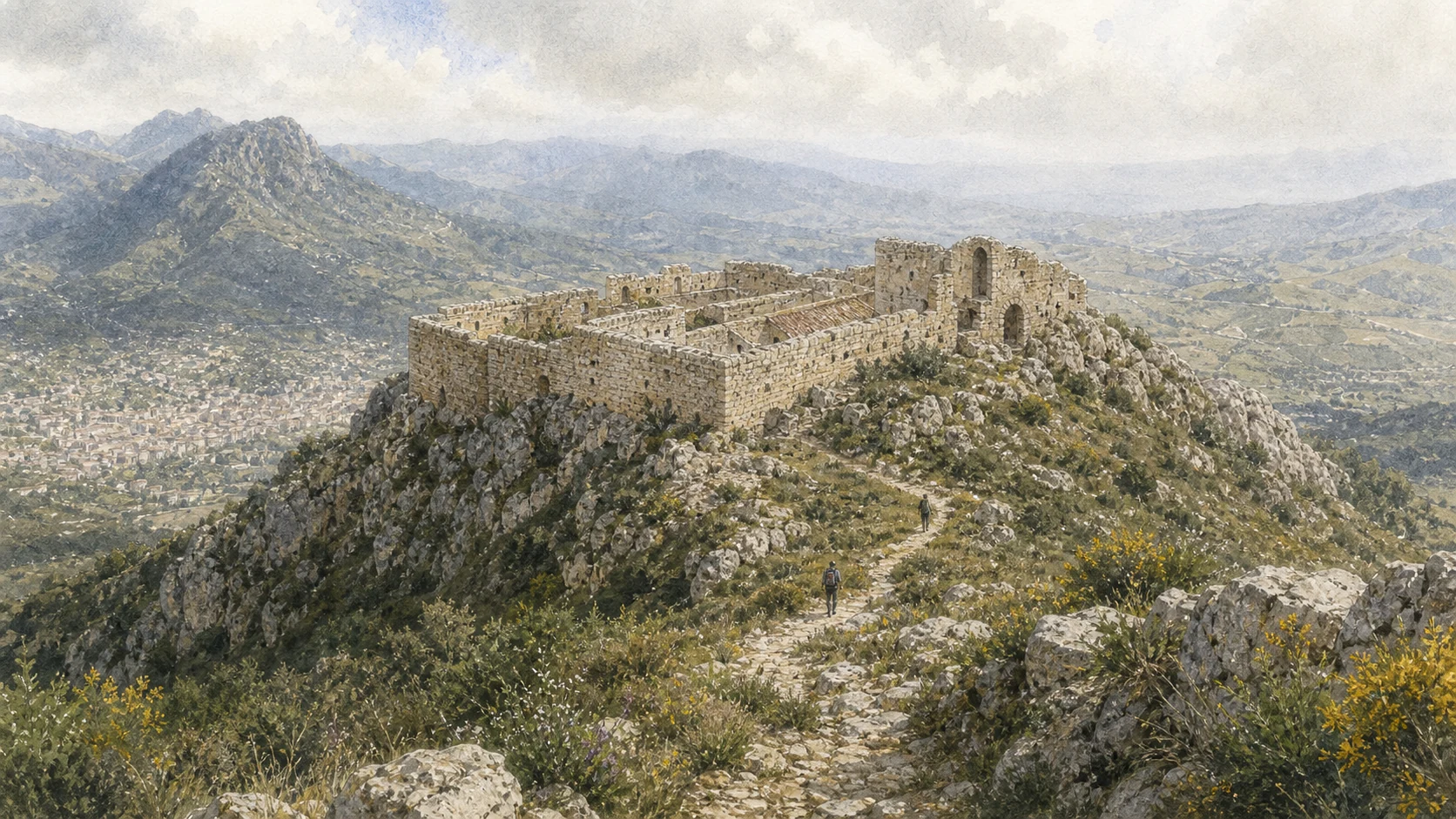
Documentary watercolour of the low ruined Castellaccio fortified monastery on Monte Caputo with rough limestone walls, ascent path and the Conca d'Oro far below
MONTE CAPUTOThe Castellaccio is a roofless fortified monastery in an exposed mountain landscape, not a reconstructed castle above the cathedral.
19

A FORTIFIED MONASTERY ABOVE THE CATHEDRAL BELONGS TO A SEPARATE MOUNTAIN LANDSCAPE

Monte Caputo and the Castellaccio

The difficult ascent reaches walls and ruins whose defensive and religious functions should not be confused with the royal complex below.

Documentary watercolour of the low ruined Castellaccio fortified monastery on Monte Caputo with rough limestone walls, ascent path and the Conca d'Oro far below
MONTE CAPUTO

The place today

The Castellaccio is reached by mountain routes and has conditions very different from the cathedral visit. Heat, wind, fire danger, path state and site access must be checked with local custodians or hiking organisations. Its walls, towers, church and courtyards are substantial, but the ruin should not be entered or climbed beyond authorised areas.

The historical chapter

Regional scholarship describes an elongated fortified complex with towers, a triapsidal church, monastic and residential zones. Architectural features suggest late Norman or early Swabian origins, yet written documentation is later and the site remains only partly investigated. Its position relates to defence, surveillance and the troubled inland frontier, not a romantic pleasure castle.

What to notice

  • Do not state an exact twelfth-century foundation as settled fact; the chronology remains debated.
  • Treat this as a mountain excursion requiring water, footwear, weather and access checks.
Sicilian Region · medieval castles and the Castellaccio of Monreale
20

A LIVING BENEDICTINE ABBEY HAS ITS OWN HISTORY BEYOND MONREALE'S CATHEDRAL

San Martino delle Scale

The mountain abbey deserves independent time for architecture, music, collections and present monastic life.

Documentary watercolour of the low ruined Castellaccio fortified monastery on Monte Caputo with rough limestone walls, ascent path and the Conca d'Oro far below
MONTE CAPUTO

The place today

The church, abbey, museum, library and guided areas can follow different opening regimes. The community remains active and offers religious, cultural and educational programmes. Choir stalls, paintings, cloister, refectory and later monumental ranges belong chiefly to rebuilding from the sixteenth through eighteenth centuries.

The historical chapter

A foundation by Gregory the Great is traditional and judged uncertain by the Benedictine congregation's own account. Documented history begins with six monks and Angelo Sinisio in 1347 on land belonging to the archbishop of Monreale. Subsequent rebuilding produced the present monumental abbey, including Giulio Lasso's cloister and Venanzio Marvuglia's later ranges.

What to notice

  • Keep San Martino's abbey distinct from the twelfth-century Benedictine monastery beside Monreale Cathedral.
  • Verify guided visits directly; active monastic life takes precedence over tourism.
Sublacense Cassinese Benedictine Congregation · San Martino delle Scale
21

FRACTIONS, WOODS AND CULTIVATED SLOPES EXTEND THE MUNICIPALITY BEYOND THE HILLTOP CORE

Pioppo, Grisi, Villaciambra, Aquino and the Wider Territory

The wider territory provides settlements and landscapes with their own identities rather than a generic hinterland backdrop.

Documentary watercolour of the low ruined Castellaccio fortified monastery on Monte Caputo with rough limestone walls, ascent path and the Conca d'Oro far below
MONTE CAPUTO

The place today

Aquino and Villaciambra sit close to Palermo's urban expansion; Pioppo and San Martino delle Scale occupy inland valleys and uplands; Grisì connects with western agricultural and wine landscapes. Public transport, road time and services differ greatly. These communities are places where people live, not scenic satellites to be consumed in one driving loop.

The historical chapter

The enormous municipal boundary reflects long histories of estates, ecclesiastical jurisdiction, agriculture, settlement and later administration. Fractions developed distinct churches, festivals, products and connections with neighbouring towns. Modern municipal identity links them to Monreale centre, but their histories cannot be reduced to the cathedral's foundation.

What to notice

  • Do not present the five fractions as adjacent neighbourhoods; distances and landscapes vary substantially.
  • Check local road, fire and weather conditions before combining woodland and agricultural routes.
Municipality of Monreale · territory and official fractions
22

CONSERVATION MUST PROTECT GOLD, STONE, WOOD AND DAILY WORSHIP WITHOUT FREEZING THE CITY

World Heritage and a Living Cathedral

The final chapter joins stewardship, liturgy, research and visitor pressure as ongoing responsibilities rather than a completed status label.

Documentary watercolour of the low ruined Castellaccio fortified monastery on Monte Caputo with rough limestone walls, ascent path and the Conca d'Oro far below
MONTE CAPUTO

The place today

The cathedral is one component within a nine-monument World Heritage property. Conservation campaigns can involve mosaics, roofs, facades and the cloister colonnade; access may change accordingly. The town still manages housing, traffic, public space and economic pressure around an intensely visited church.

The historical chapter

World Heritage inscription recognised the exceptional reworking of western, Islamic and Byzantine traditions under the Norman kingdom. That modern framework followed centuries of repair, collecting and reinterpretation. Current funding announcements signal planned or developing work, not proof that every intervention is complete.

What to notice

  • Do not use UNESCO status as a guarantee of unrestricted access, perfect condition or a single management authority.
  • Check official cathedral, regional and municipal notices close to the visit; worship and works can override general schedules.
Italian National Commission for UNESCO · serial World Heritage property

The city through time

Ten passages from royal foundation to living World Heritage

The chronology separates foundation documents, building and decoration, institutional change, later patronage, disaster and modern conservation instead of compressing Monreale into a single Norman decade.

  1. Royal presence and a productive hill landscape precede the cathedral; the exact form of the earlier residence is only partly recoverable.

  2. William II begins Santa Maria Nuova and the coordinated church, palace and monastery project above the Conca d'Oro.

  3. The church is entrusted to Benedictines from Cava de' Tirreni under Abbot Theobald.

  4. Pope Lucius III elevates Monreale to an archbishopric, confirming its territorial and ecclesiastical weight.

  5. Mosaic teams complete the vast biblical and royal programme; Bonanno dates the main bronze door 1186 and Barisano's side door follows around 1190.

  6. The cathedral is formally consecrated and dedicated to the Nativity of the Virgin, Santa Maria Nuova.

  7. Seminary, Torres Library, north portico, San Castrense chapel and Roano Chapel reshape the institutional and artistic complex.

  8. San Benedetto chapel, Francesco Testa's patronage, Valadier's silver altar and the new western portico add major Baroque and late-Baroque layers.

  9. Lightning damage and the catastrophic fire of 1811 are followed by rebuilding, mosaic work and restoration of the royal burials.

  10. UNESCO inscription places the cathedral within a nine-part serial property; worship, research, restoration and management continue rather than ending the monument's history.

Before your visit

Practical information,
without turning it into promises

01

Give cathedral and cloister separate time

Allow at least two focused visits or a generous half-day: first exterior, nave and mosaic sequence; then cloister, museum or civic complex. A Palermo coach excursion rarely reveals the town or mountain context.

02

Treat worship and ticketed heritage as different access systems

The cathedral is an active church; terraces, museum, cloister and exhibitions may have separate hours, tickets and closures. Check the official cathedral, diocese and regional channels shortly before travelling.

03

Plan town, Castellaccio and San Martino as distinct movements

The historic centre is walkable but steep. Monte Caputo requires a mountain plan; San Martino delle Scale is a separate inland excursion; the other fractions are dispersed and cannot be added casually to one afternoon.

04

Look slowly and behave as a participant, not a collector

Use optical aids for mosaics, avoid blocking aisles, ask before close photography in workshops or festivals, support local producers transparently and leave active worship, neighbourhoods and monastic life their own rhythm.

Sources

This guide cross-checks the UNESCO nomination dossier and Italian National Commission, the Archdiocese and Cathedral of Monreale, the Sicilian Region's cultural publications and conservation notices, the Municipality of Monreale, the University of Palermo, the Diocesan Museum and Torres Library, the Sublacense Cassinese Benedictine Congregation and the State Archives. It separates legend from institutional history, stylistic encounter from equal power, a church model from a measured drawing, medieval fabric from later restoration, UNESCO recognition from completed conservation, monastic spaces from present museum uses, and the cathedral centre from the municipality's dispersed living territory.

The hero is an original documentary illustration, not an official photograph, a reconstruction of William II's court or an image of the cathedral interior. Worship, cathedral and terrace access, cloister tickets, museum and library openings, exhibitions, restoration, festival routes, mountain paths, fire danger, monastic visits and transport across the fractions can change; consult the linked institutions shortly before travelling. The royal residence before 1174, precise building stages, individual mosaic and sculpture workshops, original circulation, Castellaccio chronology and several local traditions remain qualified where evidence does not permit certainty.