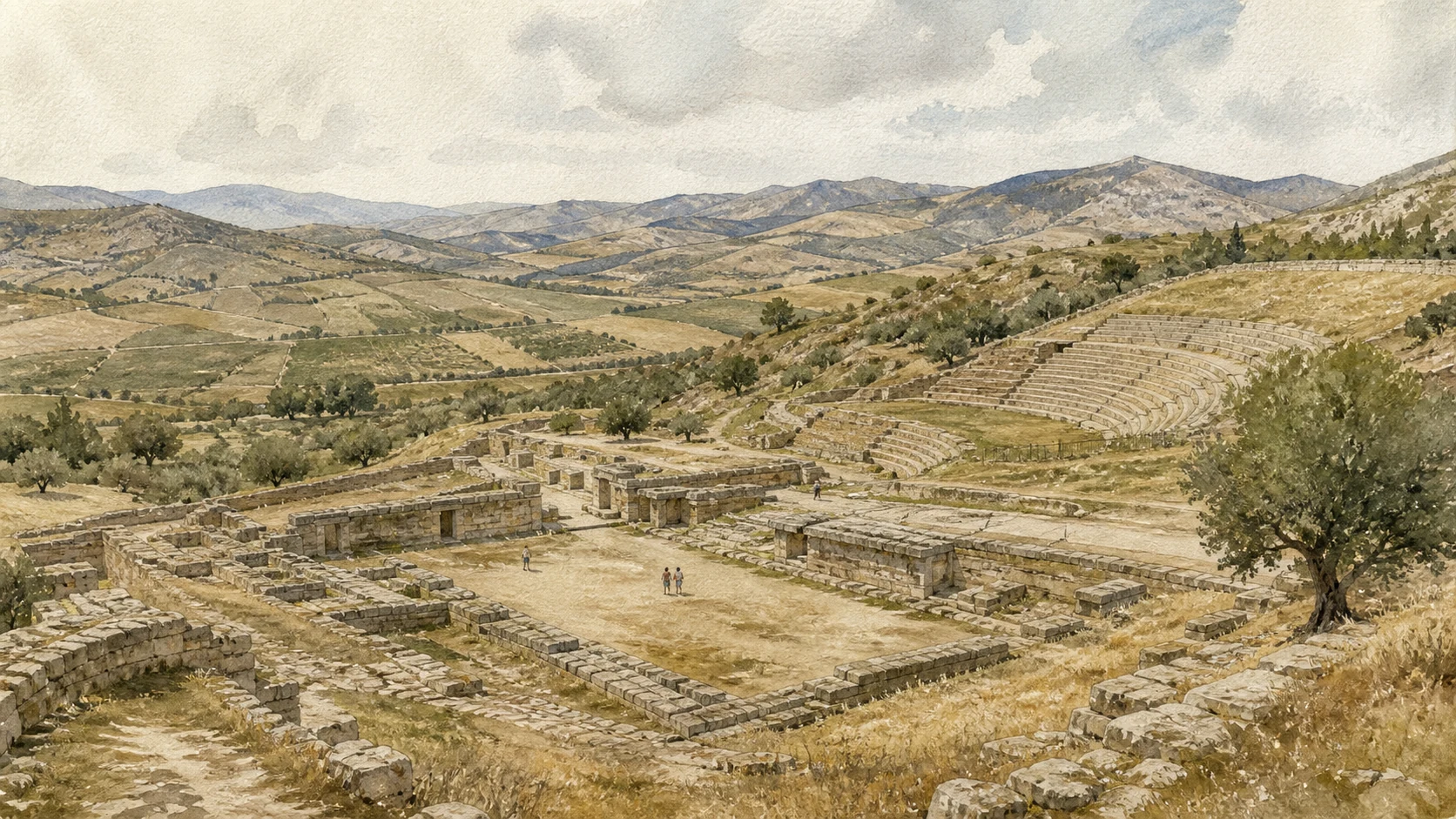
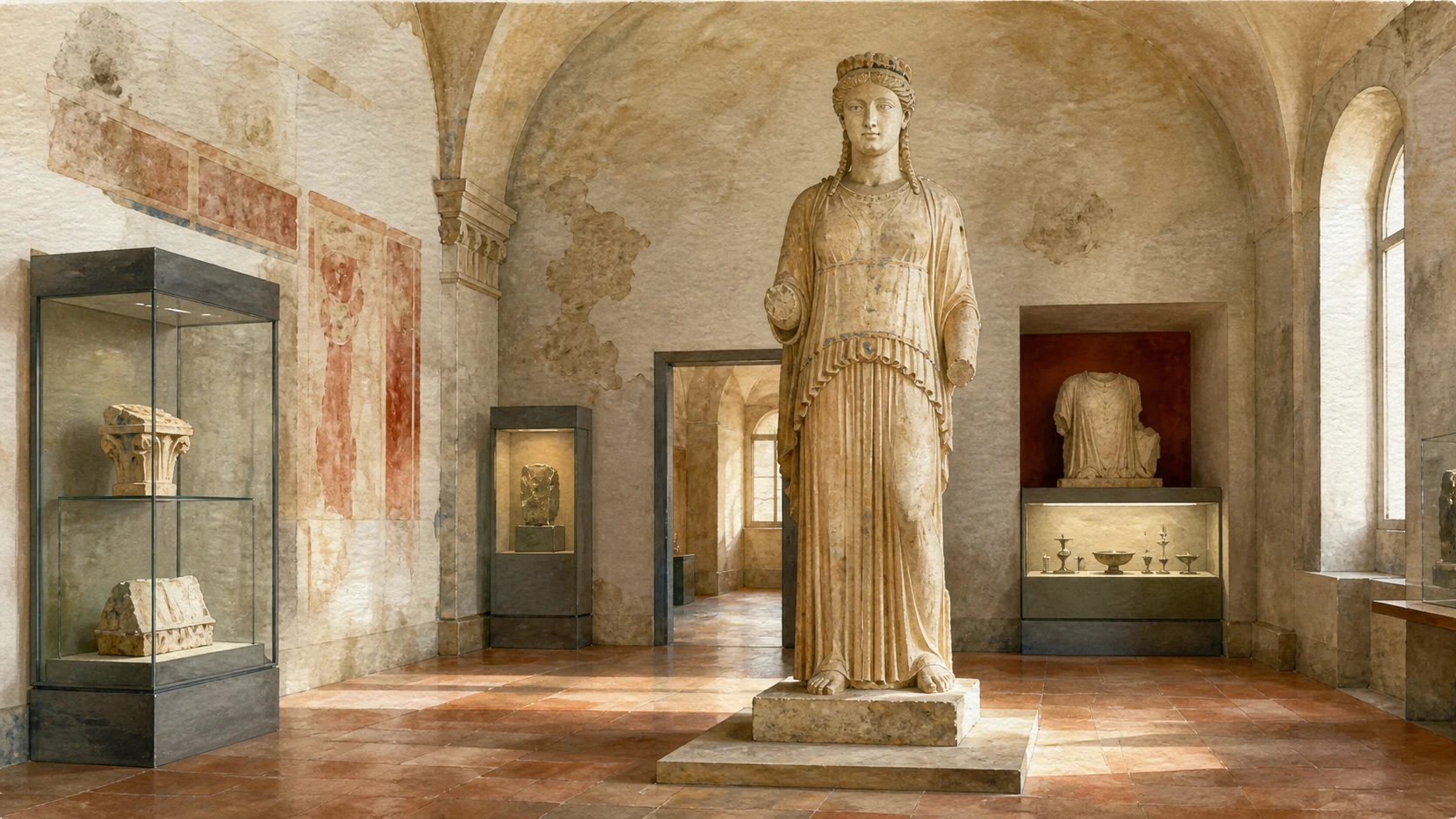
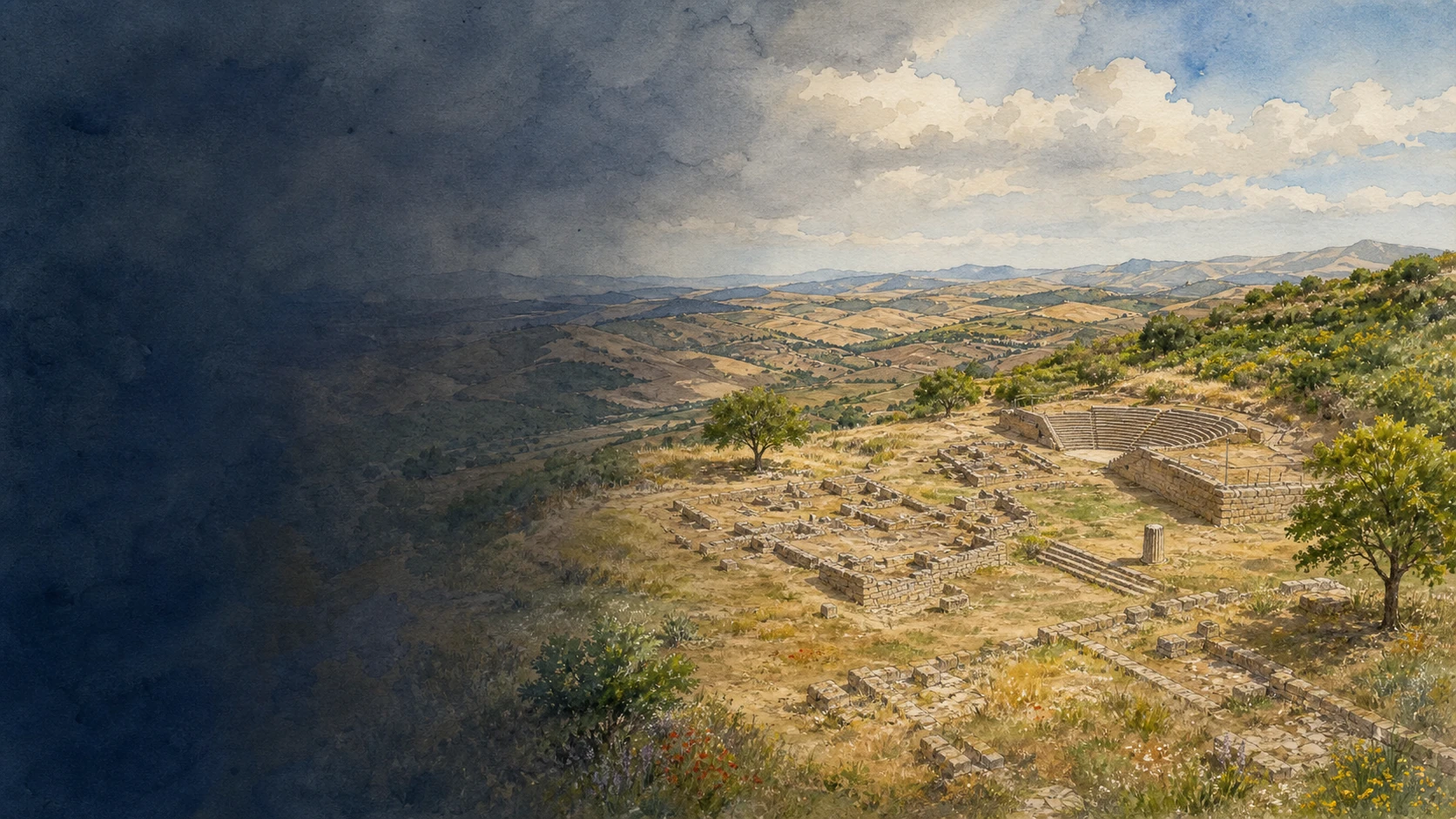
Documentary watercolour of Morgantina's lower agora, theatre, assembly steps and green Erei landscape

Illustrated guide · Sicily

Where the agora
still holds
the horizon

Twenty places through which to read an inland Sicilian city from Bronze Age settlement and Greek urbanism to Roman conquest, archaeological research and the return of looted masterpieces.

Explore the places
Morgantina · Aidone · city, museum and landscape

An abandoned city can preserve connections that famous objects alone cannot

Morgantina is sometimes presented as a quiet archaeological detour and Aidone as the room in which its celebrated objects happen to be stored. That division destroys the meaning of both places.

On the ridges of Cittadella and Serra Orlando, houses, sanctuaries, streets, cisterns, baths, granaries, assembly steps and theatre explain how an inland community worked. In the former Capuchin convent at Aidone, statues, silver, architectural terracottas and ordinary pottery restore people, ritual and image to those excavated foundations.

The relationship is also ethical. Important works were torn from archaeological contexts, sold abroad and eventually returned after long investigations. Their beauty is inseparable from the damage caused by clandestine excavation and from the patient work that re-established where they belonged.

This guide therefore begins in Aidone, moves through the complete ancient landscape and returns to the museum. The aim is not to collect masterpieces, but to reconnect every masterpiece with a building, a cult, a civic institution and an island history.

One destination

One inland territory, twenty chapters and more than a thousand years of urban life.

Morgantina occupies two principal areas east of Aidone in central Sicily. Cittadella preserves the earlier sequence, from Bronze and Iron Age occupation to an archaic settlement and sanctuary. Serra Orlando holds the extensive later city: an orthogonal street plan descends toward an upper and lower agora, with public buildings, theatre, baths, sanctuaries and large Hellenistic houses spread across the ridge.

The city flourished especially in the third century BC within the political and economic world of Hieron II of Syracuse. Roman capture in 211 BC transformed ownership and civic life; occupation continued, but Morgantina did not survive the Augustan reorganisation after the wars of the first century BC as a major living centre. Because later building did not bury it under a modern town, urban relationships remain unusually legible.

Aidone is not merely the modern gateway. Its churches, hilltop castle ruins and former Capuchin convent form a separate historic centre. The Regional Archaeological Museum completes the site visit with finds arranged from prehistory to the Hellenistic and Roman phases, including works returned from North American collections.

The selection

Twenty places, from Aidone to the ancient city and back

The first four places establish Aidone and its museum. Twelve chapters then cross Cittadella and Serra Orlando in archaeological order. The final four reunite the returned masterpieces with their original contexts and modern history.

  1. 01Aidone, the Hill Town Above Morgantina
  2. 02San Domenico and the Diamond-Point Façade
  3. 03San Lorenzo, the Castellaccio and San Leone
  4. 04The Regional Archaeological Museum in the Capuchin Convent
  5. 05Cittadella Before the Greek City
  6. 06The Hekatompedon and Archaic Cittadella
  7. 07San Francesco Bisconti and the Sanctuary of Demeter and Kore
  8. 08Serra Orlando and the Orthogonal City
  9. 09The Upper and Lower Agora
  10. 10The Ekklesiasterion and the Architecture of Assembly
  11. 11The Theatre Facing the Agora
  12. 12Granaries, Prytaneion and the Public Economy
  13. 13The North and South Baths
  14. 14The House of Ganymede and Figured Mosaics
  15. 15Urban Sanctuaries and the Religious City
  16. 16The Roman Capture of 211 BC and the City's Long Decline
  17. 17The Acroliths of Demeter and Kore
  18. 18The Goddess of Morgantina
  19. 19The Morgantina Silver and the Name of Eupolemos
  20. 20The Head of Hades, Excavation and the Work of Return
01

THE MODERN CENTRE IS A HIGH INLAND TOWN WITH ITS OWN STREETS, CHURCHES AND MEMORY

Aidone, the Hill Town Above Morgantina

Aidone should be walked as a historic town, not crossed only on the road between museum and ruins.

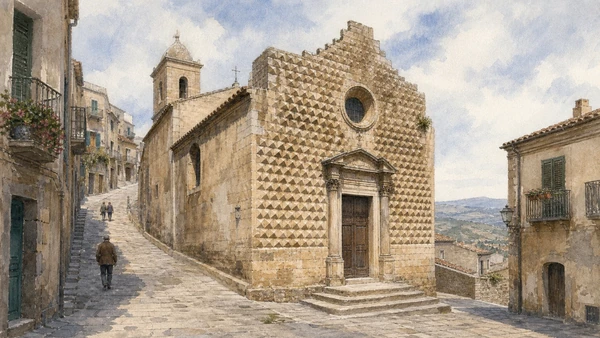
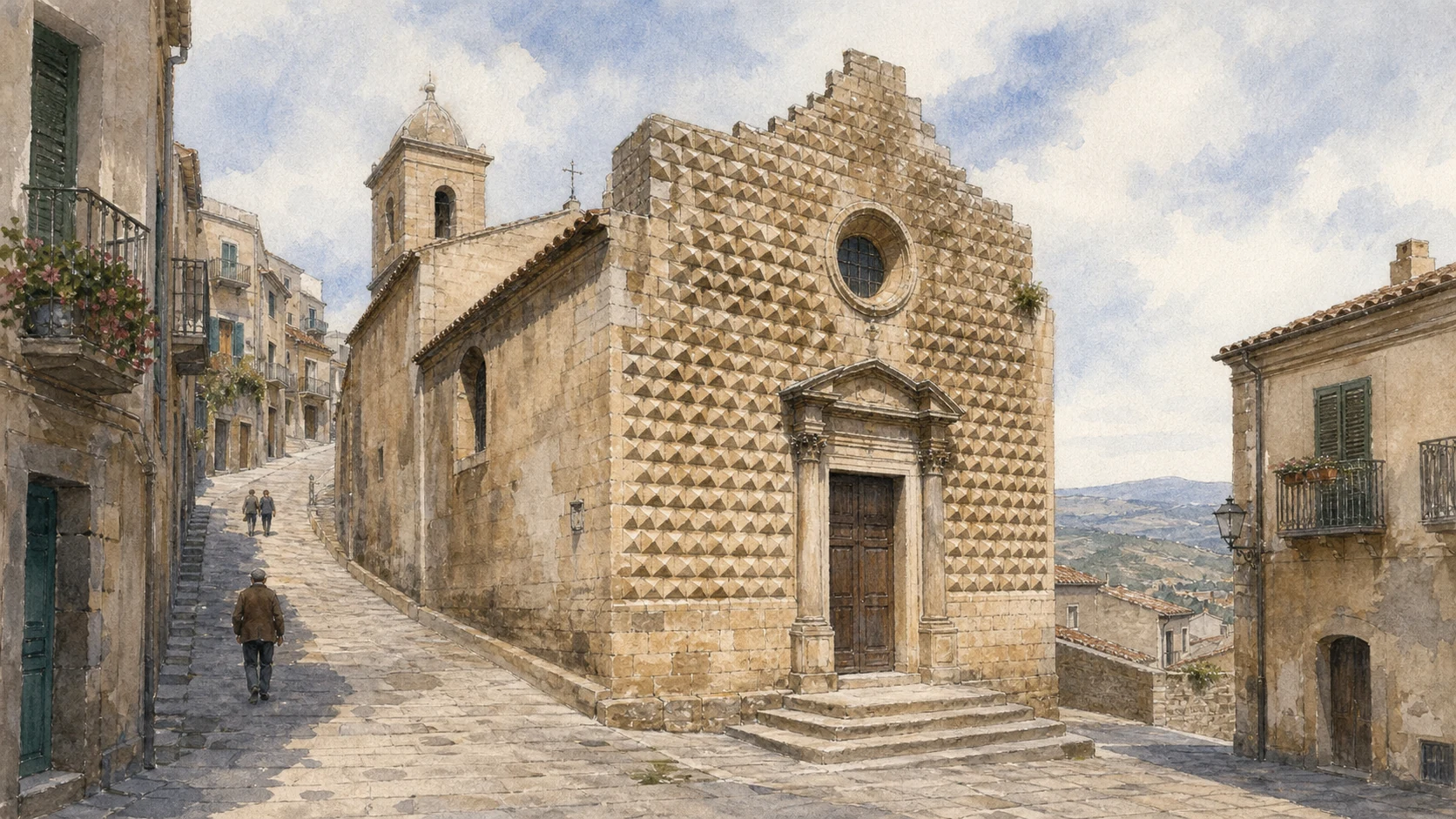
Documentary watercolour of San Domenico in Aidone with its diamond-point stone façade, sloping street and inland landscape
A DIAMOND-POINT FAÇADE ON THE HILL-TOWN STREET

The place today

The centre occupies a steep ridge above the valleys and agricultural plateaus of the Erei. Streets rise and turn between stone houses, churches and small squares; openings at the edge of the urban fabric reveal why the settlement commanded routes through the interior. Piazza Umberto and the approach to the museum provide a practical orientation, while the climb toward San Lorenzo and the Castellaccio reveals the older defensive logic of the site.

The historical chapter

Aidone developed separately from abandoned Morgantina through medieval and early-modern phases. Its local identity also belongs to the Gallo-Italic linguistic area of central Sicily, shaped by northern settlers in the Norman period and subsequent interaction with Sicilian speech. The visible town is layered rather than uniform: medieval topography, post-medieval churches, monastic foundations and later rebuilding share the same ridge.

What to notice

  • Allow time for the slopes and viewpoints; driving directly to the museum conceals the town's relationship with the surrounding plateau.
  • Treat dialect, medieval settlement and ancient Morgantina as connected but distinct histories; they do not belong to one uninterrupted city.
Municipality of Aidone · Official portal and historic centre
02

A FIFTEENTH-CENTURY CHURCH TURNS STONE RUSTICATION INTO A RARE URBAN LANDMARK

San Domenico and the Diamond-Point Façade

San Domenico's façade is Aidone's most immediately recognisable architectural surface, but its history continues into the former monastery beside it.

Documentary watercolour of San Domenico in Aidone with its diamond-point stone façade, sloping street and inland landscape
A DIAMOND-POINT FAÇADE ON THE HILL-TOWN STREET

The place today

The church façade is covered by pale diamond-point blocks framed by darker sandstone at corners and openings. Light changes the apparent depth of every stone, making the surface almost textile-like. The adjoining conventual fabric is more restrained. Even when the interior is inaccessible, the façade can be read from the street as a deliberate contrast between geometry, material colour and the irregular town around it.

The historical chapter

The official municipal account dates the foundation to 1419. San Domenico and its monastery remained a religious complex for roughly four centuries. The façade has been discussed in relation to Catalan and Plateresque currents, but those comparisons should describe visual and cultural connections rather than assign the building to one simple imported style.

What to notice

  • Observe the façade from several distances: close light reveals individual points, while the full pattern appears only from across the street.
  • Do not assume the church interior is open because the exterior is accessible; current religious and conservation access should be checked locally.
Municipality of Aidone · Church of San Domenico
03

THE HIGHEST PART OF AIDONE CONNECTS SACRED BUILDINGS, RUINED FORTIFICATION AND LONG-DISTANCE VIEWS

San Lorenzo, the Castellaccio and San Leone

Three monuments explain how Aidone's upper ridge was defended, sanctified and rebuilt.

Documentary watercolour of San Domenico in Aidone with its diamond-point stone façade, sloping street and inland landscape
A DIAMOND-POINT FAÇADE ON THE HILL-TOWN STREET

The place today

The Matrice of San Lorenzo stands near the upper town with an unfinished tower and a treasury of sacred silver. Above and around it, the fragmentary Castellaccio occupies the most naturally defended point; its value lies in topography and surviving masonry rather than an intact castle silhouette. San Leone, lower in the historic fabric, presents a later façade and Baroque portal after repeated reconstruction.

The historical chapter

The municipality identifies the Castellaccio as the town's oldest traced monument, with an Islamic-period watch function followed by Norman fortification, although its ruined fabric demands caution about exact phases. San Leone is traditionally connected with the Norman period, suffered collapse in the 1693 earthquake and was rebuilt in 1794. The local claim that large blocks came from Morgantina is significant as a tradition of reuse, but should not be treated as proven for every stone.

What to notice

  • At the Castellaccio, read the inaccessible slopes and sight lines before trying to reconstruct walls that no longer survive.
  • Separate documented rebuilding dates from local traditions about Norman foundations and reused ancient masonry.
Municipality of Aidone · San Lorenzo, Castellaccio and San Leone
04

ELEVEN ROOMS TURN AN EARLY-SEVENTEENTH-CENTURY CONVENT INTO THE SECOND HALF OF THE ARCHAEOLOGICAL SITE

The Regional Archaeological Museum in the Capuchin Convent

The museum is not an optional display after Morgantina; it supplies the objects, chronology and ritual evidence missing from open foundations.

Documentary watercolour of San Domenico in Aidone with its diamond-point stone façade, sloping street and inland landscape
A DIAMOND-POINT FAÇADE ON THE HILL-TOWN STREET

The place today

Visitors enter the former Capuchin complex through spaces associated with the church of San Francesco. Arcades, the convent courtyard, vaulted rooms and traces of the religious building remain visible around modern cases. The route is arranged chronologically and thematically: early settlement, necropoleis, architecture, sanctuaries, baths, domestic life and returned masterpieces. Room availability and temporary displays can change.

The historical chapter

The convent was built between 1611 and 1613 and adapted as the archaeological museum in 1984. The older official catalogue describes eleven rooms and thousands of recorded objects. Later returns reshaped the display: acroliths, the silver treasure, the monumental Goddess and the terracotta head of Hades transformed the museum into a central place for understanding both ancient Morgantina and modern illicit trafficking.

What to notice

  • Visit before or after the site with enough time to follow the chronological route; a quick masterpiece circuit leaves the city unexplained.
  • The convent is itself historic architecture. Notice arcades, church space and reuse without confusing them with ancient Morgantina.
Regional Archaeological Park · Museum of Aidone
Documentary watercolour of San Domenico in Aidone with its diamond-point stone façade, sloping street and inland landscape
A DIAMOND-POINT FAÇADE ON THE HILL-TOWN STREETSan Domenico's dense stone pattern and unfinished profile introduce Aidone as more than the gateway to the archaeological site.
05

HUTS, POTTERY AND A RIDGE SETTLEMENT PUSH MORGANTINA'S HISTORY BACK INTO THE BRONZE AND IRON AGES

Cittadella Before the Greek City

The first Morgantina was not the monumental agora at Serra Orlando but a much older community on Cittadella.

Documentary watercolour of San Domenico in Aidone with its diamond-point stone façade, sloping street and inland landscape
A DIAMOND-POINT FAÇADE ON THE HILL-TOWN STREET

The place today

Cittadella is a separate elevated zone whose traces are less monumental than the later city. Low walls, cuts in the ground and the relation between summit and slopes require patient reading. Final Bronze and Early Iron Age houses have been studied here, while earlier Castelluccian evidence places human occupation in the third and second millennia BC. The landscape, not a standing temple, is the principal visual guide.

The historical chapter

The regional park records Early Bronze Age Castelluccian occupation around 2200–1600 BC. Later long rectangular huts and associated finds document an indigenous settlement through the Iron Age. Research by Edinburgh and the American mission has examined houses of the eleventh to eighth centuries BC, showing continuity and change before Greek architectural forms appeared.

What to notice

  • Do not judge Cittadella by monument height; settlement archaeology often survives as plans, deposits and relationships rather than façades.
  • Use the museum's prehistoric rooms before visiting if possible, because pottery and household material make the exposed structures legible.
University of Edinburgh · Prehistoric Morgantina Project
06

A LONG CULT BUILDING SHOWS GREEK ARCHITECTURAL LANGUAGE ENTERING AN INDIGENOUS SETTLEMENT

The Hekatompedon and Archaic Cittadella

The archaic sanctuary reveals cultural exchange more clearly than a simple story of replacement or colonisation.

Documentary watercolour of San Domenico in Aidone with its diamond-point stone façade, sloping street and inland landscape
A DIAMOND-POINT FAÇADE ON THE HILL-TOWN STREET

The place today

The foundations define a building about thirty-three metres long, conventionally called a hekatompedon. It lacked the surrounding colonnade of a canonical peripteral temple. Fragments of Ionic architectural terracotta once decorated the roof and are better understood in the museum than on the exposed plan. Nearby burials and domestic areas show that cult occupied one part of a living settlement.

The historical chapter

In the sixth century BC a large earlier hut was replaced by this Greek-type sacred building. Its form and terracotta decoration record the adoption and adaptation of Mediterranean architectural practice by the Cittadella community. The settlement was damaged and partly abandoned in the middle of the fifth century BC, a transformation often connected with Ducezio's campaigns, though archaeology cannot turn every destruction layer into a securely named event.

What to notice

  • A hekatompedon describes exceptional length; it does not mean the building was a fully developed marble temple.
  • Compare roof terracottas in the museum with the foundation plan rather than imagining a complete elevation unsupported by evidence.
Regional Archaeological Park · Archaeological Area of Morgantina
07

TERRACES, OFFERINGS AND ACROLITHIC STATUES CONNECT AGRICULTURAL LAND, WOMEN'S RITUAL AND DIVINE PRESENCE

San Francesco Bisconti and the Sanctuary of Demeter and Kore

The sanctuary is the archaeological context that gives the famous acroliths their meaning.

Documentary watercolour of San Domenico in Aidone with its diamond-point stone façade, sloping street and inland landscape
A DIAMOND-POINT FAÇADE ON THE HILL-TOWN STREET

The place today

The sanctuary occupies terraced ground at San Francesco Bisconti, outside the later urban core. Walls and deposits mark repeated ritual activity rather than one symmetrical temple court. Finds include votive material and elements of two acrolithic cult statues: marble heads and extremities attached in antiquity to bodies made in another material and dressed.

The historical chapter

Cult activity began by the late sixth century BC and continued through later phases. Demeter and Kore were central to the religious life of many Sicilian communities, where grain, fertility, seasonal change and social identity converged. At Morgantina, the sanctuary and its objects show that Greek divine forms were embedded within a culturally mixed inland society rather than imported into an empty landscape.

What to notice

  • Understand the acroliths as composite dressed statues; the surviving marble parts were never intended to form complete nude stone bodies.
  • The sanctuary is dispersed and topographic. Follow terraces and findspots instead of searching for one intact temple.
Regional Archaeological Museum of Aidone · Acroliths and sanctuary
08

STREETS, BLOCKS AND SLOPES REVEAL A PLANNED CITY THAT GREW AROUND AN INLAND RIDGE

Serra Orlando and the Orthogonal City

Morgantina's later city is understood first as an urban plan, not as a collection of isolated monuments.

Documentary watercolour of San Domenico in Aidone with its diamond-point stone façade, sloping street and inland landscape
A DIAMOND-POINT FAÇADE ON THE HILL-TOWN STREET

The place today

Long streets run across and down Serra Orlando, dividing residential blocks and directing movement toward the agora. The grid adapts to steep terrain rather than imposing a flat diagram. Cisterns, drains and retaining walls expose the infrastructure required by a large inland population. Only part of the ancient city has been excavated, so visible blocks are a sample of a much wider settlement.

The historical chapter

Occupation expanded on Serra Orlando from the fifth century BC. The planned city combined Greek urban forms with a population rooted in inland Sicily. Much of the architecture visible today belongs to the prosperous third century BC, when Morgantina lay within Hieron II's Syracusan sphere. The plan was modified after Roman conquest rather than instantaneously erased.

What to notice

  • Pause at a high point and identify street axes before descending; the urban grid is difficult to recover from inside one house.
  • Do not equate the excavated area with the whole city. Older regional documentation estimated that only a minority had been exposed.
Freie Universität Berlin · Urban Morgantina and bath research
09

TWO LEVELS OF PUBLIC SPACE JOINED MARKETS, PROCESSIONS, GOVERNMENT AND DAILY ENCOUNTER

The Upper and Lower Agora

Morgantina's agora is a civic landscape distributed across a slope rather than one empty rectangular square.

Documentary watercolour of San Domenico in Aidone with its diamond-point stone façade, sloping street and inland landscape
A DIAMOND-POINT FAÇADE ON THE HILL-TOWN STREET

The place today

The lower agora opens as a broad space framed by stoas and public buildings, with the theatre set into one side of the valley. Above it, a second level concentrates additional civic and commercial functions. The central stair system and retaining architecture make the two areas visually continuous. Trees, grass and low walls now soften the ancient boundaries, so column bases and alignments must be followed carefully.

The historical chapter

The monumental form belongs mainly to the early Hellenistic period and was enlarged during the third-century prosperity of the city. Stoas provided sheltered circulation and ordered the edges of civic space. The agora accommodated political assembly, administration, exchange, commemoration and festival movement; it should not be reduced to a modern market square with a single purpose.

What to notice

  • Read the upper and lower spaces together from the connecting steps; photographs from ground level can conceal their designed unity.
  • Surviving column fragments do not justify reconstructing continuous marble façades; most elevations are known only in part.
Regional Archaeological Park · Archaeological Area of Morgantina
10

A MONUMENTAL STAIR JOINED THE AGORA LEVELS AND GAVE CITIZENS A PLACE TO SEE, HEAR AND DECIDE

The Ekklesiasterion and the Architecture of Assembly

The celebrated steps are circulation, seating and political architecture at the same time.

Documentary watercolour of San Domenico in Aidone with its diamond-point stone façade, sloping street and inland landscape
A DIAMOND-POINT FAÇADE ON THE HILL-TOWN STREET

The place today

Broad stone flights rise between the two levels of the agora, focused on a central speaking or assembly zone. Their geometry is most legible from the lower square, where they appear as an architectural hinge rather than a stair leading to one building. Weathering and restoration complicate the boundary between ancient surface and conserved fabric.

The historical chapter

The structure is interpreted as an ekklesiasterion, a place for civic assembly, integrated into the Hellenistic remodelling of the agora. It materialised participation by arranging bodies and voices within public space. The exact composition of Morgantina's citizen body changed across political phases, so the building proves an institution of assembly but not modern democratic equality.

What to notice

  • Distinguish the ekklesiasterion from the nearby theatre: political gathering and staged performance used different spaces even when their forms overlap.
  • Use 'assembly of citizens' carefully; citizenship in the ancient city excluded many inhabitants whose labour sustained it.
Regional Archaeological Park · Agora and ekklesiasterion
11

PERFORMANCE WAS BUILT INTO THE CIVIC CENTRE AND OPENED TOWARD THE LANDSCAPE

The Theatre Facing the Agora

The theatre's modest surviving scale and direct relationship with the agora are more revealing than an imagined monumental stage façade.

Documentary watercolour of San Domenico in Aidone with its diamond-point stone façade, sloping street and inland landscape
A DIAMOND-POINT FAÇADE ON THE HILL-TOWN STREET

The place today

A stone cavea is set into the natural slope at the edge of the lower agora. Seating curves around the orchestra while the stage building survives principally in its lower courses. From the upper rows, the ancient public centre and Erei landscape remain part of the view. Modern performances may temporarily add equipment or restrict portions of the monument.

The historical chapter

The theatre took monumental form in the Hellenistic city and participated in its third-century civic programme. Drama, music and public ceremony could reinforce collective identity and political relationships. Later alterations belong to changing use under Roman control. No surviving decoration supports the fantasy of a complete white-marble theatre isolated from the working agora.

What to notice

  • Turn from the orchestra toward the agora to understand why the theatre belongs to the civic centre rather than a separate entertainment district.
  • Check the archaeological park for event closures and never climb on seating or walls outside the authorised path.
Regional Archaeological Park · Morgantina theatre and civic centre
Documentary watercolour of Morgantina's lower agora, stepped Ekklesiasterion and Greek theatre within the Serra Orlando inland landscape
ASSEMBLY, EXCHANGE AND PERFORMANCE IN ONE LANDSCAPEThe lower agora, Ekklesiasterion and theatre remain connected by real topography and low surviving walls rather than an imagined complete city.
12

STORAGE, OFFICIAL DINING AND ADMINISTRATION MAKE THE AGORA A PLACE OF RESOURCES AS WELL AS MONUMENTS

Granaries, Prytaneion and the Public Economy

Morgantina's prosperity can be read in buildings that managed grain, hospitality and civic institutions.

Documentary watercolour of Morgantina's lower agora, stepped Ekklesiasterion and Greek theatre within the Serra Orlando inland landscape
ASSEMBLY, EXCHANGE AND PERFORMANCE IN ONE LANDSCAPE

The place today

Long compartments near the agora are identified as granaries, while nearby public structures have been interpreted through plans, inscriptions and associated finds. The prytaneion, the institutional house of civic officials and communal hospitality, is especially important for connecting architecture with the silver treasure. Low foundations require comparison with museum labels and site plans.

The historical chapter

Central Sicily's agricultural production supported Morgantina's third-century economy and its place within Hieron II's kingdom. Public storage could regulate supplies and taxes, while ritualised official meals helped reproduce political relationships. The silver vessels later hidden during the crisis of 211 BC are thought to have served banquets in the prytaneion, though the exact path from building to hiding place must remain an archaeological interpretation.

What to notice

  • Do not reduce prosperity to elite houses: storage, water systems and public administration reveal how resources were collected and redistributed.
  • Building names reflect archaeological interpretation; confirm them through plans instead of assigning every rectangular foundation a single fixed function.
Regional Archaeological Museum of Aidone · Silver and civic context
13

EARLY VAULTED BATHS CONNECT WATER, ENGINEERING, SOCIAL LIFE AND EXPERIMENTAL CONSTRUCTION

The North and South Baths

Morgantina preserves two of the most important early Hellenistic bathing complexes in the western Greek world.

Documentary watercolour of Morgantina's lower agora, stepped Ekklesiasterion and Greek theatre within the Serra Orlando inland landscape
ASSEMBLY, EXCHANGE AND PERFORMANCE IN ONE LANDSCAPE

The place today

The bath buildings lie between the western gate area and the agora. Rooms of different shapes, water installations, furnaces and supports reveal controlled sequences of washing and heated space. The South Baths are especially known for evidence of lightweight vaulted roofing. Their present low walls can look domestic until water systems and room geometry are identified.

The historical chapter

Both complexes belong principally to the third century BC. Their sophisticated domes and mortar construction have been linked to Syracusan engineering and sometimes to Archimedes. That attribution is a stimulating hypothesis, not a signed work. Research by the American mission and Freie Universität Berlin continues to refine phases, use and the relationship between bathing and nearby houses.

What to notice

  • Follow water and heat: tanks, channels, furnaces and room sequence explain the buildings better than one reconstructed dome drawing.
  • Present the Archimedes connection as a cautious technological hypothesis, never as a documented commission by the inventor.
Freie Universität Berlin · North and South Baths research
14

A PRIVATE HOUSE TURNS COURTYARDS, FLOORS AND MYTH INTO EVIDENCE OF EDUCATION AND STATUS

The House of Ganymede and Figured Mosaics

Morgantina's large houses show how public prosperity entered domestic architecture and visual culture.

Documentary watercolour of Morgantina's lower agora, stepped Ekklesiasterion and Greek theatre within the Serra Orlando inland landscape
ASSEMBLY, EXCHANGE AND PERFORMANCE IN ONE LANDSCAPE

The place today

Residential blocks preserve peristyle courts, reception rooms, service areas, cisterns and decorated pavements. In the House of Ganymede, a figured mosaic representing the youth carried by Zeus's eagle is among Sicily's early narrative mosaics. Protective conditions may limit visibility, and museum reproductions or conserved fragments can be more legible than exposed floors.

The historical chapter

Wealthy houses expanded during the third century BC, when contacts with Syracuse and the wider Hellenistic Mediterranean brought new forms of dining, display and mosaic craft. Mythological imagery distinguished rooms and signalled cultural literacy. These houses also depended on hidden labour and water management; peristyles and mosaics should not turn residents into the only inhabitants of the block.

What to notice

  • Read mosaic subject, border, threshold and room function together; the image was designed for a specific direction of approach.
  • Respect covers and closures. Temporary protection of a floor is evidence of conservation, not a reason to step beyond the route.
Regional Archaeological Park · Hellenistic houses and Ganymede mosaic
15

CULT WAS DISTRIBUTED ACROSS THE AGORA, RESIDENTIAL QUARTERS, GATES AND THE COUNTRYSIDE

Urban Sanctuaries and the Religious City

Morgantina's religious landscape cannot be compressed into one temple or only the cult of Demeter and Kore.

Documentary watercolour of Morgantina's lower agora, stepped Ekklesiasterion and Greek theatre within the Serra Orlando inland landscape
ASSEMBLY, EXCHANGE AND PERFORMANCE IN ONE LANDSCAPE

The place today

Sacred areas survive through altars, deposits, architectural terracottas and small building plans located in different parts of the city. Some stood near civic spaces, others at edges or on extramural terraces. Museum cases of figurines and votive vessels restore the gestures of offering that bare foundations cannot show.

The historical chapter

Cults changed from archaic Cittadella through Hellenistic Serra Orlando and Roman occupation. Demeter and Kore were especially prominent, but other divine figures and household practices belonged to the city's ritual network. Imported iconography, local manufacture and mixed communities produced forms that are neither purely colonial copies nor timeless indigenous survivals.

What to notice

  • Avoid calling every small sacred building a temple in the monumental sense; altars, deposits and precinct boundaries may be the decisive evidence.
  • Use find context to distinguish public sanctuary, domestic cult and funerary offering when the museum display provides it.
Regional Archaeological Museum of Aidone · Sanctuaries and cult material
16

CONQUEST CHANGED OWNERSHIP AND INSTITUTIONS, BUT IT DID NOT EMPTY EVERY STREET IN A SINGLE DAY

The Roman Capture of 211 BC and the City's Long Decline

The crisis of 211 BC is a turning point whose archaeological effects unfolded across later generations.

Documentary watercolour of Morgantina's lower agora, stepped Ekklesiasterion and Greek theatre within the Serra Orlando inland landscape
ASSEMBLY, EXCHANGE AND PERFORMANCE IN ONE LANDSCAPE

The place today

Roman-period alterations appear throughout the agora and houses: reused rooms, changed circulation and different commercial arrangements. Evidence is scattered rather than concentrated in one Roman monument. The absence of later monumental rebuilding is itself significant because it helped preserve the Hellenistic plan visible today.

The historical chapter

After the Second Punic War, Morgantina was captured in 211 BC and assigned to a group of Hispanic mercenaries who had served Rome. Houses were damaged, valuables were hidden and civic life was reorganised. Occupation continued into the first century BC, but the city failed to recover its earlier political and economic role and did not survive the Augustan reorganisation after the conflict of 36 BC as a major centre.

What to notice

  • Separate destruction in 211 BC from later abandonment; the archaeological record documents continued occupation and adaptation.
  • Do not present Romanisation as an instant change of culture. Buildings, objects and institutions altered at different speeds.
Regional Archaeological Park · Roman conquest and abandonment
Documentary watercolour of the Goddess of Morgantina displayed in the Aidone Archaeological Museum with restrained cases of returned finds
THE RETURNED OBJECTS REUNITED WITH THEIR LANDSCAPEThe Goddess of Morgantina stands within Aidone's former Capuchin convent, where the acroliths, silver and excavation history can be read together.
17

SURVIVING MARBLE FACES AND HANDS RECOVER THE PRESENCE OF TWO DRESSED CULT STATUES

The Acroliths of Demeter and Kore

The paired acroliths are powerful because the museum reunites them with their sanctuary and composite ancient form.

Documentary watercolour of the Goddess of Morgantina displayed in the Aidone Archaeological Museum with restrained cases of returned finds
THE RETURNED OBJECTS REUNITED WITH THEIR LANDSCAPE

The place today

Two marble heads, hands and feet are displayed so that their relationship as figures can be understood without inventing the missing bodies. In antiquity, the stone extremities were attached to internal supports and clothed, allowing expensive marble to concentrate expression on face and gesture. The display returns them conceptually to the San Francesco Bisconti sanctuary.

The historical chapter

The statues date to the late sixth century BC and are identified with Demeter and Kore through sanctuary context. Illicitly removed fragments passed through collections in the United States before their restitution to Italy and presentation at Aidone. Their return, publicly celebrated in 2009, preceded other major restitutions and demonstrated how technical study and provenance investigation can restore a dismembered cult group.

What to notice

  • Do not describe the surviving marble fragments as broken complete statues; acrolithic construction was composite from the beginning.
  • Their identification depends on paired form and sanctuary context, which clandestine excavation placed at risk.
Sicilian Region · 2009 exhibition of the returned acroliths
18

LIMESTONE DRAPERY AND GREEK MARBLE CREATE A MONUMENTAL FIGURE WHOSE NAME REMAINS OPEN

The Goddess of Morgantina

The museum's most imposing statue is securely returned to Morgantina but not securely identified as one named goddess.

Documentary watercolour of the Goddess of Morgantina displayed in the Aidone Archaeological Museum with restrained cases of returned finds
THE RETURNED OBJECTS REUNITED WITH THEIR LANDSCAPE

The place today

The figure stands more than two metres high. Deeply cut limestone drapery produces strong movement, while the head and exposed extremities were made from fine Greek marble and joined to the body. Traces and technical study indicate that colour once intensified the surface. The work was carved at the back as a freestanding statue rather than a flat architectural ornament.

The historical chapter

The statue was made around 420 BC in a Siceliot artistic environment. It was illicitly excavated, sold to the J. Paul Getty Museum in 1986 for a reported eighteen million dollars and returned to Italy in 2011 after investigations established its provenance. Demeter or Kore are plausible identifications, but no surviving attribute proves either name. The title 'Goddess of Morgantina' preserves that responsible uncertainty.

What to notice

  • Use 'Goddess', Demeter or Kore with explicit uncertainty; the monumental scale does not supply a missing attribute.
  • Notice the deliberate contrast between local limestone clothing and imported marble flesh rather than calling the entire statue marble.
Regional Archaeological Museum of Aidone · Goddess of Morgantina
19

A HIDDEN SERVICE OF VESSELS TURNS THE ROMAN ATTACK INTO A PERSONAL AND CIVIC EMERGENCY

The Morgantina Silver and the Name of Eupolemos

The silver treasure connects elite craftsmanship, public dining and a hurried concealment around 211 BC.

Documentary watercolour of the Goddess of Morgantina displayed in the Aidone Archaeological Museum with restrained cases of returned finds
THE RETURNED OBJECTS REUNITED WITH THEIR LANDSCAPE

The place today

The museum displays bowls, cups, vessels and ritual or dining equipment whose forms and decoration reveal exceptional Hellenistic metalwork. A small object bearing the name Eupolemos provides a human connection to the hoard. The group is most informative when viewed as a service used together, not as separate luxury objects ranked by beauty.

The historical chapter

Made in the third century BC, the silver is thought to have belonged to the city and to have served official banquets in the prytaneion. It was hidden during the Roman attack of 211 BC, probably by Eupolemos, and never recovered in antiquity. Illicit excavation severed the first archaeological record; the pieces entered the Metropolitan Museum of Art and were returned to Italy in 2010 after negotiations and provenance work.

What to notice

  • Distinguish the secure evidence—the hoard, date, inscription and return—from the plausible reconstruction of Eupolemos's role.
  • Look at weight, repeated shapes and signs of use: an official service expressed civic institution as well as private wealth.
Regional Archaeological Museum of Aidone · Morgantina silver treasure
20

BLUE CURLS, TECHNICAL MATCHES AND ARCHIVAL RESEARCH RECONNECTED A SEVERED HEAD WITH ITS SANCTUARY

The Head of Hades, Excavation and the Work of Return

The last chapter is not an epilogue to archaeology: provenance, restitution and public care determine what the ancient city can still teach.

Documentary watercolour of the Goddess of Morgantina displayed in the Aidone Archaeological Museum with restrained cases of returned finds
THE RETURNED OBJECTS REUNITED WITH THEIR LANDSCAPE

The place today

The terracotta head has a beard and hair retaining rare traces of colour, including blue. It is displayed within the museum route dedicated to sanctuaries and returned works. Evidence from fragments and find history connected it to a larger cult group, probably Hades and Kore. Nearby documentation should be read as part of the object, because appearance alone cannot reveal its modern journey.

The historical chapter

The head was made in the late fourth century BC and illicitly removed before entering the J. Paul Getty Museum. Archaeological fragments from Morgantina helped establish the match, and the work returned to Aidone in 2016. Since the American excavation mission began in 1953–55, systematic fieldwork has reconstructed the city; clandestine digging repeatedly destroyed the very associations that make that research possible. Restitution repairs ownership and public access, but it cannot recreate every lost context.

What to notice

  • Treat colour as archaeological evidence, not decorative novelty; ancient terracotta sculpture was vividly finished.
  • A returned object is not the end of the story. Research, conservation, site protection and transparent provenance remain continuing obligations.
Regional Archaeological Museum of Aidone · Hades and the returned collections

The city through time

A city measured in millennia, not one golden age

Ten passages connect early settlement, urban transformation, conquest, excavation and restitution without forcing Morgantina into a simple Greek-to-Roman sequence.

  1. Castelluccian communities occupy the Cittadella area during the Early Bronze Age, beginning the long archaeological sequence later associated with Morgantina.

  2. Final Bronze and Early Iron Age houses form an indigenous ridge settlement whose domestic archaeology precedes Greek monumental architecture.

  3. The Cittadella hekatompedon and San Francesco Bisconti sanctuary introduce Greek architectural and sculptural forms, including the Demeter and Kore acroliths.

  4. Cittadella is damaged and partly abandoned; occupation and planned urban expansion shift toward Serra Orlando in a period associated with Ducezio's campaigns.

  5. Agora, theatre, assembly steps, baths, sanctuaries and large houses make Morgantina one of inland Sicily's most articulate Hellenistic cities.

  6. Within Hieron II's Syracusan sphere, urban building and agricultural prosperity reach their most visible monumental expression.

  7. Roman forces capture Morgantina during the Second Punic War; valuables are hidden, buildings damaged and the city assigned to Hispanic mercenaries.

  8. Occupation and reuse continue, but Morgantina loses its former role and does not emerge from the Augustan reorganisation as a major urban centre.

  9. The American archaeological mission begins systematic excavation at Serra Orlando and expands research across city, houses, sanctuaries and Cittadella.

  10. Acroliths, silver, the Goddess and the head of Hades return from United States collections, transforming the Aidone museum and public understanding of provenance.

Before your visit

Practical information,
without turning it into promises

01

Give Aidone, museum and site a full day

Morgantina is extensive and exposed; the museum is a substantial chronological route, while Aidone's upper monuments require steep walking. A rushed half-day reduces all three to fragments.

02

Begin with the plan, then follow the slope

At Serra Orlando, identify streets, upper agora, assembly steps, lower agora and theatre from a high point. Only then enter houses, baths and individual public buildings.

03

Prepare for sun, uneven ground and distance

The archaeological route crosses slopes and open terrain with limited shade. Carry water, use suitable footwear and verify the current accessible route and weather restrictions with the park.

04

Check both official museum and site notices

Hours, tickets, room visibility, conservation covers, event closures and seasonal routes can change independently. Confirm the archaeological area and Aidone museum separately shortly before visiting.

Sources

This guide cross-checks the Sicilian Region's archaeological park and museum documentation with the older official museum catalogue, the Municipality of Aidone, university excavation projects and the regional record of restitutions. It separates Cittadella from Serra Orlando, Hellenistic urban planning from later Roman reuse, secure find evidence from proposed identifications, and aesthetic appreciation from provenance. Current openings are never presented as permanent.

The hero image is an illustration, not a photograph. The official regional reference photographs remain archived locally for visual verification. Opening hours, tickets, conservation works, room displays, site routes and accessibility can change; consult the linked institutional pages shortly before visiting.