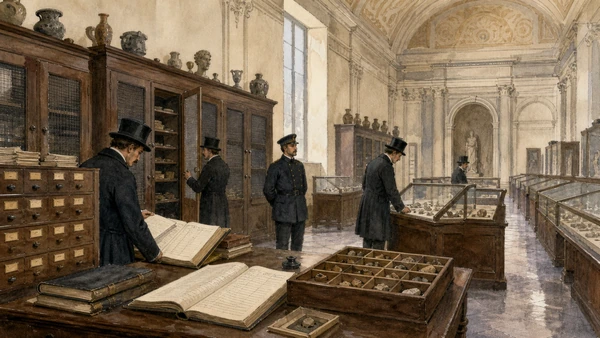
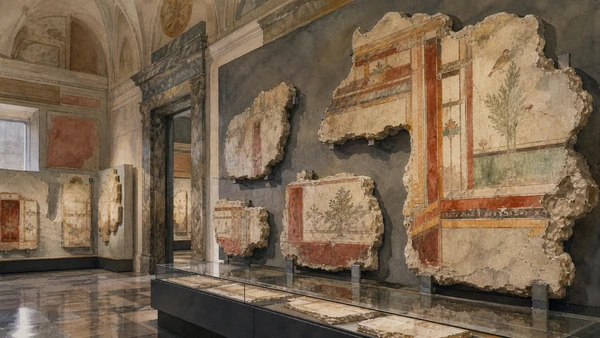
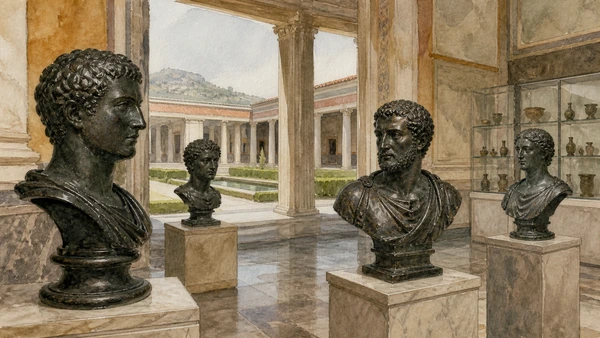
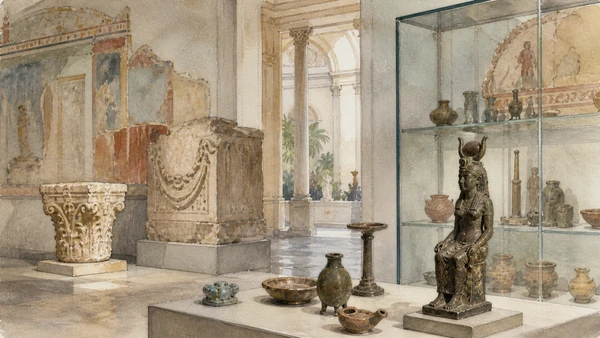
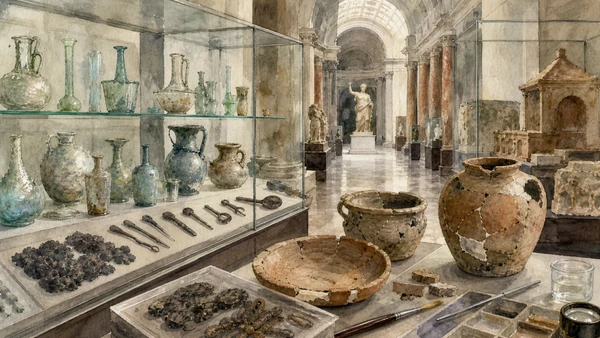
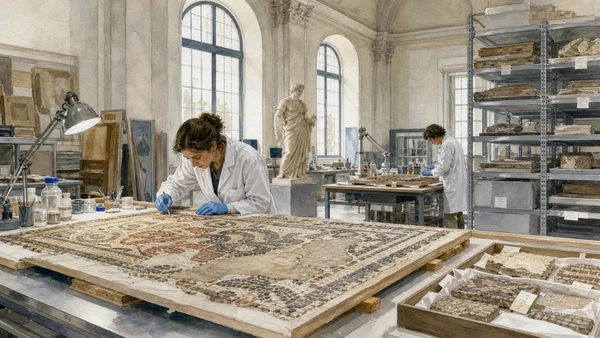
Original documentary watercolour panorama for Naples National Archaeological Museum and the Ancient Bay: Complete Guide, with accurate Naples architecture and lived urban context

Naples Guide 04 · Bourbon collections, Vesuvian cities, Farnese sculpture and archaeological method

MANN
& the Ancient Bay

A collection-led guide to the National Archaeological Museum of Naples, explaining how objects from Pompeii, Herculaneum, the Bay of Naples and the Farnese collections were excavated, transferred, restored, classified and displayed.

Plan the route
Naples · Campania10 chapters · one full day

Why this Naples district must be read in layers

The MANN is not a warehouse of objects removed from Pompeii: it is a historic museum whose building, royal collections, excavation politics and changing displays shaped the modern image of the ancient Mediterranean.

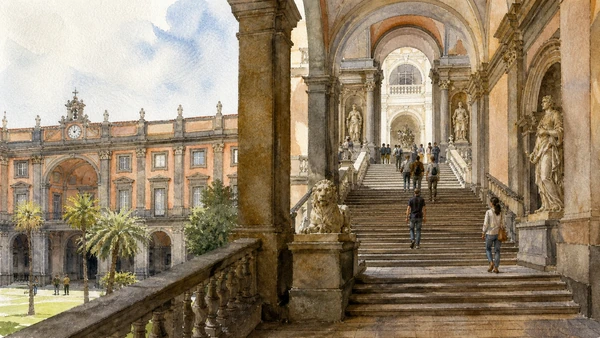
The museum’s roots join the former cavalry barracks and university building to Bourbon cultural policy and the transfer of the Farnese collections. Architecture and collection history explain why monumental sculpture and Vesuvian domestic objects meet in Naples.

Pompeian mosaics, wall paintings, bronzes and everyday objects were separated from their archaeological contexts under earlier conservation systems. A responsible visit reconnects them to findspot, room, excavation date and restoration history through current labels and digital records.

Collections rotate and galleries close for loans, installation or maintenance. The route therefore prioritises methods and collection groups rather than promising one object will always be visible.

Check the museum’s live gallery map, choose three collection groups in depth and retain enough time to read provenance: the object and its archaeological context must be reunited intellectually.

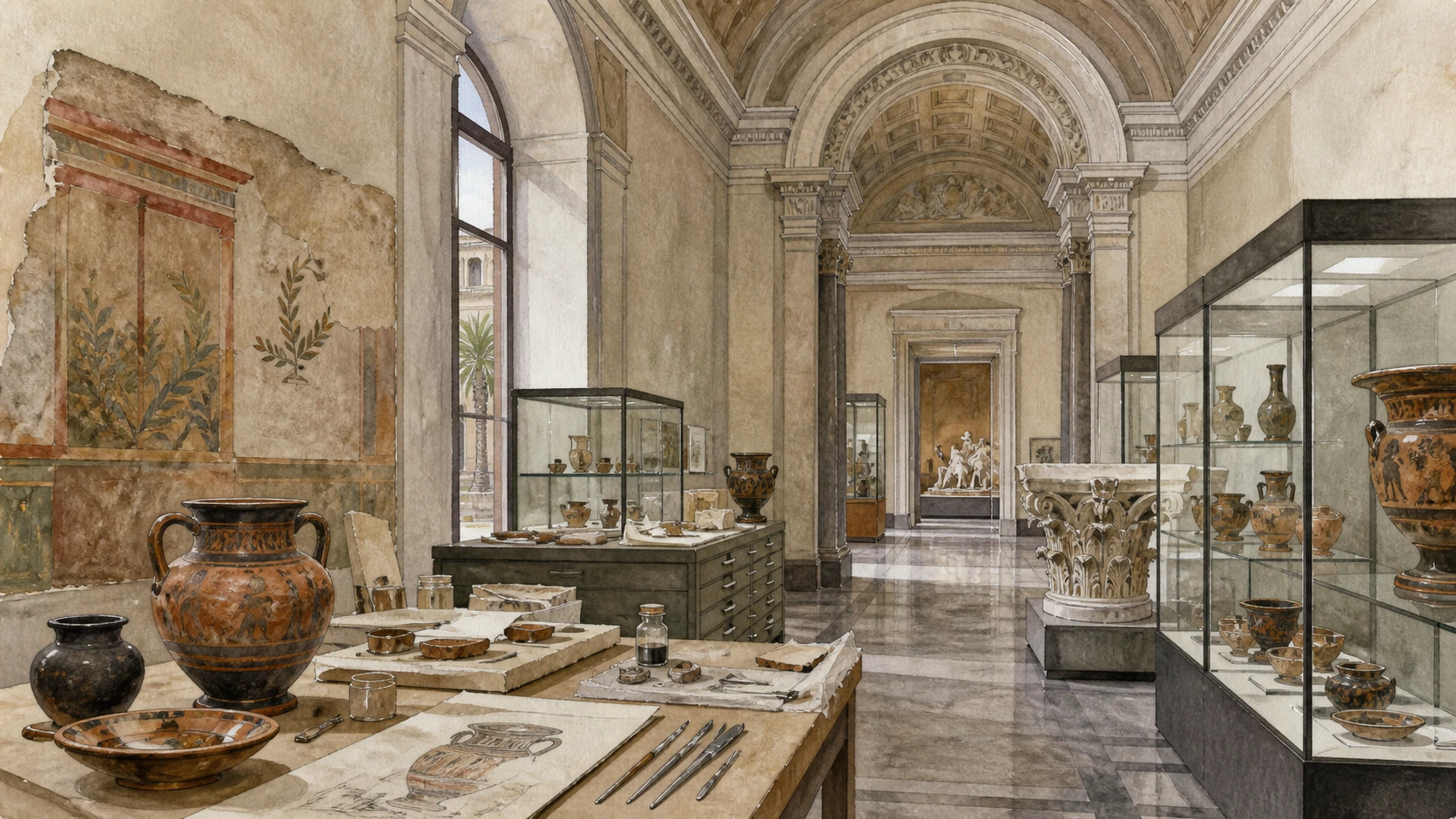
The route

Plan your visit

Begin with the building and Farnese marbles, continue through mosaics, paintings and domestic evidence from the Vesuvian cities, then finish with conservation, archives and the modern museum.

Early morning

The museum building · The Farnese Bull · Farnese Hercules

Move in the documented order: The museum building: barracks, university and collection palace; then The Farnese Bull: ancient sculpture and modern reconstruction; then Farnese Hercules: body, labour and collection fame. Check live access before entering ticketed or liturgical spaces.

Late morning

Alexander Mosaic · Secret Cabinet · Vesuvian wall paintings

Move in the documented order: Alexander Mosaic: a floor image reconstructed in a museum wall; then Secret Cabinet: sexuality, censorship and museum classification; then Vesuvian wall paintings: fragments of complete rooms. Check live access before entering ticketed or liturgical spaces.

Afternoon

Bronzes from the Villa of the Papyri · Temple of Isis collection · Everyday objects

Move in the documented order: Bronzes from the Villa of the Papyri: one collection within an elite house; then Temple of Isis collection: ritual, Egypt and Roman Pompeii; then Everyday objects: food, tools, vessels and domestic systems. Check live access before entering ticketed or liturgical spaces.

Late afternoon

Conservation and provenance

Move in the documented order: Conservation and provenance: how the museum keeps changing. Check live access before entering ticketed or liturgical spaces.

Ten chapters

Explore the places

The order follows terrain, institutions and present-day movement. Use the index to return to a chapter without reducing the district to isolated monuments.

  1. 01The museum building: barracks, university and collection palace
  2. 02The Farnese Bull: ancient sculpture and modern reconstruction
  3. 03Farnese Hercules: body, labour and collection fame
  4. 04Alexander Mosaic: a floor image reconstructed in a museum wall
  5. 05Secret Cabinet: sexuality, censorship and museum classification
  6. 06Vesuvian wall paintings: fragments of complete rooms
  7. 07Bronzes from the Villa of the Papyri: one collection within an elite house
  8. 08Temple of Isis collection: ritual, Egypt and Roman Pompeii
  9. 09Everyday objects: food, tools, vessels and domestic systems
  10. 10Conservation and provenance: how the museum keeps changing
01

The institution occupies a large building whose changing uses preceded the archaeological museum

The museum building: barracks, university and collection palace

Understanding the courtyards and stair sequence prevents the collections from appearing institutionally neutral.

Today

Use the current museum map because entrances, lifts and gallery routes can shift. Security screening and large bags follow live rules.

History

The building began in the late sixteenth century for cavalry use, was adapted for the university and later reorganised to house royal collections and Vesuvian finds.

How to read this place

Read courtyards, monumental stairs and gallery axes as part of the Bourbon museum project before concentrating on individual objects.

What to notice

  • Courtyards preserving earlier institutional phases
  • Grand stair organising collection hierarchy
  • Modern access inserted into a historic building
MANN · Official museum
Original documentary watercolour of The museum building: barracks, university and collection palace in Naples, showing architecture, people and present-day urban context
The museum building: barracks, university and collection palaceOriginal Merlintravel documentary watercolour · 2026
02

A monumental marble group arrived through excavation, dynastic inheritance and extensive restoration

The Farnese Bull: ancient sculpture and modern reconstruction

Its present appearance records both Roman production and later decisions about missing parts.

Today

Display location and surrounding galleries can change. Observe from permitted distances and use current labels for material and restoration history.

History

Excavated in Rome in the sixteenth century, the group entered the Farnese collection and later moved to Naples. Restorers reconstructed elements to make the complex mythological scene legible.

How to read this place

Walk around the group, distinguish support from figure and ask which parts are ancient, restored or reassembled.

What to notice

  • Multiple figures carved into one monumental group
  • Restoration completing a damaged archaeological object
  • Dynastic transfer linking Rome and Naples
MANN · Farnese Collection
Original documentary watercolour of The Farnese Bull: ancient sculpture and modern reconstruction in Naples, showing architecture, people and present-day urban context
The Farnese Bull: ancient sculpture and modern reconstructionOriginal Merlintravel documentary watercolour · 2026
03

The colossal resting hero became a model for artists through copies, prints and museum display

Farnese Hercules: body, labour and collection fame

Its influence belongs to reception history as well as ancient sculpture.

Today

The sculpture is large but the gallery is shared; keep circulation open and compare it with nearby works rather than using a single frontal viewpoint.

History

The Roman marble, linked to an ancient Greek sculptural type, was found in the Baths of Caracalla and entered the Farnese collection before transfer to Naples.

How to read this place

Circle the weight-bearing body and locate the hidden apples. Compare scale, pose and restoration with smaller replicas.

What to notice

  • Resting pose carrying immense physical mass
  • Attributes revealing the completed labours
  • Museum reception turning one sculpture into an icon
MANN · Farnese Collection
Original documentary watercolour of Farnese Hercules: body, labour and collection fame in Naples, showing architecture, people and present-day urban context
Farnese Hercules: body, labour and collection fameOriginal Merlintravel documentary watercolour · 2026
04

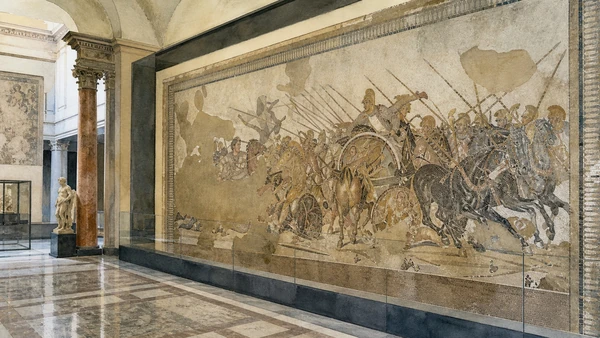
The famous battle scene came from the House of the Faun and now requires its original architectural context to be restored through interpretation

Alexander Mosaic: a floor image reconstructed in a museum wall

Display orientation can make visitors forget that it functioned as a floor mosaic.

Today

The original or a conservation substitute may be affected by current restoration and installation work. Check the museum notice and accept that preservation can temporarily limit visibility.

History

The mosaic was discovered at Pompeii in the nineteenth century and transferred to Naples. Its tiny tesserae, composition and relationship to Greek painting have made it central to ancient art history.

How to read this place

Study direction, damaged zones and tessera scale, then use the house plan to recover the threshold and room in which the image was encountered.

What to notice

  • Tiny tesserae producing painterly detail
  • Battle movement organised across a floor
  • Transfer separating object from House of the Faun
MANN · Mosaics Collection
Original documentary watercolour of Alexander Mosaic: a floor image reconstructed in a museum wall in Naples, showing architecture, people and present-day urban context
Alexander Mosaic: a floor image reconstructed in a museum wallOriginal Merlintravel documentary watercolour · 2026
05

Ancient objects were segregated under modern moral regimes that became part of their collection history

Secret Cabinet: sexuality, censorship and museum classification

The gallery is evidence for both Roman imagery and later censorship.

Today

Age guidance, room access and display content follow museum policy. Treat explicitly sexual material analytically and avoid photographing other visitors.

History

Objects from the Vesuvian cities were grouped and restricted under Bourbon and later governments. Access rules changed repeatedly as scholarship and public morality shifted.

How to read this place

Read findspot, household or ritual function and later cataloguing together. Do not treat the room as proof that Roman society was uniformly permissive.

What to notice

  • Ancient objects separated by modern moral categories
  • Access history preserved in the collection narrative
  • Domestic and ritual contexts varying across displays
MANN · Secret Cabinet
Original documentary watercolour of Secret Cabinet: sexuality, censorship and museum classification in Naples, showing architecture, people and present-day urban context
Secret Cabinet: sexuality, censorship and museum classificationOriginal Merlintravel documentary watercolour · 2026
06

Removed panels preserve colour and figural scenes but often lose the architectural system that framed them

Vesuvian wall paintings: fragments of complete rooms

Museum display must be mentally reconnected to walls, rooms and houses.

Today

Gallery lighting protects sensitive surfaces and rotation is normal. Do not use flash and consult the current room labels.

History

Bourbon and later excavators detached many paintings from Pompeii and Herculaneum for royal collections and protection. Scholarly classification later organised them into broad stylistic phases.

How to read this place

Look for painted architecture, borders and cut edges. Use provenance to imagine height, room function and neighbouring panels without claiming certainty beyond the record.

What to notice

  • Cut edges revealing removal from plastered walls
  • Painted architecture organising figural scenes
  • Protective low light supporting conservation
MANN · Frescoes Collection
Original documentary watercolour of Vesuvian wall paintings: fragments of complete rooms in Naples, showing architecture, people and present-day urban context
Vesuvian wall paintings: fragments of complete roomsOriginal Merlintravel documentary watercolour · 2026
07

Portraits and ideal sculptures once formed an unusually rich programme at Herculaneum

Bronzes from the Villa of the Papyri: one collection within an elite house

Their museum grouping should remain connected to villa architecture and the papyrus library.

Today

Not every bronze is permanently displayed. Use the museum inventory and Herculaneum documentation when galleries rotate.

History

Eighteenth-century tunnelling at the Villa of the Papyri recovered sculptures and carbonised scrolls from a major seaside residence. Finds were moved to Naples under royal control.

How to read this place

Compare portrait types, scale and likely placement, then use the villa plan to understand sight lines across courts and gardens.

What to notice

  • Dark bronze surfaces requiring controlled light
  • Portrait and ideal sculpture sharing one villa
  • Tunnelling history shaping provenance records
MANN · Villa of the Papyri collection
Original documentary watercolour of Bronzes from the Villa of the Papyri: one collection within an elite house in Naples, showing architecture, people and present-day urban context
Bronzes from the Villa of the Papyri: one collection within an elite houseOriginal Merlintravel documentary watercolour · 2026
08

Objects from one sanctuary show how Egyptian religious imagery was adapted within a Roman city

Temple of Isis collection: ritual, Egypt and Roman Pompeii

The collection is more precise than a generic story about exotic influence.

Today

Follow the gallery’s current arrangement and compare objects with the Pompeii sanctuary plan. Some works may rotate.

History

The Temple of Isis was among the early Pompeii discoveries and strongly affected eighteenth-century taste. Its paintings, sculpture and ritual furnishings were transferred to the Bourbon museum.

How to read this place

Identify which objects belonged to architecture, ritual action or decoration. Separate ancient Isis worship from later Egyptomania.

What to notice

  • Ritual objects linked to a documented sanctuary
  • Nilotic and Egyptian imagery adapted in Pompeii
  • Early excavation influencing European taste
MANN · Temple of Isis collection
Original documentary watercolour of Temple of Isis collection: ritual, Egypt and Roman Pompeii in Naples, showing architecture, people and present-day urban context
Temple of Isis collection: ritual, Egypt and Roman PompeiiOriginal Merlintravel documentary watercolour · 2026
09

Small finds correct a museum route dominated by monumental art

Everyday objects: food, tools, vessels and domestic systems

Wear, repair and ordinary materials reveal households, labour and unequal access to resources.

Today

Displays rotate because the collection is vast. Read object groups and contexts rather than expecting a single famous artefact.

History

Excavation recovered metalwork, glass, ceramics, food remains and tools from houses, shops, baths and streets. Early collection priorities did not always value them equally.

How to read this place

Look for use marks, scale and manufacturing technique. Connect each item to a room or activity to distinguish everyday objects from luxury goods.

What to notice

  • Wear and repair preserving human use
  • Object groups reconstructing specific activities
  • Ordinary materials balancing elite art
MANN · Collections
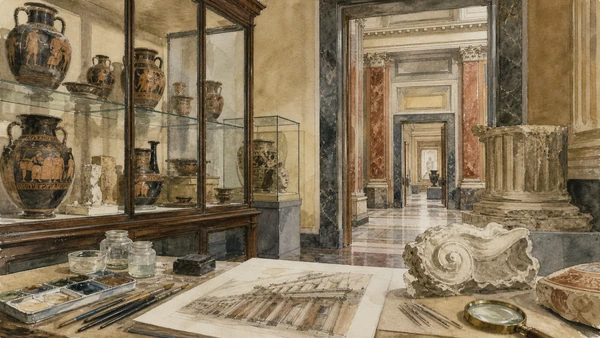
Original documentary watercolour of Everyday objects: food, tools, vessels and domestic systems in Naples, showing architecture, people and present-day urban context
Everyday objects: food, tools, vessels and domestic systemsOriginal Merlintravel documentary watercolour · 2026
10

Restoration, storage, loans and research determine what the public can see and how an object is understood

Conservation and provenance: how the museum keeps changing

A closed gallery or absent object can signal active care rather than failure.

Today

Check live closure notices and never rely on an old floor plan. Respect barriers even when a display appears visually accessible.

History

Objects have been cleaned, completed, moved and reclassified since the eighteenth century. Modern conservation uses documentation and reversible methods while scholarship revises provenance and interpretation.

How to read this place

Read old inventory numbers, restoration joins and mounting systems. Treat museum labels as current research statements open to future revision.

What to notice

  • Mounts supporting fragile archaeological material
  • Inventory numbers preserving collection history
  • Conservation work changing public availability
MANN · Official museum
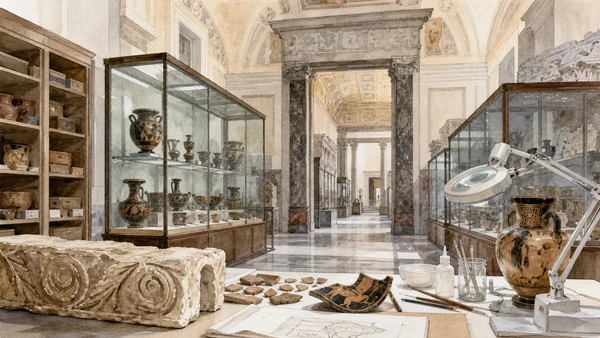
Original documentary watercolour of Conservation and provenance: how the museum keeps changing in Naples, showing architecture, people and present-day urban context
Conservation and provenance: how the museum keeps changingOriginal Merlintravel documentary watercolour · 2026

Naples through time

A short chronology

From Greek Neapolis and Roman infrastructure to dynastic capitals, wartime rupture, UNESCO care and a living metropolitan centre.

  1. Greek settlements and Neapolis establish the coastal and gridded urban foundations later absorbed by Roman Naples.

  2. Walls, streets, sanctuaries and civic spaces consolidate the ancient city on the tuff plateau.

  3. Roman Naples expands its theatres, baths, water systems, port functions and elite residences.

  4. Christian worship, burial and episcopal institutions reshape the ancient city and its edges.

  5. The Duchy of Naples maintains a distinct Mediterranean political and cultural identity.

  6. Norman and Swabian rule integrate Naples into larger southern kingdoms while reusing existing institutions.

  7. Angevin rule makes Naples a royal capital and begins major castle, church and urban commissions.

  8. Aragonese rule adds court culture, fortification and monumental Renaissance patronage.

  9. Spanish viceregal government extends Via Toledo, military quarters, religious houses and administrative power.

  10. Bourbon rule restores Naples as a dynastic capital and expands royal, cultural and infrastructural projects.

  11. The brief Parthenopean Republic and its repression expose deep political and social conflict.

  12. French-period government reforms streets, institutions and public administration.

  13. Naples enters the unified Kingdom of Italy and its capital functions are reorganised.

  14. Bombing, occupation, the Four Days and post-war rebuilding transform the city and port.

  15. UNESCO inscription, restoration, tourism pressure and resident-led cultural work renew debate over a living historic centre.

Before your visit

Practical information

01

Reserve constrained interiors

Timed museums, underground routes and major chapels can sell out; use only their current official booking channels.

02

Respect worship

Church access can pause for liturgy, funerals or community events; a visitor ticket never overrides religious use.

03

Walk the terrain

Tuff ridges, steep stairs, uneven paving and dense traffic are part of the city; keep a shorter accessible alternative.

04

Do not turn residents into scenery

Keep doorways, workshops, market lanes and courtyards clear; photograph people only with consent.

05

Check live transport

Metro, funicular, port and bus service can change; verify the same-day operator notice before relying on a connection.

06

Read layers, not clichés

Religious devotion, poverty, theatricality and danger are not interchangeable labels for Naples; use documented sites and institutions.

Method and sources

Sources and image credits

This guide uses official museum, ministry, church, transport and UNESCO documentation checked on 29 August 2026. It separates durable historical interpretation from access details that can change; distinguishes surviving fabric from reconstruction, restoration and legend; and treats worship, work, residence and public movement as part of the evidence rather than visual interference. Every chapter links its principal institutional source, while current tickets, closures and transport must always be verified again on the day of the visit.

All ten images are original Merlintravel editorial watercolours based on documented present-day conditions. They are illustrations, not substitutes for archaeological plans. Opening hours, tickets, accessible routes, temporary exhibitions and conservation work can change; consult the linked official pages shortly before visiting.