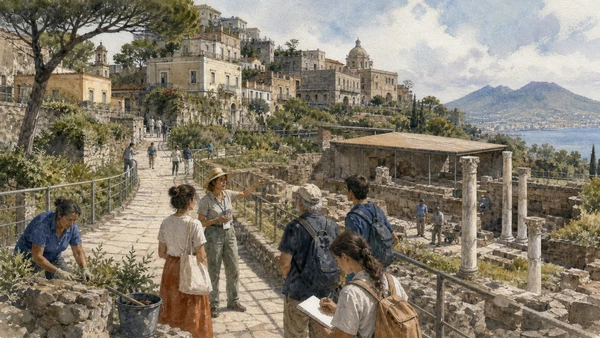
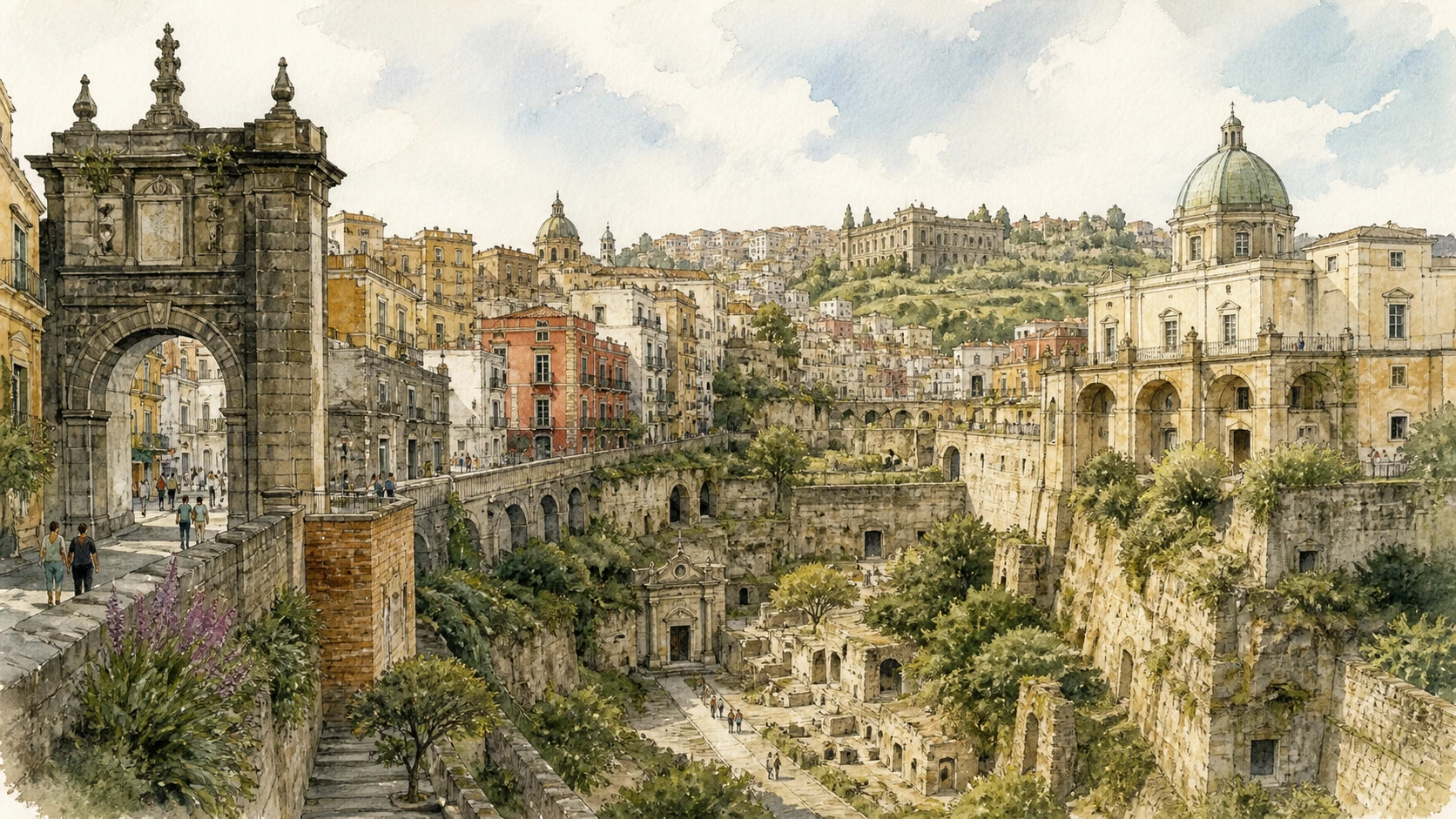
Original documentary watercolour panorama for Naples Rione Sanità, Catacombs and the Inhabited Tuff Landscape: Complete Guide, with accurate Naples architecture and lived urban context

Naples Guide 10 · Early Christian burial, Baroque architecture, bridge infrastructure and community-led heritage

Rione Sanità, Catacombs
& the Tuff Landscape

A neighbourhood-scale route from Porta San Gennaro through the Sanità valley to the Catacombs of San Gaudioso and San Gennaro, palaces, bridges, cemeteries and community cultural institutions.

Plan the route
Naples · Campania10 chapters · one full day

Why this Naples district must be read in layers

The Sanità is a topographic system before it is a collection of attractions: a valley outside the ancient walls became a burial landscape, pilgrimage route, aristocratic address, dense neighbourhood and site of modern separation and renewal.

Tuff allowed catacombs, quarries and later burial grounds to develop along the valley edges. Early Christian devotion around saints and bishops connected underground spaces to basilicas and processional routes above.

Baroque palaces and the Basilica of Santa Maria della Sanità record seventeenth- and eighteenth-century investment, while the nineteenth-century bridge carried traffic overhead and altered neighbourhood movement and social geography.

Recent access to the catacombs and heritage sites is closely tied to local organisations and employment. Visitors should recognise community governance, avoid poverty tourism and keep homes, schools and businesses outside the camera unless consent is clear.

Book the catacombs through their official community operator, walk the Holy Mile in daylight and treat the neighbourhood itself as a living place whose access and dignity come before photography.

The route

Plan your visit

Enter through Porta San Gennaro, follow the valley to its basilica and palaces, visit the two catacomb systems under controlled guidance, then read the bridge and cemetery landscape as later transformations.

Early morning

Porta San Gennaro · The Sanità valley · Santa Maria della Sanità

Move in the documented order: Porta San Gennaro: gate toward burial and pilgrimage; then The Sanità valley: terrain before neighbourhood; then Santa Maria della Sanità: basilica above the catacomb. Check live access before entering ticketed or liturgical spaces.

Late morning

Catacombs of San Gaudioso · Catacombs of San Gennaro · Palazzo Sanfelice

Move in the documented order: Catacombs of San Gaudioso: burial, fresco and bodily memory; then Catacombs of San Gennaro: two levels and an early Christian community; then Palazzo Sanfelice: Baroque stairs as urban theatre. Check live access before entering ticketed or liturgical spaces.

Afternoon

Palazzo dello Spagnuolo · Ponte della Sanità · Fontanelle Cemetery

Move in the documented order: Palazzo dello Spagnuolo: staircase, density and present residence; then Ponte della Sanità: infrastructure that connected and divided; then Fontanelle Cemetery: quarry, ossuary and contested devotion. Check live access before entering ticketed or liturgical spaces.

Late afternoon

The Holy Mile

Move in the documented order: The Holy Mile: community governance and a connected route. Check live access before entering ticketed or liturgical spaces.

Ten chapters

Explore the places

The order follows terrain, institutions and present-day movement. Use the index to return to a chapter without reducing the district to isolated monuments.

  1. 01Porta San Gennaro: gate toward burial and pilgrimage
  2. 02The Sanità valley: terrain before neighbourhood
  3. 03Santa Maria della Sanità: basilica above the catacomb
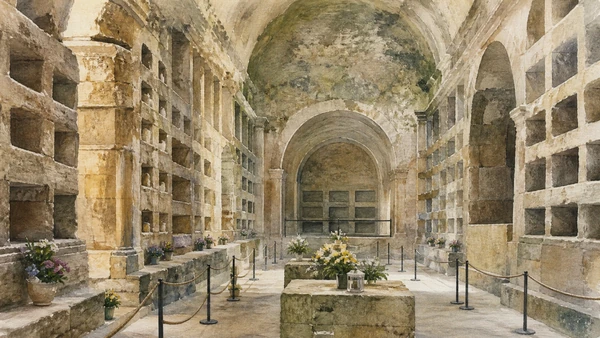
  4. 04Catacombs of San Gaudioso: burial, fresco and bodily memory
  5. 05Catacombs of San Gennaro: two levels and an early Christian community
  6. 06Palazzo Sanfelice: Baroque stairs as urban theatre
  7. 07Palazzo dello Spagnuolo: staircase, density and present residence
  8. 08Ponte della Sanità: infrastructure that connected and divided
  9. 09Fontanelle Cemetery: quarry, ossuary and contested devotion
  10. 10The Holy Mile: community governance and a connected route
01

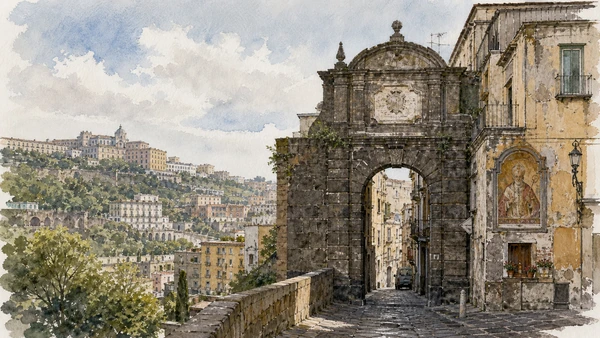
One of Naples’s ancient gates marks the route from the historic centre into the northern valley

Porta San Gennaro: gate toward burial and pilgrimage

Its surviving form is later than the earliest route but preserves a durable urban threshold.

Today

The gate stands on a busy street and is freely visible. Use crossings and do not obstruct shops or traffic while examining it.

History

The route connected Naples to catacombs and northern roads. The gate was moved and altered as walls and neighbourhoods changed, while religious imagery reinforced its association with San Gennaro.

How to read this place

Read the opening, adjacent street levels and painted sacred image. Then look north to understand the valley rather than treating the gate as an isolated arch.

What to notice

  • Urban gate opening toward the Sanità valley
  • Sacred image reinforcing pilgrimage identity
  • Later buildings pressing against defensive fabric
UNESCO World Heritage Centre · Historic Centre of Naples
Original documentary watercolour of Porta San Gennaro: gate toward burial and pilgrimage in Naples, showing architecture, people and present-day urban context
Porta San Gennaro: gate toward burial and pilgrimageOriginal Merlintravel documentary watercolour · 2026
02

A natural depression between tuff hills shaped roads, burial, drainage and later dense settlement

The Sanità valley: terrain before neighbourhood

Topography explains the district’s separation from adjacent high ground.

Today

Walk in daylight on active streets and use local guidance if unfamiliar. Traffic and pavement conditions vary; choose public transport when mobility is limited.

History

Ancient burial developed outside the city, followed by Christian cult sites and later residential expansion. Infrastructure crossed and sometimes bypassed the valley rather than integrating it evenly.

How to read this place

Use street slopes, retaining walls and bridge height to reconstruct the valley. The physical terrain complicates simple social explanations.

What to notice

  • Steep tuff sides enclosing a dense urban floor
  • Roads following the valley toward burial sites
  • Bridge crossing overhead rather than descending
Catacombs of Naples · Rione Sanità
Original documentary watercolour of The Sanità valley: terrain before neighbourhood in Naples, showing architecture, people and present-day urban context
The Sanità valley: terrain before neighbourhoodOriginal Merlintravel documentary watercolour · 2026
03

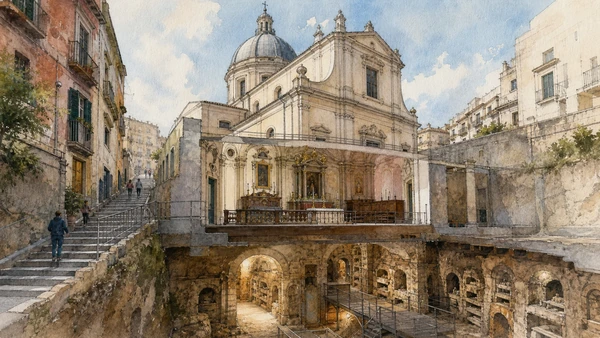
A Baroque church rises over an early Christian burial and devotional site

Santa Maria della Sanità: basilica above the catacomb

Stairs, crypt and dome make the vertical relationship visible.

Today

The basilica is active; guided catacomb access and worship follow different rules. Respect services and use the official operator for the underground route.

History

Dominicans developed the present church in the early seventeenth century above the Catacombs of San Gaudioso. Its plan and raised presbytery respond to the earlier sacred space below.

How to read this place

Stand beneath the dome, then locate the elevated sanctuary and descent. Architecture negotiates rather than hides the archaeological constraint.

What to notice

  • Baroque dome anchoring the neighbourhood
  • Raised presbytery above an earlier burial space
  • Street, church and catacomb connected vertically
Catacombs of Naples · Santa Maria della Sanità
Original documentary watercolour of Santa Maria della Sanità: basilica above the catacomb in Naples, showing architecture, people and present-day urban context
Santa Maria della Sanità: basilica above the catacombOriginal Merlintravel documentary watercolour · 2026
04

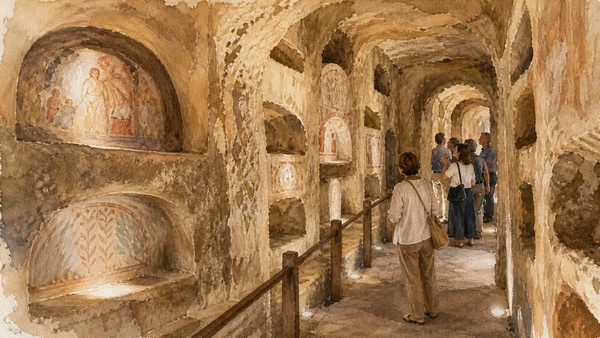
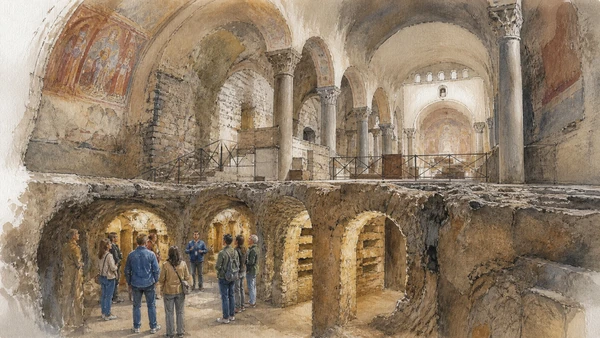
An early Christian cemetery was reused through later funerary practices beneath the basilica

Catacombs of San Gaudioso: burial, fresco and bodily memory

Painted bodies and skull displays require careful historical and ethical interpretation.

Today

Entry is only by guided route. The environment involves steps, humidity and confined space; follow the operator’s accessibility and photography rules.

History

Burial developed around the memory of Gaudiosus and continued through early Christian phases. Early modern elite practices added distinctive painted representations and arrangements of remains.

How to read this place

Distinguish ancient tomb types from later interventions. Human remains and memorial images should never be handled as theatrical props.

What to notice

  • Early Christian tombs cut into tuff
  • Later painted memorial practices
  • Guided route protecting human burial space
Catacombs of Naples · San Gaudioso
Original documentary watercolour of Catacombs of San Gaudioso: burial, fresco and bodily memory in Naples, showing architecture, people and present-day urban context
Catacombs of San Gaudioso: burial, fresco and bodily memoryOriginal Merlintravel documentary watercolour · 2026
05

Wide galleries, basilicas and episcopal burials form one of southern Italy’s most important early Christian complexes

Catacombs of San Gennaro: two levels and an early Christian community

Their spaciousness differs from the narrow tunnel stereotype.

Today

Timed guided access is required and entry and exit can be at different levels. Confirm accessibility, meeting point and current route before arrival.

History

Burial areas developed on two levels and expanded around important tombs, including those associated with bishops and San Gennaro. Basilical spaces and paintings document worship as well as burial.

How to read this place

Follow changes in gallery width, light and tomb density. Look for architectural spaces created for assembly, not only individual niches.

What to notice

  • Two broad levels adapted to tuff geology
  • Basilical spaces inserted within burial galleries
  • Frescoes identifying community and devotion
Catacombs of Naples · San Gennaro
Original documentary watercolour of Catacombs of San Gennaro: two levels and an early Christian community in Naples, showing architecture, people and present-day urban context
Catacombs of San Gennaro: two levels and an early Christian communityOriginal Merlintravel documentary watercolour · 2026
06

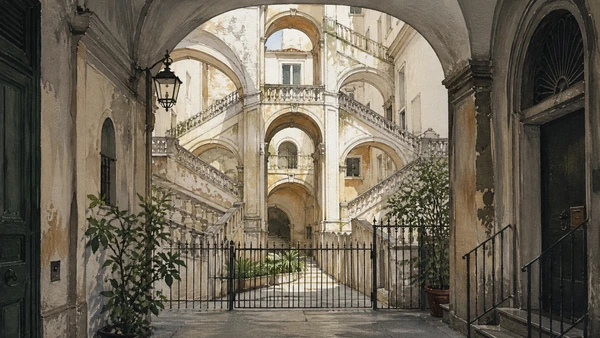
Open stair systems turn a confined palace courtyard into a complex sequence of arches and landings

Palazzo Sanfelice: Baroque stairs as urban theatre

The famous view remains a residential threshold.

Today

The palace is inhabited and is not automatically open for tourist entry. Observe only from public or explicitly permitted space and never block residents.

History

Ferdinando Sanfelice designed the eighteenth-century palace, using structural and visual invention to organise movement on a difficult site. Later subdivision and use changed the building.

How to read this place

From the permitted threshold, compare paired stair flights, arches and light. Do not enter deeper courtyards without consent.

What to notice

  • Open stair flights crossing a narrow courtyard
  • Arches framing movement and changing light
  • Current residence limiting visitor access
Comune di Napoli · Rione Sanità
Original documentary watercolour of Palazzo Sanfelice: Baroque stairs as urban theatre in Naples, showing architecture, people and present-day urban context
Palazzo Sanfelice: Baroque stairs as urban theatreOriginal Merlintravel documentary watercolour · 2026
07

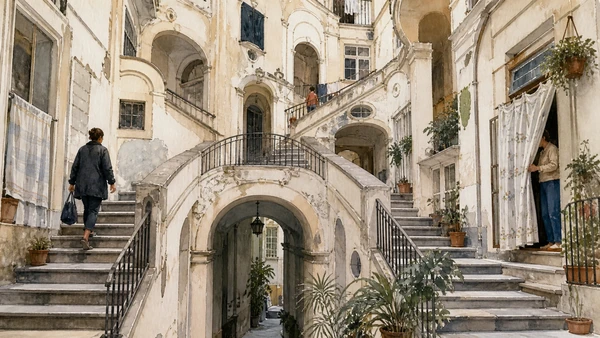
A dramatic double staircase became an emblem of Neapolitan Baroque domestic architecture

Palazzo dello Spagnuolo: staircase, density and present residence

Its visual fame increases pressure on a building where people still live.

Today

Access is not guaranteed. Remain outside if gates are closed, keep voices low and never photograph residents through doors or windows.

History

The palace was built in the eighteenth century with a staircase design associated with Ferdinando Sanfelice’s architectural language. Subdivision and modern use altered apartments and services.

How to read this place

Read the stair as circulation first and image second. Landings distribute multiple households and show how social movement shaped design.

What to notice

  • Double staircase distributing many dwellings
  • Curved stucco and arches shaping a tight court
  • Inhabited fabric requiring privacy
Comune di Napoli · Rione Sanità
Original documentary watercolour of Palazzo dello Spagnuolo: staircase, density and present residence in Naples, showing architecture, people and present-day urban context
Palazzo dello Spagnuolo: staircase, density and present residenceOriginal Merlintravel documentary watercolour · 2026
08

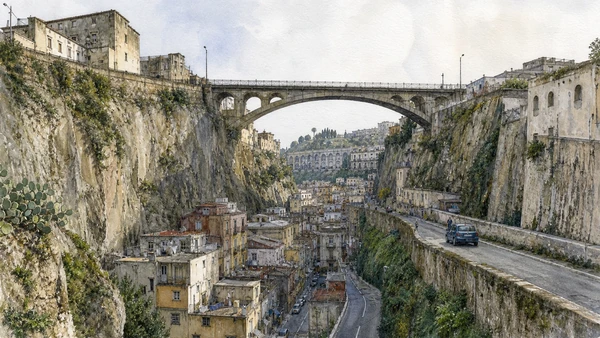
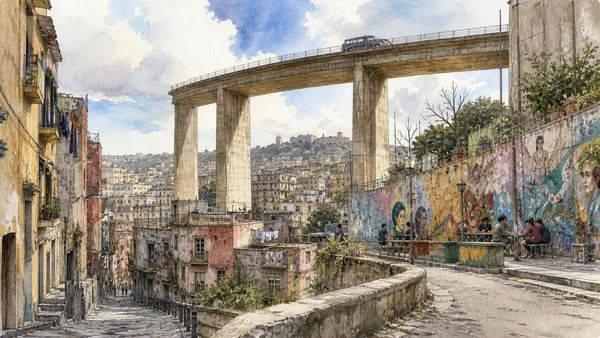
A high early nineteenth-century bridge carried a direct road above the valley

Ponte della Sanità: infrastructure that connected and divided

It improved regional movement while bypassing the neighbourhood below.

Today

Traffic and pedestrian routes differ between upper and lower levels. Use safe crossings and avoid informal edge viewpoints.

History

The bridge formed part of a new connection toward Capodimonte under French-period planning. Its piers cut through the urban and religious landscape, altering access and social relationships.

How to read this place

Stand below to grasp scale, then use a legal route above. Compare speed overhead with the finer street network in the valley.

What to notice

  • Tall piers crossing the inhabited valley
  • Direct upper road bypassing lower streets
  • Later murals and community use reclaiming infrastructure
Comune di Napoli · Ponte della Sanità
Original documentary watercolour of Ponte della Sanità: infrastructure that connected and divided in Naples, showing architecture, people and present-day urban context
Ponte della Sanità: infrastructure that connected and dividedOriginal Merlintravel documentary watercolour · 2026
09

A large tuff cavity became an ossuary and a site of popular relationships with anonymous remains

Fontanelle Cemetery: quarry, ossuary and contested devotion

Closure, conservation and religious regulation must be checked before any visit.

Today

Access has changed repeatedly for safety and management reasons. Consult the Comune’s live notice and do not use unofficial entrances.

History

The quarry supplied building stone and later received human remains transferred from crowded burial grounds and crises. Practices of caring for selected skulls developed within popular devotion and were later restricted.

How to read this place

If officially open, treat the site as a cemetery. Separate documented burial history from sensational stories and never touch remains or offerings.

What to notice

  • Large quarry volume reused for collective burial
  • Ordered remains preserving institutional interventions
  • Devotional care requiring ethical interpretation
Comune di Napoli · Cimitero delle Fontanelle
Original documentary watercolour of Fontanelle Cemetery: quarry, ossuary and contested devotion in Naples, showing architecture, people and present-day urban context
Fontanelle Cemetery: quarry, ossuary and contested devotionOriginal Merlintravel documentary watercolour · 2026
10

A locally managed itinerary links catacombs, churches, palaces and streets through employment and cultural care

The Holy Mile: community governance and a connected route

The model makes residents participants in heritage rather than background to it.

Today

Book through the official cooperative, follow group-size rules and support neighbourhood businesses without invading private life.

History

Community organisations developed guided access, restoration support and cultural programmes around sites long affected by underinvestment. The route reframes physical distance as shared history.

How to read this place

Notice staff knowledge, maintenance and local partnerships as part of the heritage infrastructure. A responsible visitor contributes time and attention, not only photographs.

What to notice

  • Connected route joining above- and below-ground sites
  • Local guides mediating evidence and access
  • Heritage employment rooted in the neighbourhood
Catacombs of Naples · The Holy Mile
Original documentary watercolour of The Holy Mile: community governance and a connected route in Naples, showing architecture, people and present-day urban context
The Holy Mile: community governance and a connected routeOriginal Merlintravel documentary watercolour · 2026

Naples through time

A short chronology

From Greek Neapolis and Roman infrastructure to dynastic capitals, wartime rupture, UNESCO care and a living metropolitan centre.

  1. Greek settlements and Neapolis establish the coastal and gridded urban foundations later absorbed by Roman Naples.

  2. Walls, streets, sanctuaries and civic spaces consolidate the ancient city on the tuff plateau.

  3. Roman Naples expands its theatres, baths, water systems, port functions and elite residences.

  4. Christian worship, burial and episcopal institutions reshape the ancient city and its edges.

  5. The Duchy of Naples maintains a distinct Mediterranean political and cultural identity.

  6. Norman and Swabian rule integrate Naples into larger southern kingdoms while reusing existing institutions.

  7. Angevin rule makes Naples a royal capital and begins major castle, church and urban commissions.

  8. Aragonese rule adds court culture, fortification and monumental Renaissance patronage.

  9. Spanish viceregal government extends Via Toledo, military quarters, religious houses and administrative power.

  10. Bourbon rule restores Naples as a dynastic capital and expands royal, cultural and infrastructural projects.

  11. The brief Parthenopean Republic and its repression expose deep political and social conflict.

  12. French-period government reforms streets, institutions and public administration.

  13. Naples enters the unified Kingdom of Italy and its capital functions are reorganised.

  14. Bombing, occupation, the Four Days and post-war rebuilding transform the city and port.

  15. UNESCO inscription, restoration, tourism pressure and resident-led cultural work renew debate over a living historic centre.

Before your visit

Practical information

01

Reserve constrained interiors

Timed museums, underground routes and major chapels can sell out; use only their current official booking channels.

02

Respect worship

Church access can pause for liturgy, funerals or community events; a visitor ticket never overrides religious use.

03

Walk the terrain

Tuff ridges, steep stairs, uneven paving and dense traffic are part of the city; keep a shorter accessible alternative.

04

Do not turn residents into scenery

Keep doorways, workshops, market lanes and courtyards clear; photograph people only with consent.

05

Check live transport

Metro, funicular, port and bus service can change; verify the same-day operator notice before relying on a connection.

06

Read layers, not clichés

Religious devotion, poverty, theatricality and danger are not interchangeable labels for Naples; use documented sites and institutions.

Method and sources

Sources and image credits

This guide uses official museum, ministry, church, transport and UNESCO documentation checked on 29 August 2026. It separates durable historical interpretation from access details that can change; distinguishes surviving fabric from reconstruction, restoration and legend; and treats worship, work, residence and public movement as part of the evidence rather than visual interference. Every chapter links its principal institutional source, while current tickets, closures and transport must always be verified again on the day of the visit.

All ten images are original Merlintravel editorial watercolours based on documented present-day conditions. They are illustrations, not substitutes for archaeological plans. Opening hours, tickets, accessible routes, temporary exhibitions and conservation work can change; consult the linked official pages shortly before visiting.