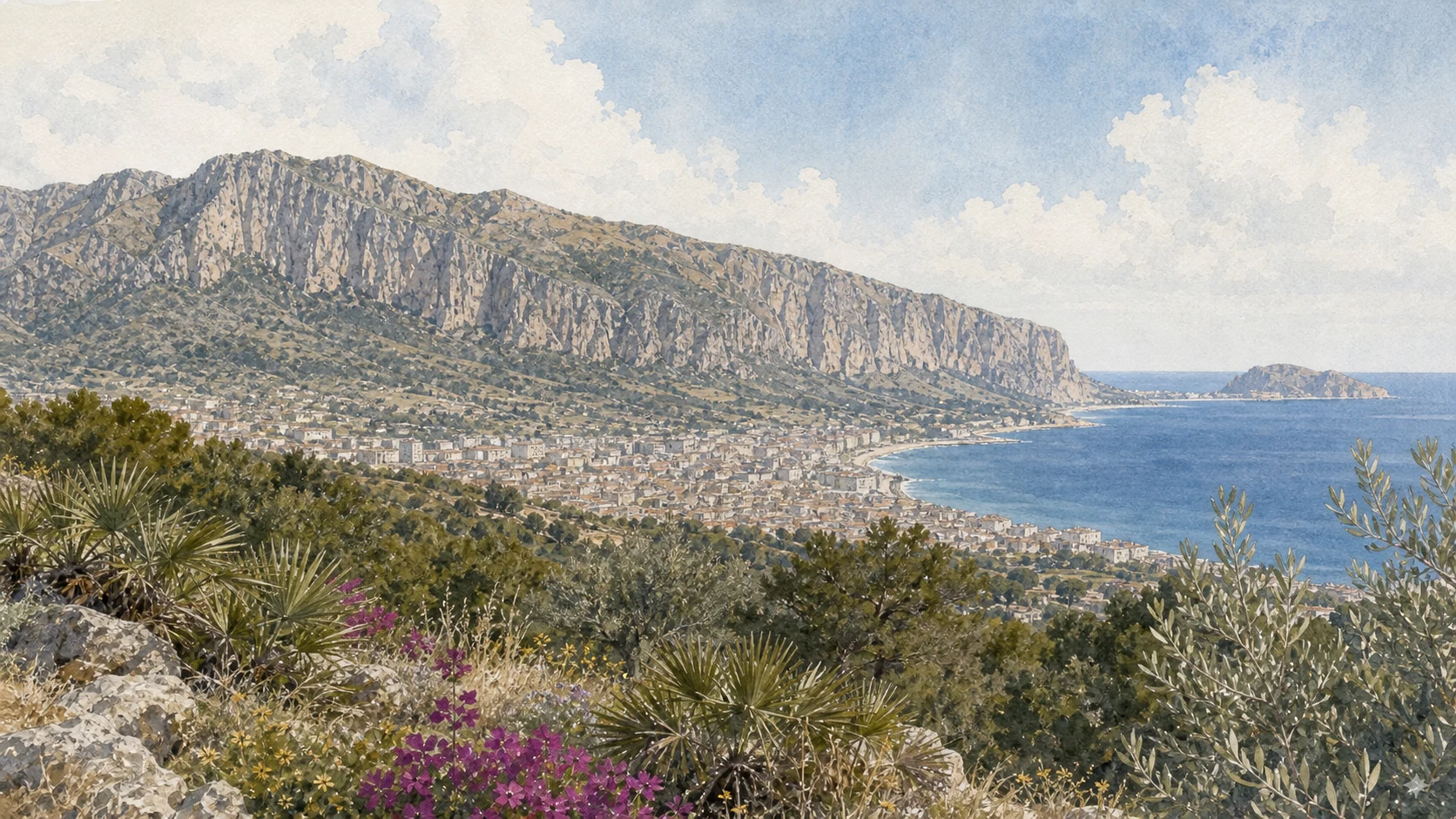
Documentary watercolour of Palermo between the Tyrrhenian Sea and Monte Pellegrino, with historic roofs, domes, gardens and spring colour

Illustrated guide · Sicily

A harbour city,
a royal capital
and many Palermos

Twenty-six substantial chapters follow Palermo from buried rivers and Punic harbour through Islamic and Norman capitals, Baroque streets, markets, theatres, living traditions and the Monte Pellegrino coast.

Explore the places
Palermo · harbour, royal city, markets, mountains and living memory

Where the family journey through Sicily reaches its great Mediterranean capital

Sicily entered this project first as family geography.

Relatives across the island, journeys since childhood and summers in Taormina.

Palermo adds a different scale to that personal route. It is not one ancestral village or one holiday landscape, but a capital repeatedly enlarged by people arriving from the sea and by communities remaking the same streets under new languages, governments and forms of belief.

The guide therefore resists the easy phrase that every culture simply left a layer. Some buildings replaced earlier ones; some techniques survived through artisans whose names are lost; some communities were displaced; rivers were covered; gardens became streets; wartime destruction and speculative building altered the city again. Continuity and rupture must be read together.

The aim is to encounter Palermo as several cities that still negotiate one another: Panormos between two rivers, Balarm and its quarters, a royal laboratory of the Norman kingdom, a viceregal stage, a nineteenth-century metropolis, a city marked by mafia violence and civic resistance, and a living coast held between Monte Pellegrino and the sea.

One destination

Twenty-six chapters across a Mediterranean metropolis

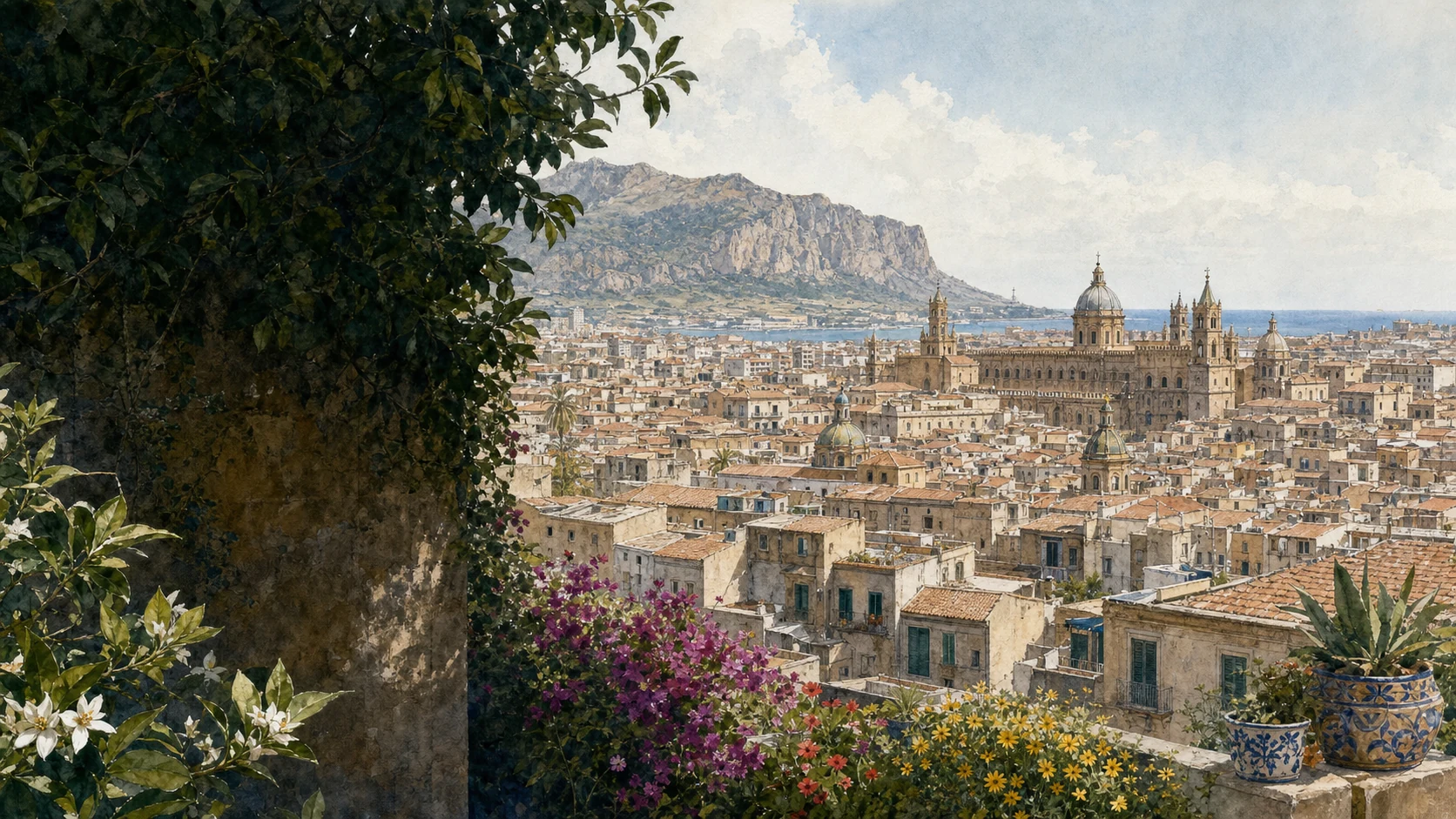
The historic centre occupies a low coastal plain inside the Conca d'Oro, protected by limestone mountains and opened to the Tyrrhenian Sea. The Phoenician settlement developed on a tongue of land between the Kemonia and Papireto rivers; both waterways were later redirected, covered and absorbed into the urban fabric, but they still explain the Cassaro, ancient walls, harbour and drainage problems.

The Islamic city of Balarm was one of the Mediterranean's major urban centres. Norman rulers conquered it in 1072 and later made Palermo the capital of the Kingdom of Sicily, employing and reorganising Latin, Greek, Islamic, Jewish and other knowledge. The UNESCO monuments preserve an extraordinary courtly synthesis, but they do not prove an age without hierarchy, conflict, conversion or displacement.

Later Palermo expanded through Angevin, Aragonese, Spanish, Bourbon and Italian rule. Quattro Canti and the new Via Maqueda reorganised the old quarters; Baroque churches and oratories turned stucco into narrative theatre; the Teatro Massimo, Via Libertà and the Florio world expressed new ambitions. Markets, puppet theatres, religious festivals, migration and neighbourhood life kept remaking the city below official monuments.

Contemporary Palermo cannot be understood without the violence of Cosa Nostra and the people who resisted it. The Falcone tree, Via D'Amelio and the No Mafia Memorial are not sensational attractions but places of civic responsibility. Beyond the centre, Monte Pellegrino, the Favorita, Mondello and Capo Gallo show that the metropolis is also a protected geological, botanical and marine landscape.

The selection

Twenty-six chapters,
one city that resists a single image

The route consolidates connected sites and histories while preserving Palermo's metropolitan scale, lived quarters, museums, markets, ritual calendars, mountain and coast.

  1. 01Conca d'Oro, Sea, Mountains and Buried Rivers
  2. 02Phoenician Panormos and the Punic Necropolis
  3. 03From Roman Panormus to Islamic Balarm
  4. 04Qasr, Cassaro and Kalsa
  5. 05Qanat, Genoard and the Making of a Norman Capital
  6. 06Palazzo Reale and the Cappella Palatina
  7. 07San Giovanni, Martorana and San Cataldo
  8. 08Palermo Cathedral: Mosque Memory, Royal Tombs and Layered Architecture
  9. 09La Zisa, La Cuba and the Cubula
  10. 10Maredolce, the Favara and the Admiral's Bridge
  11. 11La Magione and Palazzo Steri
  12. 12Quattro Canti and Piazza Pretoria
  13. 13Casa Professa and the Oratories of Serpotta
  14. 14Palazzo Abatellis
  15. 15The Salinas Museum
  16. 16The Capuchin Catacombs
  17. 17Ballaro, Albergheria, Capo and Seralcadio
  18. 18Vucciria, Loggia and Cala
  19. 19Teatro Massimo, Politeama and the New City
  20. 20Liberty Palermo, Ernesto Basile and the Florios
  21. 21La Favorita and the Chinese Palace
  22. 22Opera dei Pupi and the Festino of Santa Rosalia
  23. 23Monte Pellegrino, Addaura and the Sanctuary in the Rock
  24. 24Mondello and Capo Gallo
  25. 25Falcone Tree, Via D'Amelio and No Mafia Memorial
  26. 26Cantieri Culturali alla Zisa and Contemporary Palermo
01

PALERMO'S PLAIN WAS SHAPED BY WATERCOURSES NOW HIDDEN BENEATH A DENSE METROPOLIS

Conca d'Oro, Sea, Mountains and Buried Rivers

Sea, Monte Pellegrino, Kemonia and Papireto explain the city's position and the risks of reading the present street surface as unchanged terrain.

Documentary watercolour of Palermo's Cappella Palatina looking along the central nave through marble columns toward the gold mosaics beneath the carved wooden ceiling
THE ROYAL CHAPEL

The place today

Monte Pellegrino, Monte Gallo and the inland crowns of the Palermo mountains frame a metropolitan plain now densely urbanised. The Kemonia and Papireto are no longer open rivers through central Palermo.

The historical chapter

Springs, seasonal streams, fertile soils and a sheltered inlet supported settlement and intensive cultivation. Phoenician and Punic Panormos developed on defensible land between the two waterways.

What to notice

  • Do not use Conca d'Oro as a synonym for the historic centre; it is the wider plain around the city.
  • Subterranean water structures are not automatically public qanat routes; access depends on conservation and authorised openings.
UNESCO · Arab-Norman Palermo nomination dossier and territorial setting
02

HARBOUR, TWO URBAN CORES AND BURIALS REVEAL A WESTERN MEDITERRANEAN CITY BEFORE ROME

Phoenician Panormos and the Punic Necropolis

Cassaro, Cala and museum archaeology make Punic Palermo visible without reconstructing a complete ancient skyline.

Documentary watercolour of Palermo's Cappella Palatina looking along the central nave through marble columns toward the gold mosaics beneath the carved wooden ceiling
THE ROYAL CHAPEL

The place today

Most ancient Panormos lies beneath later Palermo. Punic funerary zones survive in excavated sectors and through objects conserved by the Antonino Salinas Regional Archaeological Museum.

The historical chapter

Phoenician settlement developed by at least the archaic period and became an important Punic centre in western Sicily. The necropolis developed beyond the western defences as Panormos grew.

What to notice

  • Call Panormos a Phoenician-Punic city within Greek and wider Mediterranean networks, not a Greek colony.
  • Check current museum galleries and special openings rather than promising access to every excavated tomb.
University of Palermo · Phoenician Cassaro and ancient wall circuit
03

LONG CONTINUITY GAVE WAY TO A CAPITAL EXPANDING THROUGH FIVE URBAN QUARTERS

From Roman Panormus to Islamic Balarm

Roman and Byzantine layers precede the political, demographic and hydraulic transformation of Islamic Palermo.

Documentary watercolour of Palermo's Cappella Palatina looking along the central nave through marble columns toward the gold mosaics beneath the carved wooden ceiling
THE ROYAL CHAPEL

The place today

Roman mosaics, architectural fragments, inscriptions and reused materials appear in museums and scattered archaeological contexts rather than a single monumental forum. Few Islamic buildings survive in an unaltered state, but the old street structure, later monuments, place names, archaeology and medieval descriptions preserve elements of the city.

The historical chapter

Panormus entered Roman control during the First Punic War and remained a port city connected to Sicilian agriculture and Mediterranean routes. After conquest in 831, Palermo replaced Syracuse as the island's principal political centre.

What to notice

  • Do not present Roman Palermo as a completely new city laid over an abandoned Punic site; continuity and adaptation mattered.
  • Do not equate the later four mandamenti with the five quarters described for medieval Balarm.
Palermo Cathedral · institutional chronology from late antiquity to the present
04

TWO POLITICAL DISTRICTS ORGANISED POWER ALONG THE MAIN AXIS AND WATERFRONT

Qasr, Cassaro and Kalsa

The old fortified core and the khalisa should be kept distinct while their names and street patterns continue through later Palermo.

Documentary watercolour of Palermo's Cappella Palatina looking along the central nave through marble columns toward the gold mosaics beneath the carved wooden ceiling
THE ROYAL CHAPEL

The place today

The Cassaro links Palazzo Reale, the Cathedral, Quattro Canti, the lower historic centre and the sea. Piazza Magione, Palazzo Abatellis, Palazzo Mirto, churches, gardens, alleys and the Foro Italico make the Kalsa one of Palermo's richest urban palimpsests.

The historical chapter

The route follows the high spine of ancient Panormos and the fortified Qasr of Islamic Palermo. The Fatimid-period al-Khalisa concentrated government, military and court functions outside the older Qasr.

What to notice

  • Do not call every building along the Cassaro Arab-Norman; the street contains medieval, Renaissance, Baroque and modern fabric.
  • Do not describe wartime voids or restored squares as timeless medieval urban form.
Municipality of Palermo · official tourism and monument portal
05

ENGINEERED WATER AND CULTIVATED PARKS BECAME RESOURCES FOR A NEW ROYAL LANDSCAPE

Qanat, Genoard and the Making of a Norman Capital

Islamic hydraulic knowledge and Norman conquest belong to a connected but unequal transformation of palace, gardens and government.

Documentary watercolour of Palermo's Cappella Palatina looking along the central nave through marble columns toward the gold mosaics beneath the carved wooden ceiling
THE ROYAL CHAPEL

The place today

Qanat or ingruttati systems survive underground in different conditions, while visible basins at royal palaces evoke only part of the water network. Royal palace, churches, bridges and suburban palaces survive within a city altered by Spanish rebuilding, Bourbon intervention and modern restoration.

The historical chapter

Water-capture and distribution techniques developed across ancient, Islamic and later Palermo. Norman forces captured Palermo in 1072.

What to notice

  • Do not promise a qanat visit without a current authorised operator and safety confirmation.
  • Do not translate multicultural production into social equality unsupported by the evidence.
UNESCO · nomination dossier on royal parks and Islamic-derived water culture
Documentary watercolour of Palermo's Cappella Palatina looking along the central nave through marble columns toward the gold mosaics beneath the carved wooden ceiling
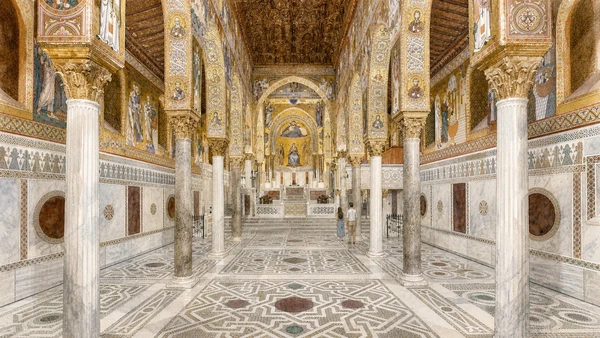
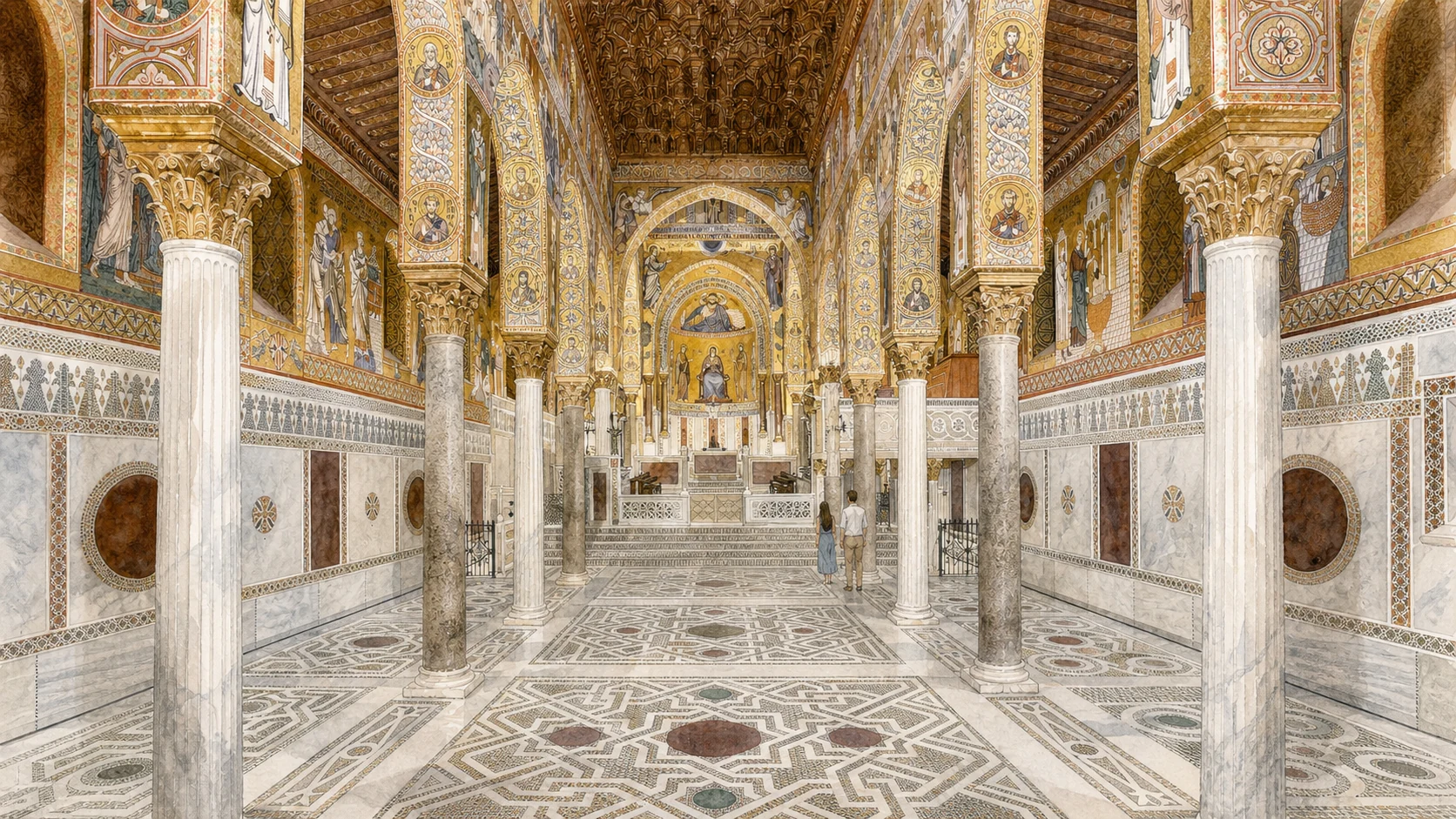
THE ROYAL CHAPELGold mosaics, a painted wooden ceiling, marble columns and geometric floors make the Cappella Palatina a material encounter between Byzantine, Islamic-derived and Latin traditions.
06

POWER WAS WRITTEN IN GOLD, PAINTED WOOD, STONE AND CEREMONIAL MOVEMENT

Palazzo Reale and the Cappella Palatina

The palace complex and chapel bring Byzantine, Islamic-derived and Latin traditions together without erasing conquest or institutional hierarchy.

Documentary watercolour of Palermo's Cappella Palatina looking along the central nave through marble columns toward the gold mosaics beneath the carved wooden ceiling
THE ROYAL CHAPEL

The place today

The palace is both a monumental complex and the seat of the Sicilian Regional Assembly. Visits may exclude rooms or change without notice for parliamentary, religious or conservation needs. Inside the chapel, mosaics, opus sectile, muqarnas ceiling, inscriptions, royal throne and liturgical space require slow looking; photography rules and access routes can change.

The historical chapter

Earlier fortifications occupied the upper city, but Roger II transformed the complex after his coronation. The chapel was begun around 1129–1130 and inaugurated in the 1140s. Greek-speaking mosaicists, Islamic-trained or Islamic-derived craftsmen and Western builders created coordinated images of sacred and royal order. Spanish-period wings and later restorations changed the palace around the surviving Norman towers and rooms.

What to notice

  • Check the Foundation's current notices because parliamentary sessions and mosaic restoration can alter access suddenly.
  • Do not call the painted wooden ceiling Byzantine; its form and imagery belong to Islamic-derived court craftsmanship within a Christian chapel.
Fondazione Federico II · Royal Palace visits and current access notices
07

THREE DIFFERENT CHURCHES REVEAL HOW DOMES, CLOISTERS AND MOSAICS WERE USED BY DISTINCT PATRONS

San Giovanni, Martorana and San Cataldo

A connected route preserves each foundation, later transformation and living use rather than turning red domes into one generic Arab-Norman style.

Documentary watercolour of Palermo's Cappella Palatina looking along the central nave through marble columns toward the gold mosaics beneath the carved wooden ceiling
THE ROYAL CHAPEL

The place today

The church, cloister, garden and surviving walls form a compact UNESCO component near Palazzo Reale. The church shares Piazza Bellini with San Cataldo but differs in plan, decoration and use. Three red domes rise above a severe cubic exterior beside the Martorana.

The historical chapter

Roger II founded the Benedictine complex in the twelfth century on an area associated with earlier religious buildings. George of Antioch, admiral of Roger II, founded the church in the 1140s. The church was founded in the mid-twelfth century in the orbit of Maio of Bari, a powerful minister under William I.

What to notice

  • Do not repeat the claim that the present church is simply a former mosque without explaining the debated earlier phases.
  • Explain that the uncluttered interior is partly a modern restoration outcome, not complete survival without alteration.
UNESCO · San Giovanni degli Eremiti component history
08

A LONG EXTERIOR AND NEOCLASSICAL INTERIOR RECORD MANY POLITICAL AND LITURGICAL REWRITINGS

Palermo Cathedral: Mosque Memory, Royal Tombs and Layered Architecture

The cathedral cannot be reduced to Norman fabric or its later dome; royal burial and urban setting remain part of the whole.

Documentary watercolour of Palermo's Cappella Palatina looking along the central nave through marble columns toward the gold mosaics beneath the carved wooden ceiling
THE ROYAL CHAPEL

The place today

The free worship area and ticketed monumental route have different conditions. Roofs, treasury, crypt and royal tombs may follow specific hours or weather rules. Visitors encounter the tombs of Roger II, Henry VI, Constance and Frederick II alongside the chapel of Santa Rosalia, while the broad nave reflects the late eighteenth-century remodelling associated with Ferdinando Fuga.

The historical chapter

A late antique and Byzantine cathedral stood near the ancient walls and was adapted as a congregational mosque after 831. The Normans returned it to Christian worship in 1072; Archbishop Walter of the Mill commissioned the present cathedral, consecrated in 1185. Gothic portals, Aragonese and Spanish additions, Baroque devotion and the 1781–1801 transformation created the building now visible.

What to notice

  • Do not call the present cathedral a converted mosque preserved intact; the Norman church replaced and reused a much-altered predecessor.
  • Separate free liturgical space from the paid monumental route and check roof access for weather or religious restrictions.
Palermo Cathedral · official architectural and liturgical chronology
09

WATER, AIR AND PAVILIONS STRUCTURED A ROYAL PARK NOW FRAGMENTED BY THE MODERN CITY

La Zisa, La Cuba and the Cubula

Palace and smaller structures survive at different scales and access conditions within the lost Genoard landscape.

Documentary watercolour of Palermo's Cappella Palatina looking along the central nave through marble columns toward the gold mosaics beneath the carved wooden ceiling
THE ROYAL CHAPEL

The place today

The palace stands within a dense modern district where the surviving garden and water channel only partly evoke the Genoard. The main Cuba stands along Corso Calatafimi, while the small Cubula survives in the grounds associated with Villa Napoli.

The historical chapter

William I began the palace in the 1160s and William II completed it. William II commissioned the Cuba in 1180 within the Genoard.

What to notice

  • Do not call Zisa an Arab palace built before the Normans; it is a Norman royal commission using Islamic-derived knowledge and labour.
  • Avoid reconstructing a complete lake and court scene as fact when the landscape is known through partial evidence.
UNESCO · Zisa and Genoard component dossier
10

PALACE WATER AND INFRASTRUCTURE EXTENDED ROYAL PALERMO BEYOND ITS MONUMENTAL CENTRE

Maredolce, the Favara and the Admiral's Bridge

Eastern gardens, reservoir memory, bridge and Oreto corridor show a lived edge whose geography should not be collapsed into one park.

Documentary watercolour of Palermo's Cappella Palatina looking along the central nave through marble columns toward the gold mosaics beneath the carved wooden ceiling
THE ROYAL CHAPEL

The place today

The castle and surviving water landscape stand in the Brancaccio area, separated from the central UNESCO route and surrounded by later urbanisation. Twelve stone arches rise within an urban park south-east of the centre, while the Oreto follows a different modern channel.

The historical chapter

A pre-Norman estate and hydraulic landscape were reorganised by Roger II into the Favara royal complex, with palace, chapel, water and island. The bridge was built in the twelfth century in the orbit of Admiral George of Antioch, linking Palermo with eastern routes across the Oreto.

What to notice

  • Check official opening announcements; Maredolce should not be advertised as a permanently accessible museum on a fixed daily schedule.
  • Treat the surrounding district and river condition as part of the visit, not visual clutter to crop away.
Sicilian Region · official register of Palermo cultural sites
11

THE KALSA HOLDS NORMAN-SWABIAN RELIGION, ARISTOCRATIC POWER AND INQUISITION MEMORY

La Magione and Palazzo Steri

Two institutions reveal the quarter's long political afterlife without treating it as a preserved medieval enclave.

Documentary watercolour of Palermo's Cappella Palatina looking along the central nave through marble columns toward the gold mosaics beneath the carved wooden ceiling
THE ROYAL CHAPEL

The place today

The austere church of Santissima Trinità faces an unusually open square in the Kalsa. The palace anchors Piazza Marina and is used by the University of Palermo.

The historical chapter

The church was founded in the 1190s by Matthew of Aiello and passed to the Teutonic Order under Henry VI. The Chiaramonte family built the palace in the fourteenth century, giving its name to the Chiaramontan Gothic language.

What to notice

  • Do not describe Piazza Magione's lawn as the original medieval setting of the church.
  • Approach prison graffiti as testimony by detained people, not atmospheric decoration.
Municipality of Palermo · official places and cultural portal
Documentary watercolour of Palermo's Quattro Canti from street level with two concave Baroque facades, fountains and the crossing streets visible between them
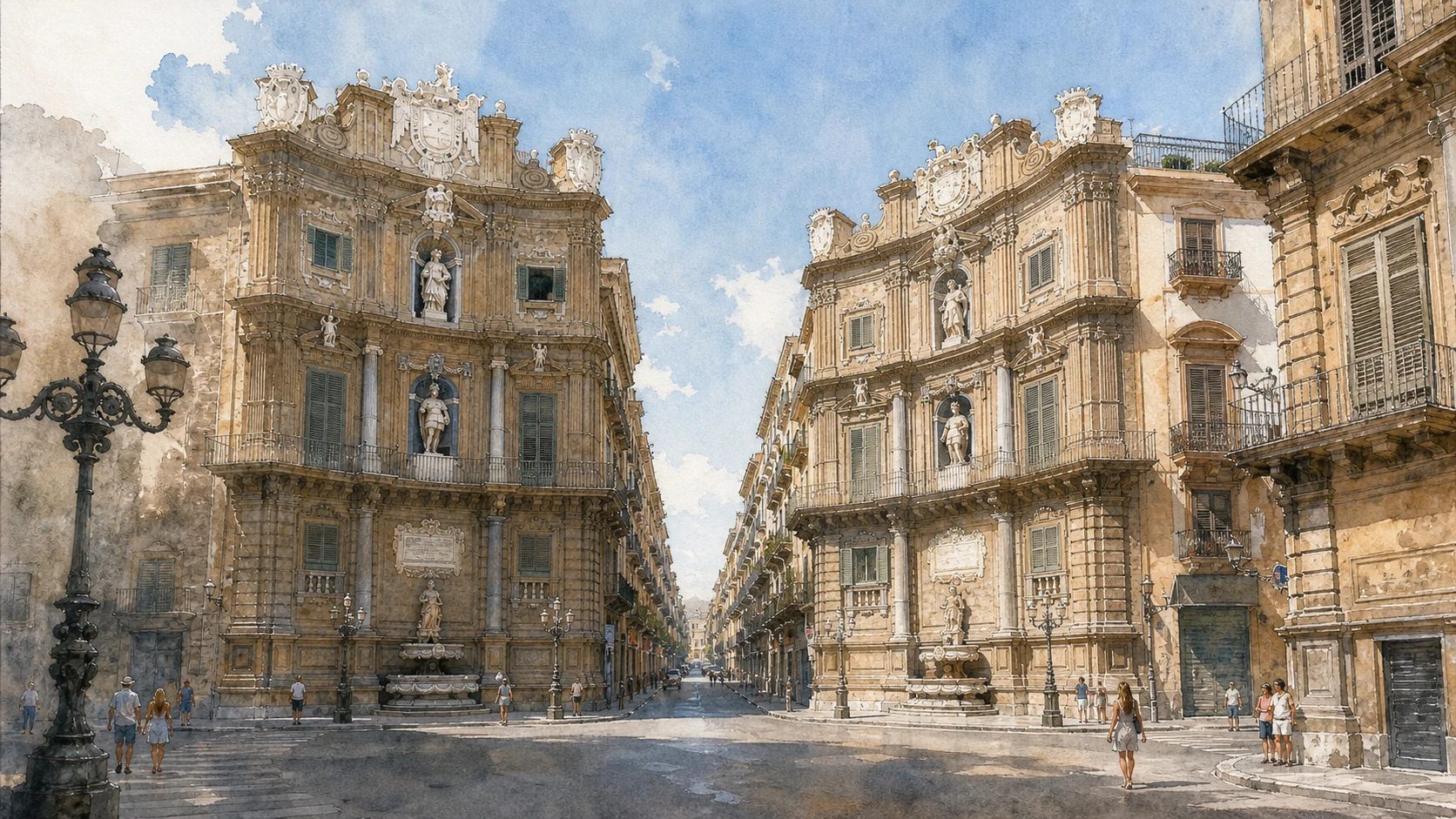
THE BAROQUE CROSSROADSFour concave facades turn the meeting of the Cassaro and Via Maqueda into an urban theatre whose real subject is movement through the city.
12

A BAROQUE CROSSROADS AND A REASSEMBLED FOUNTAIN REFRAMED THE FOUR MANDAMENTI

Quattro Canti and Piazza Pretoria

Street axes, civic palace and sculptural programme make a connected urban stage rather than two isolated photograph stops.

Documentary watercolour of Palermo's Quattro Canti from street level with two concave Baroque facades, fountains and the crossing streets visible between them
THE BAROQUE CROSSROADS

The place today

Four concave facades organise fountains, seasons, Spanish kings and patron saints around the intersection of Via Maqueda and the Cassaro. The monumental fountain fills the square between Palazzo delle Aquile, Santa Caterina and the rear of Piazza Bellini.

The historical chapter

Via Maqueda was opened from 1600 under Spanish rule, crossing the ancient east-west axis. Francesco Camilliani created the fountain for a Tuscan villa in the sixteenth century.

What to notice

  • Do not treat the four mandamenti as four monuments confined to the corner facades.
  • Do not assume municipal ceremonial rooms are open whenever the square is accessible.
Municipality of Palermo · Quattro Canti official monument page
13

COLOURED MARBLE AND WHITE STUCCO TURNED TEACHING AND BROTHERHOOD INTO DIFFERENT BAROQUE THEATRES

Casa Professa and the Oratories of Serpotta

Jesuit church and lay oratories reward comparison while their patrons, materials and ritual uses remain distinct.

Documentary watercolour of Palermo's Quattro Canti from street level with two concave Baroque facades, fountains and the crossing streets visible between them
THE BAROQUE CROSSROADS

The place today

The church of the Gesù stands beside the Ballarò-Albergheria district and the Jesuit complex of Casa Professa. Several oratories preserve Serpotta's figures, frames, allegories and playful putti, but each has its own management and opening pattern.

The historical chapter

The Jesuits established their Palermo house in the sixteenth century and expanded the church through the seventeenth and eighteenth centuries. Between the late seventeenth and early eighteenth centuries Giacomo Serpotta and his workshop transformed stucco into a sophisticated sculptural medium.

What to notice

  • Do not describe the decoration as random Baroque excess; follow chapel themes, materials and patronage.
  • At San Lorenzo, state clearly that Caravaggio's Nativity was stolen in 1969 and remains missing.
Palermo Cathedral circuit · official linked sacred monuments and current visit network
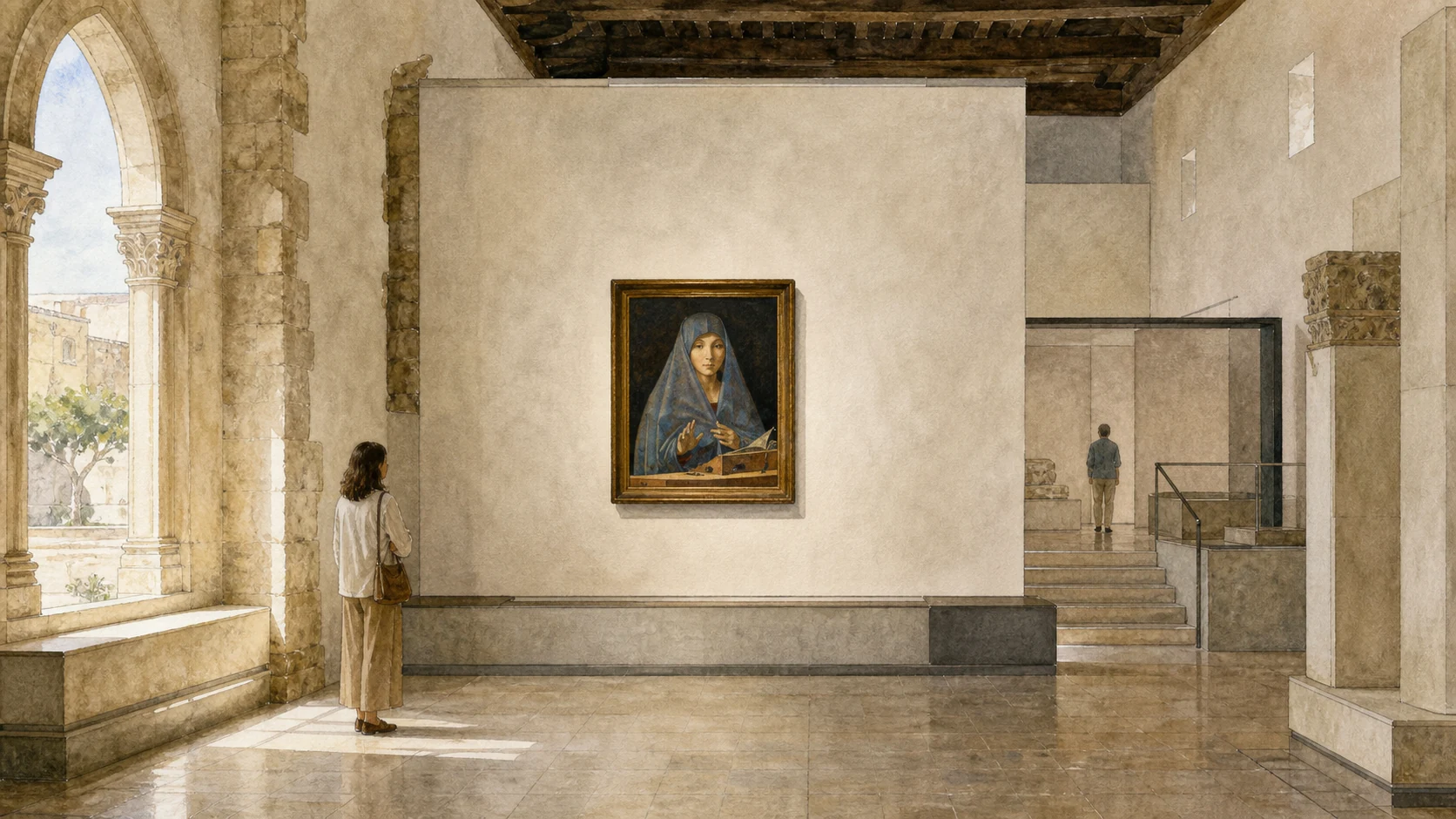
Documentary watercolour of a quiet gallery in Palermo's Palazzo Abatellis with Antonello da Messina's Annunciata displayed at human scale and two distant visitors
PALAZZO ABATELLISAntonello's Annunciata is encountered at human scale within a museum installation where medieval fabric, daylight and Carlo Scarpa's restraint shape the act of looking.
14

THE TRIUMPH OF DEATH AND ANTONELLO'S ANNUNCIATA INHABIT A MODERN MUSEUM DESIGN

Palazzo Abatellis

Artworks, palace and Carlo Scarpa's installation form one critical experience rather than a list of masterpieces.

Documentary watercolour of a quiet gallery in Palermo's Palazzo Abatellis with Antonello da Messina's Annunciata displayed at human scale and two distant visitors
PALAZZO ABATELLIS

The place today

The regional gallery presents medieval and early modern sculpture and painting, including the Triumph of Death fresco and Antonello da Messina's Annunciata. Carlo Scarpa's postwar display uses stands, colour, light and sequence as interpretive tools. Galleries or individual works may close for loans and conservation, so current notices matter.

The historical chapter

Matteo Carnilivari designed the palace for Francesco Abatellis around the end of the fifteenth century. It later became a convent and suffered wartime damage. The regional gallery opened in 1954 after restoration, with Scarpa's installation establishing a landmark in modern museography. Frescoes removed from damaged buildings and works from suppressed religious institutions bring histories of displacement into the collection.

What to notice

  • Do not separate Scarpa's twentieth-century display from the experience of the medieval and Renaissance works.
  • Check the current gallery status before promising that every major work is on view.
Sicilian Region · Galleria Regionale di Palazzo Abatellis
15

PALERMO READS ITSELF INSIDE THE ARCHAEOLOGY OF WESTERN SICILY

The Salinas Museum

Courtyards and collections connect Punic city, nearby ancient centres and the history of excavation while object origins remain explicit.

Documentary watercolour of a quiet gallery in Palermo's Palazzo Abatellis with Antonello da Messina's Annunciata displayed at human scale and two distant visitors
PALAZZO ABATELLIS

The place today

The Antonino Salinas museum occupies the former Olivella complex and holds major archaeological collections. Palermo finds share space with material from other western Sicilian sites, including sculpture and architectural elements whose original landscapes must be remembered. Long-term reorganisation and exhibitions can change which rooms are accessible.

The historical chapter

Collections grew from royal, ecclesiastical and private holdings, excavations and the work of scholars including Antonino Salinas. The museum became central to the formation of Sicilian archaeology, but older collecting practices sometimes removed objects from their contexts. Modern conservation and interpretation seek to reconnect artefacts with provenance, excavation and regional history.

What to notice

  • Do not attribute the Selinunte metopes or other regional masterpieces to ancient Palermo merely because they are displayed here.
  • Consult the museum's current information because reinstallation can close sections while the institution remains open.
Sicilian Region · Antonino Salinas Regional Archaeological Museum
16

BURIAL SOCIETY AND CONSERVATION REQUIRE AN ETHICS OF LOOKING

The Capuchin Catacombs

Human remains, clothing and social display demand respectful interpretation, current rules and rejection of sensational tourism.

Documentary watercolour of a quiet gallery in Palermo's Palazzo Abatellis with Antonello da Messina's Annunciata displayed at human scale and two distant visitors
PALAZZO ABATELLIS

The place today

Corridors contain mummified and skeletal remains arranged historically by clerical, professional, gender and family categories. Conditions of preservation differ, and conservation research continues. Rules against intrusive photography, touching and sensational behaviour protect both human dignity and fragile material.

The historical chapter

Capuchin burial began in the late sixteenth century and expanded as clergy, elites, professionals and families sought interment. Natural desiccation and other treatments produced varied preservation. The catacombs reflect social hierarchy and changing ideas of death; later scientific study has examined bodies, textiles, disease and environment while raising questions about consent and display.

What to notice

  • Use respectful cemetery language and follow all photography restrictions without trying to evade them.
  • Do not reduce Rosalia Lombardo or other individuals to macabre spectacle; names and bodies belong to human histories.
Municipality of Palermo · official tourism and monument portal
17

MARKET LABOUR PERSISTS INSIDE QUARTERS TRANSFORMED BY MIGRATION, TOURISM AND HOUSING PRESSURE

Ballaro, Albergheria, Capo and Seralcadio

Two market systems remain lived economies and neighbourhood routes rather than interchangeable street-food stages.

Documentary watercolour of a quiet gallery in Palermo's Palazzo Abatellis with Antonello da Messina's Annunciata displayed at human scale and two distant visitors
PALAZZO ABATELLIS

The place today

Stalls and shops extend through Albergheria with different intensity by day, street and season. The market runs through narrow streets near Porta Carini, the Cathedral and Teatro Massimo.

The historical chapter

The district lies within an urban area shaped by medieval expansion and later the Albergheria mandamento. The area formed part of Seralcadio, a name often related to an Islamic-period quarter but transmitted through later urban history.

What to notice

  • Ask before photographing vendors or customers closely and keep circulation routes clear.
  • Visit as a customer and pedestrian, not as if every vendor were a performer in a street-food attraction.
Municipality of Palermo · official tourism portal and market materials
18

A PROVISION MARKET BECAME A NIGHT-TIME SYMBOL BESIDE A WATERFRONT REPEATEDLY TRANSFORMED

Vucciria, Loggia and Cala

Commerce, decline, reinvention and port proximity require different times of day and attention to residents.

Documentary watercolour of a quiet gallery in Palermo's Palazzo Abatellis with Antonello da Messina's Annunciata displayed at human scale and two distant visitors
PALAZZO ABATELLIS

The place today

Piazza Caracciolo and nearby lanes retain food stalls and vendors but are also strongly associated with evening drinking and nightlife. The Loggia quarter reaches toward San Domenico, Piazza Marina and the Cala, where port redevelopment has changed movement. Day and night offer different places and require different safety and noise expectations.

The historical chapter

The district developed around trade, crafts and communities connected to the port. Its name has several proposed derivations, including French and market vocabulary, and should not be reduced to one certain Arabic origin. Twentieth-century decline in traditional provisioning, building deterioration, Guttuso's celebrated painting, tourism and nightlife reshaped the Vucciria's identity.

What to notice

  • Do not promise the dense daytime food market represented in mid-twentieth-century images; current activity is smaller and variable.
  • Treat nightlife, residents and historic fabric as competing uses of one quarter, not a single entertainment zone.
Municipality of Palermo · official market guide
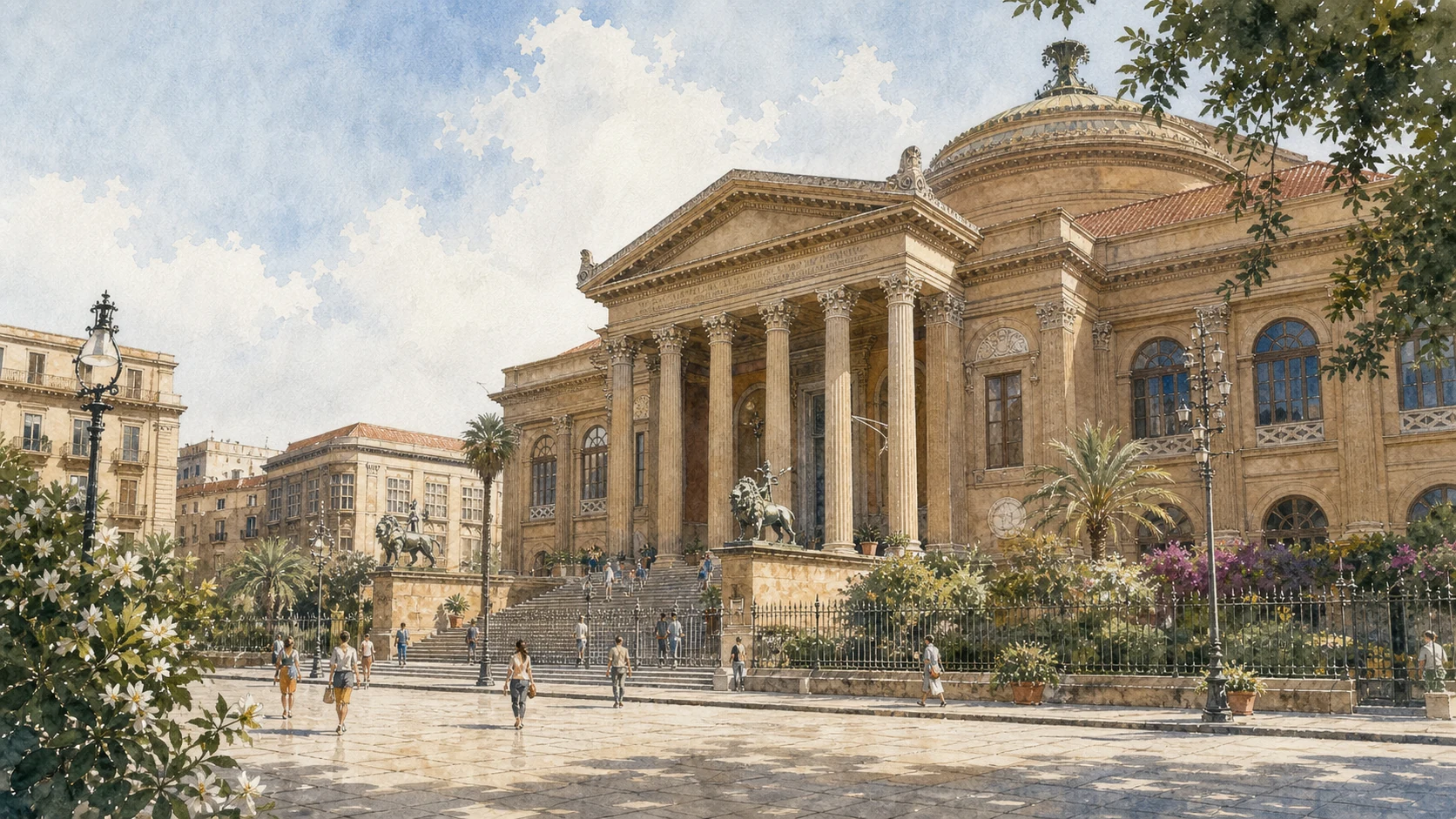
Documentary watercolour of Palermo's Teatro Massimo from Piazza Verdi with its broad staircase, Corinthian portico, dome and small groups of pedestrians
THE NEW CITYThe Teatro Massimo's staircase, portico and great dome announce the northward expansion of Palermo while the surrounding square keeps the monument inside everyday urban life.
19

OPERA HOUSES AND NORTHWARD AVENUES EXPRESSED NATIONAL AMBITION THROUGH DEMOLITION AND EXPANSION

Teatro Massimo, Politeama and the New City

The two theatres and connecting streets reveal different institutions within the late nineteenth-century city.

Documentary watercolour of Palermo's Teatro Massimo from Piazza Verdi with its broad staircase, Corinthian portico, dome and small groups of pedestrians
THE NEW CITY

The place today

The vast stair, Corinthian pronaos, bronze groups, dome and performance halls dominate Piazza Verdi. Piazza Castelnuovo and Piazza Ruggero Settimo form a broad urban stage around the Politeama, gateway to Via Libertà.

The historical chapter

Palermo launched a competition after Italian unification. The Politeama was conceived as a multipurpose popular theatre and opened in the later nineteenth century, with Damiani Almeyda's architecture and a triumphal quadriga.

What to notice

  • Distinguish a guided architectural visit from attending an opera, ballet or concert.
  • Read the route as urban expansion from the old city, not a detached shopping district without history.
Fondazione Teatro Massimo · official history
20

VILLAS, DECORATIVE ARTS AND ENTREPRENEURIAL PATRONAGE FORMED A FRAGILE BELLE EPOQUE LANDSCAPE

Liberty Palermo, Ernesto Basile and the Florios

Surviving architecture and lost interiors demand careful distinction between cultural innovation and nostalgic family myth.

Documentary watercolour of Palermo's Teatro Massimo from Piazza Verdi with its broad staircase, Corinthian portico, dome and small groups of pedestrians
THE NEW CITY

The place today

Villino Florio, Villa Igiea and surviving buildings around Via Libertà and the expanding city display different aspects of modern design. Some are museums or public sites, others hotels, institutions or private property. Interiors, gardens and original furnishings have survived unevenly.

The historical chapter

Around 1900 the Florio family's shipping, wine, industry and patronage helped position Palermo within European commercial and cultural networks. Ernesto Basile developed a distinctive modern architecture and total design language with local craftsmen. Economic decline, the First World War, changing ownership, bombing and postwar demolition dispersed the ensemble and fuelled later nostalgia.

What to notice

  • Do not enter private villas or hotel areas as if all Liberty heritage were a public museum.
  • Avoid romanticising the Florio era without discussing labour, economic risk, decline and the loss of buildings.
Sicilian Region · official register of Palermo cultural sites
21

BOURBON REFUGE, AGRICULTURE AND AN URBAN RESERVE SHARE THE FOOT OF MONTE PELLEGRINO

La Favorita and the Chinese Palace

Palace and park connect court history to present ecological and access pressures.

Documentary watercolour of Palermo's Teatro Massimo from Piazza Verdi with its broad staircase, Corinthian portico, dome and small groups of pedestrians
THE NEW CITY

The place today

Broad avenues, sports facilities, woodland and agricultural remnants stretch between the city and Monte Pellegrino. The Palazzina Cinese preserves an extraordinary royal interior but follows museum conditions separate from the park. Traffic closures, events, fire risk and reserve management can change movement.

The historical chapter

Ferdinand IV established the estate in 1799 after the Bourbon court took refuge in Palermo. The landscape combined hunting, leisure and experimental cultivation. Giuseppe Venanzio Marvuglia transformed the Chinese Palace through an imaginative European Orientalism rather than authentic Chinese architecture. The estate later became public and was incorporated into the Monte Pellegrino reserve.

What to notice

  • Call the Palazzina an Orientalising Bourbon creation, not a genuine Chinese building transplanted to Sicily.
  • Do not treat every road or field in the Favorita as unrestricted parkland; reserve and event rules vary.
Sicilian Region ORBS · Monte Pellegrino reserve and Favorita history
22

LIVING CRAFT AND CIVIC DEVOTION MOVE STORIES THROUGH WORKSHOPS, STREETS AND GENERATIONS

Opera dei Pupi and the Festino of Santa Rosalia

Two major traditions require current makers, dates and communities rather than staged folklore detached from the city.

Documentary watercolour of Palermo's Teatro Massimo from Piazza Verdi with its broad staircase, Corinthian portico, dome and small groups of pedestrians
THE NEW CITY

The place today

The Antonio Pasqualino International Puppet Museum conserves Sicilian and global puppet collections and presents research, exhibitions and live shows. The main July celebrations transform the Cassaro from Palazzo Reale and the Cathedral through Quattro Canti toward Porta Felice and the Foro Italico.

The historical chapter

The Opera dei Pupi emerged in Sicily in the early nineteenth century and became popular among urban working communities. During the plague of 1624, remains identified as Rosalia's were found on Monte Pellegrino.

What to notice

  • Check whether a live show is scheduled; the museum collection and a performance are related but different experiences.
  • For festival nights, use current municipal crowd, transport and route information instead of ordinary sightseeing plans.
UNESCO Intangible Cultural Heritage · Opera dei Pupi
Documentary watercolour of Monte Pellegrino's long pale limestone cliff above Palermo and the blue gulf with Mediterranean scrub and dwarf palms in the foreground
MOUNTAIN, CITY AND SEAMonte Pellegrino is not a backdrop: its carbonate cliffs, protected vegetation and long shoreline organise Palermo's metropolitan relationship with the gulf.
23

PREHISTORIC CAVES, CARBONATE LANDSCAPE AND PILGRIMAGE OCCUPY DIFFERENT LEVELS OF ONE PROMONTORY

Monte Pellegrino, Addaura and the Sanctuary in the Rock

The mountain must be read as archaeology, protected habitat and living devotion, with access limits kept distinct.

Documentary watercolour of Monte Pellegrino's long pale limestone cliff above Palermo and the blue gulf with Mediterranean scrub and dwarf palms in the foreground
MOUNTAIN, CITY AND SEA

The place today

Roads and paths climb through the reserve to viewpoints and the sanctuary built against the grotto of Santa Rosalia. The Addaura cave complex preserves important prehistoric engravings but access and conservation are highly restricted. Heat, wind, fire danger, rockfall and closures require current checks; not every mapped path or cave is open.

The historical chapter

The mountain formed from ancient carbonate environments and preserves caves used in prehistory. Later sacred associations, defence and resource use accumulated on its slopes. The Rosalia cult reorganised pilgrimage after 1624, while the Favorita and modern road changed access. The reserve, established in 1995, protects geology, vegetation, fauna and cultural sites within the city.

What to notice

  • Do not promise entry to the Addaura caves or close access to engravings; conservation restrictions are fundamental.
  • Carry water and respect fire closures; an urban mountain can still present serious heat, exposure and rock hazards.
Sicilian Region ORBS · Monte Pellegrino nature reserve
24

A METROPOLITAN BEACH MEETS A PROTECTED CLIFF AND VERMETID REEF SYSTEM

Mondello and Capo Gallo

Liberty resort history, fishing village memory and ecological pressure make the coast more complex than a bathing postcard.

Documentary watercolour of Monte Pellegrino's long pale limestone cliff above Palermo and the blue gulf with Mediterranean scrub and dwarf palms in the foreground
MOUNTAIN, CITY AND SEA

The place today

A pale beach curves between Monte Pellegrino and Monte Gallo, with fishing harbour, villas and the offshore bathing establishment associated with the Liberty period. Trails and coastal approaches reach sectors of Monte Gallo, cliffs, scrub and rocky shore.

The historical chapter

The coastal area included marsh and fishing settlement before drainage and transport schemes encouraged resort development in the early twentieth century. Isolation, limestone substrate, exposure and marine influence supported rare plants and animals and the development of important coastal formations.

What to notice

  • Do not promise free access to every beach sector or facility; concessions and seasonal arrangements change.
  • Do not assume that every apparent gate, road or shoreline approach is public or officially authorised.
Municipality of Palermo · official tourism and coastal information portal
25

CIVIC MEMORY NAMES VICTIMS, INSTITUTIONS AND RESPONSIBILITY WITHOUT TURNING VIOLENCE INTO SPECTACLE

Falcone Tree, Via D'Amelio and No Mafia Memorial

Three sites require factual chronology, respectful behaviour and attention to the living antimafia movement.

Documentary watercolour of Monte Pellegrino's long pale limestone cliff above Palermo and the blue gulf with Mediterranean scrub and dwarf palms in the foreground
MOUNTAIN, CITY AND SEA

The place today

The ficus outside Giovanni Falcone's former home in Via Notarbartolo carries messages and has become a national symbol. Via D'Amelio commemorates Paolo Borsellino and the five escort officers killed there. Palazzo Gulì on the Cassaro hosts the No Mafia Memorial; hours and exhibitions require current checks. These sites remain part of neighbourhood and civic life.

The historical chapter

The 1992 bombings at Capaci and Via D'Amelio killed Falcone, Francesca Morvillo, Borsellino and escort officers, after decades of mafia violence against magistrates, police, politicians, journalists, entrepreneurs and citizens. Palermitans gathered at the Falcone tree, schools and associations mobilised, and new memorial institutions developed. Judicial and civic struggle neither began nor ended in 1992.

What to notice

  • Name the escort officers and other victims; do not reduce the history to two celebrity judges or mafia bosses.
  • Keep voices low, avoid performative selfies and use verified institutions rather than commercial mafia-themed entertainment.
Fondazione Falcone · history and the Falcone Tree
26

REUSED INDUSTRIAL SPACE CLOSES THE ROUTE WITH CULTURE, CONFLICT AND A CITY STILL BEING MADE

Cantieri Culturali alla Zisa and Contemporary Palermo

The contemporary chapter joins production, performance and urban inequality without claiming that cultural reuse solves the wider metropolis.

Documentary watercolour of Monte Pellegrino's long pale limestone cliff above Palermo and the blue gulf with Mediterranean scrub and dwarf palms in the foreground
MOUNTAIN, CITY AND SEA

The place today

The Cantieri Culturali occupy former industrial buildings near the Zisa and host institutions, festivals, exhibitions, film and workshops whose programmes change. Across Palermo, reused palaces, confiscated properties, libraries and community spaces create a distributed contemporary scene. Open doors and event calendars are more reliable than assuming every hall functions daily as a museum.

The historical chapter

The industrial site developed in the twentieth century and later lost its original production. Municipal cultural reuse began in the 1990s and evolved through different projects, closures and reopenings. Palermo's contemporary reputation also reflects antimafia mobilisation, migration, artistic exchange and events such as Manifesta, but temporary visibility should not be mistaken for the resolution of unemployment, housing or heritage maintenance.

What to notice

  • Check the live programme before visiting; the complex is a platform of institutions and events, not one permanently open exhibition.
  • Do not use cultural regeneration as proof that neighbourhood inequality or conservation problems have been solved.
Municipality of Palermo · cultural portal

The territory through time

Ten passages through harbour settlement, royal capitals and a city claiming its present

The chronology keeps Phoenician Panormos, Islamic Balarm, Norman court culture and modern Palermo distinct while following the same terrain between mountains and sea.

  1. Phoenician-Punic Panormos develops on the high tongue between Kemonia and Papireto, with fortified Palaeapolis, later expansion, harbour and western necropolis.

  2. Roman Panormus and later Byzantine Palermo remain an active port and Christian city, although much evidence survives below later buildings or in museums.

  3. Aghlabid conquest creates Islamic Balarm; under Kalbid rule the city expands into major quarters including al-Khalisa and becomes Sicily's political and commercial centre.

  4. Norman conquest, coronation of Roger II in 1130 and royal patronage produce palace, mosaics, churches, bridges and garden estates through multilingual Mediterranean labour.

  5. Hohenstaufen and Angevin rule reshape the capital; Frederick II's court and administration continue Palermo's royal role before the Sicilian Vespers.

  6. Aragonese and Spanish government, aristocratic palaces, the Inquisition, Via Maqueda, Quattro Canti, Baroque churches and the Rosalia cult remake the old quarters.

  7. Bourbon Palermo transforms Cathedral and palace interiors, creates the Favorita and Chinese Palace, and confronts revolution, reform and Garibaldi's campaign.

  8. Unification, Teatro Massimo, Politeama, Via Libertà, Florio enterprise and Liberty design expand Palermo northward and connect it to a European Belle Époque.

  9. Allied bombing, difficult reconstruction, speculative expansion, deindustrialisation and mafia violence transform the city while cultural and civic resistance grows.

  10. Antimafia memory, reopening of Teatro Massimo, UNESCO inscription in 2015, cultural reuse and environmental protection coexist with continuing social, infrastructural and conservation challenges.

Before your visit

Practical information,
without turning it into promises

01

Divide the historic centre by systems, not by a monument checklist

Give at least one day to Cassaro, royal and ancient core; one to Kalsa, Piazza Marina and waterfront; and one to markets, museums and Baroque interiors. Quattro Canti is a hinge, not the whole city.

02

Treat active worship, parliament and museums as different access regimes

Palazzo Reale, Cappella Palatina, Cathedral, Martorana, churches, oratories and regional museums may close for sessions, liturgy, restoration, loans or special events. Verify each official source shortly before visiting.

03

Plan Monte Pellegrino, Mondello and Capo Gallo around season and safety

Heat, wind, fire danger, traffic, reserve rules, water conditions and private boundaries change the coastal and mountain day. Do not compress all three landscapes into an improvised afternoon.

04

Enter markets and memory sites as a respectful participant

Ask before close photographs, buy from vendors, avoid blocking work and keep antimafia places free of spectacle. Palermo's living culture is not a stage supplied for visitors.

Sources

This guide cross-checks UNESCO's World Heritage and Intangible Heritage records, the nomination dossier, University of Palermo research, the Municipality's tourism and cultural portals, the Sicilian Region's museums and nature-reserve system, Palazzo Reale and Cathedral institutions, Teatro Massimo, the Pasqualino Museum and the Falcone Foundation. It distinguishes Phoenician Panormos from Greek colonial identity, buried waterways from fixed modern streets, Islamic Balarm from later market folklore, Norman patronage from equal social power, original medieval fabric from nineteenth-century restoration, royal gardens from effortless paradise, museum location from archaeological provenance, living worship from visitor access, traditional markets from staged continuity, memorial practice from criminal spectacle and cultural regeneration from solved inequality.

The hero is an original documentary illustration, not an official photograph or a reconstruction of Islamic or Norman Palermo. Parliamentary sessions, religious services, museum reinstallation, restoration, festival routes, market rhythms, live performances, mountain and cave closures, fire danger, reserve access, beach concessions and memorial exhibitions can change; consult the linked institutions shortly before travelling. Ancient river courses, quarter boundaries, etymologies, early building phases and individual workshop attributions remain qualified where evidence does not permit certainty.