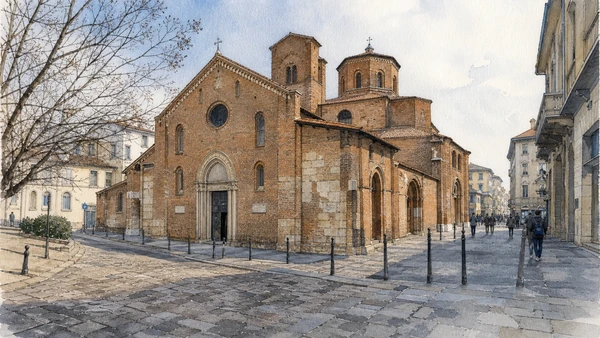
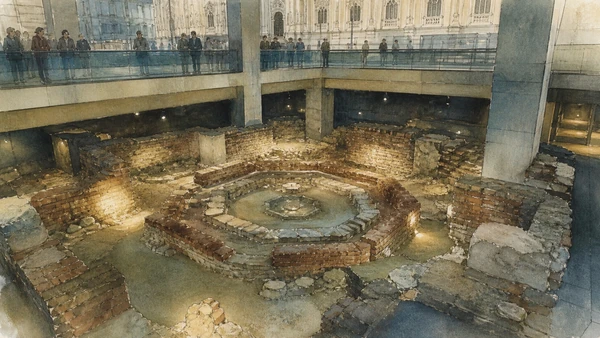
Original documentary watercolour panorama for Roman Mediolanum and Early Christian Milan: Complete Guide, with accurate Lombardy architecture, landscape and lived context

Milan Guide 05 · Imperial palace, circus, amphitheatre, basilicas, baptisteries and reused Roman fabric

Roman Mediolanum
& Early Christian Milan

A complete archaeological route joining the civic museum, imperial palace and circus traces to the amphitheatre and the basilicas associated with Ambrose, episcopal government, burial and the Christian remaking of the late-antique city.

Plan the route
Milan · Lombardy10 chapters · one complete route

Why this route must be read in layers

Imperial Mediolanum is dispersed below streets, courtyards, museums and churches; its clearest form emerges by linking fragments rather than expecting a single open archaeological park.

Milan’s elevation as an imperial residence brought palace, circus and administrative investment. Much of this fabric survives only in partial foundations because medieval and modern occupation repeatedly reused the same central ground.

Christian institutions did not simply replace a vanished Roman city. Basilicas used roads, cemeteries, elite patronage and existing materials while creating new ceremonial geographies around bishops, martyrs and burial.

The route therefore moves between state archaeology and active churches. It distinguishes current dedications from ancient phases and avoids presenting every exposed column as if it remained in its first location.

Use the museum to establish chronology, then map exterior fragments and basilicas in a broad loop; surface distance is part of understanding the scale of the late-antique capital.

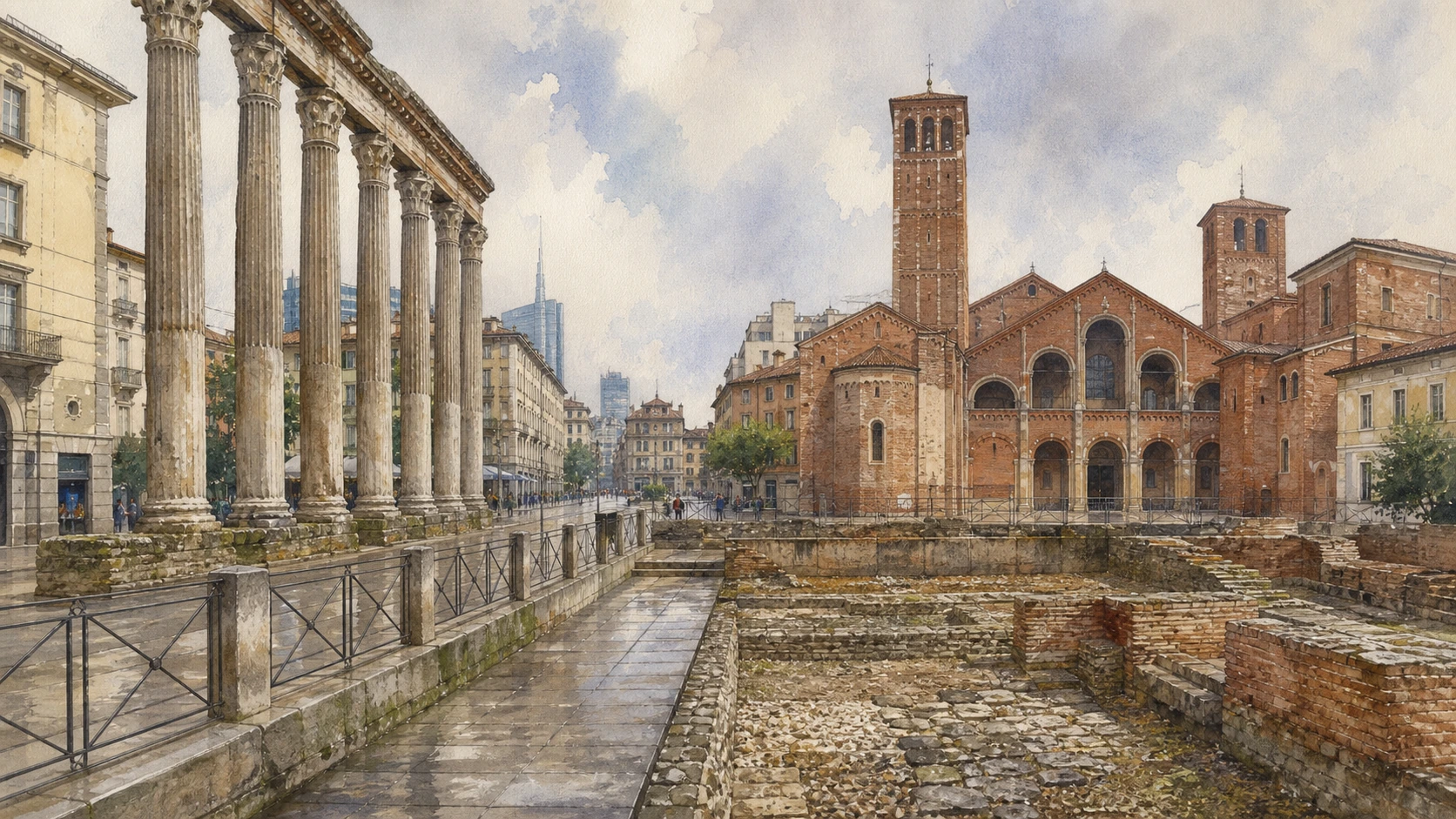
The route

Plan your visit

Begin with the museum and western imperial quarter, continue to amphitheatre and San Lorenzo, then complete the early Christian circuit through Ambrosian foundations and the cathedral baptistery.

Early morning

Civico Museo Archeologico · The imperial palace at Via Brisa · Roman circus traces

Move in the documented order: Civico Museo Archeologico: the map before the walk; then The imperial palace at Via Brisa: foundations in public space; then Roman circus traces: entertainment beside imperial power. Recheck live access and transport before entering a controlled site.

Late morning

Amphitheatre and Antiquarium · San Lorenzo and its columns · Sant’Ambrogio

Move in the documented order: Amphitheatre and Antiquarium: spectacle at the city edge; then San Lorenzo and its columns: late-antique monument and reuse; then Sant’Ambrogio: bishop, burial and Romanesque rebuilding. Recheck live access and transport before entering a controlled site.

Afternoon

Sant’Eustorgio · San Simpliciano · San Nazaro in Brolo

Move in the documented order: Sant’Eustorgio: cemetery basilica, relics and Dominican city; then San Simpliciano: an Ambrosian foundation through medieval form; then San Nazaro in Brolo: an apostolic basilica on a Roman road. Recheck live access and transport before entering a controlled site.

Late afternoon

San Giovanni alle Fonti

Move in the documented order: San Giovanni alle Fonti: baptism beneath the Duomo. Recheck live access and transport before entering a controlled site.

Ten chapters

Explore the places

The order follows terrain, institutions and present-day movement. Use the index to return to a chapter without reducing the route to isolated monuments.

  1. 01Civico Museo Archeologico: the map before the walk
  2. 02The imperial palace at Via Brisa: foundations in public space
  3. 03Roman circus traces: entertainment beside imperial power
  4. 04Amphitheatre and Antiquarium: spectacle at the city edge
  5. 05San Lorenzo and its columns: late-antique monument and reuse
  6. 06Sant’Ambrogio: bishop, burial and Romanesque rebuilding
  7. 07Sant’Eustorgio: cemetery basilica, relics and Dominican city
  8. 08San Simpliciano: an Ambrosian foundation through medieval form
  9. 09San Nazaro in Brolo: an apostolic basilica on a Roman road
  10. 10San Giovanni alle Fonti: baptism beneath the Duomo
01

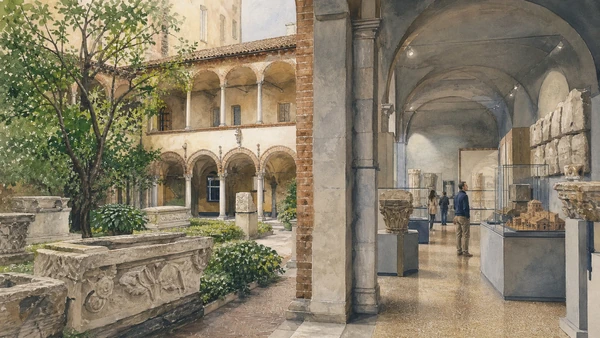
Collections and surviving structures in the former Monastero Maggiore establish the sequence from Celtic and Roman Milan to the early Middle Ages.

Civico Museo Archeologico: the map before the walk

Collections and surviving structures in the former Monastero Maggiore establish the sequence from Celtic and Roman Milan to the early Middle Ages. The site becomes clearer when its surviving fabric, later alterations and present use are read together.

Today

Opening, ticketing, room access and temporary displays can change. Check the institution’s official notice shortly before visiting, use the designated entrance and allow for security or conservation controls.

History

Municipal archaeology assembled finds from excavations across the city while the museum site itself preserves a Roman tower and layers of later occupation.

How to read this place

Begin with findspots and urban maps. Then compare the roman tower within the complex with objects separated from their excavated settings; the differences are evidence, not visual noise.

What to notice

  • findspots and urban maps
  • the Roman tower within the complex
  • objects separated from their excavated settings
Comune di Milano · Civic museums and exhibition spaces
Original documentary watercolour of Civico Museo Archeologico: the map before the walk in Milan · Lombardy, showing accurate architecture, landscape, people and present-day use
Civico Museo Archeologico: the map before the walkOriginal Merlintravel documentary watercolour · 2026
02

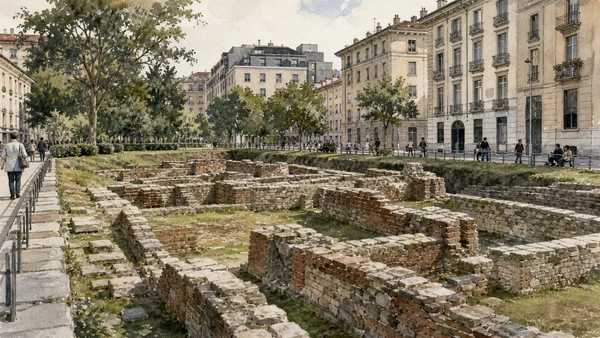
Low walls and interpretive remains mark part of the palace district without reconstructing its full ceremonial architecture.

The imperial palace at Via Brisa: foundations in public space

Low walls and interpretive remains mark part of the palace district without reconstructing its full ceremonial architecture. The site becomes clearer when its surviving fabric, later alterations and present use are read together.

Today

Archaeological access may be limited to protected viewpoints, scheduled openings or guided routes. Stay outside barriers, distinguish original material from supports and reconstruction, and verify the official opening notice.

History

From the late third century, imperial residence made Mediolanum a western political centre. Palace buildings spread across a large zone connected to circus and court chapel.

How to read this place

Begin with wall lines at the excavated level. Then compare modern streets cutting the complex with the wider relationship to the circus; the differences are evidence, not visual noise.

What to notice

  • wall lines at the excavated level
  • modern streets cutting the complex
  • the wider relationship to the circus
Comune di Milano · Civic museums and exhibition spaces
Original documentary watercolour of The imperial palace at Via Brisa: foundations in public space in Milan · Lombardy, showing accurate architecture, landscape, people and present-day use
The imperial palace at Via Brisa: foundations in public spaceOriginal Merlintravel documentary watercolour · 2026
03

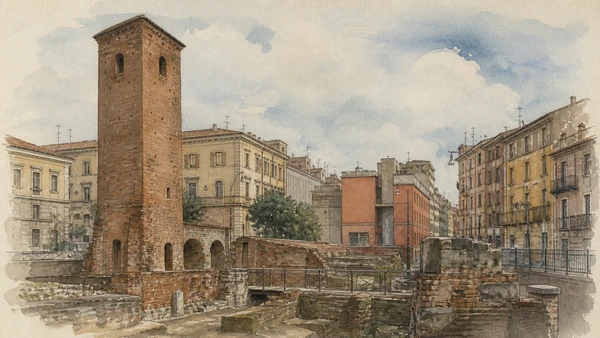
A surviving tower and dispersed masonry help reconstruct a vast racing venue attached to the imperial quarter.

Roman circus traces: entertainment beside imperial power

A surviving tower and dispersed masonry help reconstruct a vast racing venue attached to the imperial quarter. The site becomes clearer when its surviving fabric, later alterations and present use are read together.

Today

Archaeological access may be limited to protected viewpoints, scheduled openings or guided routes. Stay outside barriers, distinguish original material from supports and reconstruction, and verify the official opening notice.

History

The circus developed around the imperial-residence phase and remained a major urban structure before its masonry and footprint were absorbed by later buildings.

How to read this place

Begin with the polygonal tower reused by the monastery. Then compare street alignments around the former arena with documented fragments inside controlled sites; the differences are evidence, not visual noise.

What to notice

  • the polygonal tower reused by the monastery
  • street alignments around the former arena
  • documented fragments inside controlled sites
Comune di Milano · Civic museums and exhibition spaces
Original documentary watercolour of Roman circus traces: entertainment beside imperial power in Milan · Lombardy, showing accurate architecture, landscape, people and present-day use
Roman circus traces: entertainment beside imperial powerOriginal Merlintravel documentary watercolour · 2026
04

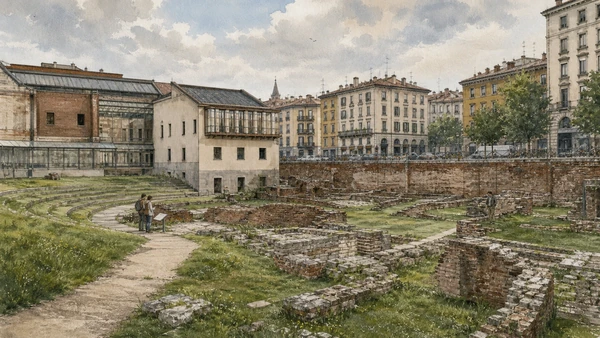
Protected remains and collections explain a large public building once set outside the Roman walls.

Amphitheatre and Antiquarium: spectacle at the city edge

Protected remains and collections explain a large public building once set outside the Roman walls. The site becomes clearer when its surviving fabric, later alterations and present use are read together.

Today

Archaeological access may be limited to protected viewpoints, scheduled openings or guided routes. Stay outside barriers, distinguish original material from supports and reconstruction, and verify the official opening notice.

History

The amphitheatre served spectacles in the imperial city and was later quarried or reused as urban priorities and defensive needs changed.

How to read this place

Begin with the elliptical plan reconstructed from foundations. Then compare masonry technique with the relation to the modern archaeological park; the differences are evidence, not visual noise.

What to notice

  • the elliptical plan reconstructed from foundations
  • masonry technique
  • the relation to the modern archaeological park
Comune di Milano · Parco dell’Anfiteatro Romano
Original documentary watercolour of Amphitheatre and Antiquarium: spectacle at the city edge in Milan · Lombardy, showing accurate architecture, landscape, people and present-day use
Amphitheatre and Antiquarium: spectacle at the city edgeOriginal Merlintravel documentary watercolour · 2026
05

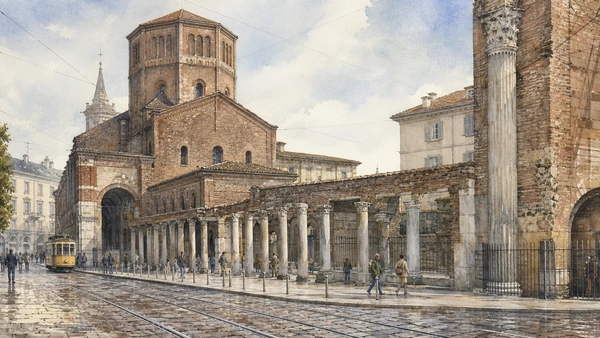
The basilica’s centralised mass and the columned forecourt preserve an exceptional but heavily transformed late-antique ensemble.

San Lorenzo and its columns: late-antique monument and reuse

The basilica’s centralised mass and the columned forecourt preserve an exceptional but heavily transformed late-antique ensemble. The site becomes clearer when its surviving fabric, later alterations and present use are read together.

Today

This is an active religious place as well as a historic building. Services, ceremonies and conservation can interrupt tourist access; dress appropriately, remain quiet and never treat a booked visit as priority over worship.

History

Built in the late Roman period with reused material and monumental ambition, San Lorenzo passed through fires, collapse, rebuilding and restoration while remaining a church.

How to read this place

Begin with the freestanding colonnade. Then compare the basilica’s central plan with chapels and masonry from different phases; the differences are evidence, not visual noise.

What to notice

  • the freestanding colonnade
  • the basilica’s central plan
  • chapels and masonry from different phases
Basilica di San Lorenzo Maggiore · Official site
Original documentary watercolour of San Lorenzo and its columns: late-antique monument and reuse in Milan · Lombardy, showing accurate architecture, landscape, people and present-day use
San Lorenzo and its columns: late-antique monument and reuseOriginal Merlintravel documentary watercolour · 2026
06

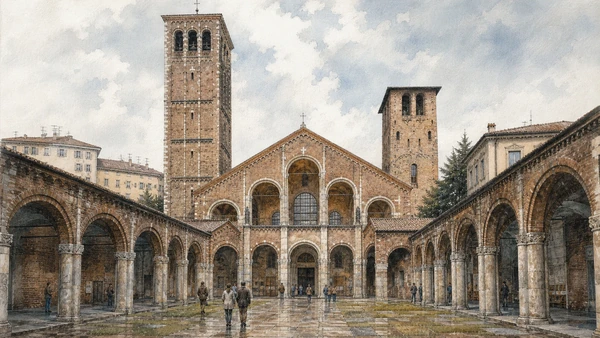
Atrium, brick basilica, crypt and chapels preserve a central Ambrosian institution whose current form is largely medieval.

Sant’Ambrogio: bishop, burial and Romanesque rebuilding

Atrium, brick basilica, crypt and chapels preserve a central Ambrosian institution whose current form is largely medieval. The site becomes clearer when its surviving fabric, later alterations and present use are read together.

Today

This is an active religious place as well as a historic building. Services, ceremonies and conservation can interrupt tourist access; dress appropriately, remain quiet and never treat a booked visit as priority over worship.

History

Ambrose founded a basilica near martyrs’ burials in the fourth century. Romanesque rebuilding, later additions, wartime damage and restoration produced the present complex.

How to read this place

Begin with the atrium as a threshold. Then compare romanesque nave and galleries with the crypt and earlier sacred memory; the differences are evidence, not visual noise.

What to notice

  • the atrium as a threshold
  • Romanesque nave and galleries
  • the crypt and earlier sacred memory
Basilica di Sant’Ambrogio · Official site
Original documentary watercolour of Sant'Ambrogio: bishop, burial and Romanesque rebuilding in Milan · Lombardy, showing accurate architecture, landscape, people and present-day use
Sant’Ambrogio: bishop, burial and Romanesque rebuildingOriginal Merlintravel documentary watercolour · 2026
07

Early Christian origins, Romanesque fabric, chapels and the Portinari Chapel connect burial, pilgrimage and mendicant patronage.

Sant’Eustorgio: cemetery basilica, relics and Dominican city

Early Christian origins, Romanesque fabric, chapels and the Portinari Chapel connect burial, pilgrimage and mendicant patronage. The site becomes clearer when its surviving fabric, later alterations and present use are read together.

Today

This is an active religious place as well as a historic building. Services, ceremonies and conservation can interrupt tourist access; dress appropriately, remain quiet and never treat a booked visit as priority over worship.

History

A basilica developed near an extra-urban burial area and later became a major Dominican complex. Medieval rebuilding and Renaissance patronage added new architectural identities.

How to read this place

Begin with the basilica’s long nave. Then compare archaeological and funerary evidence with the portinari chapel as a later courtly insertion; the differences are evidence, not visual noise.

What to notice

  • the basilica’s long nave
  • archaeological and funerary evidence
  • the Portinari Chapel as a later courtly insertion
Basilica di Sant’Eustorgio · Official museum
Original documentary watercolour of Sant'Eustorgio: cemetery basilica, relics and Dominican city in Milan · Lombardy, showing accurate architecture, landscape, people and present-day use
Sant’Eustorgio: cemetery basilica, relics and Dominican cityOriginal Merlintravel documentary watercolour · 2026
08

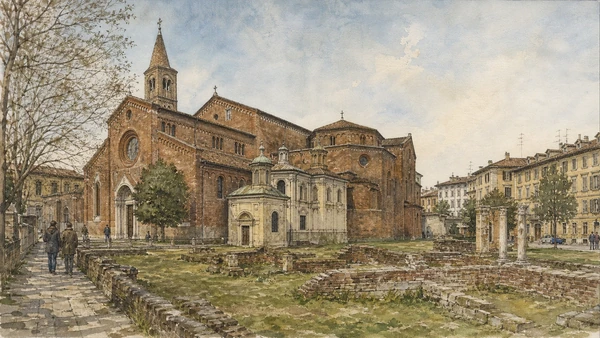
A large brick basilica preserves late-antique origin beneath Romanesque rebuilding and later intervention.

San Simpliciano: an Ambrosian foundation through medieval form

A large brick basilica preserves late-antique origin beneath Romanesque rebuilding and later intervention. The site becomes clearer when its surviving fabric, later alterations and present use are read together.

Today

This is an active religious place as well as a historic building. Services, ceremonies and conservation can interrupt tourist access; dress appropriately, remain quiet and never treat a booked visit as priority over worship.

History

Tradition associates the foundation with Ambrose; subsequent medieval construction redefined the structure while maintaining an early Christian site and dedication.

How to read this place

Begin with the austere exterior mass. Then compare nave proportions and masonry phases with later decoration within the older spatial frame; the differences are evidence, not visual noise.

What to notice

  • the austere exterior mass
  • nave proportions and masonry phases
  • later decoration within the older spatial frame
Chiesa di Milano · Basilica di San Simpliciano
Original documentary watercolour of San Simpliciano: an Ambrosian foundation through medieval form in Milan · Lombardy, showing accurate architecture, landscape, people and present-day use
San Simpliciano: an Ambrosian foundation through medieval formOriginal Merlintravel documentary watercolour · 2026
09

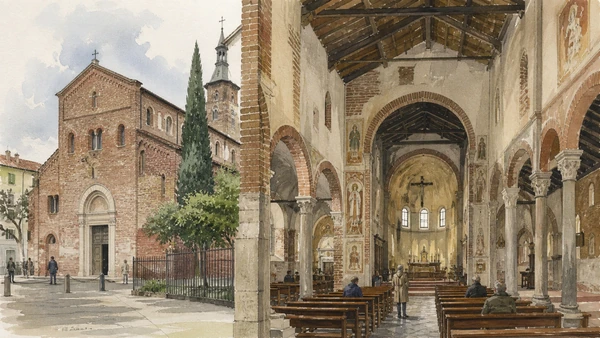
A cross-shaped early Christian foundation and later Trivulzio mausoleum show how burial and elite patronage continued at a city approach.

San Nazaro in Brolo: an apostolic basilica on a Roman road

A cross-shaped early Christian foundation and later Trivulzio mausoleum show how burial and elite patronage continued at a city approach. The site becomes clearer when its surviving fabric, later alterations and present use are read together.

Today

This is an active religious place as well as a historic building. Services, ceremonies and conservation can interrupt tourist access; dress appropriately, remain quiet and never treat a booked visit as priority over worship.

History

Ambrose founded the Basilica Apostolorum in the fourth century beside the route toward Rome. Medieval rebuilding and a Renaissance mausoleum altered the complex.

How to read this place

Begin with the cruciform organisation. Then compare surviving early and medieval fabric with the trivulzio mausoleum at the entrance; the differences are evidence, not visual noise.

What to notice

  • the cruciform organisation
  • surviving early and medieval fabric
  • the Trivulzio mausoleum at the entrance
Chiesa di Milano · San Nazaro in Brolo
Original documentary watercolour of San Nazaro in Brolo: an apostolic basilica on a Roman road in Milan · Lombardy, showing accurate architecture, landscape, people and present-day use
San Nazaro in Brolo: an apostolic basilica on a Roman roadOriginal Merlintravel documentary watercolour · 2026
10

An octagonal baptistery below the cathedral parvis anchors episcopal ritual in the late-antique centre.

San Giovanni alle Fonti: baptism beneath the Duomo

An octagonal baptistery below the cathedral parvis anchors episcopal ritual in the late-antique centre. The site becomes clearer when its surviving fabric, later alterations and present use are read together.

Today

Archaeological access may be limited to protected viewpoints, scheduled openings or guided routes. Stay outside barriers, distinguish original material from supports and reconstruction, and verify the official opening notice.

History

The baptistery formed part of the cathedral complex associated with Ambrose’s Milan and was later buried as sacred buildings and ground levels changed.

How to read this place

Begin with the octagonal foundation. Then compare water and liturgical organisation with duomo structures built above the ancient level; the differences are evidence, not visual noise.

What to notice

  • the octagonal foundation
  • water and liturgical organisation
  • Duomo structures built above the ancient level
Veneranda Fabbrica del Duomo · Official site
Original documentary watercolour of San Giovanni alle Fonti: baptism beneath the Duomo in Milan · Lombardy, showing accurate architecture, landscape, people and present-day use
San Giovanni alle Fonti: baptism beneath the DuomoOriginal Merlintravel documentary watercolour · 2026

Milan through time

A short chronology

From Insubrian settlement and imperial Mediolanum to the ducal court, industrial metropolis, wartime rupture and contemporary redevelopment.

  1. An Insubrian settlement develops on the plain at the crossing of routes later absorbed by Roman Mediolanum.

  2. Roman forces take Mediolanum, which grows into a major Cisalpine administrative and commercial centre.

  3. Milan becomes an imperial residence in the western Roman Empire and gains palace, circus, baths and monumental infrastructure.

  4. The agreement associated with Constantine and Licinius establishes religious toleration and becomes inseparable from Milan’s Christian memory.

  5. Ambrose serves as bishop; basilicas, burial places and episcopal authority reshape the late-antique city.

  6. Frederick Barbarossa’s forces destroy much of Milan; reconstruction and communal institutions subsequently re-form the city.

  7. Visconti power becomes dominant, beginning a long phase of ducal patronage, fortification and territorial government.

  8. Construction of the Duomo begins, creating a building site and civic-religious institution that continue across centuries.

  9. Sforza rule renews the castle and court while artists, engineers and scholars, including Leonardo, work within ducal networks.

  10. Spanish Habsburg administration reshapes government, defence, religion and the social geography of the city.

  11. French and Napoleonic rule reorganises institutions, collections, ceremonial space and Milan’s role in northern Italy.

  12. Austrian rule ends and Milan enters the Kingdom of Italy, accelerating railway, industrial and civic expansion.

  13. The present Milano Centrale opens as a monumental transport complex within a rapidly expanding metropolis.

  14. Bombing, occupation, resistance and liberation damage monuments, housing and industry and leave a difficult memorial landscape.

  15. Post-war migration, design and manufacturing, deindustrialisation, Expo 2015 and metropolitan redevelopment repeatedly transform the city.

Before your visit

Practical information

01

Check the live page

Opening hours, reservation systems, restoration, exhibitions and transport can change. Recheck the linked official institution shortly before departure.

02

Separate worship and tourism

Churches and sanctuaries remain religious spaces. Services, funerals and community use take priority over visitor itineraries.

03

Plan real distances

Milan · Lombardy combines dense urban routes with lakes, valleys and dispersed towns. Do not compress distant chapters into an unsafe or superficial day.

04

Keep thresholds open

Arcades, station halls, markets, courtyards, workshops and residential streets must continue to function while you observe or photograph them.

05

Use current mobility data

Check the responsible rail, navigation, bus, road or park operator on the day; replacement services and weather can change an otherwise sound route.

06

Read change honestly

Restoration, reconstruction, adaptive reuse and new development have all shaped the landscape visible today.

Method and sources

Sources and image credits

This guide uses official museum, ministry, municipal, transport, park and UNESCO documentation checked on 29 August 2026. It separates durable historical interpretation from access details that can change, distinguishes surviving fabric from restoration or reconstruction, and treats worship, work, residence and public movement as part of the evidence. Every chapter links its principal institutional source; tickets, closures, weather and transport must always be verified again on the day of the visit.

All ten images are original Merlintravel editorial watercolours based on documented present-day conditions. They are illustrations, not substitutes for archaeological plans. Opening hours, tickets, accessible routes, temporary exhibitions and conservation work can change; consult the linked official pages shortly before visiting.