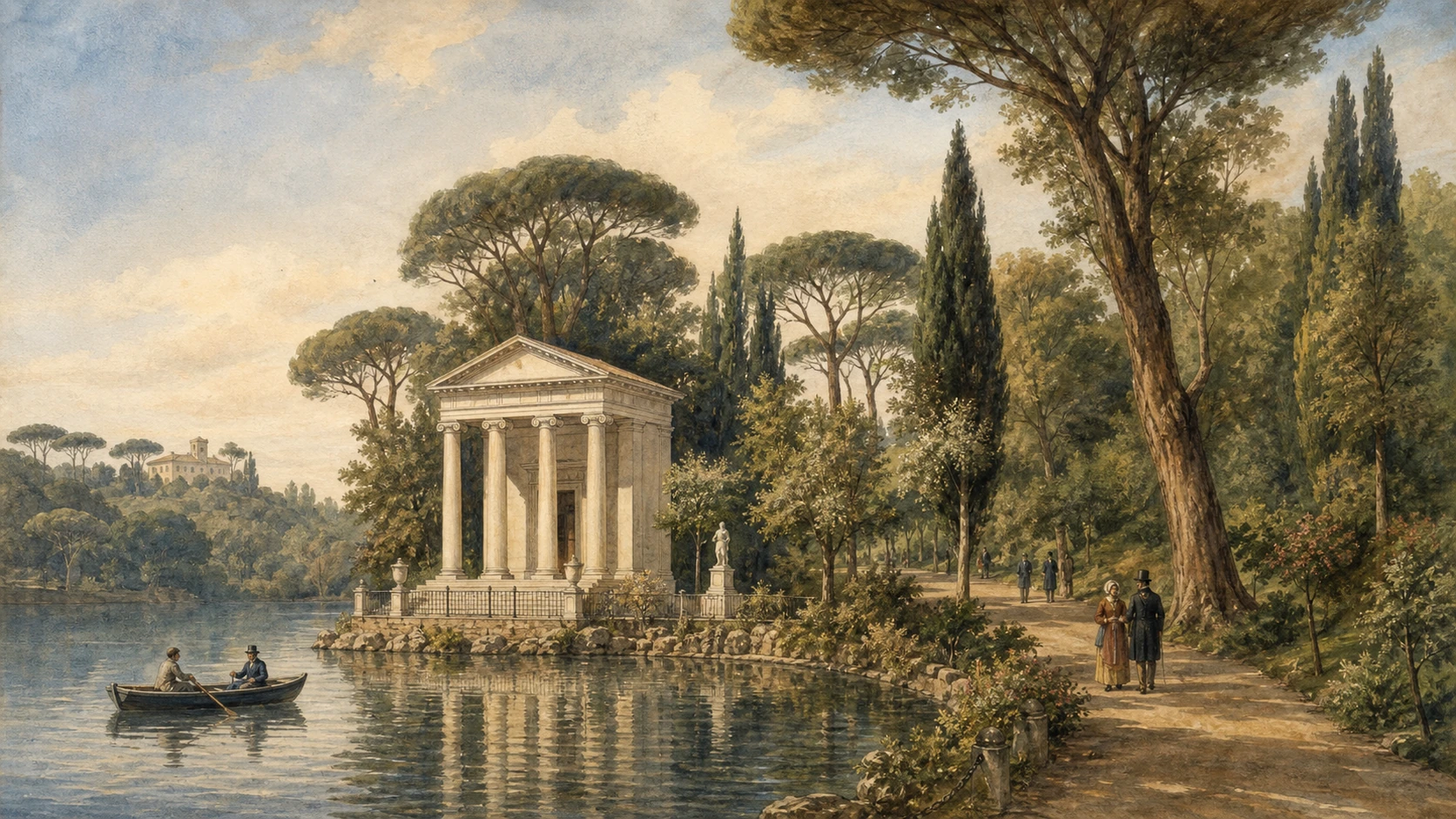
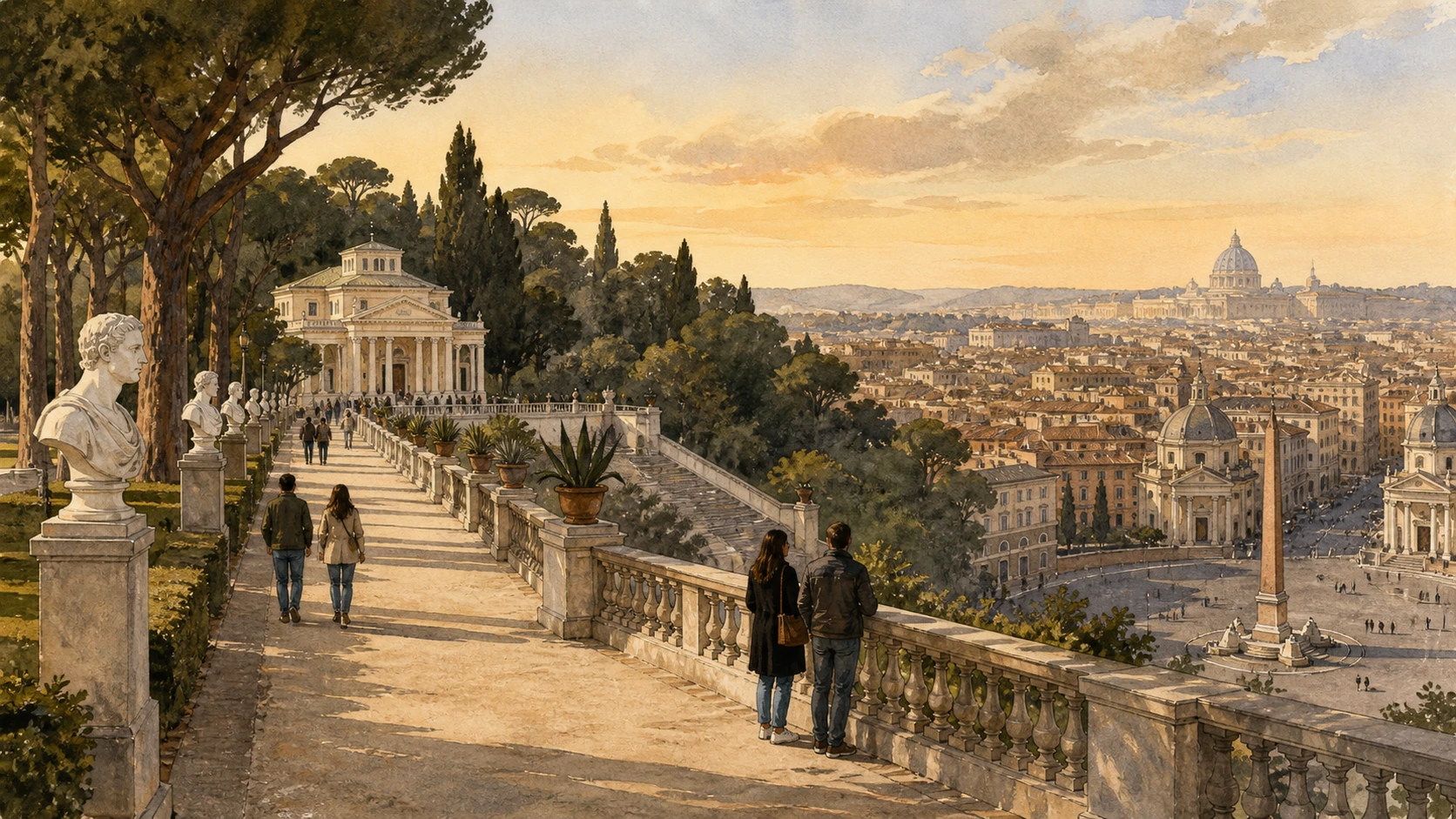
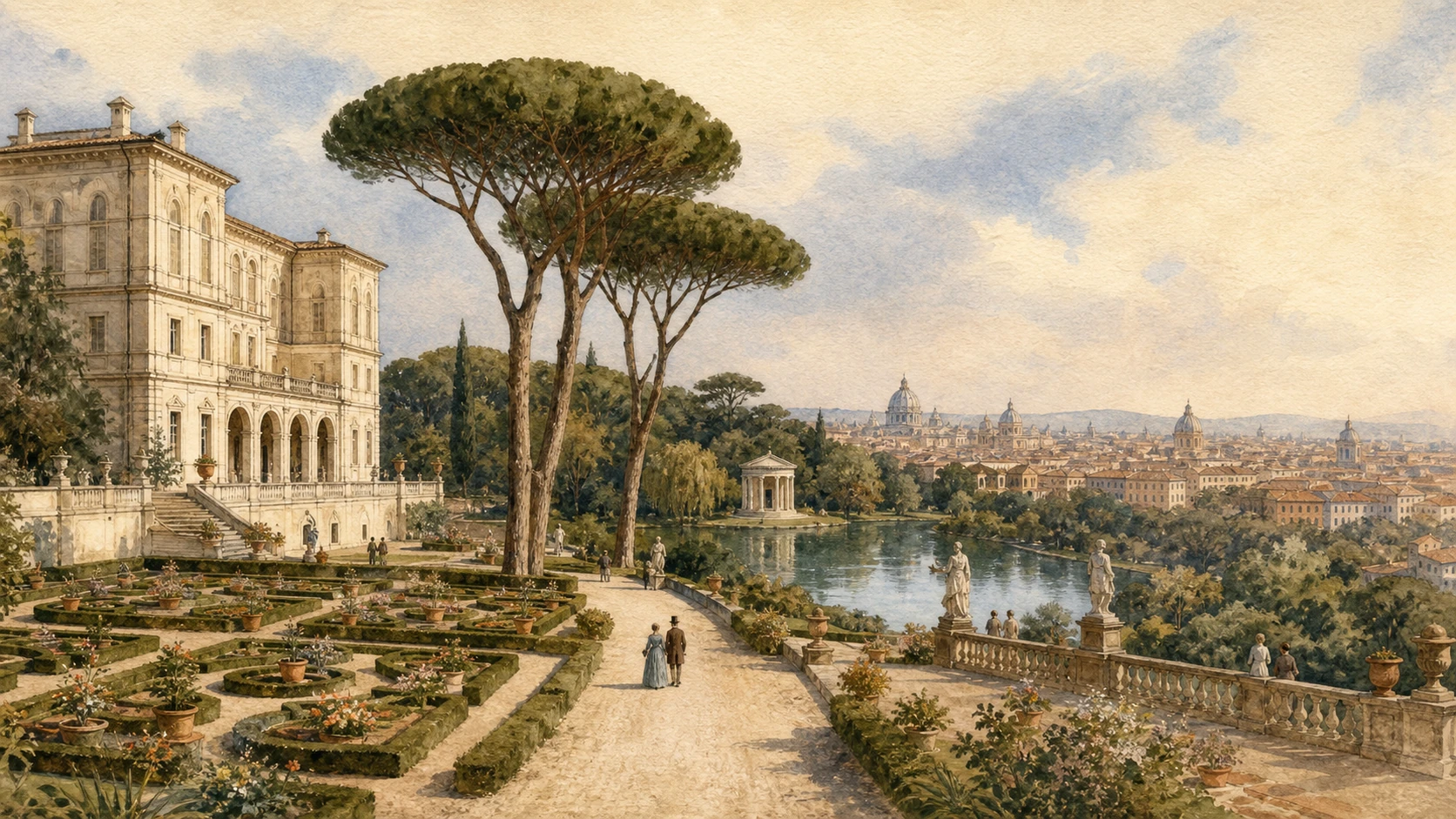
Original documentary watercolour joining the Galleria Borghese casino, garden lake, Pincio terrace and Rome beyond

Rome Guide 16 · Collection, designed landscape and public promenade

Villa Borghese,
the Gallery
and the Pincio

A full-day route from Scipione Borghese's collection and its room-scale Baroque encounters through secret gardens, lake, studios and public spaces to Valadier's terrace above Piazza del Popolo.

Plan the route
Galleria Borghese · Villa · Pincio10 chapters · timed museum plus park

Why this district matters

Villa Borghese is a collection landscape: paintings, sculpture, buildings, gardens and viewpoints were repeatedly rearranged to make power visible.

Cardinal Scipione Caffarelli Borghese created a suburban villa in the early seventeenth century as a setting for collecting, sociability and estate management. The Casino Nobile, now Galleria Borghese, never functioned as a neutral white-box museum. Sculpture, ancient fragments, painted ceilings, coloured marbles and framed views were composed room by room. The late eighteenth-century refurbishment by Antonio Asprucci added another total design, while the sale of hundreds of antiquities to Napoleon in 1807 created absences later filled by new acquisitions and arrangements.

Bernini's groups ask the visitor to move. Apollo and Daphne turns pursuit into metamorphosis across marble leaves and bark; the Rape of Proserpina makes pressure and resistance legible from several angles; David coils around an action that extends into the viewer's space. Canova's Pauline Borghese belongs to a later political and sculptural language. The six Caravaggios in the Silenus Room likewise form a collection history: some arrived by confiscation, one was rejected from a church, and David with the Head of Goliath links self-image, gift and uncertain hopes for pardon.

Outside, the park is neither untouched nature nor one seventeenth-century plan. Productive grounds, formal compartments, animal enclosures and display buildings were transformed into fashionable landscape gardens, expanded in the nineteenth century and opened publicly after state acquisition in 1903. The Pincio is connected but historically distinct: Giuseppe Valadier organised a civic promenade, terrace, ramps and café above his redesigned Piazza del Popolo. The overpass joining it to Villa Borghese dates only from 1908.

Reserve the Gallery first and treat its two-hour visit as the day's fixed point. The park and Pincio then become a sequence of designed rooms outdoors rather than spare time around a famous museum.

The route

Plan your visit

Enter the Galleria Borghese only at the reserved time and read the ground-floor sculpture rooms before the upper picture gallery. Outside, cross the secret-garden and service-building zone toward Piazza di Siena and the Canonica museum, continue to the Garden of the Lake, then follow the modern connection toward the Pincio, Casina Valadier and the terrace above Piazza del Popolo.

Morning I

Villa as museum architecture

Begin with the Casino Nobile, collection history and Canova; use ceilings, pavements and room names as evidence, not decoration around isolated masterpieces.

Morning II

Bernini and Caravaggio

Circulate around sculpture without blocking the timed route, then read the Silenus Room as a Borghese collecting history rather than six unrelated paintings.

Afternoon I

Park rooms and working buildings

Move through secret gardens, Piazza di Siena and the Fortezzuola, separating reconstructed formal compartments from later public recreation.

Afternoon II

Lake and Pincio

Use the Temple of Aesculapius and Valadier's promenade to compare an aristocratic landscape picture with a nineteenth-century civic panorama.

Ten chapters

Explore the places

The route moves from room-scale collection design to formal garden compartments, public park and the civic panorama of the Pincio. Use the index to revisit a work or place without erasing the history of its setting.

  1. 01The Casino Nobile and the Borghese collection
  2. 02Pauline Borghese as Venus Victrix
  3. 03Bernini's Apollo and Daphne
  4. 04The Rape of Proserpina and David
  5. 05Caravaggio in the Silenus Room
  6. 06The upper picture gallery
  7. 07The Secret Gardens and the Uccelliera
  8. 08Piazza di Siena and the Museo Pietro Canonica
  9. 09The Garden of the Lake and Temple of Aesculapius
  10. 10The Pincio, Casina Valadier and the terrace
01

A suburban display villa became a state museum without losing the logic of rooms designed around a collection

The Casino Nobile and the Borghese collection

Architecture, ceilings, ancient materials and movable works belong to successive programmes rather than one untouched Baroque interior.

Today

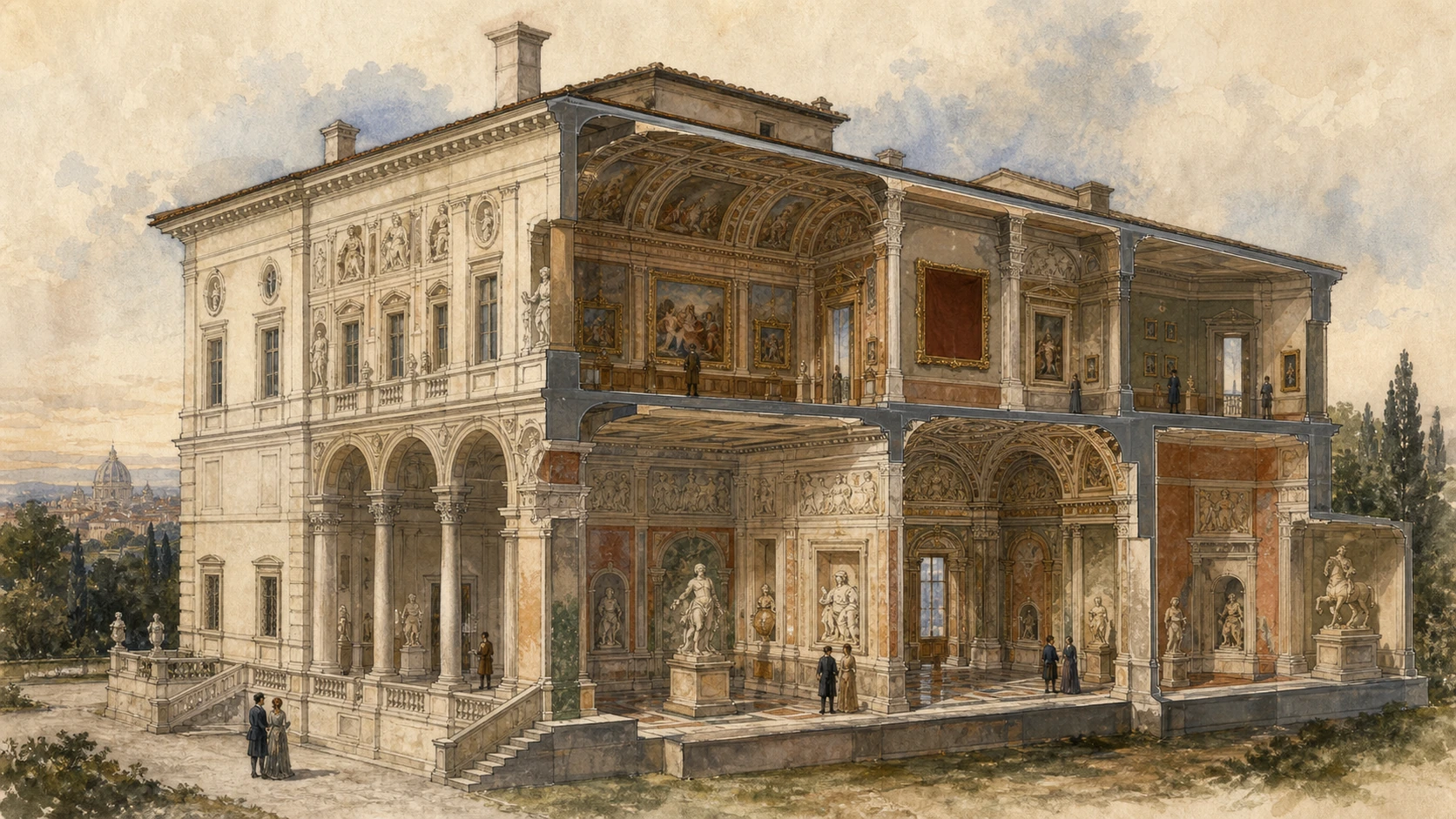
The Gallery occupies a richly articulated villa façade with a recessed loggia and sculptural decoration. Inside, eight ground-floor rooms concentrate ancient and modern sculpture amid coloured marble, stucco and painted vaults; the upper floor holds the picture gallery. The sequence is tightly controlled by timed admission. Works can move for conservation or loans, and room capacity shapes how long a visitor can stand at a single object. The building's surfaces deserve the same attention as the famous sculptures placed at their centres.

History

Scipione Borghese, nephew of Pope Paul V, commissioned the villa from Flaminio Ponzio; Giovanni Vasanzio continued it after Ponzio's death, with the main casino substantially complete by the 1610s. Scipione assembled paintings, modern sculpture and antiquities through patronage, purchase, excavation, political pressure and confiscation. Marcantonio IV Borghese ordered Antonio Asprucci's late eighteenth-century neoclassical refit. In 1807 Camillo Borghese sold 695 antiquities to Napoleon, now central to the Louvre. The Italian state acquired the casino and collection in 1902.

How to read this place

The visible interiors combine Scipione’s commissions with later arrangements. Late eighteenth-century ceilings, marble ensembles and new room themes reshaped the villa, and the Napoleonic sale removed defining antiquities. Conversely, it is not a modern gallery merely installed in an old house: many surviving relationships between object and decorated room are historically intentional. Reservation is compulsory; use only the official ticket channel and check temporary room closures before assuming a masterpiece is on view.

What to notice

  • The loggia and relief-rich façade presenting the casino as a display object
  • Room decoration coordinated with sculpture themes
  • Gaps and replacements created after the 1807 antiquities sale
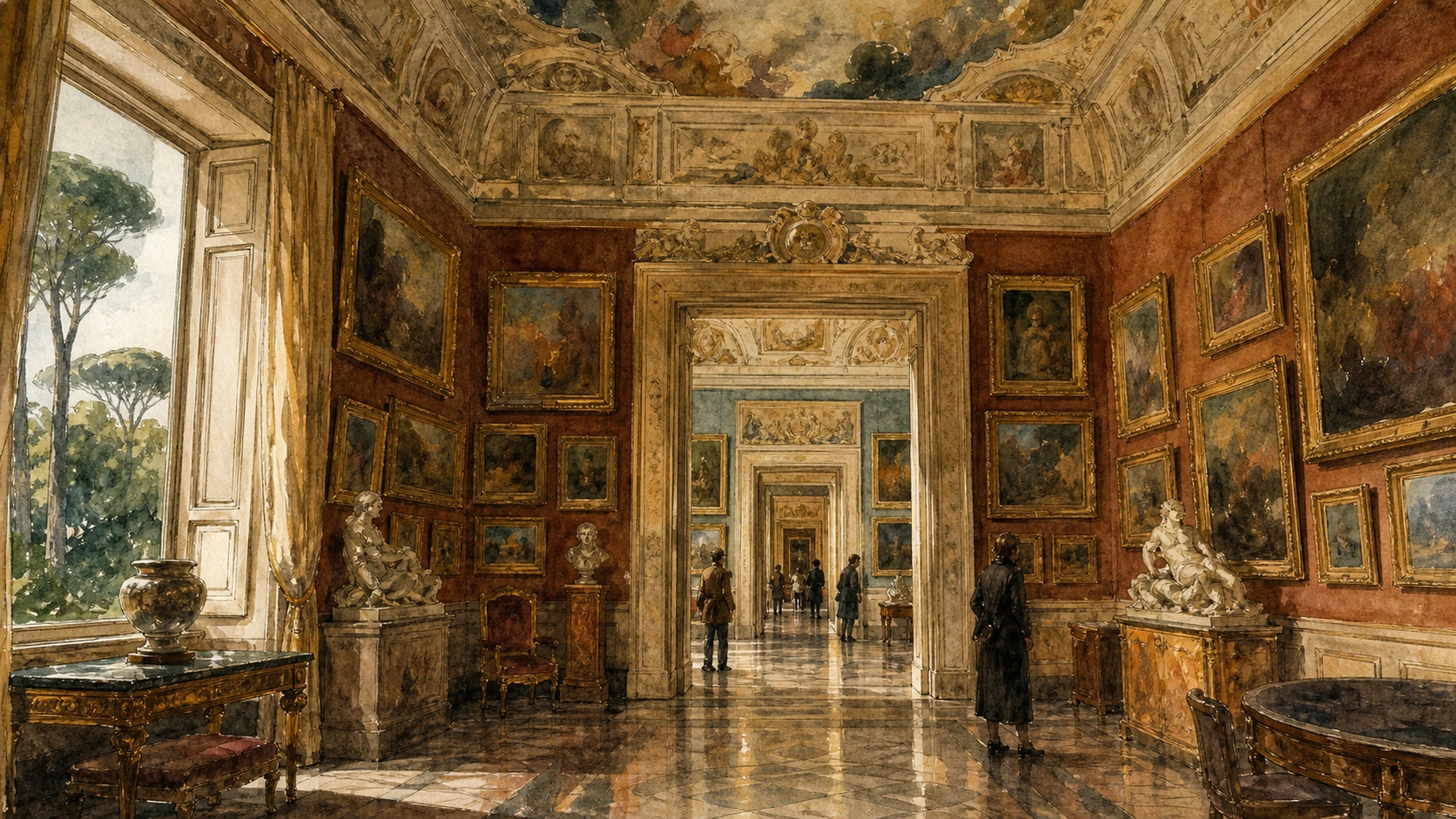
Galleria Borghese · the villa and museum
Original documentary watercolour cutaway of the Casino Nobile façade and its coordinated sculpture and picture rooms
The Casino Nobile and the Borghese collectionOriginal Merlintravel documentary watercolour · 2026
02

Canova turned a living Bonaparte princess into an idealised Venus while preserving portrait specificity

Pauline Borghese as Venus Victrix

The rotating encounter between viewer, couch and marble body belongs to early nineteenth-century portrait politics, not classical antiquity.

Today

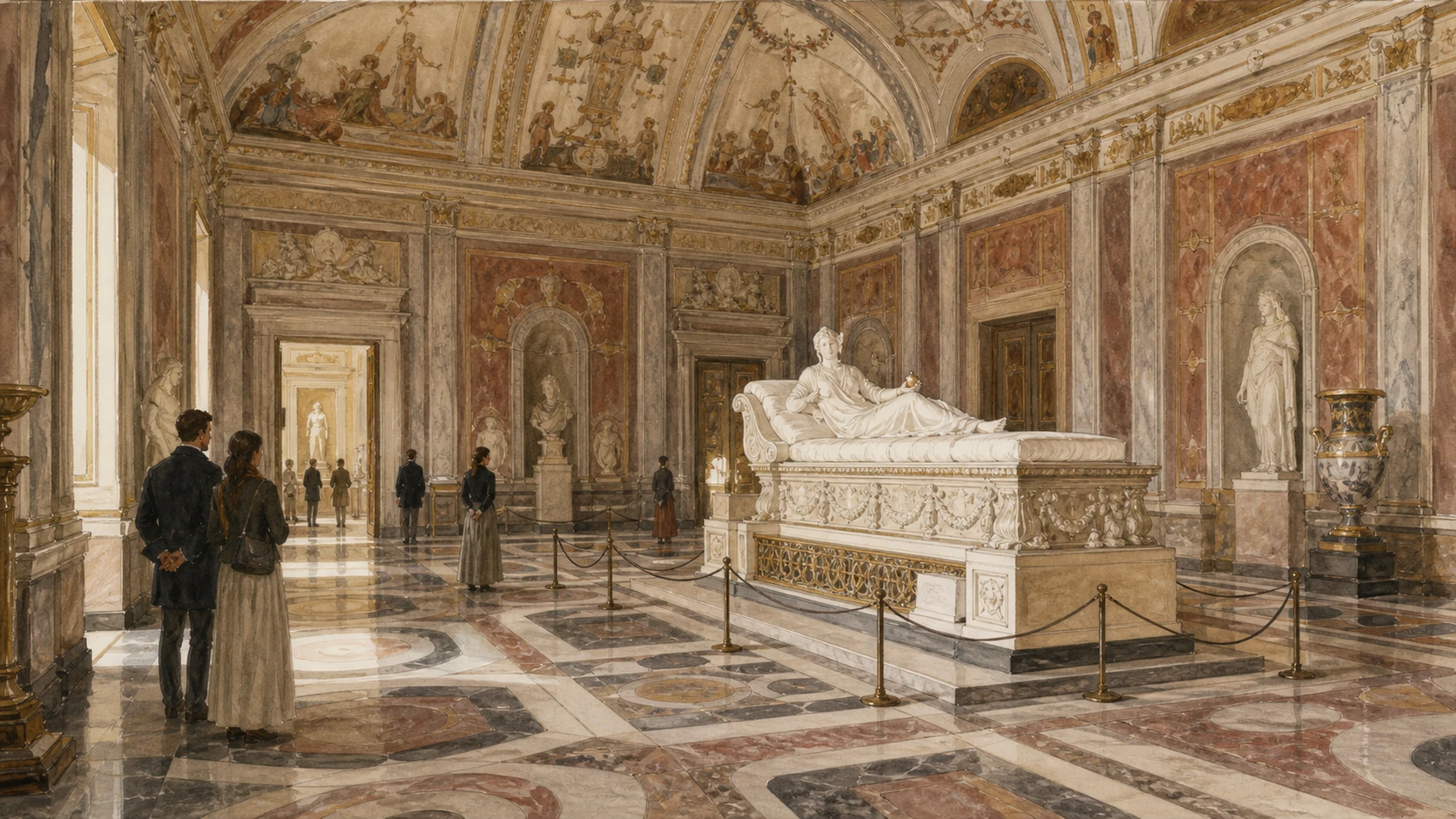
Canova's life-size marble reclines on an upholstered ancient-style couch, holding the apple awarded to Venus by Paris. Polished flesh contrasts with drapery and the couch's harder surfaces; the wooden base once contained a mechanism that allowed the work to rotate. The sculpture occupies Room I amid a decoration designed to frame its mythological identity. It is neither an ancient statue nor an anonymous ideal nude, and its present visibility should be checked against loans and conservation notices.

History

Antonio Canova made the portrait between 1805 and 1808 after Pauline Bonaparte married Prince Camillo Borghese. Presenting her as Venus Victrix joined aristocratic portraiture, Bonapartist power and the sculptor's study of antique forms. The commission followed the couple's marriage but was completed around the period when Camillo transferred much of the family's antiquities collection to France. Its modern marble celebrity therefore sits within a room shaped by both dynastic ambition and the loss of ancient sculpture.

How to read this place

The apple identifies the victorious Venus of the Judgement of Paris; it is not a casual fruit. The figure's semi-nudity should not be reduced to gossip about Pauline. Canova constructed a controlled public image through surface, pose and mythological attribute. Move around the work to see how the profile, hand, cushion and couch change, but do not imply that today's museum rotates the sculpture during visits.

What to notice

  • Wax-like polish of skin set against carved cloth
  • The apple as the narrative key to Venus Victrix
  • Couch and base engineered as part of the sculpture, not later furniture
Galleria Borghese · Pauline Borghese educational dossier
Original documentary watercolour of Canova's Pauline Borghese in the decorated Room I, discreetly represented as museum sculpture
Pauline Borghese as Venus VictrixOriginal Merlintravel documentary watercolour · 2026
03

Marble changes from skin to bark and leaves as the viewer walks around a pursuit frozen at its turning point

Bernini's Apollo and Daphne

The sculpture's virtuosity serves an unsettling Ovidian narrative of pursuit and escape, not a simple romantic embrace.

Today

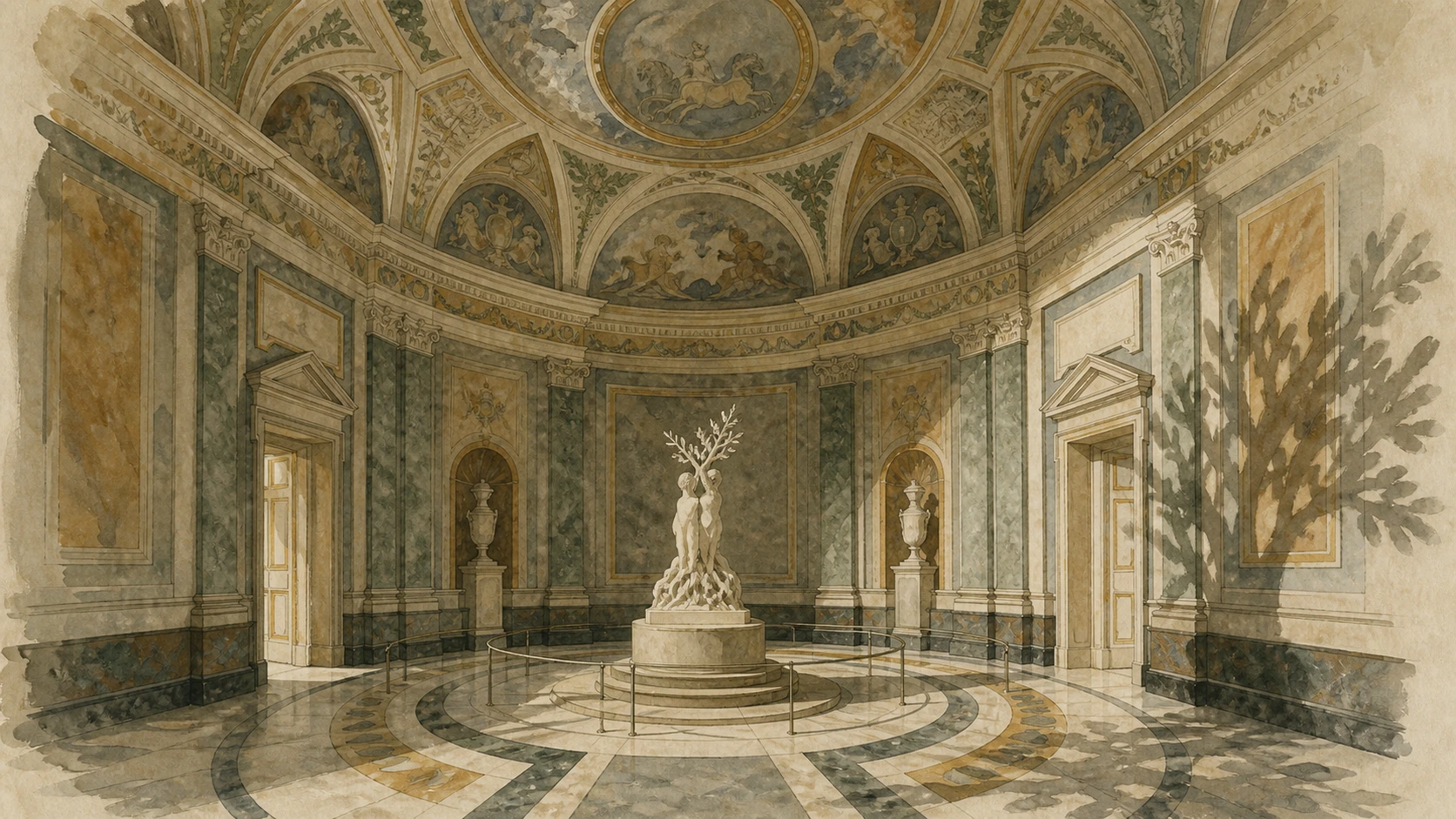
The group stands in Room III, where the late eighteenth-century ceiling and decorative programme repeat the metamorphosis theme. From one approach Apollo appears to catch Daphne; from another, fingers become laurel twigs, toes root into the ground and bark rises over her body. Deep drilling and thin marble leaves draw light through fragile edges. A wall placement originally controlled the first viewpoint; the sculpture's later central arrangement makes circulation more continuous but also increases crowd pressure.

History

Bernini carved Apollo and Daphne between 1622 and 1625 for Scipione Borghese, with Giuliano Finelli contributing to especially fine details according to longstanding scholarship. The subject comes from Ovid's Metamorphoses: Daphne asks to escape Apollo and is transformed into laurel. The group originally stood against a wall near the chapel. During Asprucci's redecoration around 1780–1785 it moved to its current room, which was redesigned around the sculpture and its story.

How to read this place

Do not describe the moment as consensual love. Apollo's pursuit drives Daphne's transformation and loss of human form. Bernini makes incompatible substances appear continuous, but the marble has not literally become weightless: supports, joins and restoration protect an audacious structure. Respect barriers and view from changing angles rather than forcing a frontally perfect photograph in the timed circulation path.

What to notice

  • Fingers separating into translucent-looking laurel leaves
  • Bark advancing across Daphne's torso while Apollo still moves
  • The ceiling narrative amplifying a sculpture installed there later
Galleria Borghese · Room of Apollo and Daphne
Original documentary watercolour of the Apollo and Daphne room, with the marble metamorphosis treated respectfully and without photorealistic nudity
Bernini's Apollo and DaphneOriginal Merlintravel documentary watercolour · 2026
04

Two early Bernini groups turn marble into opposing forces: coercive grasp and concentrated release

The Rape of Proserpina and David

Read pressure, resistance and implied space rather than treating technical illusion as the only subject.

Today

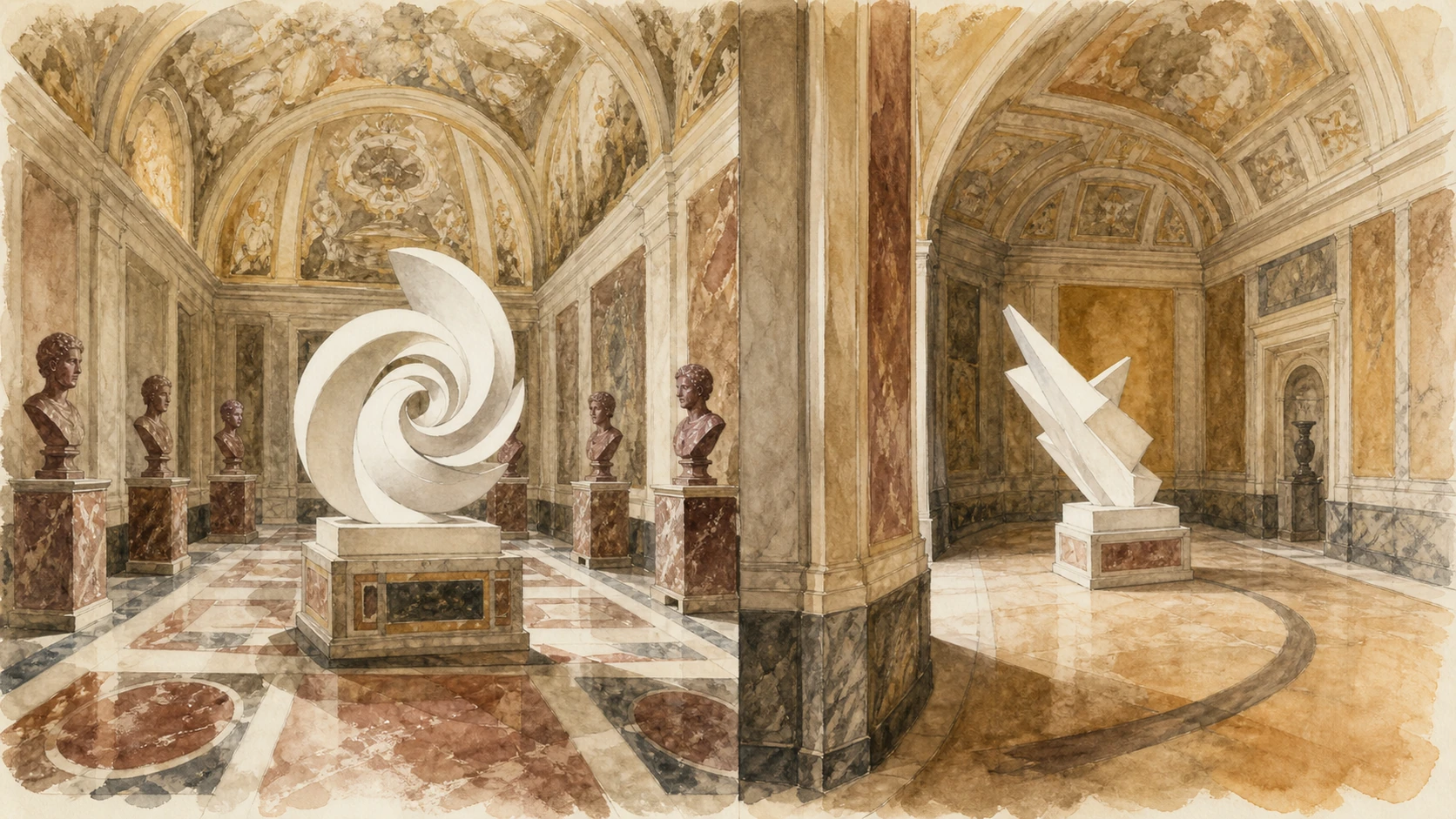
In the Emperors Room, Pluto carries Proserpina across a composition of spiralling limbs, streaming hair and tears; his fingers appear to press into her thigh, while Cerberus anchors the underworld narrative. In a separate room, David twists around the loaded sling immediately before release. The enemy occupies invisible space beyond the sculpture, so the viewer enters the line of action. Their rooms, bases and sightlines are integral to each encounter even though both works have moved within the villa.

History

Bernini completed the Rape of Proserpina in 1621–1622 and David in 1623–1624 for Scipione Borghese. The first was briefly given to Cardinal Ludovico Ludovisi before returning to the Borghese collection in the early twentieth century. David followed earlier monumental groups and marks Bernini's development of narrative action beyond a self-contained silhouette. Late eighteenth-century room programmes later framed each work within new mythological and moral ensembles.

How to read this place

The historical title uses rape in the older sense of abduction, but the sculpture represents violence and resistance; euphemistic romance is misleading. Technical admiration for marble pressure must not erase the subject. David is not Michelangelo's calm figure before decision: Bernini shows the split second of action, with discarded armour at his feet and Goliath outside the stone. Observe without copying the strained pose into another visitor's space.

What to notice

  • Proserpina's resisting hand and tear contrasted with Pluto's grip
  • Cerberus establishing the underworld destination
  • David's compressed torso projecting the sling's next movement beyond the base
Galleria Borghese · Emperors Room
Original documentary watercolour study of Bernini's Proserpina and David in their separate rooms, figures simplified as museum sculpture
The Rape of Proserpina and DavidOriginal Merlintravel documentary watercolour · 2026
05

Six paintings reveal acquisition by seizure, rejection, patronage and personal negotiation rather than one planned cycle

Caravaggio in the Silenus Room

Youthful self-fashioning, sacred controversy and a late double portrait of violence make the room a compressed biography of collecting.

Today

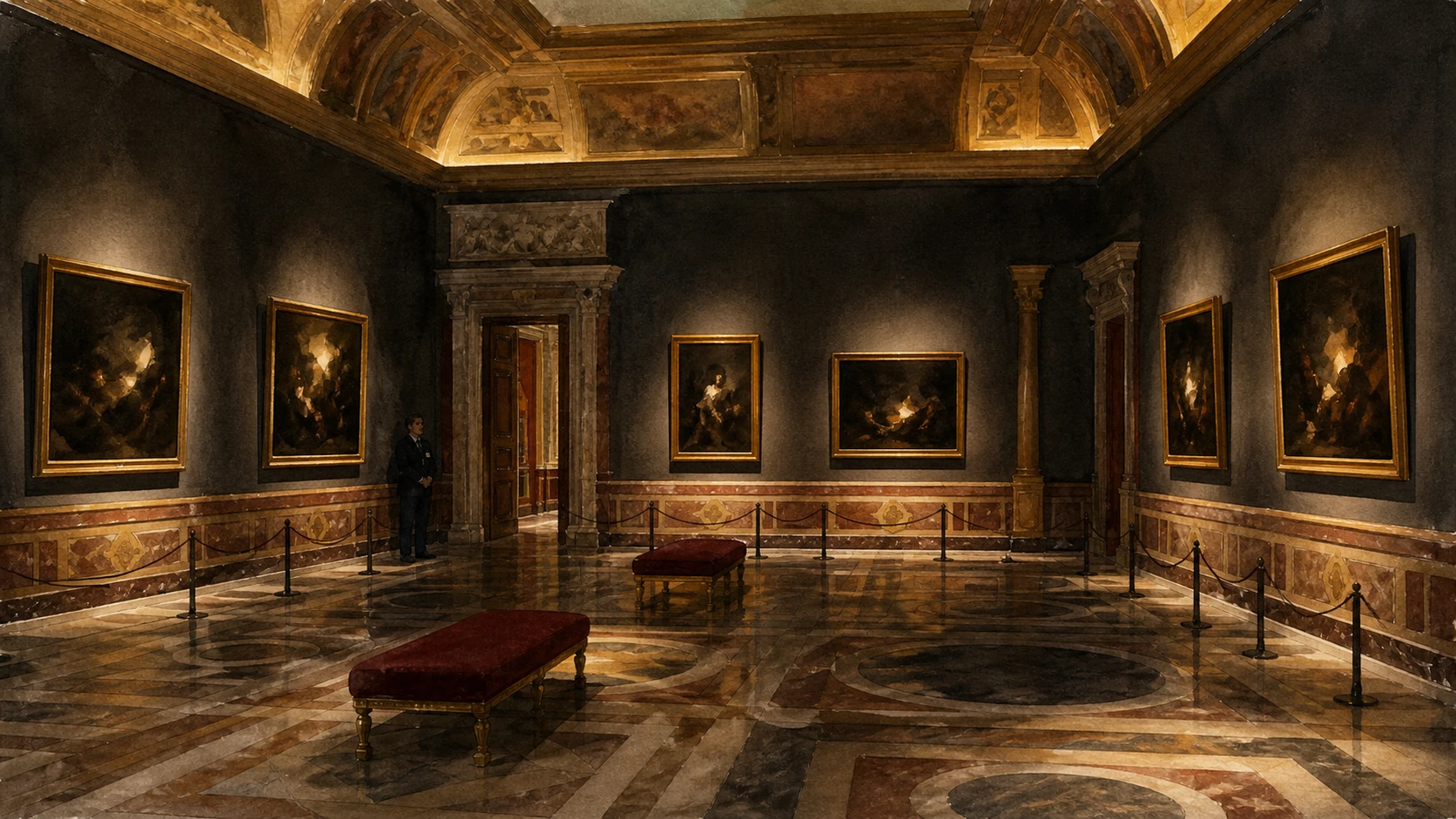
Room VIII displays six Caravaggios: Boy with a Basket of Fruit, Sick Bacchus, Saint Jerome, Madonna and Child with Saint Anne, Saint John the Baptist and David with the Head of Goliath. They differ radically in size, original function and date. Dark backgrounds, abrupt illumination and closely observed bodies unite them only partially. The late eighteenth-century Silenus decoration and ancient sculpture around them belong to another curatorial layer, so the current concentration is not an artist-designed chapel or cycle.

History

Paul V's seizure of Cavalier d'Arpino's collection in 1607 brought the two early paintings to Scipione. The Madonna of the Palafrenieri was removed soon after installation in Saint Peter's and entered Borghese ownership. Saint Jerome was probably made for the cardinal. David with the Head of Goliath, often dated to Caravaggio's final years, uses the artist's features in Goliath and may have been intended as a gift connected to his pursuit of papal pardon, though motive and dating remain debated.

How to read this place

The six paintings have different commissioning histories, and the room’s labels explain their arrangement. The sickly Bacchus identification as self-portrait and the autobiographical reading of Goliath are interpretations rather than established biographical facts. At David, look at the ambiguous expression and sword inscription before turning the painting into a simple confession. Low light protects the works; raising screen brightness is more respectful than obstructive flash photography.

What to notice

  • Fruit and skin observed with equal intensity in the early works
  • Saint Jerome's red mantle organising a severe writing scene
  • David's compassion and the self-like head complicating triumph
Galleria Borghese · Silenus Room
Original documentary watercolour of the Silenus Room with six dark Caravaggio canvases arranged amid its later decoration
Caravaggio in the Silenus RoomOriginal Merlintravel documentary watercolour · 2026
07

Formal compartments, aviaries and service buildings reveal a villa that produced, displayed and managed nature

The Secret Gardens and the Uccelliera

Today's reconstructed parterres recover historical geometry without pretending every plant descends from the seventeenth century.

Today

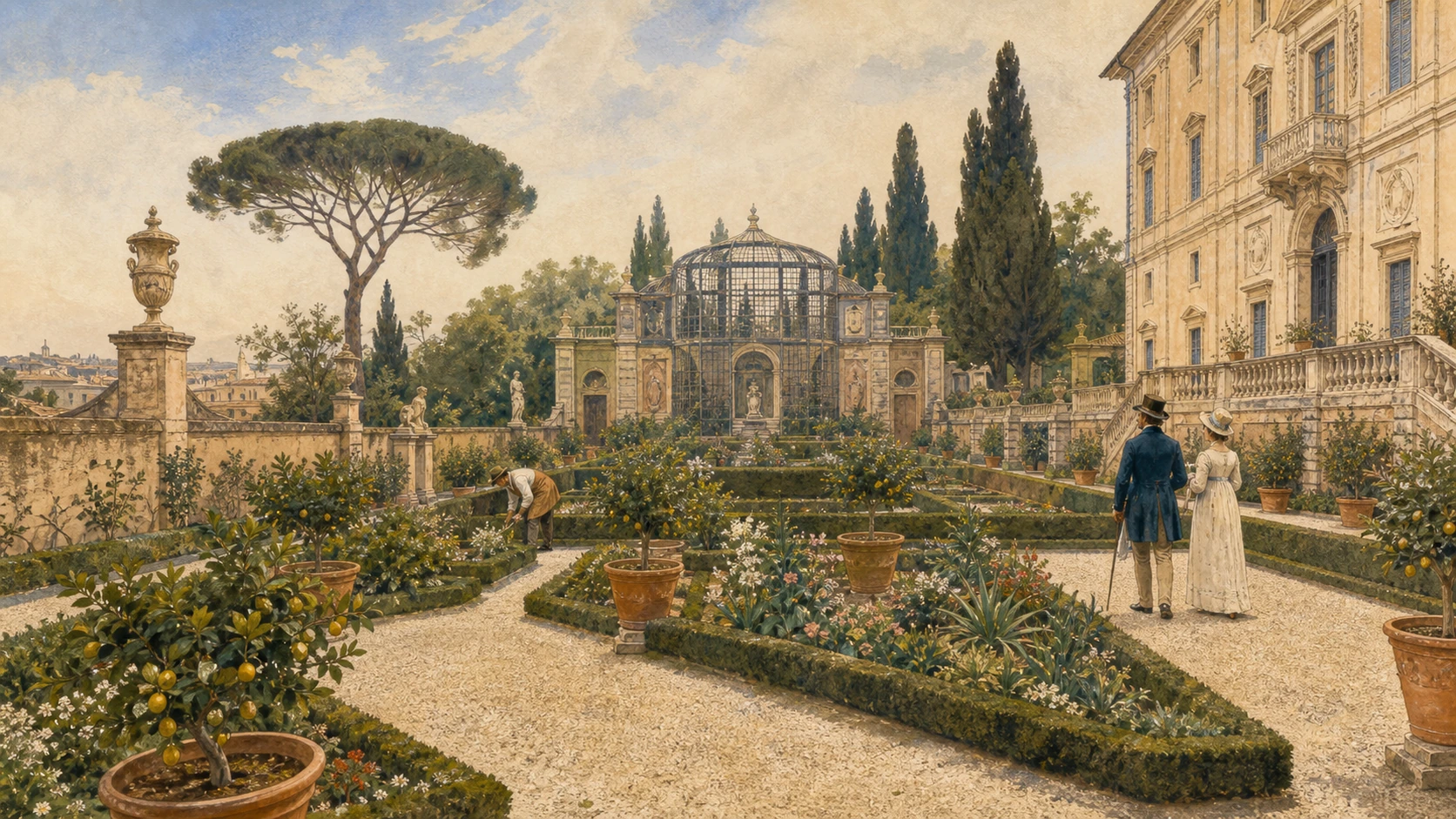
Beside the Gallery, walled gardens divide citrus, flowers, herbs and ornamental beds into controlled compartments. The Uccelliera and Casino della Meridiana form elaborate architectural edges with stucco, emblems and framed openings. Planting schemes have been reconstructed from archival and iconographic evidence, while current horticulture responds to disease, climate and public management. Some enclosures are visible only through scheduled access or from their boundaries; an open park does not mean every gate is public.

History

Scipione's villa combined display gardens with productive and animal spaces. Aviaries, rare plants and geometric beds advertised control over nature and global exchange. Marcantonio IV's late eighteenth-century reforms altered buildings and garden fashion, and nineteenth-century landscape changes weakened some formal divisions. Modern restorations recovered several secret gardens as historical interpretations. Their clipped geometry therefore records both Borghese design and contemporary conservation decisions.

How to read this place

The gardens combine historic structures with changing plants and reconstructed layouts. Walls and buildings preserve historic fabric, but plants are living, replaceable material and current layouts are scholarly reconstructions. The word secret means enclosed and privileged, not hidden treasure. Look for sightlines between casino, garden doors and aviary architecture, then distinguish aesthetic display from the labour of gardeners, irrigation and seasonal replacement.

What to notice

  • Walled compartments aligned with casino rooms and service paths
  • Borghese eagle-and-dragon motifs in garden architecture
  • Reconstructed planting beds whose living material cannot be original
Roma Capitale Tourism · Villa Borghese
Original documentary watercolour plan-view of Villa Borghese secret gardens, Uccelliera and Meridiana with reconstructed beds
The Secret Gardens and the UccellieraOriginal Merlintravel documentary watercolour · 2026
08

A princely outdoor theatre and an animal building became public event ground and an artist's house museum

Piazza di Siena and the Museo Pietro Canonica

The oval and Fortezzuola preserve different transformations of estate entertainment, public spectacle and studio life.

Today

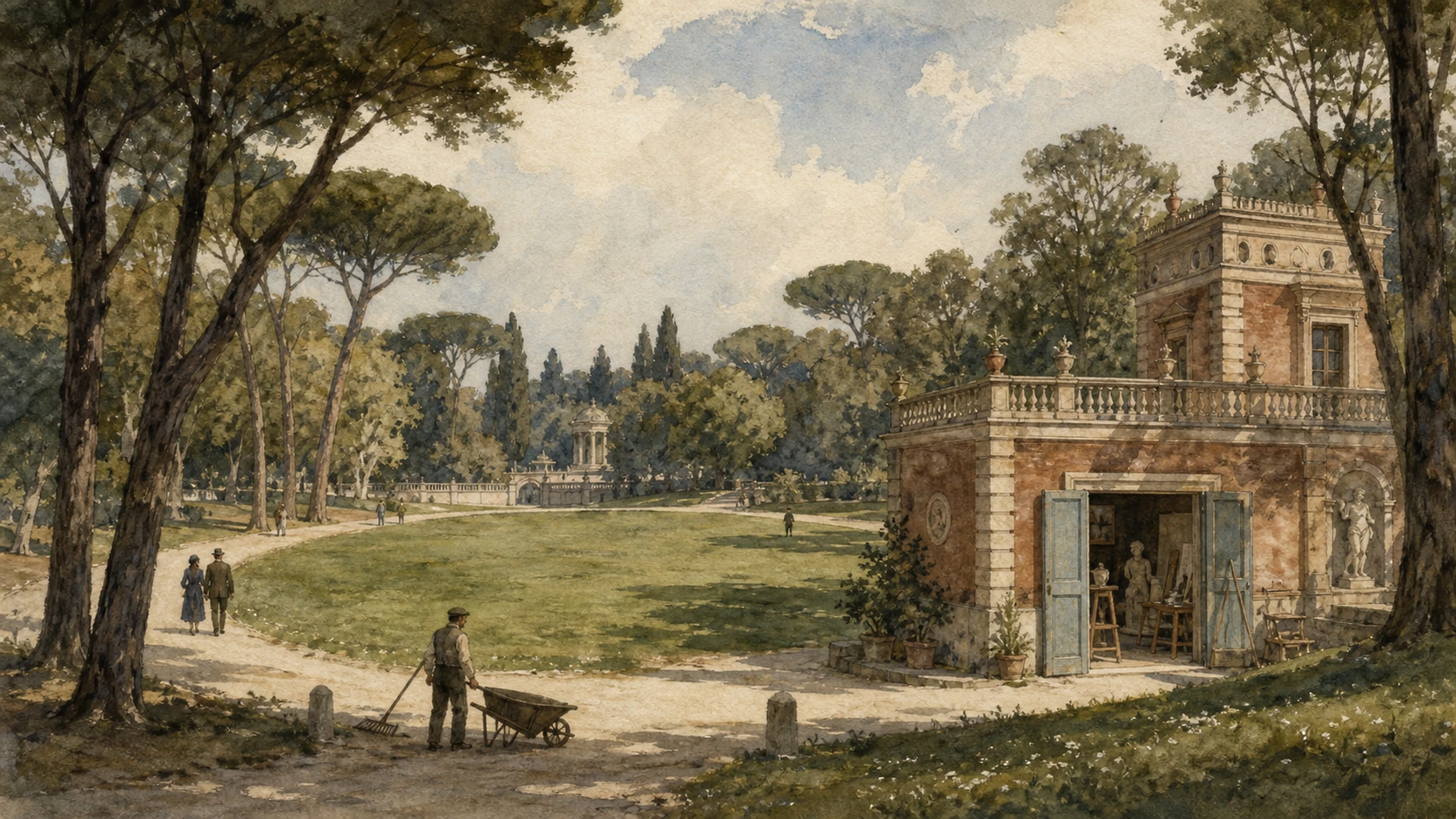
Piazza di Siena is a broad oval clearing shaped by trees and paths, used for the annual international horse show and other events. Near it, the turreted Fortezzuola houses the Pietro Canonica Museum. Ground-floor rooms display models, marbles and bronzes; the studio and private apartment preserve furnishings and working context, with some areas accompanied by staff. Event infrastructure can temporarily transform paths and views, so the empty green oval is not guaranteed throughout the year.

History

Marcantonio IV Borghese developed Piazza di Siena in the late eighteenth century, naming it for the family's Tuscan origin and adapting it for spectacles. The Fortezzuola had earlier served as an animal enclosure known as the Hen House; Antonio Asprucci's circle gave it a picturesque medievalising character. After fire and abandonment, Rome granted it to sculptor Pietro Canonica in 1926. He repaired the building, lived and worked there until 1959, and his collection formed the museum nucleus.

How to read this place

Piazza di Siena is not an ancient Roman circus and the Fortezzuola is not a medieval fortress. Both are designed estate features with later public lives. Canonica's museum is valuable not only for finished monuments: plaster models, studies, tools and domestic rooms expose a twentieth-century professional practice shaped by international court commissions. Check hours and accompanied-room conditions before assuming an unrestricted house visit.

What to notice

  • The oval ground functioning differently during and outside events
  • Picturesque turret and palisade language added to an older service building
  • Studio models revealing translation from small study to public monument
Museo Pietro Canonica · the Fortezzuola
Original documentary watercolour of Piazza di Siena and the Fortezzuola cut away to Canonica's studio and apartment
Piazza di Siena and the Museo Pietro CanonicaOriginal Merlintravel documentary watercolour · 2026
09

An artificial lake and classical temple created an eighteenth-century landscape picture for walking, boating and reflection

The Garden of the Lake and Temple of Aesculapius

The temple is a modern neoclassical garden building using an ancient statue, not a surviving Roman sanctuary.

Today

Curving paths and mature trees surround a small artificial lake where boats pass before an Ionic temple on an island. The building's pale colonnade, pediment and central statue form a controlled vista across water. Nearby stand the Sundial and other ornamental structures within the landscape-garden sector. Plant loss, water maintenance and heavy public use continually alter the scene. The island building is normally viewed from shore or boat rather than entered as a museum.

History

Marcantonio IV Borghese commissioned the lake garden during the villa's late eighteenth-century transformation. Antonio and Mario Asprucci worked with landscape designers to create irregular paths and carefully framed classical incidents. The Temple of Aesculapius was built in 1785–1786 to house an ancient statue restored for display. Its form evokes an antique sanctuary while belonging entirely to the culture of the European landscape garden.

How to read this place

Ancient material and classical columns form part of an eighteenth-century temple design. It is an eighteenth-century architectural composition, and the lake is engineered. The scene should be read as intentional artifice: irregular shore, tree groups, reflection and island distance guide movement. Boating is a contemporary concession within a historic park; follow operating rules and keep away from wildlife and planted banks.

What to notice

  • Temple axis reflected across a deliberately shaped lake
  • Ancient statue incorporated into a modern garden building
  • Irregular paths producing changing framed views rather than a formal straight approach
Roma Capitale Tourism · Villa Borghese and Garden of the Lake
Original documentary watercolour of the artificial Garden of the Lake and neoclassical Temple of Aesculapius
The Garden of the Lake and Temple of AesculapiusOriginal Merlintravel documentary watercolour · 2026
10

Valadier's civic promenade turned a garden hill into a sequence of ramps, busts, café and panorama

The Pincio, Casina Valadier and the terrace

The view over Piazza del Popolo is the endpoint of nineteenth-century urban design, not a natural overlook discovered by chance.

Today

Piazzale Napoleone I opens above Piazza del Popolo toward domes, roofs and the western horizon. Promenade avenues carry rows of commemorative busts, an Egyptianising obelisk dedicated by Hadrian to Antinous, the 1873 hydrochronometer and Casina Valadier. The neoclassical café building combines a cubic body, Ionic exedra and later decorative histories above an ancient cistern. The Pincio joins Villa Borghese across the Muro Torto overpass, but the two spaces retain different axes and civic identities.

History

Giuseppe Valadier redesigned Piazza del Popolo and developed the Pincio promenade under Napoleonic and papal administrations in the early nineteenth century. Casina Valadier adapted an earlier casino between 1816 and 1837 as a social focus. Busts of notable Italians were installed from 1849, turning the walk into a national pantheon. Giovanni Battista Embriaco's water-powered clock arrived in 1873. The bridge over Muro Torto connected the promenade directly to Villa Borghese in 1908, five years after the villa became public.

How to read this place

The Pincio is not one of the canonical Seven Hills of ancient Rome. Its ancient elite gardens matter, but the visible promenade is chiefly nineteenth-century. The Antinous obelisk is Roman Egyptianising, not pharaonic; it moved several times before its 1822 installation. The panorama is architecturally staged by terrace, ramps and Piazza del Popolo below. At sunset, allow circulation along the balustrade rather than occupying the viewpoint as private seating.

What to notice

  • Terrace and Piazza del Popolo designed as one vertical urban theatre
  • Bust-lined avenues constructing public memory
  • Water clock and Casina Valadier as technological and social ornaments of the promenade
Roma Capitale Tourism · Pincio terrace and promenade
Original documentary watercolour of the Pincio terrace, Casina Valadier, water clock and Piazza del Popolo panorama
The Pincio, Casina Valadier and the terraceOriginal Merlintravel documentary watercolour · 2026

The district through time

A short chronology

From Scipione Borghese’s early seventeenth-century casino to the public park, Pincio promenade and twentieth-century artist’s house.

  1. Camillo Borghese becomes Pope Paul V, elevating the family and his nephew Scipione.

  2. Scipione's suburban casino and collection landscape take monumental form under Ponzio and Vasanzio.

  3. Confiscation and papal pressure bring early Caravaggios and Raphael's Deposition into Borghese ownership.

  4. Bernini completes Proserpina, David and Apollo and Daphne for Scipione.

  5. Marcantonio IV and Antonio Asprucci recast villa rooms, gardens and service buildings in neoclassical language.

  6. The Temple of Aesculapius is built as the focus of the new Garden of the Lake.

  7. Canova creates Pauline Borghese as Venus Victrix.

  8. Camillo Borghese sells 695 antiquities to Napoleon, transforming the collection's balance.

  9. Valadier develops Casina Valadier and the civic promenade on the Pincio.

  10. Installation of the Pincio's commemorative busts begins.

  11. Embriaco's hydrochronometer is installed in its pond on the promenade.

  12. The state acquires the Gallery and collection; Villa Borghese opens as a public park.

  13. The overpass across Muro Torto directly connects Villa Borghese with the Pincio.

  14. Pietro Canonica receives and occupies the Fortezzuola as studio and home.

  15. Canonica's death, collection and later opening of the private apartment establish the house museum route.

Before your visit

Practical information

01

Book the Gallery first

Admission is compulsory-reservation and time-controlled; buy only through the official channel and check the current procedure.

02

Expect works to move

Loans, exhibitions and conservation can change rooms; confirm a must-see object shortly before the visit.

03

Circulate around sculpture

Bernini and Canova reward changing viewpoints, but timed routes and other visitors require patience rather than blocking a perfect angle.

04

Treat gardens as collections

Walls, plants, paths, water and small buildings are managed heritage; closed gates and planted beds are not shortcuts.

05

Check event transformations

Piazza di Siena and nearby routes can be occupied or rerouted by equestrian and cultural events.

06

End at the terrace with margin

Allow daylight for the lake-to-Pincio walk and remember that Casina Valadier, boats and museums keep separate hours.

Method and sources

Sources and image credits

The guide uses current official material from Galleria Borghese, Roma Capitale Tourism, the Sovrintendenza Capitolina and Museo Pietro Canonica, checked on 27 August 2026. It distinguishes Scipione's casino from Asprucci's later room programmes; collection display from a neutral modern gallery; ancient sculpture from Canova; Ovidian pursuit and abduction from romantic euphemism; Bernini's implied action from static frontal icons; six Caravaggio acquisition histories from a planned cycle; historic painting titles from secure original meanings; living reconstructed gardens from untouched survivals; the Fortezzuola from a medieval fortress; Piazza di Siena from an ancient circus; the Temple of Aesculapius from a Roman sanctuary; and the Pincio's nineteenth-century civic promenade from both the ancient Seven Hills and Villa Borghese's aristocratic landscape.

All ten images are original Merlintravel editorial watercolours based on documented present-day conditions. They are illustrations, not substitutes for archaeological plans. Opening hours, tickets, accessible routes, temporary exhibitions and conservation work can change; consult the linked official pages shortly before visiting.