Illustrated guide · Spello
Flowers, gates
and Roman memory
Ten places through which to read the Roman colony of Hispellum, a walled hill town and the living craft of making streets bloom.
Explore the placesPreface
Spello rewards the visitor who looks at the spaces between monuments.
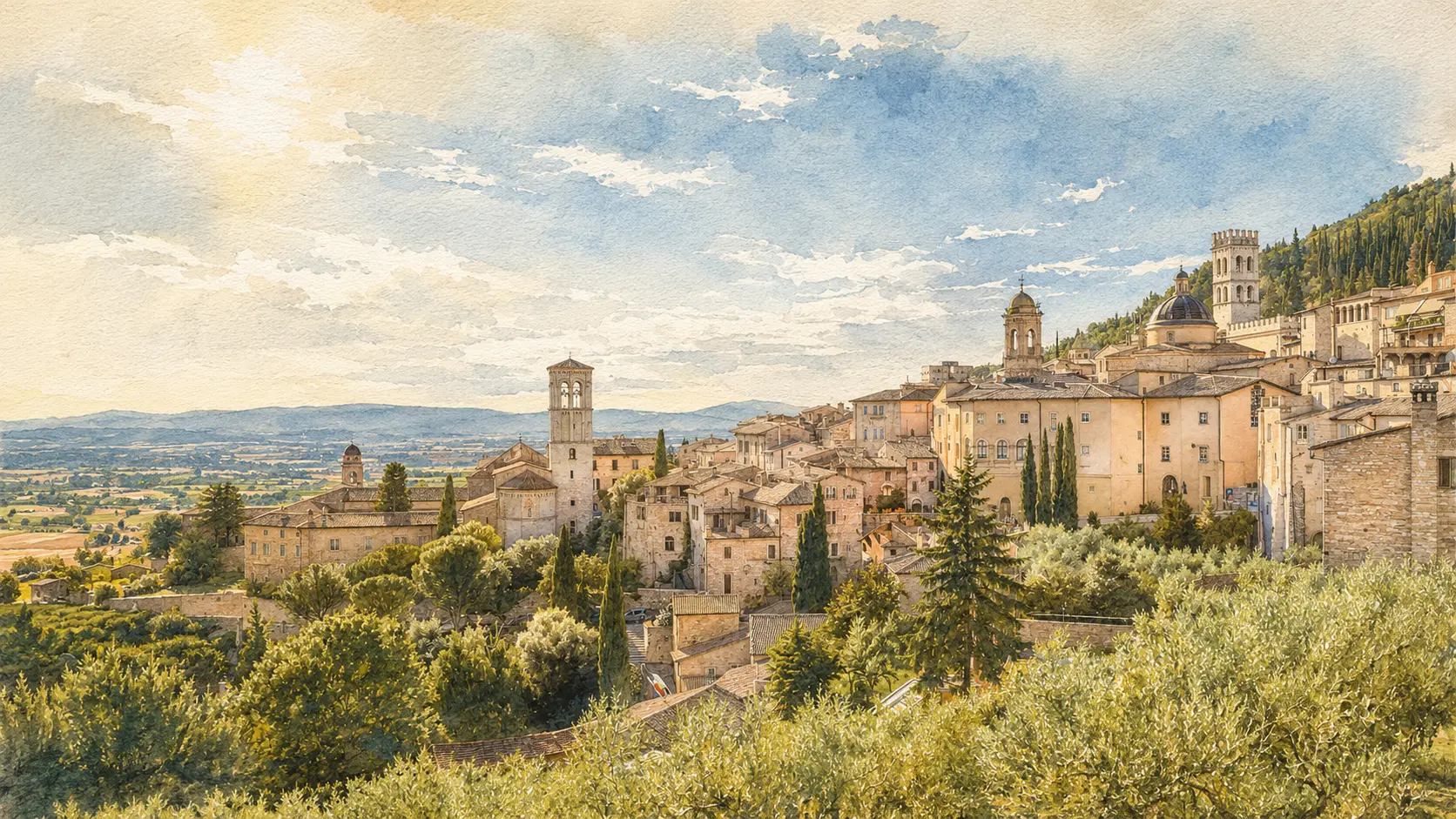
Spello is often introduced through flowers, and the flowers are real: balconies, doorways and the Infiorate change the experience of its streets. But the town is equally defined by Roman gates, medieval masonry, Renaissance painting and the long ridge of Mount Subasio.
Living in Umbria for forty-two years has taught me that small distances can contain very different histories. Spello lies close to Assisi, yet it has a separate voice: Roman Hispellum, the Baglioni Chapel, the mosaics of a late antique villa and the careful domestic culture of its lanes.
This guide moves uphill from the ancient entrance, pauses in churches and civic spaces, then descends again towards the mosaics and landscape beyond the walls.
In Spello, the smallest detail often carries the longest history.

One destination
Spello,
detail by detail.
The route keeps the celebrated flowered lanes in their historical context. Roman infrastructure, medieval urban form, Renaissance patronage and living community practice are treated as connected layers rather than competing images of the town.
The selection
Ten places,
one story
An uphill walk through the historic centre followed by two essential sites beyond the walls, showing the full extent of ancient and modern Spello.
- 01Porta Consolare
- 02Santa Maria Maggiore
- 03Baglioni Chapel
- 04Church of Sant'Andrea
- 05Porta Venere and Towers of Propertius
- 06Piazza della Repubblica and Town Hall
- 07Belvedere, Roman remains and upper walls
- 08Flowered lanes and the Infiorate
- 09Villa of the Mosaics
- 10Villa Fidelia and the ancient sanctuary area
The Roman threshold
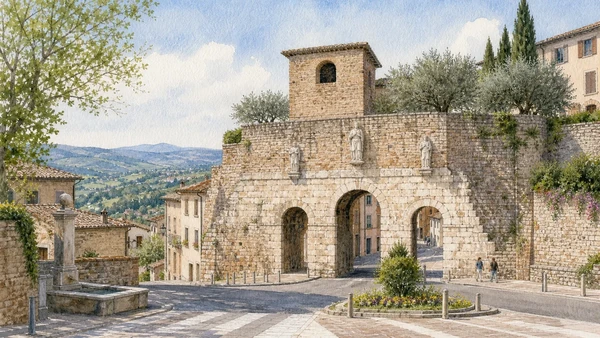
Porta Consolare
A monumental entrance to Hispellum whose ancient stonework remains embedded in a medieval and modern gateway.

The place today
The gate marks the lower entrance to the historic centre. Three openings pass through the wall; above them, a later tower and olive trees soften the defensive mass. Funerary statues found near the Roman amphitheatre were placed on the façade in the modern period and should not be mistaken for the gate's original decoration.
The historical chapter
Porta Consolare belonged to the Augustan wall circuit of Hispellum, built in local limestone around the late first century BC. Its position connected the colony to the roads of the Umbrian valley. Medieval construction reused and altered the gate, preserving it because the ancient entrance continued to serve the living town.
What to notice
- The three openings and carefully fitted Roman blocks
- The medieval tower rising above ancient masonry
- The later placement of Roman funerary statues on the façade
The church of the town
Santa Maria Maggiore
A medieval collegiate church transformed by Renaissance patronage and best known for one concentrated masterpiece.

The place today
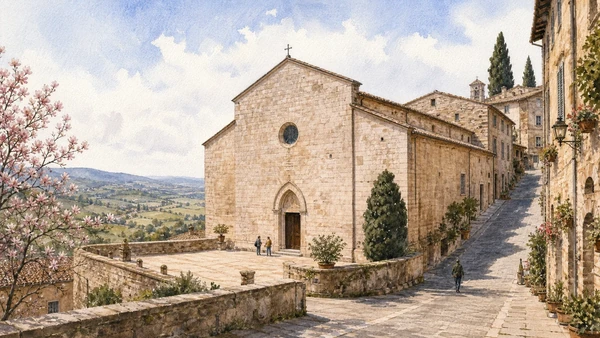
The church stands along the main climbing street and contains architecture and art from several periods. Its most important space is the Baglioni Chapel, but the wider interior also preserves sculpture, paintings, pavement and furnishings that record the ambitions of clergy and local families.
The historical chapter
The building grew from an earlier religious foundation and assumed its present importance during the Middle Ages. It was repeatedly altered, especially between the fifteenth and seventeenth centuries. These changes explain why the exterior is restrained while the interior moves between medieval fabric and later decorative campaigns.
What to notice
- The relationship between the simple exterior and decorated interior
- Fragments and furnishings from different building phases
- The chapel opening as a distinct Renaissance room within the church
Pinturicchio in full colour
Baglioni Chapel
A small frescoed room in which architecture, narrative and the recognisable landscape of Umbria become one.

The place today
The chapel is viewed as a complete painted environment. Pinturicchio's Annunciation, Nativity and Dispute with the Doctors occupy the walls beneath a decorated vault. The scenes reward close looking: portraits, textiles, grotesques, inscriptions and distant Umbrian hills turn sacred narrative into an image of contemporary life.
The historical chapter
Troilo Baglioni commissioned the cycle, painted around 1500–1501 when Pinturicchio was at the height of his career. The chapel demonstrates how a powerful local patron used Renaissance painting to unite family memory, learned imagery and devotion. The artist included his signed self-portrait in the decoration.
What to notice
- Pinturicchio's self-portrait and signature
- The Umbrian landscape behind the Nativity
- Illusionistic architectural details that enlarge the small room
A second Pinturicchio encounter
Church of Sant'Andrea
A Franciscan church where a major altarpiece remains connected to the community and architecture for which it was made.

The place today
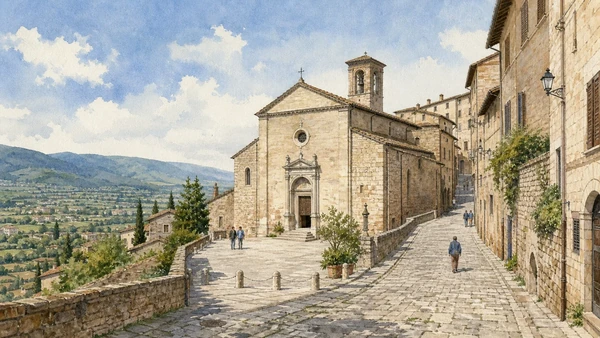
The church has a plain stone façade and a layered interior shaped by medieval and later interventions. Its principal artistic focus is Pinturicchio's Madonna and Child with Saints, completed with workshop participation and still displayed within the church rather than removed to a distant museum.
The historical chapter
The Franciscans established themselves here in the thirteenth century. The church was enlarged and transformed over time, while the altarpiece was commissioned in the early sixteenth century. Its presence helps reconstruct the network linking Spello's religious institutions, patrons and one of Umbria's most sought-after painters.
What to notice
- The contrast between mendicant simplicity and later altars
- The original architectural setting of the Pinturicchio altarpiece
- Evidence of successive changes in the nave and chapels
The most theatrical Roman gate
Porta Venere and Towers of Propertius
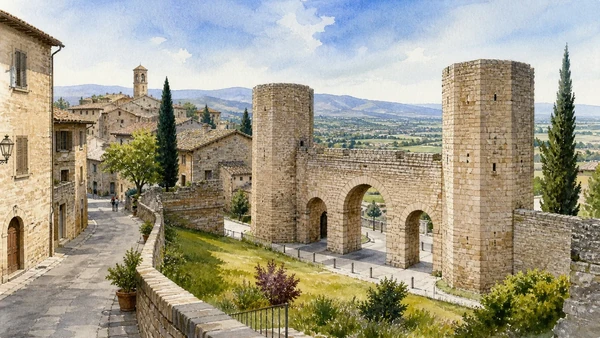
A triple-arched gate framed by tall polygonal towers, preserving one of the strongest images of Roman Hispellum.

The place today
The gate is best approached from outside the wall circuit, where the three openings and the two twelve-sided towers can be read together. The towers are traditionally called the Towers of Propertius, a name connected to the poet whose birthplace was long associated with Spello, though the identification is not archaeological proof.
The historical chapter
Porta Venere formed part of the Augustan defences and probably faced an important sacred area. The towers visible today reflect restoration as well as ancient fabric. Their careful geometry and the gate's ceremonial scale suggest that this entrance was designed to impress, not merely to control movement.
What to notice
- The three arched passages
- The polygonal plan of the flanking towers
- The view back towards the gate from outside the walls
The civic centre
Piazza della Repubblica and Town Hall
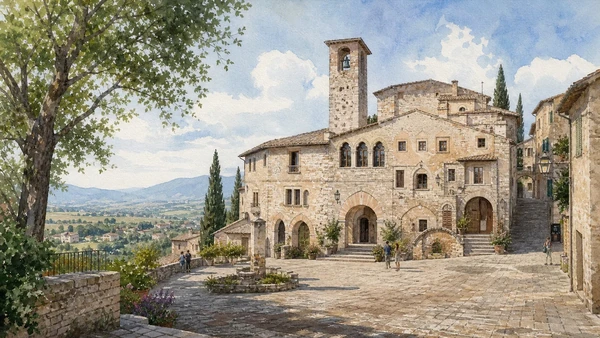
A compact square where medieval government, later additions and archaeological memory occupy the ancient centre of the town.

The place today
The Town Hall presents an irregular frontage shaped by successive centuries, with arched openings, a tower and rooms used for civic collections. The small square is less monumental than Perugia or Gubbio, but its scale reveals the local character of Spello's communal institutions.
The historical chapter
The palace developed from the thirteenth century and was altered repeatedly as offices and representational needs changed. The area corresponds broadly to the centre of ancient Hispellum, so the medieval piazza continues the public function of a much older urban core.
What to notice
- The palace's different masonry phases
- The tower as a civic marker within the narrow town
- How the square interrupts the continuous climb of the main street
The town and its plain
Belvedere, Roman remains and upper walls
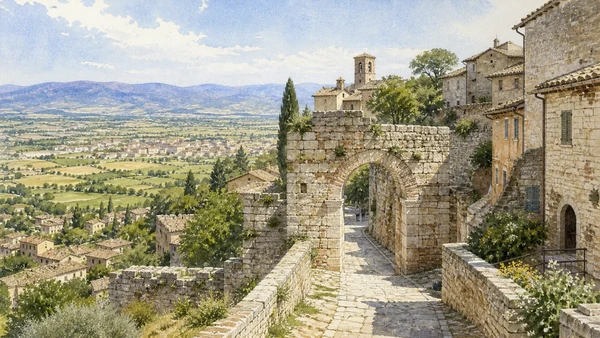
At the highest streets, fragments of ancient construction and broad views reveal why Hispellum occupied this ridge.

The place today
The upper town offers terraces and openings towards the Umbrian valley, Foligno and the distant Apennines. Wall fragments, gates and reused stone appear among houses and gardens. The panorama is not an optional background: it explains the town's control of routes across the plain.
The historical chapter
Roman Hispellum extended along the ridge with terraces adapted to the slope. Medieval Spello inherited the defensive advantage and compressed itself within renewed walls. Later houses, convents and gardens reused the ancient platforms, often leaving archaeological evidence visible only in fragments.
What to notice
- The valley routes visible from the ridge
- Roman blocks reused in later walls
- The close relationship between gardens, terraces and defensive masonry
The lived-in town
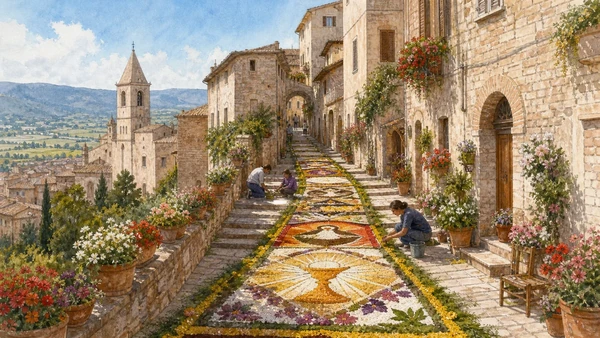
Flowered lanes and the Infiorate
Domestic care and a major religious festival turn streets into a changing form of collective art.

The place today
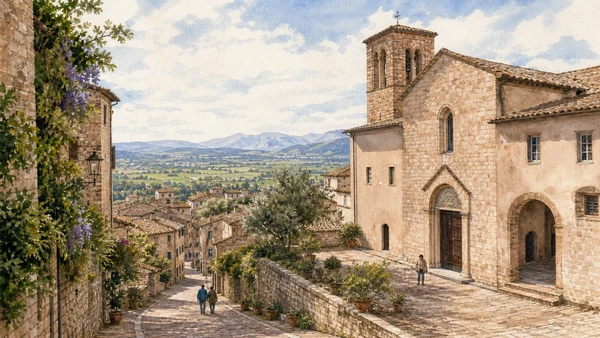
Side lanes climb by stairs and narrow passages between pale stone houses. Pots, balconies and doorways are arranged by residents rather than by a single authority. For Corpus Christi, teams create elaborate carpets from flower petals and plant material; the works are completed overnight and crossed by the religious procession.
The historical chapter
The urban fabric is fundamentally medieval, adapted to the steep ridge and constrained by walls. The custom of flower decoration has older devotional roots, while the organised Infiorate took its modern form in the twentieth century. It is therefore a living tradition within historical streets, not a preserved medieval spectacle.
What to notice
- Stairs and covered passages shaped by the slope
- The difference between year-round domestic planting and festival carpets
- The deliberate use of local stone as a neutral setting for colour
A Roman house rediscovered
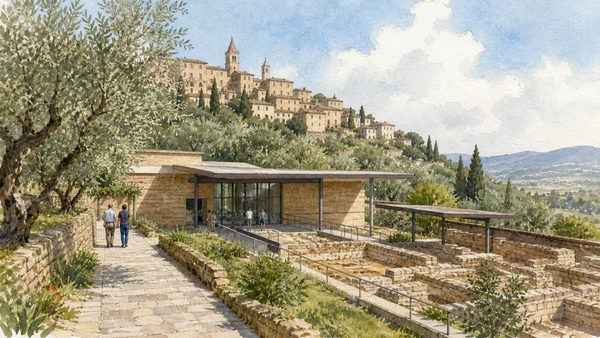
Villa of the Mosaics
A late Roman residential complex whose floors preserve marine figures, geometric patterns and evidence of elite life.

The place today
The museum shelters rooms discovered near the railway in 2005. Walkways allow visitors to see extensive mosaic floors with dolphins, sea creatures, birds, vine motifs and geometric designs. Digital interpretation clarifies the plan without obscuring the archaeological material.
The historical chapter
The principal decorative phase dates between the third and early fourth centuries AD. The scale and quality of the mosaics indicate a wealthy residence connected to late Roman Hispellum. Its discovery expanded the known ancient city beyond the walled hill and created one of Umbria's most important recent archaeological museums.
What to notice
- The marine imagery in the principal rooms
- Threshold patterns marking movement between spaces
- The relationship between the villa and the lower Roman settlement
The sacred landscape beyond the walls
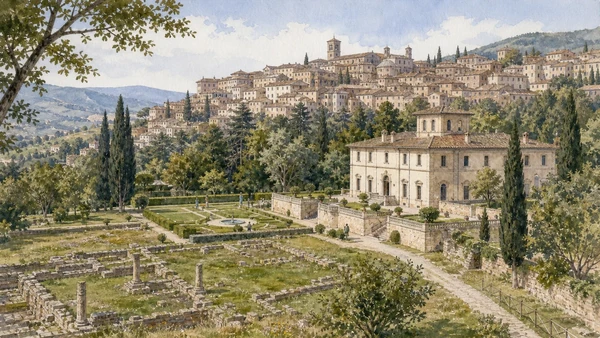
Villa Fidelia and the ancient sanctuary area
A later villa and garden occupy a site connected to the monumental extra-urban landscape of Roman Hispellum.

The place today
Villa Fidelia stands below the historic centre within formal gardens and a broad park used for exhibitions and events. Its terraces frame views back to Spello. Archaeological research in the surrounding area has identified structures associated with an important Roman sanctuary complex.
The historical chapter
Ancient sources and excavations connect the area with a federal sanctuary favoured under Constantine in the fourth century AD. The present villa developed much later, especially between the seventeenth and nineteenth centuries, but its commanding terraces continue the site's long relationship with ceremony, landscape and approach routes.
What to notice
- The axial garden terraces below the hill town
- Views linking the villa to Spello's walls
- The distinction between the later residence and the ancient sacred landscape beneath and around it
The city through time
Eight dates for orientation
An essential chronology showing how ancient foundations, medieval institutions and later transformations overlap.
Augustan Hispellum receives monumental walls, gates and a planned urban identity.
The Villa of the Mosaics reaches its principal decorative phase.
Imperial evidence confirms the continuing importance of the sanctuary landscape below the town.
The medieval commune consolidates the hilltop within renewed walls.
Franciscan institutions expand around Sant'Andrea.
Pinturicchio paints the Baglioni Chapel in Santa Maria Maggiore.
The Roman villa with its extensive mosaic floors is discovered.
Each year the Infiorate transform the streets into a collective work made from flowers.
Before your visit
Practical information,
without turning it into promises
Climbing the ridge
The historic centre rises steadily from Porta Consolare. Stone paving, steps and gradients are integral to the route; comfortable footwear matters.
Church access
The Baglioni Chapel and other churches remain places of worship. Hours and viewing arrangements can change around services and conservation needs.
Two sites below
The Villa of the Mosaics and Villa Fidelia lie outside the upper walking circuit. Plan them deliberately rather than expecting to encounter them between the gates.
Infiorate
Corpus Christi brings exceptional crowds and traffic changes. The floral carpets are ephemeral religious works; consult the official programme and respect barriers and processions.
Sources
The guide was checked against the official regional portal, the Villa of the Mosaics and the Infiorate organisation. Legendary associations, such as the traditional connection between the Towers of Propertius and the poet, are identified without presenting them as archaeological certainty.
- Umbria Tourism · Spello ↗
- Villa of the Mosaics · official website ↗
- Infiorate di Spello · official website ↗
- Municipality of Spello ↗
The hero image is an illustration, not a photograph. Opening hours, tickets, worship schedules, restoration works and path access can change; always consult the linked official pages shortly before visiting.