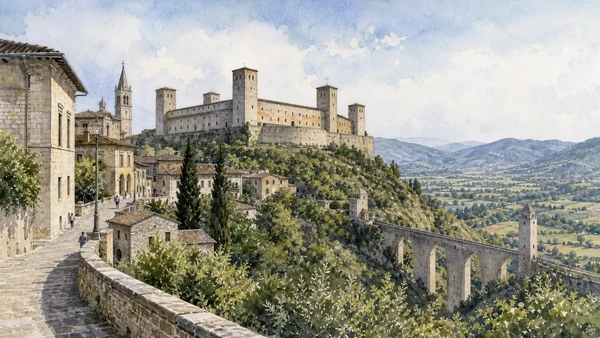
Illustrated guide · Spoleto
Theatre, stone
and the mountain
Ten places through which to read Roman Spoletium, the Lombard duchy, the papal fortress and a city that has made performance part of its modern identity.
Explore the placesPreface
Spoleto is built as a sequence of stages.
A Roman theatre, a cathedral square, a fortress and the crossing towards Monteluco: Spoleto repeatedly turns architecture into a setting. That quality explains why an ancient city could become an international centre for performance without losing its historical gravity.
After forty-two years in Umbria and a professional life in travel since 1990, I read Spoleto as one of the region's most complete urban stories. Rome, the Lombards, the medieval commune, papal government and twentieth-century art remain visible within a remarkably compact slope.
This guide climbs through those layers and ends at the bridge where the built city opens directly into mountain landscape.
In Spoleto, every ascent leads to another scene.
One destination
Spoleto,
stage by stage.
The ten places connect ancient infrastructure, Lombard sacred architecture, Romanesque sculpture, Renaissance defence and modern art. Current access is treated carefully because restoration and post-earthquake work can alter individual visits.
The selection
Ten places,
one story
A climb from Roman Spoletium to the Rocca, followed by the crossing towards Monteluco and a final return to the modern city of art.
- 01Roman Theatre and Archaeological Museum
- 02Roman House and Arch of Drusus
- 03Basilica of San Salvatore
- 04San Ponziano
- 05Cathedral of Santa Maria Assunta and Piazza del Duomo
- 06Church of Sant'Eufemia
- 07San Pietro extra moenia
- 08Rocca Albornoziana and National Museum of the Duchy
- 09Ponte delle Torri and the Sacred Wood
- 10Palazzo Collicola and the Festival city
The ancient city performs
Roman Theatre and Archaeological Museum
A first-century BC theatre still used for performance, integrated with a museum that explains Spoletium and its territory.

The place today
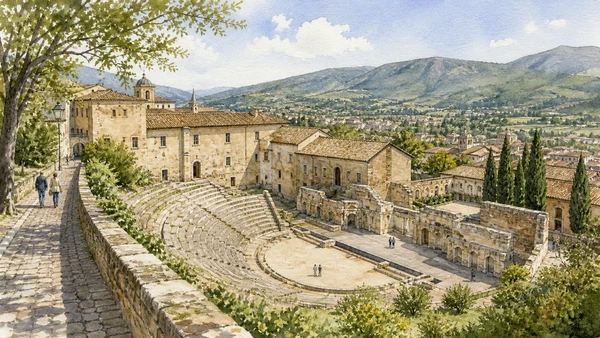
The theatre lies within the former monastery of Sant'Agata. Its cavea, orchestra and stage remain clear, and performances return it to its original function during festivals. The museum occupies the surrounding complex and presents inscriptions, sculpture and objects from prehistoric, Umbrian and Roman phases.
The historical chapter
Built in the first century BC, the theatre suffered an early structural movement and was repaired in antiquity. In the Middle Ages religious buildings grew over and around it, preserving much of the structure beneath later uses. Excavation and restoration between 1954 and 1960 recovered the monument as a central element of Roman Spoleto.
What to notice
- The theatre embedded within the former monastery
- Ancient repairs visible in the structure
- The modern return of live performance to the cavea
Domestic Spoletium
Roman House and Arch of Drusus
A mosaic-floored residence and a monumental arch reveal the scale and street level of the Roman forum district.

The place today
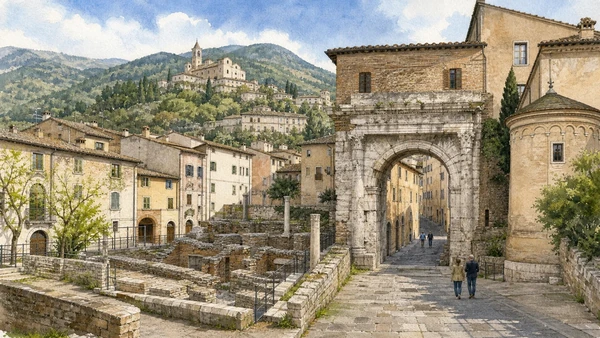
The Roman House preserves rooms arranged around an atrium, with black-and-white mosaic floors and surviving wall bases. A short distance away, the Arch of Drusus and Germanicus stands partly absorbed into later buildings beside Sant'Ansano. Together they locate the ancient forum beneath the medieval centre.
The historical chapter
The house dates principally to the first century AD and belonged to a wealthy urban family; the traditional association with Vespasia Polla, mother of Emperor Vespasian, remains a hypothesis. The arch was erected in AD 23 in honour of Drusus and Germanicus and marked an important approach to the forum.
What to notice
- The atrium plan and geometric mosaic floors
- The difference between Roman and present street levels
- The arch disappearing into later masonry
Lombard heritage
Basilica of San Salvatore
An early medieval church whose façade and interior reuse the language and material of classical architecture.

The place today
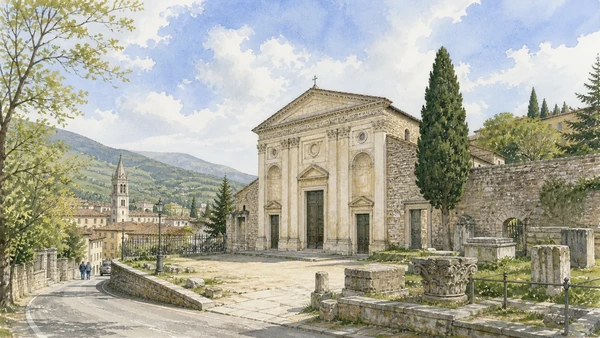
The basilica stands in the cemetery area outside the historic core. Its façade is organised by pilasters, portals and carved classical motifs; inside, columns and architectural fragments create a sober three-aisled space. Conservation work may restrict entry, so the exterior and current official access information are essential parts of planning.
The historical chapter
The building is generally dated between the fourth and eighth centuries and was substantially shaped in the Lombard period. Its reuse of Roman material and classical forms shows that early medieval architecture was not a simple break with antiquity. It forms part of the UNESCO serial site 'The Longobards in Italy. Places of the Power'.
What to notice
- The classical proportions reorganised on the façade
- Reused columns and carved stone
- The controlled, almost abstract clarity of the interior
Romanesque Spoleto
San Ponziano
A monastery church outside the walls where Romanesque structure, crypt and the cult of the city's patron meet.

The place today
The church presents a restrained Romanesque façade with a carved portal and rose window. Inside, later decoration partly overlays the medieval structure, while the crypt preserves columns, capitals and fresco fragments in a more intimate space. The adjoining monastic complex remains active.
The historical chapter
The Benedictine foundation is documented from the early Middle Ages and was rebuilt in Romanesque form between the eleventh and thirteenth centuries. It is dedicated to Ponziano, patron of Spoleto, whose cult was associated with protection against earthquakes. Later restorations altered the upper church but retained the crypt's layered character.
What to notice
- The carved portal and rose window
- Varied columns and capitals in the crypt
- The church's relationship with the road approaching Spoleto
The great urban stage
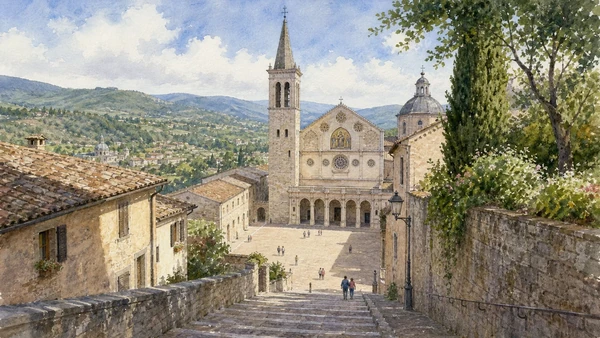
Cathedral of Santa Maria Assunta and Piazza del Duomo
A sloping approach opens into one of Umbria's most theatrical squares, centred on a Romanesque façade and Renaissance portico.

The place today
The cathedral is revealed from above as the visitor descends the broad staircase into Piazza del Duomo. Its façade combines rose windows, arcades, mosaics and an elegant portico. Inside, the apse contains Filippo Lippi's frescoes, while side chapels preserve works and relics connected to the city's religious history.
The historical chapter
The building was erected from the late twelfth century over an earlier cathedral and consecrated in 1198. The façade and bell tower preserve the medieval campaign; the portico was added around the turn of the sixteenth century, and the interior was extensively remodelled from the seventeenth century. The square became a civic and religious theatre long before the modern festival.
What to notice
- The descending approach that frames the façade
- The five arcades and mosaic above the central portal
- Filippo Lippi's apse cycle and tomb
A church within the episcopal court
Church of Sant'Eufemia
A compact Romanesque interior with unusual galleries, reached through the diocesan museum complex.

The place today
Sant'Eufemia is enclosed within the former archbishop's palace and is generally accessed through the diocesan museum. Three naves, robust piers and upper galleries create an interior of exceptional spatial density. The view from the museum route helps explain the church's relationship with the episcopal complex.
The historical chapter
A religious foundation existed here by the early Middle Ages, traditionally connected to the Lombard court. The present Romanesque building took shape around the eleventh and twelfth centuries. Its galleries have prompted different interpretations, but they clearly distinguish the church from the region's more common basilican plans.
What to notice
- The upper galleries running above the side aisles
- The rhythm of piers and rounded arches
- The church embedded within the palace rather than standing free
Sculpture outside the walls
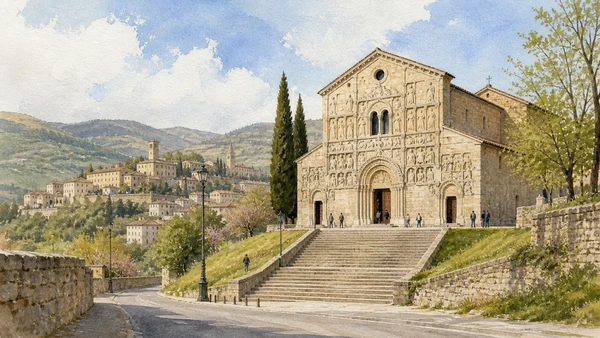
San Pietro extra moenia
A Romanesque façade covered with narrative reliefs, set on the green slope facing the city.

The place today
The church is approached by a broad staircase outside the ancient centre. Its façade is the main reason to linger: reliefs of saints, animals, moral tales and episodes from medieval literature are distributed around the portals and upper openings. The open setting allows the sculptural surface to be read in changing light.
The historical chapter
A church existed here in the early Middle Ages, while the present façade was created mainly in the twelfth and thirteenth centuries. The sculptural programme mixes sacred instruction with fables and exemplary stories familiar to medieval audiences. Later rebuilding changed the interior but left the façade as a major document of Umbrian Romanesque art.
What to notice
- Narrative reliefs around the central portal
- Animals and moral exempla beside sacred imagery
- The isolated façade seen from the staircase below
Papal authority above the city
Rocca Albornoziana and National Museum of the Duchy
A fourteenth-century fortress whose courtyards and towers dominate Spoleto and interpret the early medieval duchy.

The place today
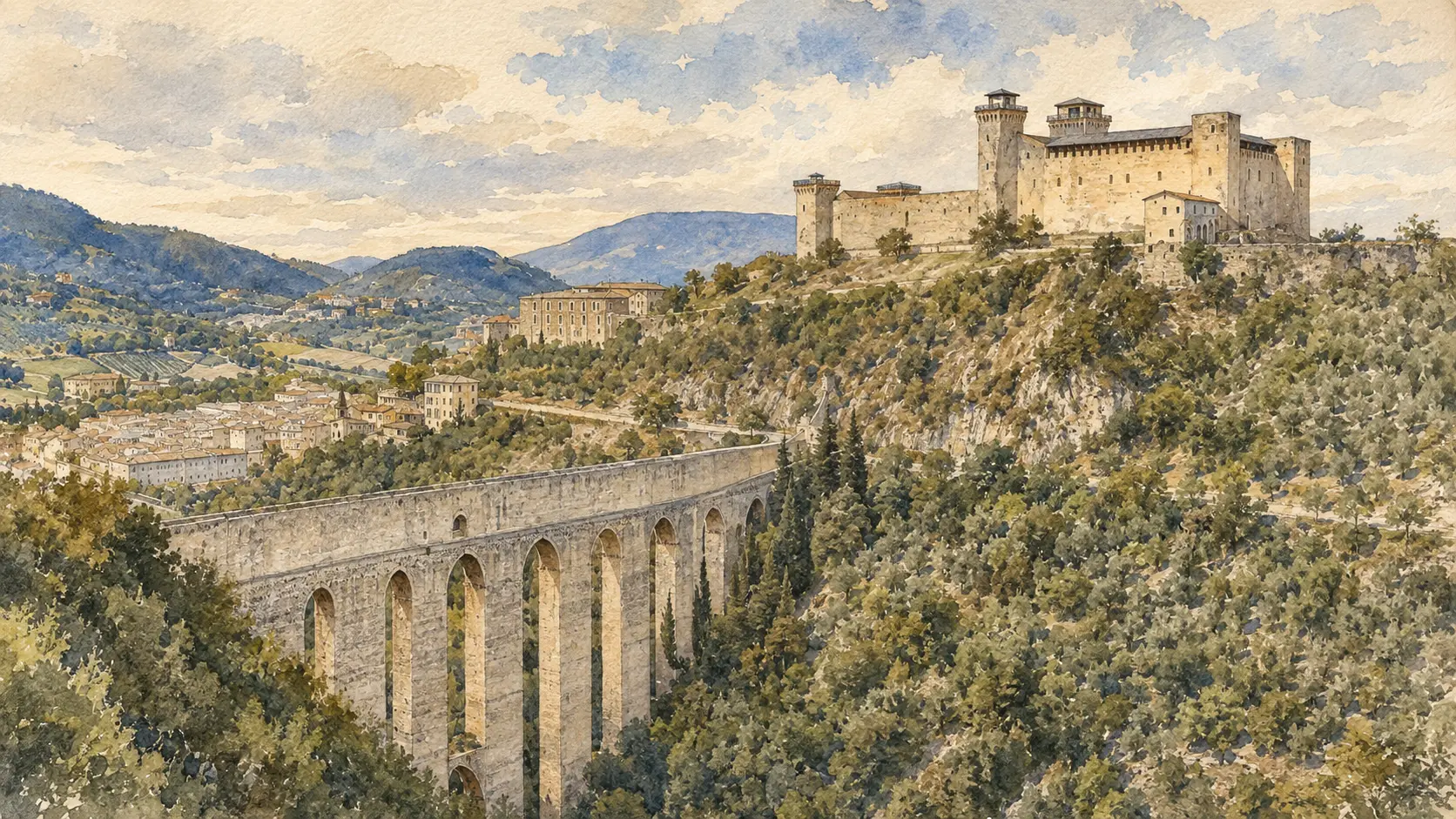
The Rocca crowns the hill with two courtyards, a ring of walls and six towers. The National Museum of the Duchy occupies restored rooms and presents sculpture, paintings and archaeological material from Spoleto and its territory. The panoramic circuit explains the fortress's strategic relation to the valley and mountain routes.
The historical chapter
Cardinal Albornoz commissioned the fortress in the 1360s during the papal reconquest of central Italy; Matteo Gattapone is associated with its design. It served governors, later became a prison and was eventually restored for cultural use. Its museum reconnects the papal monument with the much earlier Lombard political role of Spoleto.
What to notice
- The contrast between the Cortile d'Onore and the more defensive courtyard
- Painted rooms surviving within the fortress
- Views over cathedral, lower city and Ponte delle Torri
The crossing to Monteluco
Ponte delle Torri and the Sacred Wood
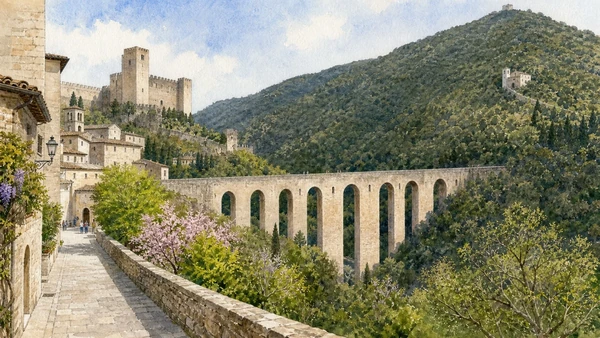
A monumental bridge-aqueduct carries the city across the Tessino gorge towards the forested mountain of hermits.

The place today
The bridge stretches between the Rocca and the slopes of Monteluco on ten tall arches. Reopened in December 2024 and accessible without time limits from April 2025, it once again forms the natural continuation of the upper-city walk. Beyond it, paths climb into the holm-oak Sacred Wood and towards the Franciscan sanctuary.
The historical chapter
The present structure is generally associated with the late Middle Ages and may incorporate or replace earlier hydraulic works; its exact origins remain debated. It carried water and provided a crossing above the gorge. Monteluco had attracted hermits since late antiquity, and its protected sacred character long limited exploitation of the woodland.
What to notice
- The ten arches and the great difference in height across the gorge
- The water channel and pedestrian passage serving two functions
- The immediate transition from fortified city to protected woodland
The modern city of art
Palazzo Collicola and the Festival city
An eighteenth-century palace and a network of theatres connect Spoleto's historical spaces with post-war and contemporary art.

The place today
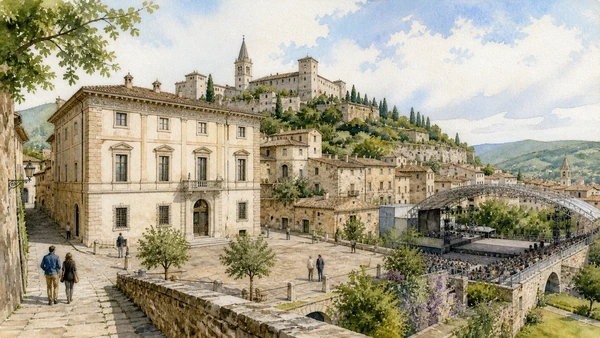
Palazzo Collicola houses the Carandente collection and changing exhibitions in rooms that move between noble-apartment decoration and modern display. Across the city, the Teatro Nuovo Menotti, Teatro Caio Melisso and open-air spaces become part of the Festival dei Due Mondi each summer.
The historical chapter
The palace was built for the Collicola family in the eighteenth century. Spoleto's modern artistic identity accelerated after Gian Carlo Menotti founded the Festival dei Due Mondi in 1958. The 1962 exhibition Sculptures in the City placed major contemporary works in public space, leaving a lasting dialogue between ancient fabric and modern art.
What to notice
- The contrast between historic apartment and contemporary galleries
- Works linked to Giovanni Carandente and the 1962 exhibition
- How theatres and squares operate as one distributed cultural venue
The city through time
Eight dates for orientation
An essential chronology showing how ancient foundations, medieval institutions and later transformations overlap.
Spoletium becomes a Roman colony controlling strategic routes across central Italy.
The Roman theatre monumentalises the public city.
Spoleto emerges as the centre of a powerful Lombard duchy.
The present cathedral is consecrated.
The Rocca Albornoziana asserts restored papal authority.
Gian Carlo Menotti founds the Festival dei Due Mondi.
Sculptures in the City turns Spoleto into an international open-air exhibition.
Ponte delle Torri reopens after post-earthquake closure and monitoring works.
Before your visit
Practical information,
without turning it into promises
Mechanised routes
Escalators and lifts help connect the lower car parks with the historic centre and Rocca, but many monuments still require slopes, stairs and uneven paving.
Current access
San Salvatore and other sites may be affected by conservation work. Check official notices rather than relying on older guidebooks.
Ponte delle Torri
The bridge is open, but monitoring, weather or maintenance can still produce temporary changes. Follow municipal signage on the day.
Festival season
Late June and early July bring performances, installations and crowds. Book ahead and expect changes to ordinary traffic and venue access.
Sources
Sources include UNESCO, the Italian Ministry of Culture, the Municipality of Spoleto, the cathedral and the official regional portal. Debated questions, especially the origin of Ponte delle Torri and the traditional identification of the Roman House's owner, are presented as interpretations rather than certainties.
- Umbria Tourism · Spoleto ↗
- UNESCO · Longobards in Italy ↗
- National Museums of Umbria · Rocca and Museum of the Duchy ↗
- Municipality of Spoleto ↗
- Cathedral of Spoleto ↗
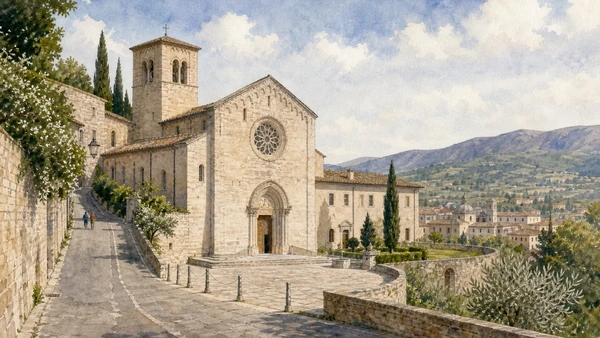
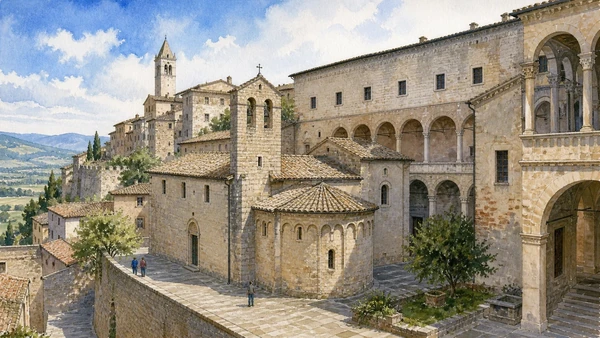
The hero image is an illustration, not a photograph. Opening hours, tickets, worship schedules, restoration works and path access can change; always consult the linked official pages shortly before visiting.