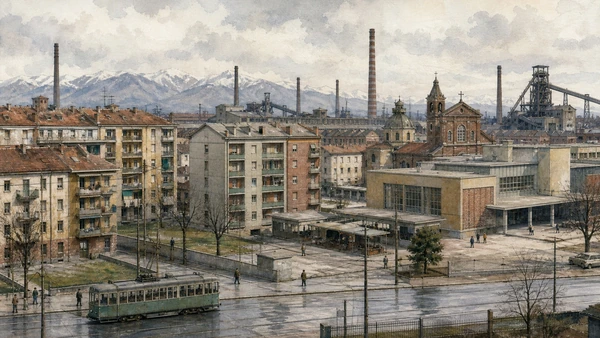
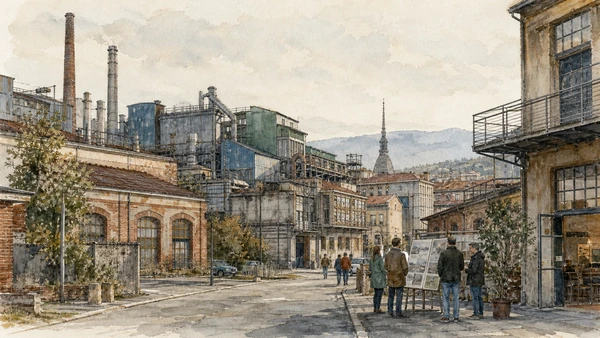
Original documentary watercolour panorama for Lingotto, FIAT and the Industrial Metropolis: Complete Guide, with accurate Piedmont architecture, landscape and lived context

Turin Guide 08 · Assembly, test track, automobile collections, exhibitions, workers’ districts, Mirafiori and migration

Lingotto, FIAT
& the Industrial Metropolis

A complete industrial-history route centred on the Lingotto factory and its rooftop track, extending to automobile collections, railway and market infrastructure, Mirafiori production, workers’ housing and the migrant city created around manufacturing.

Plan the route
Turin · Piedmont10 chapters · one complete route

Why this route must be read in layers

Industrial Turin cannot be reduced to one brand or design icon. Factories depended on labour, rail, housing, suppliers, migration, conflict and pollution, while later cultural reuse selectively preserves their architecture.

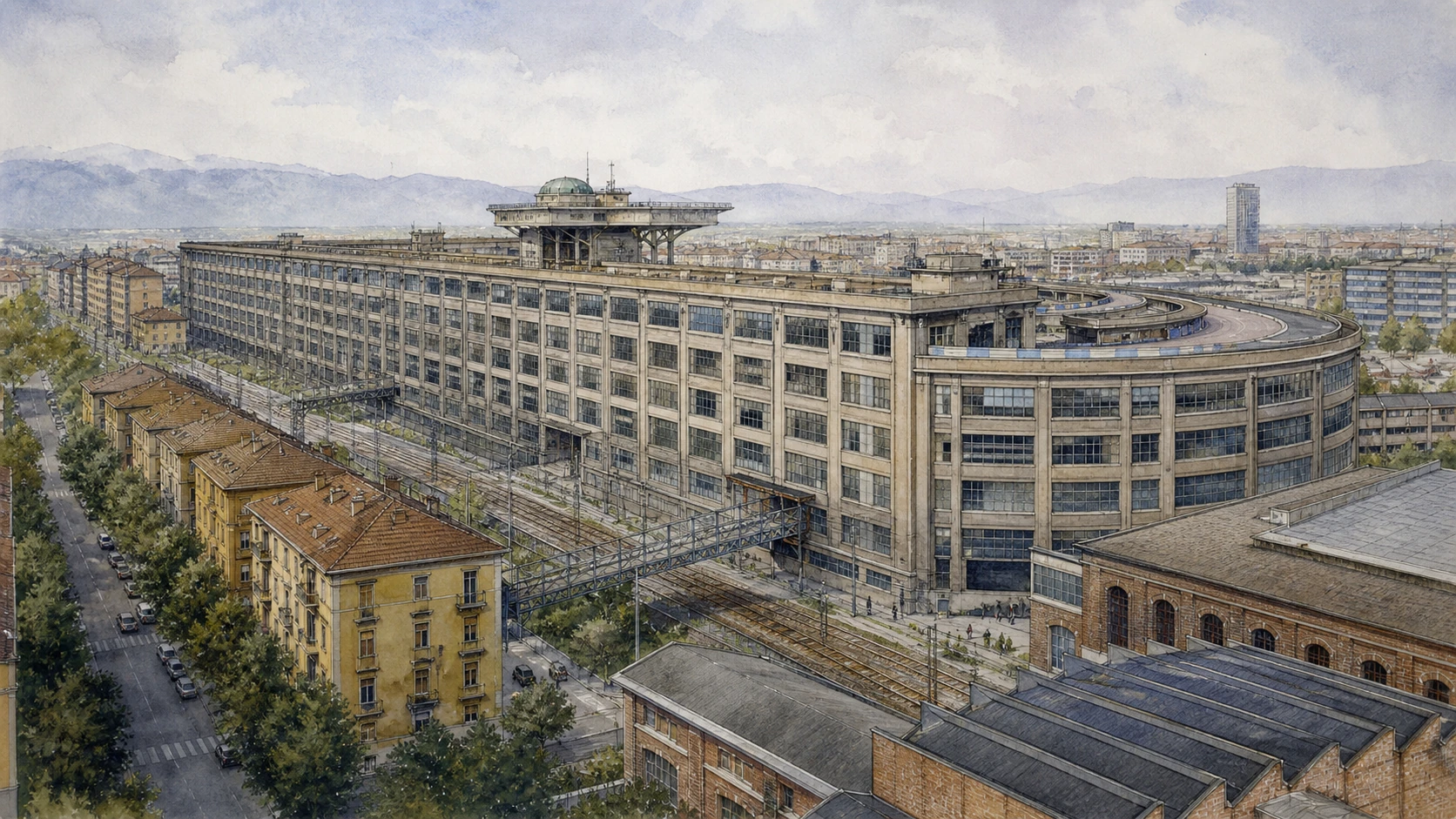
Lingotto’s vertical production route became famous because materials rose through the building and finished cars reached the roof. Its current uses alter circulation while retaining major structural evidence.

MAUTO can explain engineering and mobility only when vehicles are connected to manufacture, road systems, fuel, advertising and labour rather than displayed as isolated sculpture.

Mirafiori and surrounding quarters remain working and residential environments. Access to plants is controlled, and the social history of migration cannot be reconstructed through unauthorized industrial tourism.

Begin with publicly accessible Lingotto fabric and the museum, then use normal transit to reach southern districts; never enter production, rail or service areas without explicit institutional access.

The route

Plan your visit

Read Lingotto’s building and roof as one production system, continue through automobile and exhibition institutions, then follow rail and tram corridors toward Mirafiori and the neighbourhoods built around industry.

Early morning

Lingotto factory · The rooftop track · Pinacoteca Agnelli and the Scrigno

Move in the documented order: Lingotto factory: vertical production in reinforced concrete; then The rooftop track: testing above the factory; then Pinacoteca Agnelli and the Scrigno: a private collection above industry. Recheck live access and transport before entering a controlled site.

Late morning

Lingotto’s adaptive reuse · MAUTO · Former wholesale markets

Move in the documented order: Lingotto’s adaptive reuse: preservation through selective change; then MAUTO: automobile history beyond styling; then Former wholesale markets: food logistics beside the factory city. Recheck live access and transport before entering a controlled site.

Afternoon

Lingotto railway and freight corridors · Mirafiori · Workers’ districts

Move in the documented order: Lingotto railway and freight corridors: infrastructure behind the icon; then Mirafiori: horizontal mass production at metropolitan scale; then Workers’ districts: housing the industrial workforce. Recheck live access and transport before entering a controlled site.

Late afternoon

Migration and labour

Move in the documented order: Migration and labour: the people omitted by the factory silhouette. Recheck live access and transport before entering a controlled site.

Ten chapters

Explore the places

The order follows terrain, institutions and present-day movement. Use the index to return to a chapter without reducing the route to isolated monuments.

  1. 01Lingotto factory: vertical production in reinforced concrete
  2. 02The rooftop track: testing above the factory
  3. 03Pinacoteca Agnelli and the Scrigno: a private collection above industry
  4. 04Lingotto’s adaptive reuse: preservation through selective change
  5. 05MAUTO: automobile history beyond styling
  6. 06Former wholesale markets: food logistics beside the factory city
  7. 07Lingotto railway and freight corridors: infrastructure behind the icon
  8. 08Mirafiori: horizontal mass production at metropolitan scale
  9. 09Workers’ districts: housing the industrial workforce
  10. 10Migration and labour: the people omitted by the factory silhouette
01

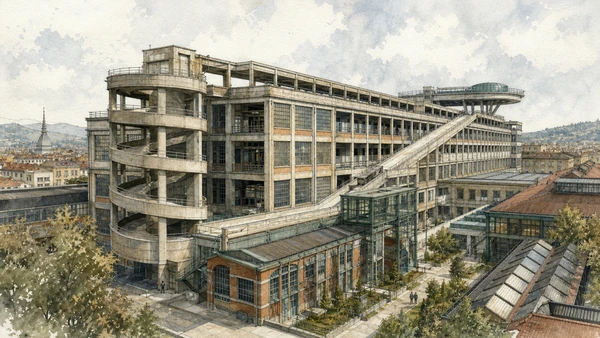
Long structural bays, ramps and courtyards reveal a factory designed to move components upward and completed cars toward the roof.

Lingotto factory: vertical production in reinforced concrete

Long structural bays, ramps and courtyards reveal a factory designed to move components upward and completed cars toward the roof. The site becomes clearer when its surviving fabric, later alterations and present use are read together.

Today

The area is inhabited and worked, not staged for visitors. Keep doorways, pavements, cycle lanes and deliveries clear, ask before photographing people and use current municipal mobility information.

History

FIAT built Lingotto in phases from the 1910s to the 1920s; the plant became an international image of modern manufacture before production ended and reuse began.

How to read this place

Begin with repetitive concrete frame. Then compare spiral ramps and internal logistics with new cultural and commercial insertions; the differences are evidence, not visual noise.

What to notice

  • repetitive concrete frame
  • spiral ramps and internal logistics
  • new cultural and commercial insertions
Lingotto · Official site
Original documentary watercolour of Lingotto factory: vertical production in reinforced concrete in Turin · Piedmont, showing accurate architecture, landscape, people and present-day use
Lingotto factory: vertical production in reinforced concreteOriginal Merlintravel documentary watercolour · 2026
02

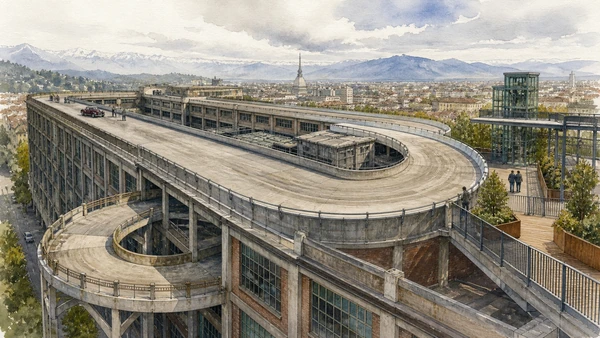
Banked curves and long straights made final testing part of the building’s celebrated silhouette.

The rooftop track: testing above the factory

Banked curves and long straights made final testing part of the building’s celebrated silhouette. The site becomes clearer when its surviving fabric, later alterations and present use are read together.

Today

Opening, ticketing, room access and temporary displays can change. Check the institution’s official notice shortly before visiting, use the designated entrance and allow for security or conservation controls.

History

Completed cars were brought to the roof as the last stage of the production sequence; later restoration and selective access converted the track into heritage and event space.

How to read this place

Begin with banking and safety edges. Then compare relationship to ramps below with current landscape and access additions; the differences are evidence, not visual noise.

What to notice

  • banking and safety edges
  • relationship to ramps below
  • current landscape and access additions
Pinacoteca Agnelli · Official site
Original documentary watercolour of The rooftop track: testing above the factory in Turin · Piedmont, showing accurate architecture, landscape, people and present-day use
The rooftop track: testing above the factoryOriginal Merlintravel documentary watercolour · 2026
03

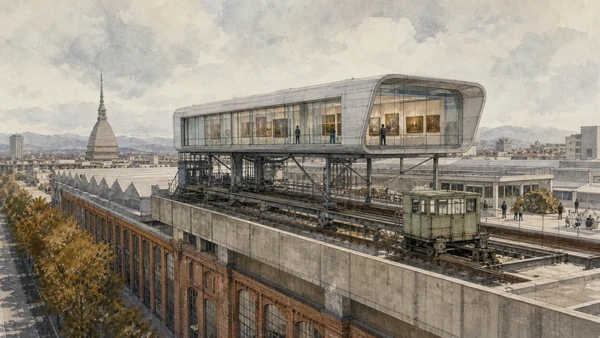
A compact gallery suspended over the roof sets paintings against a building associated with mass production.

Pinacoteca Agnelli and the Scrigno: a private collection above industry

A compact gallery suspended over the roof sets paintings against a building associated with mass production. The site becomes clearer when its surviving fabric, later alterations and present use are read together.

Today

Opening, ticketing, room access and temporary displays can change. Check the institution’s official notice shortly before visiting, use the designated entrance and allow for security or conservation controls.

History

Renzo Piano designed the rooftop gallery for the Agnelli collection in the early twenty-first century, adding a private collecting narrative to the converted factory.

How to read this place

Begin with the gallery volume above the track. Then compare collection scale versus factory scale with temporary projects across the roof; the differences are evidence, not visual noise.

What to notice

  • the gallery volume above the track
  • collection scale versus factory scale
  • temporary projects across the roof
Pinacoteca Agnelli · Official site
Original documentary watercolour of Pinacoteca Agnelli and the Scrigno: a private collection above industry in Turin · Piedmont, showing accurate architecture, landscape, people and present-day use
Pinacoteca Agnelli and the Scrigno: a private collection above industryOriginal Merlintravel documentary watercolour · 2026
04

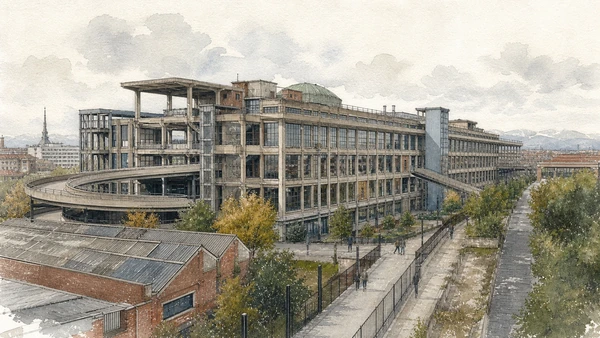
Hotels, university spaces, shops, conference halls and health services occupy a complex once organised around manufacture.

Lingotto’s adaptive reuse: preservation through selective change

Hotels, university spaces, shops, conference halls and health services occupy a complex once organised around manufacture. The site becomes clearer when its surviving fabric, later alterations and present use are read together.

Today

The area is inhabited and worked, not staged for visitors. Keep doorways, pavements, cycle lanes and deliveries clear, ask before photographing people and use current municipal mobility information.

History

An international redevelopment process from the 1980s onward retained major concrete structures while removing equipment and redistributing access among several owners and programmes.

How to read this place

Begin with retained frame and ramps. Then compare areas where machinery has disappeared with public and private circulation separated today; the differences are evidence, not visual noise.

What to notice

  • retained frame and ramps
  • areas where machinery has disappeared
  • public and private circulation separated today
Città di Torino · Official portal
Original documentary watercolour of Lingotto's adaptive reuse: preservation through selective change in Turin · Piedmont, showing accurate architecture, landscape, people and present-day use
Lingotto’s adaptive reuse: preservation through selective changeOriginal Merlintravel documentary watercolour · 2026
05

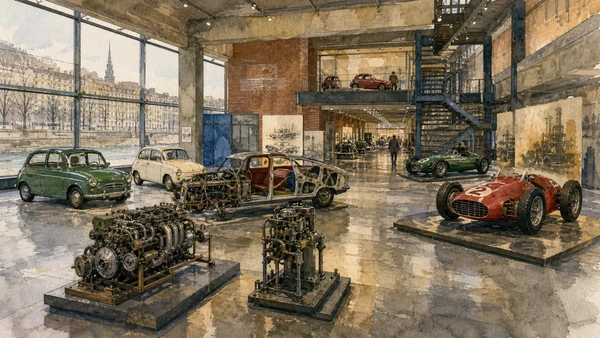
Vehicles, prototypes, engines and media can connect mobility to engineering, labour, energy and social aspiration.

MAUTO: automobile history beyond styling

Vehicles, prototypes, engines and media can connect mobility to engineering, labour, energy and social aspiration. The site becomes clearer when its surviving fabric, later alterations and present use are read together.

Today

Opening, ticketing, room access and temporary displays can change. Check the institution’s official notice shortly before visiting, use the designated entrance and allow for security or conservation controls.

History

Turin’s automobile museum originated in the 1930s and developed in a purpose-built riverfront home later extensively redesigned for contemporary display.

How to read this place

Begin with technical systems beneath bodywork. Then compare mass-market vehicles beside racing icons with labels addressing production and environmental cost; the differences are evidence, not visual noise.

What to notice

  • technical systems beneath bodywork
  • mass-market vehicles beside racing icons
  • labels addressing production and environmental cost
Museo Nazionale dell’Automobile · Official site
Original documentary watercolour of MAUTO: automobile history beyond styling in Turin · Piedmont, showing accurate architecture, landscape, people and present-day use
MAUTO: automobile history beyond stylingOriginal Merlintravel documentary watercolour · 2026
06

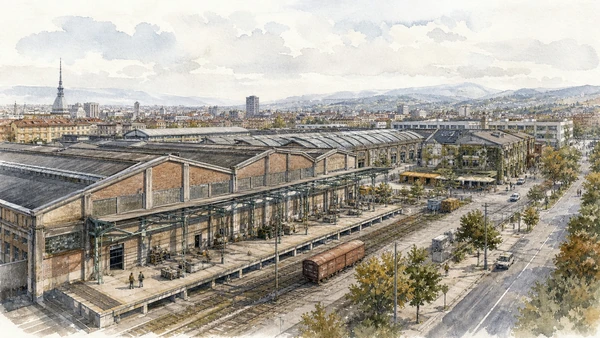
Large halls and rail-road access record the distribution systems that fed a rapidly growing industrial population.

Former wholesale markets: food logistics beside the factory city

Large halls and rail-road access record the distribution systems that fed a rapidly growing industrial population. The site becomes clearer when its surviving fabric, later alterations and present use are read together.

Today

The area is inhabited and worked, not staged for visitors. Keep doorways, pavements, cycle lanes and deliveries clear, ask before photographing people and use current municipal mobility information.

History

The Mercati Generali complex developed in the twentieth century near Lingotto and later entered cycles of partial reuse associated with events and urban redevelopment.

How to read this place

Begin with shed spans and loading edges. Then compare connections to rail and major roads with temporary uses distinguished from permanent conversion; the differences are evidence, not visual noise.

What to notice

  • shed spans and loading edges
  • connections to rail and major roads
  • temporary uses distinguished from permanent conversion
Città di Torino · Official portal
Original documentary watercolour of Former wholesale markets: food logistics beside the factory city in Turin · Piedmont, showing accurate architecture, landscape, people and present-day use
Former wholesale markets: food logistics beside the factory cityOriginal Merlintravel documentary watercolour · 2026
07

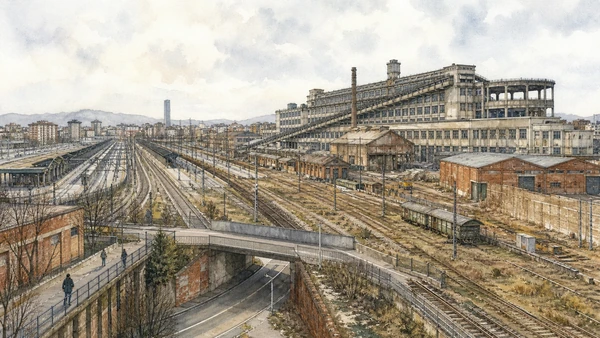
Tracks, stations and service land explain how workers, materials and goods reached southern Turin.

Lingotto railway and freight corridors: infrastructure behind the icon

Tracks, stations and service land explain how workers, materials and goods reached southern Turin. The site becomes clearer when its surviving fabric, later alterations and present use are read together.

Today

Timetables, engineering works, capacity and accessibility arrangements can change. Check the operator on the day, leave a realistic connection margin and never enter tracks, depots or restricted infrastructure.

History

National and industrial rail systems expanded with factories and neighbourhoods, then changed as freight patterns, high-speed routes and metropolitan services evolved.

How to read this place

Begin with public platforms versus restricted track land. Then compare bridges and underpasses joining neighbourhoods with former sidings visible in new development; the differences are evidence, not visual noise.

What to notice

  • public platforms versus restricted track land
  • bridges and underpasses joining neighbourhoods
  • former sidings visible in new development
RFI · Torino Lingotto
Original documentary watercolour of Lingotto railway and freight corridors: infrastructure behind the icon in Turin · Piedmont, showing accurate architecture, landscape, people and present-day use
Lingotto railway and freight corridors: infrastructure behind the iconOriginal Merlintravel documentary watercolour · 2026
08

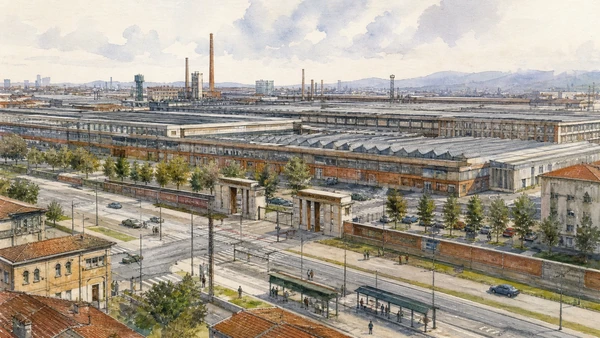
A vast controlled industrial area replaced Lingotto’s vertical model and reorganised southern Turin around shifts, gates and roads.

Mirafiori: horizontal mass production at metropolitan scale

A vast controlled industrial area replaced Lingotto’s vertical model and reorganised southern Turin around shifts, gates and roads. The site becomes clearer when its surviving fabric, later alterations and present use are read together.

Today

The area is inhabited and worked, not staged for visitors. Keep doorways, pavements, cycle lanes and deliveries clear, ask before photographing people and use current municipal mobility information.

History

FIAT opened Mirafiori in 1939 and expanded it after the war, making the plant central to Italy’s industrial growth, labour conflict and later restructuring.

How to read this place

Begin with perimeter and gate scale from public space. Then compare transport routes built for shift changes with active production kept separate from historical observation; the differences are evidence, not visual noise.

What to notice

  • perimeter and gate scale from public space
  • transport routes built for shift changes
  • active production kept separate from historical observation
Città di Torino · Official portal
Original documentary watercolour of Mirafiori: horizontal mass production at metropolitan scale in Turin · Piedmont, showing accurate architecture, landscape, people and present-day use
Mirafiori: horizontal mass production at metropolitan scaleOriginal Merlintravel documentary watercolour · 2026
09

Apartment blocks, services, parish complexes and public transport reveal how production extended far beyond factory walls.

Workers’ districts: housing the industrial workforce

Apartment blocks, services, parish complexes and public transport reveal how production extended far beyond factory walls. The site becomes clearer when its surviving fabric, later alterations and present use are read together.

Today

The area is inhabited and worked, not staged for visitors. Keep doorways, pavements, cycle lanes and deliveries clear, ask before photographing people and use current municipal mobility information.

History

Successive housing programmes responded unevenly to population growth, especially during post-war migration from southern Italy and the Veneto.

How to read this place

Begin with different housing phases. Then compare schools, markets and public space with distance and connection to industrial gates; the differences are evidence, not visual noise.

What to notice

  • different housing phases
  • schools, markets and public space
  • distance and connection to industrial gates
Città di Torino · Official portal
Original documentary watercolour of Workers' districts: housing the industrial workforce in Turin · Piedmont, showing accurate architecture, landscape, people and present-day use
Workers’ districts: housing the industrial workforceOriginal Merlintravel documentary watercolour · 2026
10

Oral histories, union records and neighbourhood institutions recover experiences of recruitment, assembly work, conflict and adaptation.

Migration and labour: the people omitted by the factory silhouette

Oral histories, union records and neighbourhood institutions recover experiences of recruitment, assembly work, conflict and adaptation. The site becomes clearer when its surviving fabric, later alterations and present use are read together.

Today

The area is inhabited and worked, not staged for visitors. Keep doorways, pavements, cycle lanes and deliveries clear, ask before photographing people and use current municipal mobility information.

History

Industrial expansion drew workers from Piedmontese countryside and across Italy before later international migration and deindustrialisation changed the city’s social geography.

How to read this place

Begin with documented testimony rather than stereotype. Then compare meeting halls and community services with new businesses occupying older industrial streets; the differences are evidence, not visual noise.

What to notice

  • documented testimony rather than stereotype
  • meeting halls and community services
  • new businesses occupying older industrial streets
Città di Torino · Official portal
Original documentary watercolour of Migration and labour: the people omitted by the factory silhouette in Turin · Piedmont, showing accurate architecture, landscape, people and present-day use
Migration and labour: the people omitted by the factory silhouetteOriginal Merlintravel documentary watercolour · 2026

Turin through time

A short chronology

From Augusta Taurinorum and the Savoy court to national capital, industrial metropolis and contemporary reuse.

  1. Augusta Taurinorum is founded on a regular Roman grid close to the Po and Dora corridors.

  2. Gates, theatre, walls and urban infrastructure develop within the Roman colony.

  3. Bishops, communes, churches and fortified routes reshape the medieval city and its territory.

  4. The House of Savoy establishes firmer control over Turin, beginning a long dynastic transformation.

  5. The University of Turin is founded and becomes a durable part of the city’s institutional landscape.

  6. Emanuele Filiberto transfers the Savoy capital to Turin, accelerating court planning and fortification.

  7. New squares, straight streets, palaces and churches expand the capital beyond the Roman core.

  8. Guarino Guarini works in Turin, transforming sacred and court architecture through geometry and light.

  9. The siege of Turin ends; the victory is later commemorated through Juvarra’s Basilica of Superga.

  10. Royal status and Juvarra’s projects reinforce Turin’s ceremonial axes and metropolitan residence system.

  11. The Statuto Albertino and the Subalpine Parliament make Turin central to constitutional politics.

  12. Turin serves as the first capital of the Kingdom of Italy before the government moves to Florence.

  13. FIAT, Lingotto and Mirafiori help turn Turin into a major industrial and migrant metropolis.

  14. Bombing, occupation, resistance and liberation damage the city and leave a complex memorial geography.

  15. Deindustrialisation, museum growth, adaptive reuse and metropolitan regeneration repeatedly change Turin.

Before your visit

Practical information

01

Check the live page

Opening hours, reservation systems, restoration, exhibitions and transport can change. Recheck the linked official institution shortly before departure.

02

Separate worship and tourism

Churches and sanctuaries remain religious spaces. Services, funerals and community use take priority over visitor itineraries.

03

Plan real distances

Turin · Piedmont combines dense urban routes with lakes, valleys and dispersed towns. Do not compress distant chapters into an unsafe or superficial day.

04

Keep thresholds open

Arcades, station halls, markets, courtyards, workshops and residential streets must continue to function while you observe or photograph them.

05

Use current mobility data

Check the responsible rail, navigation, bus, road or park operator on the day; replacement services and weather can change an otherwise sound route.

06

Read change honestly

Restoration, reconstruction, adaptive reuse and new development have all shaped the landscape visible today.

Method and sources

Sources and image credits

This guide uses official museum, ministry, municipal, transport, park and UNESCO documentation checked on 29 August 2026. It separates durable historical interpretation from access details that can change, distinguishes surviving fabric from restoration or reconstruction, and treats worship, work, residence and public movement as part of the evidence. Every chapter links its principal institutional source; tickets, closures, weather and transport must always be verified again on the day of the visit.

All ten images are original Merlintravel editorial watercolours based on documented present-day conditions. They are illustrations, not substitutes for archaeological plans. Opening hours, tickets, accessible routes, temporary exhibitions and conservation work can change; consult the linked official pages shortly before visiting.