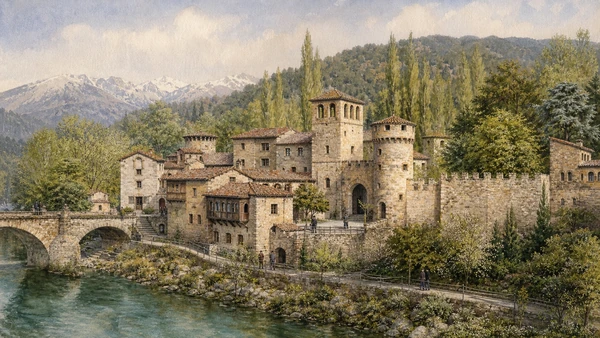
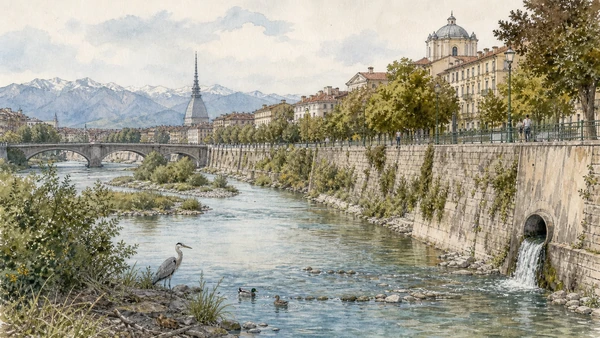
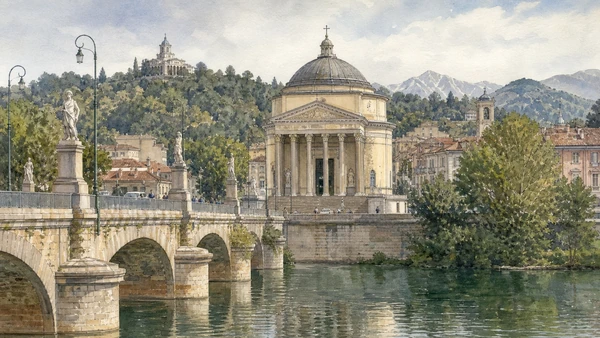
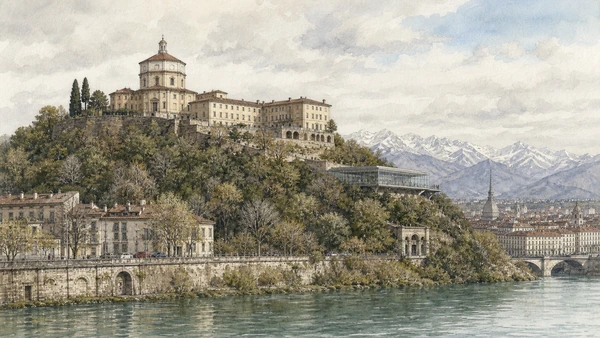
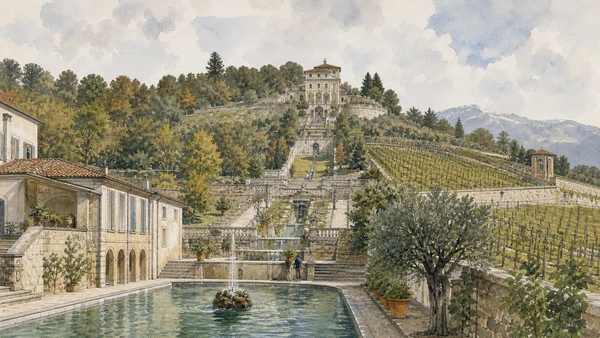
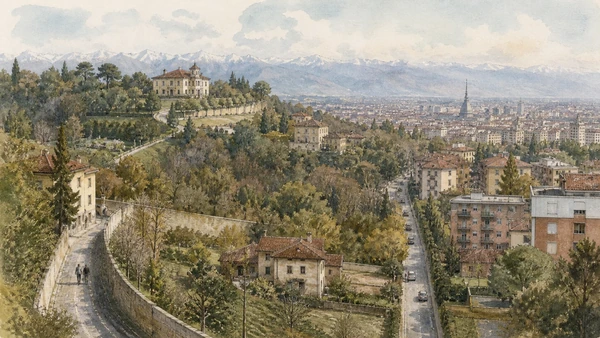
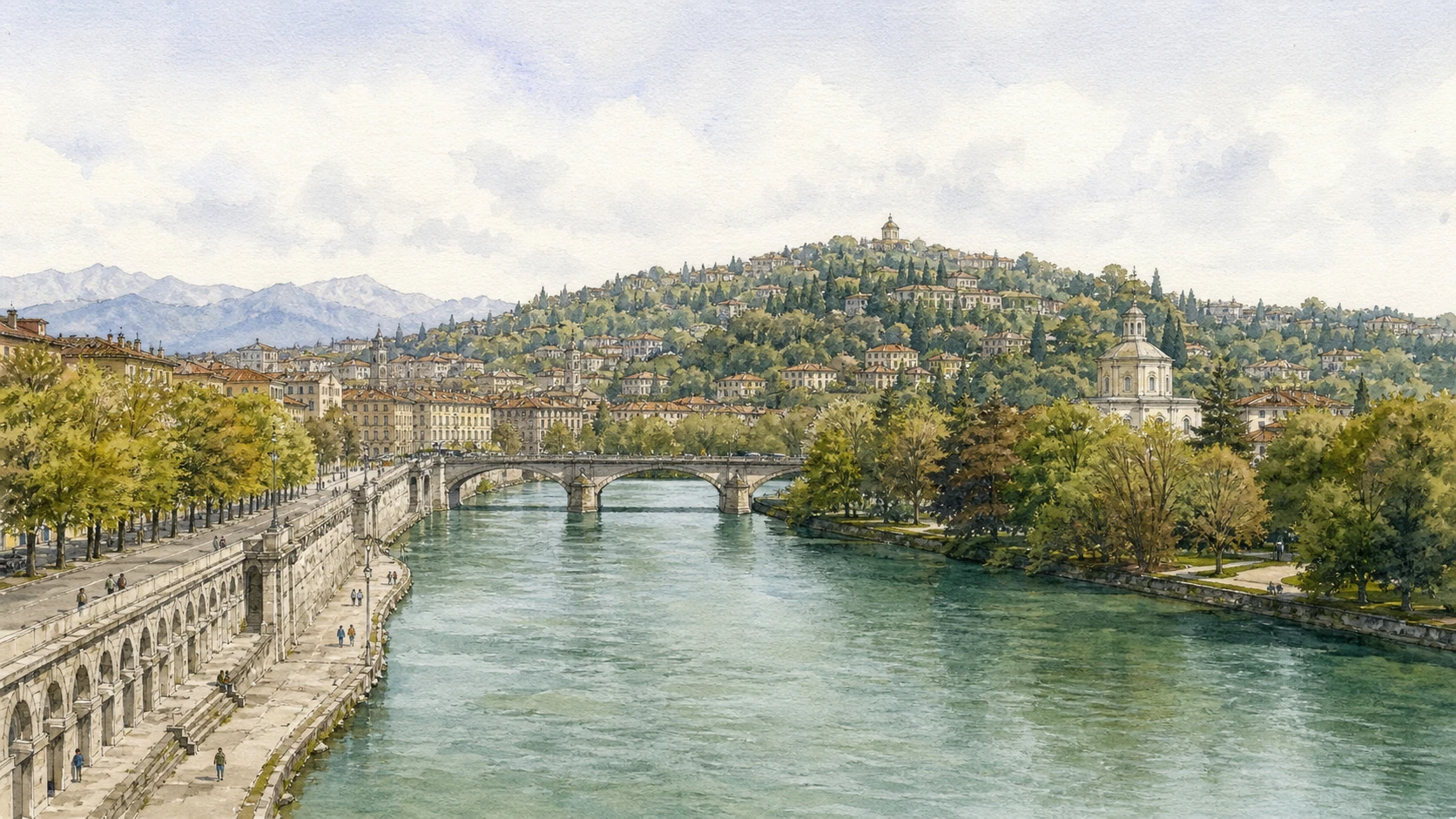
Original documentary watercolour panorama for The Po, Valentino and the Turin Hills: Complete Guide, with accurate Piedmont architecture, landscape and lived context

Turin Guide 07 · Riverbanks, park, Savoy residence, exhibition reconstruction, bridges, hill churches and ecology

The Po, Valentino
& the Turin Hills

A complete landscape guide from the Murazzi and central bridges through Valentino Park and castle to the reconstructed Borgo Medievale, then across the river toward Gran Madre, Monte dei Cappuccini and Villa della Regina.

Plan the route
Turin · Piedmont10 chapters · one complete route

Why this route must be read in layers

Turin’s riverfront joins hydraulic engineering, court landscape, public park, transport, nightlife, worship and habitat. The hills frame the city but are inhabited ground rather than a scenic backdrop.

The Po is managed water with changing levels and ecological pressures. Embankments and bridges made new public space while narrowing or hardening parts of the river edge.

Valentino contains a genuine Savoy residence and a deliberately reconstructed medieval village built for an 1884 exhibition. Responsible interpretation must keep those statuses separate.

Villa della Regina, Gran Madre and Monte dei Cappuccini use the slope to command views back toward the city; current access, worship and residential streets limit any continuous tourist circuit.

Walk downstream or upstream in one coherent direction, check river and park conditions, and use public transport for the hill rather than forcing unsafe shortcuts through steep residential roads.

The route

Plan your visit

Begin at the central river crossing, follow public banks and Valentino paths, then cross by an official bridge and climb only through recognised streets or current transport connections.

Early morning

Murazzi del Po · Ponte Vittorio Emanuele I · Valentino Park

Move in the documented order: Murazzi del Po: engineered river edge and changing public use; then Ponte Vittorio Emanuele I: an urban axis across water; then Valentino Park: public landscape on a working floodplain. Recheck live access and transport before entering a controlled site.

Late morning

Valentino Castle · Borgo Medievale · Po river ecology

Move in the documented order: Valentino Castle: Savoy residence and university; then Borgo Medievale: an 1884 reconstruction, not a surviving village; then Po river ecology: habitat inside the metropolis. Recheck live access and transport before entering a controlled site.

Afternoon

Gran Madre di Dio · Monte dei Cappuccini · Villa della Regina

Move in the documented order: Gran Madre di Dio: Restoration monument and parish church; then Monte dei Cappuccini: convent, viewpoint and Alpine interpretation; then Villa della Regina: vineyard, gardens and court retreat. Recheck live access and transport before entering a controlled site.

Late afternoon

The Turin hills

Move in the documented order: The Turin hills: residences, woods and unequal access. Recheck live access and transport before entering a controlled site.

Ten chapters

Explore the places

The order follows terrain, institutions and present-day movement. Use the index to return to a chapter without reducing the route to isolated monuments.

  1. 01Murazzi del Po: engineered river edge and changing public use
  2. 02Ponte Vittorio Emanuele I: an urban axis across water
  3. 03Valentino Park: public landscape on a working floodplain
  4. 04Valentino Castle: Savoy residence and university
  5. 05Borgo Medievale: an 1884 reconstruction, not a surviving village
  6. 06Po river ecology: habitat inside the metropolis
  7. 07Gran Madre di Dio: Restoration monument and parish church
  8. 08Monte dei Cappuccini: convent, viewpoint and Alpine interpretation
  9. 09Villa della Regina: vineyard, gardens and court retreat
  10. 10The Turin hills: residences, woods and unequal access
01

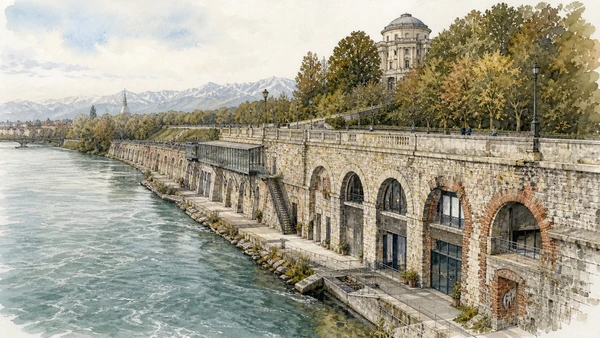
Stone embankments and former boat-store arches convert a flood-prone bank into infrastructure, circulation and social space.

Murazzi del Po: engineered river edge and changing public use

Stone embankments and former boat-store arches convert a flood-prone bank into infrastructure, circulation and social space. The site becomes clearer when its surviving fabric, later alterations and present use are read together.

Today

Weather, water levels, trail conditions and seasonal services can alter the route. Use official transport and park information, remain on authorised paths and do not enter farms, vineyards or private gardens without permission.

History

The Murazzi were constructed through nineteenth-century river engineering and later cycled through storage, nightlife, closure and renewed public projects.

How to read this place

Begin with wall and arch construction. Then compare safe public paths above changing water with new interventions distinguished from historic masonry; the differences are evidence, not visual noise.

What to notice

  • wall and arch construction
  • safe public paths above changing water
  • new interventions distinguished from historic masonry
Città di Torino · Official portal
Original documentary watercolour of Murazzi del Po: engineered river edge and changing public use in Turin · Piedmont, showing accurate architecture, landscape, people and present-day use
Murazzi del Po: engineered river edge and changing public useOriginal Merlintravel documentary watercolour · 2026
02

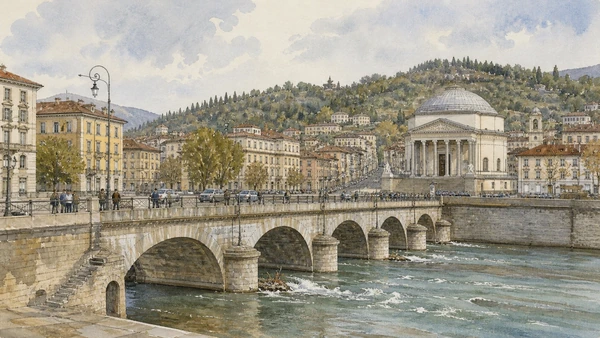
The bridge extends Via Po toward Gran Madre and the hills while revealing current and historic river levels.

Ponte Vittorio Emanuele I: an urban axis across water

The bridge extends Via Po toward Gran Madre and the hills while revealing current and historic river levels. The site becomes clearer when its surviving fabric, later alterations and present use are read together.

Today

The exterior can usually be read from public space, but events, works and crowd management may change circulation. Keep access routes open and verify any interior visit with the responsible institution.

History

The stone bridge was built during Napoleonic rule and retained after the Restoration, becoming the fixed centre of a monumental composition completed by the later church.

How to read this place

Begin with five arches and current flow. Then compare alignment between square and church with pedestrian movement beside traffic; the differences are evidence, not visual noise.

What to notice

  • five arches and current flow
  • alignment between square and church
  • pedestrian movement beside traffic
Turismo Torino e Provincia · Official destination site
Original documentary watercolour of Ponte Vittorio Emanuele I: an urban axis across water in Turin · Piedmont, showing accurate architecture, landscape, people and present-day use
Ponte Vittorio Emanuele I: an urban axis across waterOriginal Merlintravel documentary watercolour · 2026
03

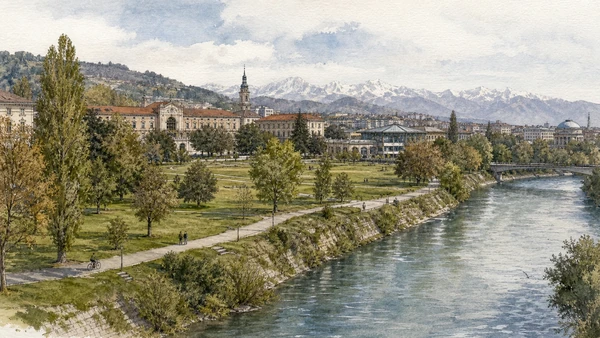
Lawns, mature trees, paths, university buildings and event spaces occupy a long river bend used daily by the city.

Valentino Park: public landscape on a working floodplain

Lawns, mature trees, paths, university buildings and event spaces occupy a long river bend used daily by the city. The site becomes clearer when its surviving fabric, later alterations and present use are read together.

Today

Weather, water levels, trail conditions and seasonal services can alter the route. Use official transport and park information, remain on authorised paths and do not enter farms, vineyards or private gardens without permission.

History

The area shifted from court and private landscapes toward a nineteenth-century public park, then absorbed exhibitions, sports, roads and institutional buildings.

How to read this place

Begin with river terraces and drainage. Then compare formal and informal planting with daily cycling and walking routes; the differences are evidence, not visual noise.

What to notice

  • river terraces and drainage
  • formal and informal planting
  • daily cycling and walking routes
Città di Torino · Official portal
Original documentary watercolour of Valentino Park: public landscape on a working floodplain in Turin · Piedmont, showing accurate architecture, landscape, people and present-day use
Valentino Park: public landscape on a working floodplainOriginal Merlintravel documentary watercolour · 2026
04

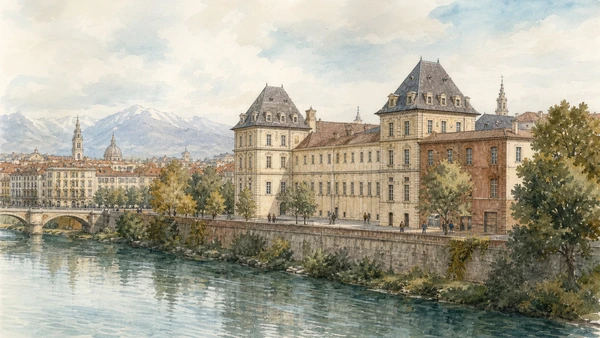
A river-facing residence with French rooflines now houses teaching, making academic use part of its conservation.

Valentino Castle: Savoy residence and university

A river-facing residence with French rooflines now houses teaching, making academic use part of its conservation. The site becomes clearer when its surviving fabric, later alterations and present use are read together.

Today

The exterior can usually be read from public space, but events, works and crowd management may change circulation. Keep access routes open and verify any interior visit with the responsible institution.

History

The castle was transformed in the seventeenth century for Christine of France and later passed through exhibition, military and educational uses before becoming part of the Polytechnic.

How to read this place

Begin with river and city façades compared. Then compare courtyard and roof silhouette with university access distinct from museum expectations; the differences are evidence, not visual noise.

What to notice

  • river and city façades compared
  • courtyard and roof silhouette
  • university access distinct from museum expectations
UNESCO · Residences of the Royal House of Savoy
Original documentary watercolour of Valentino Castle: Savoy residence and university in Turin · Piedmont, showing accurate architecture, landscape, people and present-day use
Valentino Castle: Savoy residence and universityOriginal Merlintravel documentary watercolour · 2026
05

A carefully researched ensemble reproduces Piedmontese and Aosta Valley models inside a nineteenth-century exhibition landscape.

Borgo Medievale: an 1884 reconstruction, not a surviving village

A carefully researched ensemble reproduces Piedmontese and Aosta Valley models inside a nineteenth-century exhibition landscape. The site becomes clearer when its surviving fabric, later alterations and present use are read together.

Today

Opening, ticketing, room access and temporary displays can change. Check the institution’s official notice shortly before visiting, use the designated entrance and allow for security or conservation controls.

History

The village and Rocca were created for the 1884 Italian General Exhibition to present an idealised fifteenth-century Piedmont, using documented buildings as sources rather than preserving one historic settlement.

How to read this place

Begin with labels identifying source buildings. Then compare crafted reconstruction techniques with the park setting created for the exhibition; the differences are evidence, not visual noise.

What to notice

  • labels identifying source buildings
  • crafted reconstruction techniques
  • the park setting created for the exhibition
Turismo Torino e Provincia · Official destination site
Original documentary watercolour of Borgo Medievale: an 1884 reconstruction, not a surviving village in Turin · Piedmont, showing accurate architecture, landscape, people and present-day use
Borgo Medievale: an 1884 reconstruction, not a surviving villageOriginal Merlintravel documentary watercolour · 2026
06

Birds, riparian plants, tributary water and sediment processes continue around engineered banks and intensive recreation.

Po river ecology: habitat inside the metropolis

Birds, riparian plants, tributary water and sediment processes continue around engineered banks and intensive recreation. The site becomes clearer when its surviving fabric, later alterations and present use are read together.

Today

Weather, water levels, trail conditions and seasonal services can alter the route. Use official transport and park information, remain on authorised paths and do not enter farms, vineyards or private gardens without permission.

History

Urban growth, industry, sewage treatment, flood control and environmental regulation repeatedly changed the river; current habitat reflects both damage and restoration.

How to read this place

Begin with vegetated margins versus hard walls. Then compare tributary and drainage outlets with wildlife observed without leaving public paths; the differences are evidence, not visual noise.

What to notice

  • vegetated margins versus hard walls
  • tributary and drainage outlets
  • wildlife observed without leaving public paths
Parco del Po piemontese · Official site
Original documentary watercolour of Po river ecology: habitat inside the metropolis in Turin · Piedmont, showing accurate architecture, landscape, people and present-day use
Po river ecology: habitat inside the metropolisOriginal Merlintravel documentary watercolour · 2026
07

A classical temple form anchors the bridge axis but remains an active church whose ritual use exceeds its commemorative origin.

Gran Madre di Dio: Restoration monument and parish church

A classical temple form anchors the bridge axis but remains an active church whose ritual use exceeds its commemorative origin. The site becomes clearer when its surviving fabric, later alterations and present use are read together.

Today

This is an active religious place as well as a historic building. Services, ceremonies and conservation can interrupt tourist access; dress appropriately, remain quiet and never treat a booked visit as priority over worship.

History

The church was commissioned after Victor Emmanuel I returned in 1814 and completed in the 1830s as part of the monumental riverfront.

How to read this place

Begin with classical portico and dome. Then compare inscription and restoration symbolism with worship and parish access today; the differences are evidence, not visual noise.

What to notice

  • classical portico and dome
  • inscription and Restoration symbolism
  • worship and parish access today
Turismo Torino e Provincia · Official destination site
Original documentary watercolour of Gran Madre di Dio: Restoration monument and parish church in Turin · Piedmont, showing accurate architecture, landscape, people and present-day use
Gran Madre di Dio: Restoration monument and parish churchOriginal Merlintravel documentary watercolour · 2026
08

A hilltop church and mountain museum occupy strategic ground above the Po, opening a view shaped by weather and urban air.

Monte dei Cappuccini: convent, viewpoint and Alpine interpretation

A hilltop church and mountain museum occupy strategic ground above the Po, opening a view shaped by weather and urban air. The site becomes clearer when its surviving fabric, later alterations and present use are read together.

Today

Opening, ticketing, room access and temporary displays can change. Check the institution’s official notice shortly before visiting, use the designated entrance and allow for security or conservation controls.

History

The Capuchin complex developed from the late sixteenth century on an older fortified site; the National Mountain Museum later connected the location to Alpine exploration and representation.

How to read this place

Begin with slope and defensive position. Then compare church and convent volumes with museum interpretation of the alps beyond the terrace; the differences are evidence, not visual noise.

What to notice

  • slope and defensive position
  • church and convent volumes
  • museum interpretation of the Alps beyond the terrace
Museo Nazionale della Montagna · Official site
Original documentary watercolour of Monte dei Cappuccini: convent, viewpoint and Alpine interpretation in Turin · Piedmont, showing accurate architecture, landscape, people and present-day use
Monte dei Cappuccini: convent, viewpoint and Alpine interpretationOriginal Merlintravel documentary watercolour · 2026
09

Terraces rise from residence to pavilion and vineyard, making managed slope and water central to the architecture.

Villa della Regina: vineyard, gardens and court retreat

Terraces rise from residence to pavilion and vineyard, making managed slope and water central to the architecture. The site becomes clearer when its surviving fabric, later alterations and present use are read together.

Today

Opening, ticketing, room access and temporary displays can change. Check the institution’s official notice shortly before visiting, use the designated entrance and allow for security or conservation controls.

History

The seventeenth-century villa became a residence for Savoy women and was repeatedly altered, damaged and restored before reopening as a museum and productive landscape.

How to read this place

Begin with central axis climbing the hill. Then compare water features and garden terraces with restored vineyard beside residential slopes; the differences are evidence, not visual noise.

What to notice

  • central axis climbing the hill
  • water features and garden terraces
  • restored vineyard beside residential slopes
UNESCO · Residences of the Royal House of Savoy
Original documentary watercolour of Villa della Regina: vineyard, gardens and court retreat in Turin · Piedmont, showing accurate architecture, landscape, people and present-day use
Villa della Regina: vineyard, gardens and court retreatOriginal Merlintravel documentary watercolour · 2026
10

Villas, apartment streets, small roads and protected green areas complicate the panoramic image seen from the centre.

The Turin hills: residences, woods and unequal access

Villas, apartment streets, small roads and protected green areas complicate the panoramic image seen from the centre. The site becomes clearer when its surviving fabric, later alterations and present use are read together.

Today

The area is inhabited and worked, not staged for visitors. Keep doorways, pavements, cycle lanes and deliveries clear, ask before photographing people and use current municipal mobility information.

History

Court estates and rural holdings were gradually joined by elite villas, religious institutions, modern housing and roads, producing a dispersed metropolitan landscape.

How to read this place

Begin with public road versus private drive. Then compare woodland fragments between buildings with views interrupted by inhabited terrain; the differences are evidence, not visual noise.

What to notice

  • public road versus private drive
  • woodland fragments between buildings
  • views interrupted by inhabited terrain
Città di Torino · Official portal
Original documentary watercolour of The Turin hills: residences, woods and unequal access in Turin · Piedmont, showing accurate architecture, landscape, people and present-day use
The Turin hills: residences, woods and unequal accessOriginal Merlintravel documentary watercolour · 2026

Turin through time

A short chronology

From Augusta Taurinorum and the Savoy court to national capital, industrial metropolis and contemporary reuse.

  1. Augusta Taurinorum is founded on a regular Roman grid close to the Po and Dora corridors.

  2. Gates, theatre, walls and urban infrastructure develop within the Roman colony.

  3. Bishops, communes, churches and fortified routes reshape the medieval city and its territory.

  4. The House of Savoy establishes firmer control over Turin, beginning a long dynastic transformation.

  5. The University of Turin is founded and becomes a durable part of the city’s institutional landscape.

  6. Emanuele Filiberto transfers the Savoy capital to Turin, accelerating court planning and fortification.

  7. New squares, straight streets, palaces and churches expand the capital beyond the Roman core.

  8. Guarino Guarini works in Turin, transforming sacred and court architecture through geometry and light.

  9. The siege of Turin ends; the victory is later commemorated through Juvarra’s Basilica of Superga.

  10. Royal status and Juvarra’s projects reinforce Turin’s ceremonial axes and metropolitan residence system.

  11. The Statuto Albertino and the Subalpine Parliament make Turin central to constitutional politics.

  12. Turin serves as the first capital of the Kingdom of Italy before the government moves to Florence.

  13. FIAT, Lingotto and Mirafiori help turn Turin into a major industrial and migrant metropolis.

  14. Bombing, occupation, resistance and liberation damage the city and leave a complex memorial geography.

  15. Deindustrialisation, museum growth, adaptive reuse and metropolitan regeneration repeatedly change Turin.

Before your visit

Practical information

01

Check the live page

Opening hours, reservation systems, restoration, exhibitions and transport can change. Recheck the linked official institution shortly before departure.

02

Separate worship and tourism

Churches and sanctuaries remain religious spaces. Services, funerals and community use take priority over visitor itineraries.

03

Plan real distances

Turin · Piedmont combines dense urban routes with lakes, valleys and dispersed towns. Do not compress distant chapters into an unsafe or superficial day.

04

Keep thresholds open

Arcades, station halls, markets, courtyards, workshops and residential streets must continue to function while you observe or photograph them.

05

Use current mobility data

Check the responsible rail, navigation, bus, road or park operator on the day; replacement services and weather can change an otherwise sound route.

06

Read change honestly

Restoration, reconstruction, adaptive reuse and new development have all shaped the landscape visible today.

Method and sources

Sources and image credits

This guide uses official museum, ministry, municipal, transport, park and UNESCO documentation checked on 29 August 2026. It separates durable historical interpretation from access details that can change, distinguishes surviving fabric from restoration or reconstruction, and treats worship, work, residence and public movement as part of the evidence. Every chapter links its principal institutional source; tickets, closures, weather and transport must always be verified again on the day of the visit.

All ten images are original Merlintravel editorial watercolours based on documented present-day conditions. They are illustrations, not substitutes for archaeological plans. Opening hours, tickets, accessible routes, temporary exhibitions and conservation work can change; consult the linked official pages shortly before visiting.