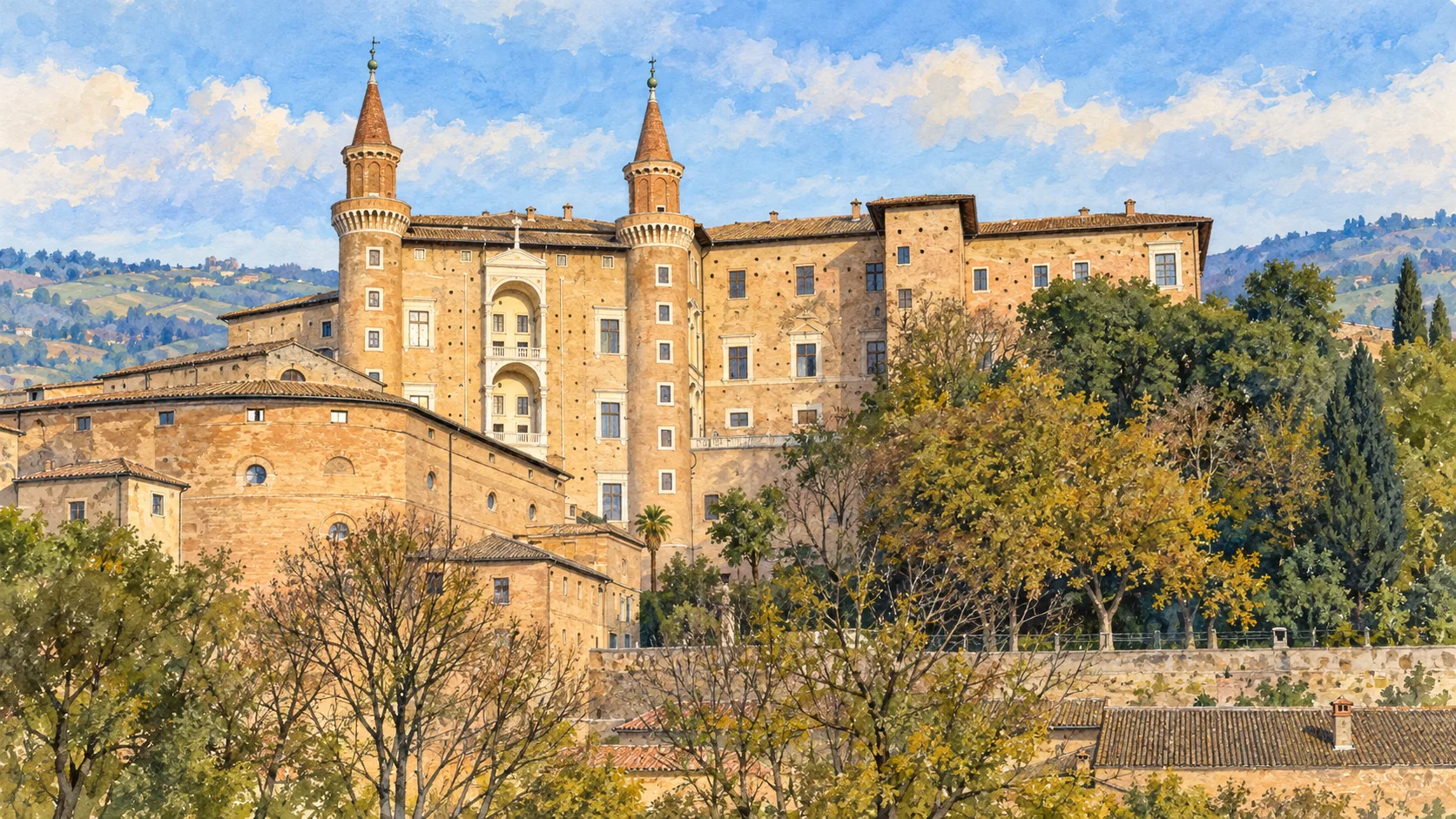
Watercolour: Urbino establishing view

Marche · Guide 01

Urbino

A Renaissance court, small oratories and a painter’s household unfold across the steep streets of a university city.

Plan the route
Urbino10 chapters · history, culture and landscape

Why this place matters

The palace makes sense within the city.

Urbino rewards a change of scale: a distant palace silhouette, a measured courtyard, a tiny study and a room made for a confraternity. Federico da Montefeltro’s court is central to its story, but the surrounding streets, religious institutions and later custodians of Raphael’s memory give the city several voices. Allow time inside a few places instead of turning every interior into a hurried stop.

The guide separates documented history from suggestions for reading the site. Named buildings and landscape relationships follow institutional sources; the illustrations are editorial interpretations, not measured surveys or records of current access.

A Renaissance court, small oratories and a painter’s household unfold across the steep streets of a university city.
The route

Plan your visit

Group the palace and cathedral around one booked museum visit. Use a second walk for the oratories and Casa Raffaello. The upper streets are steep; choose an approach suitable for your mobility and confirm interior access.

Palace visit

The court and its collections

Group the palace and cathedral around one booked museum visit. Use a second walk for the oratories and Casa Raffaello. The upper streets are steep; choose an approach suitable for your mobility and confirm interior access.

Close to the palace

Cathedral and Piazza della Repubblica

Separate interior visits

San Giovanni and San Giuseppe

Upper town

Casa Raffaello and the city outlook

Ten chapters

Explore the places

The chapters connect history and terrain. Mountain areas and outlying towns are separate options, not a single continuous walking route.

  1. 01Palazzo Ducale and the Torricini
  2. 02The palace courtyard
  3. 03The Duke’s studiolo
  4. 04Cathedral of Santa Maria Assunta
  5. 05Piazza della Repubblica
  6. 06Oratorio di San Giovanni
  7. 07Oratorio di San Giuseppe
  8. 08Casa Raffaello
  9. 09A painter’s materials at Casa Raffaello
  10. 10Reading Urbino’s skyline
01

Evidence and interpretation

Palazzo Ducale and the Torricini

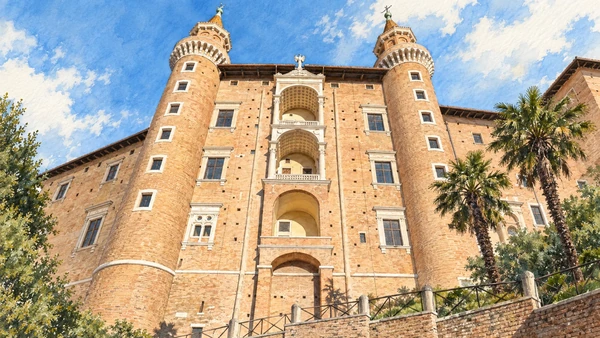
Begin with the palace’s relationship to the hillside. Its paired slender towers announce a courtly residence whose scale extends far beyond a single symmetrical façade.

Today

Check the institution’s current opening, booking arrangements and accessible route. Individual rooms, exhibitions and approaches may have separate conditions.

History

Under Federico da Montefeltro, Urbino became an influential Renaissance court. The palace brings architecture, collecting and the representation of political authority into one ensemble.

How to read this place

Compare the outward silhouette with the spaces reached from the city. The famous tower front and the courtyard belong to different aspects of the same complex.

What to notice

  • Compare the outward silhouette with the spaces reached from the city.
  • The relationship between the site and its surrounding route.
  • The distinction between surviving evidence and modern interpretation.
UNESCO · Historic Centre of Urbino
Watercolour: Palazzo Ducale and the Torricini
Palazzo Ducale and the TorriciniEditorial watercolour · AI-generated · 2026
02

Evidence and interpretation

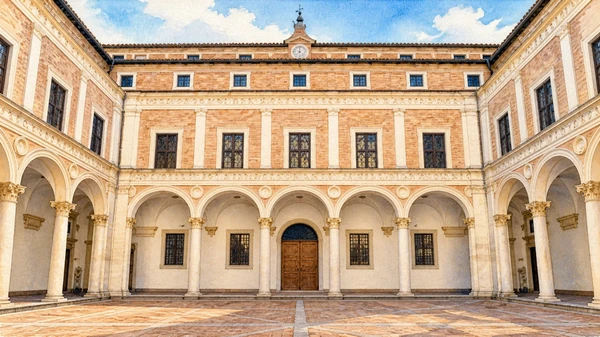
The palace courtyard

Inside the palace, repeated arches and pale architectural details offer a quieter rhythm than the external towers. The courtyard clarifies how rooms and circulation were ordered.

Today

Check the institution’s current opening, booking arrangements and accessible route. Individual rooms, exhibitions and approaches may have separate conditions.

History

Luciano Laurana and Francesco di Giorgio Martini belong to the palace’s building history. Its successive campaigns should not be reduced to the work of one designer.

How to read this place

Follow the relationship between columns, arches and the upper storey. This is a designed spatial sequence, not merely a backdrop for the paintings upstairs.

What to notice

  • Follow the relationship between columns, arches and the upper storey.
  • The relationship between the site and its surrounding route.
  • The distinction between surviving evidence and modern interpretation.
Regione Marche · Urbino cultural guide
Watercolour: The palace courtyard
The palace courtyardEditorial watercolour · AI-generated · 2026
03

Evidence and interpretation

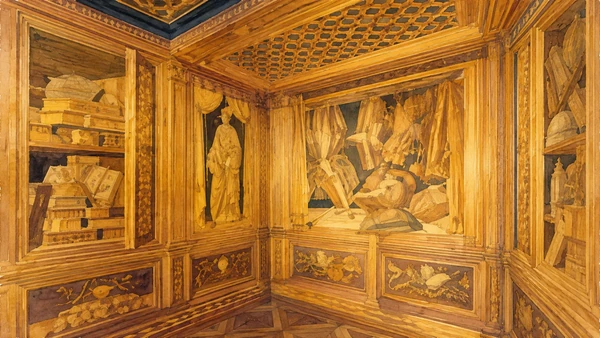
The Duke’s studiolo

A small private room gives intellectual ambition a concentrated material form. Its wooden surfaces make cupboards, objects and architectural openings appear where there is a wall.

Today

Check the institution’s current opening, booking arrangements and accessible route. Individual rooms, exhibitions and approaches may have separate conditions.

History

The studiolo belongs to Federico’s private apartment. Its celebrated intarsia joins skilled woodworking with the court’s presentation of learning.

How to read this place

Look for the difference between a real object and an illusion assembled from contrasting woods. A reproduction can explain the idea but cannot replace the room’s scale and material surface.

What to notice

  • Look for the difference between a real object and an illusion assembled from contrasting woods.
  • The relationship between the site and its surrounding route.
  • The distinction between surviving evidence and modern interpretation.
Ministry of Culture · the Duke’s studiolo
Watercolour: The Duke’s studiolo
The Duke’s studioloEditorial watercolour · AI-generated · 2026
04

Worship and memory

Cathedral of Santa Maria Assunta

Beside the palace, the cathedral places worship next to ducal authority. Its pale classical exterior provides a deliberate contrast with the palace’s brick masses.

Today

Worship and local religious life continue here. Visitor access may pause for services; consult the church or managing institution before planning an interior visit.

History

The cathedral seen today includes major rebuilding after the eighteenth-century collapse of its dome. Its appearance is therefore not an untouched survival of Federico’s court.

How to read this place

Compare the façade’s order with the older urban setting. Separate the dates of the institution from the dates of the fabric standing before you.

What to notice

  • Compare the façade’s order with the older urban setting.
  • The relationship between the site and its surrounding route.
  • The distinction between surviving evidence and modern interpretation.
Regione Marche · Urbino cultural guide
Watercolour: Cathedral of Santa Maria Assunta
Cathedral of Santa Maria AssuntaEditorial watercolour · AI-generated · 2026
05

The inhabited landscape

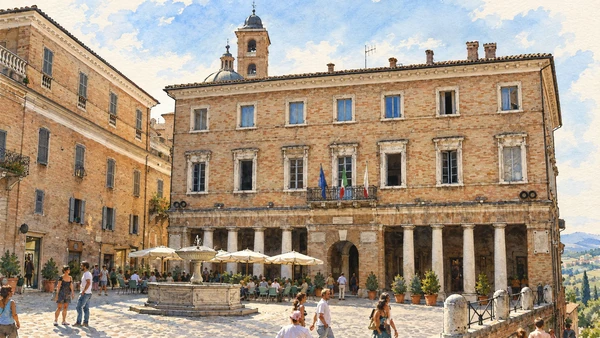
Piazza della Repubblica

The meeting of sloping streets makes this square a useful orientation point. Cafés, students and daily errands reveal a city that continues to use its inherited centre.

Today

This remains an inhabited place. Use pedestrian routes, keep entrances clear and check municipal mobility notices for any restricted area.

History

The Renaissance court is only one layer of Urbino. Its later life as a university city gives the historic streets a continuing civic role.

How to read this place

Read how streets enter at different levels and directions. Leave room for residents moving through the square and treat its buildings as occupied places.

What to notice

  • Read how streets enter at different levels and directions.
  • The relationship between the site and its surrounding route.
  • The distinction between surviving evidence and modern interpretation.
Regione Marche · Urbino cultural guide
Watercolour: Piazza della Repubblica
Piazza della RepubblicaEditorial watercolour · AI-generated · 2026
06

Worship and memory

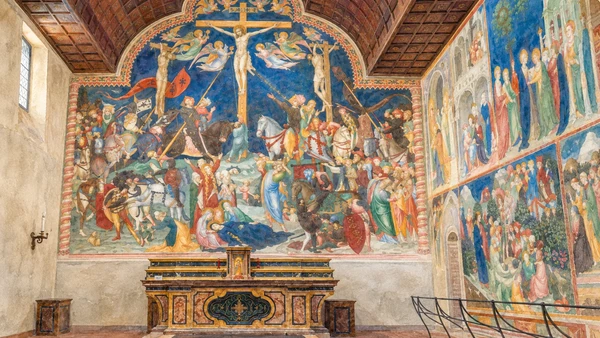
Oratorio di San Giovanni

A relatively modest entrance leads to a painted religious environment. Give the room time: its narrative surfaces reward a slower visit than a quick view of a single image.

Today

Worship and local religious life continue here. Visitor access may pause for services; consult the church or managing institution before planning an interior visit.

History

The Salimbeni brothers’ early fifteenth-century frescoes are a major expression of late Gothic painting in the region. The oratory served a confraternity rather than the ducal household.

How to read this place

Follow the painted sequences and the way figures occupy the wall. Keep the confraternity’s devotional purpose separate from the later museum-like experience of visiting.

What to notice

  • Follow the painted sequences and the way figures occupy the wall.
  • The relationship between the site and its surrounding route.
  • The distinction between surviving evidence and modern interpretation.
Regione Marche · Oratorio di San Giovanni
Watercolour: Oratorio di San Giovanni
Oratorio di San GiovanniEditorial watercolour · AI-generated · 2026
07

Worship and memory

Oratorio di San Giuseppe

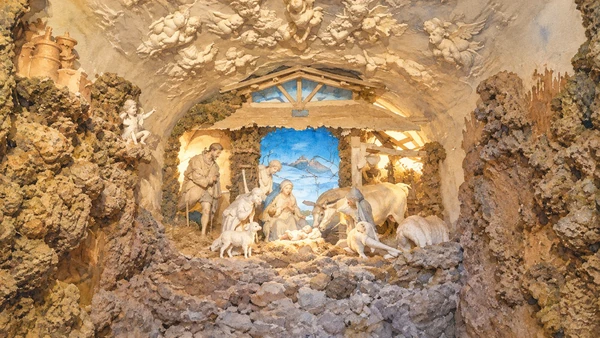
Sculpture, painted decoration and a confraternity’s history meet in a small complex close to San Giovanni. They make useful counterparts without being interchangeable visits.

Today

Worship and local religious life continue here. Visitor access may pause for services; consult the church or managing institution before planning an interior visit.

History

The original sixteenth-century oratory was substantially remade in the late seventeenth century. Federico Brandani’s life-size Nativity belongs to the earlier phase.

How to read this place

Distinguish the sculptural ensemble from the later decorated church. A single building can preserve works made for different moments in its use.

What to notice

  • Distinguish the sculptural ensemble from the later decorated church.
  • The relationship between the site and its surrounding route.
  • The distinction between surviving evidence and modern interpretation.
Regione Marche · Oratorio di San Giuseppe
Watercolour: Oratorio di San Giuseppe
Oratorio di San GiuseppeEditorial watercolour · AI-generated · 2026
08

Evidence and interpretation

Casa Raffaello

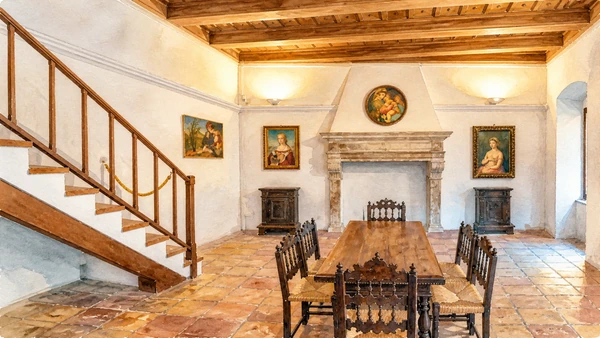
The painter’s birthplace brings the scale of the visit down to a household and workshop. Its rooms connect Raphael to his father Giovanni Santi and to later custodians of his memory.

Today

Check the institution’s current opening, booking arrangements and accessible route. Individual rooms, exhibitions and approaches may have separate conditions.

History

The collection includes works by Giovanni Santi, later copies and commemorative material. The attribution of the small Madonna fresco to Raphael remains debated.

How to read this place

Read labels for authorship and date. A copy can document Raphael’s later reputation, while an original household space answers a different historical question.

What to notice

  • Read labels for authorship and date.
  • The relationship between the site and its surrounding route.
  • The distinction between surviving evidence and modern interpretation.
Ministry of Culture · Casa natale di Raffaello
Watercolour: Sala Petrangolini inside Casa Raffaello, interpreted in watercolour
Casa RaffaelloEditorial watercolour · AI-generated · 2026
09

Evidence and interpretation

A painter’s materials at Casa Raffaello

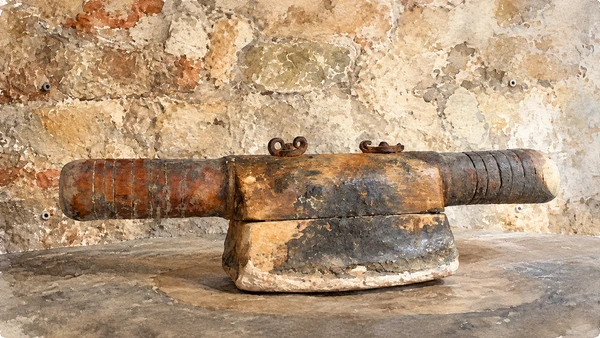
A workshop object can make artistic training more tangible than a list of famous names. Grinding colour and preparing materials formed part of the practical world surrounding painting.

Today

Check the institution’s current opening, booking arrangements and accessible route. Individual rooms, exhibitions and approaches may have separate conditions.

History

The Accademia’s house collection includes a colour-grinding stone. Its interpretation connects the birthplace with the material work of Giovanni Santi’s household.

How to read this place

Separate an exhibited tool from a claim that Raphael personally used it. Notice surface wear and function before treating every object as a biographical relic.

What to notice

  • Separate an exhibited tool from a claim that Raphael personally used it.
  • The relationship between the site and its surrounding route.
  • The distinction between surviving evidence and modern interpretation.
Accademia Raffaello · the house and collections
Watercolour: Colour-grinding stone with a wooden handle at Casa Raffaello
A painter’s materials at Casa RaffaelloEditorial watercolour · AI-generated · 2026
10

The inhabited landscape

Reading Urbino’s skyline

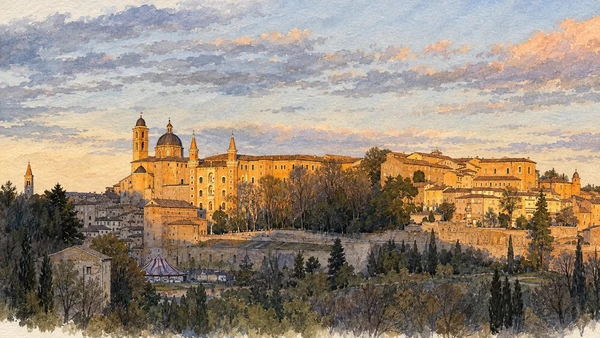
A public outlook makes the palace, cathedral and dense roofscape legible together. It is also a chance to understand the steep ground crossed during the visit.

Today

This remains an inhabited place. Use pedestrian routes, keep entrances clear and check municipal mobility notices for any restricted area.

History

UNESCO recognises the historic centre as a major Renaissance achievement. The urban fabric and its setting matter alongside the best-known individual buildings.

How to read this place

Identify the same volumes seen at street level. Use a recognised public viewpoint; the illustration explains the skyline rather than granting access to a particular terrace.

What to notice

  • Identify the same volumes seen at street level.
  • The relationship between the site and its surrounding route.
  • The distinction between surviving evidence and modern interpretation.
UNESCO · Historic Centre of Urbino
Watercolour: Reading Urbino’s skyline
Reading Urbino’s skylineEditorial watercolour · AI-generated · 2026

The territory through time

A short chronology

A concise chronology linking the documented sites to the wider story.

  1. An inhabited hill centre precedes the Renaissance court.

  2. The Salimbeni frescoes give San Giovanni its painted narrative.

  3. Federico da Montefeltro’s court transforms Urbino’s architectural and cultural role.

  4. Raphael is born into Giovanni Santi’s household in Urbino.

  5. Brandani’s Nativity adds a sculptural devotional setting at San Giuseppe.

  6. San Giuseppe undergoes substantial rebuilding.

  7. The cathedral’s later rebuilding changes its architectural appearance.

  8. The historic centre is inscribed on UNESCO’s World Heritage List.

Before your visit

Practical information

01

Plan separate days

Choose a manageable set of visits and allow for transport, booked entries and the return journey.

02

Use the exact place name

The Marche contain separate valleys, towns and coastal approaches. Confirm the precise locality and route rather than treating nearby names as one destination.

03

Check the institution

Opening hours, tickets, exhibitions and religious access change. Use the linked managing institution shortly before visiting.

04

Check the actual terrain

A town walk, gorge walkway, lift arrival and mountain path have different demands. Use current route information, weather and closures for the option you choose.

05

Arrange accessible visits

Historic interiors and mountain approaches can include steps, gradients or uneven surfaces. Ask about the specific route instead of assuming an entire destination is step-free.

06

Respect work and residence

Farms, workshops, churches and historic streets remain in use. Follow signs, keep entrances clear and ask permission before entering private spaces.

Method and sources

Sources and image credits

Prepared on 9 September 2026 from the institutional sources linked below. Historical claims are separated from editorial observations and itinerary suggestions. Older institutional brochures are used for stable cultural context, never as current timetables. Prices, transport schedules, trail status and admission are deliberately left to the responsible operators. Illustrations are not photographs, measured reconstructions or evidence of current conditions.

The eleven images are AI-generated editorial watercolours guided by photographic references. They interpret named places and are not photographs or substitutes for measured plans. Opening hours, tickets, accessible routes, temporary exhibitions and conservation work can change; consult the linked official pages shortly before visiting.

Illustration references and credits