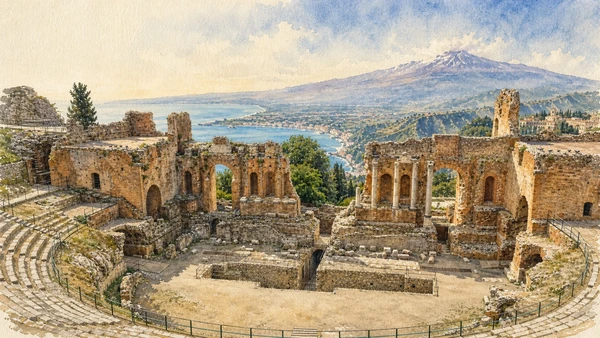
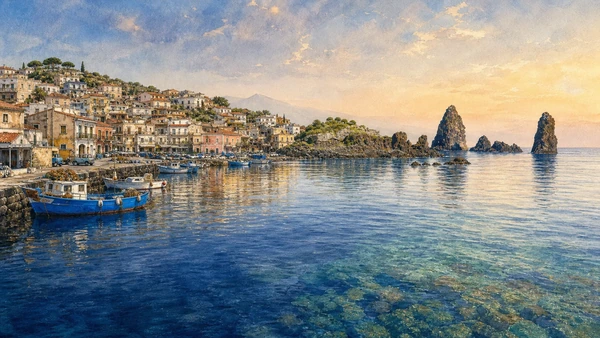
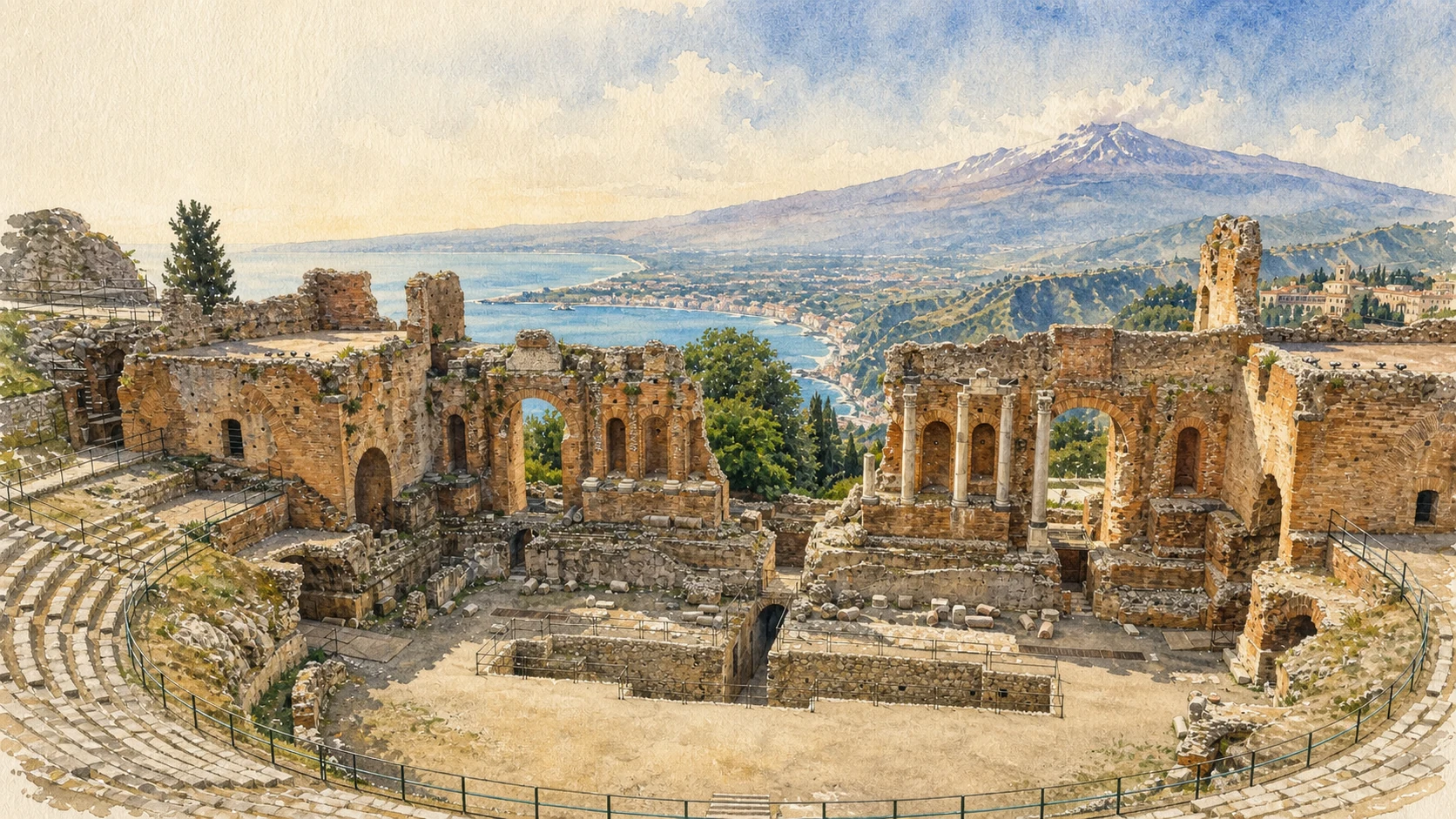
Documentary watercolour of the Ancient Theatre of Taormina, with the surviving Roman stage structure, the Ionian Sea and Mount Etna beyond
MERLINTRAVEL

Sicily · Journey 01

Roots and the Ionian coast

Family memory, Greek foundations, lava cities and the eastern sea.

The regional idea

The coast where the island rises into fire.

This chapter follows Sicily's north-eastern Ionian arc from the first Greek settlement at Naxos and the terraces of Taormina to Catania, the Cyclops Coast, the Alcantara valley and the inhabited slopes of Etna. The destinations are close enough to share horizons, roads and geological forces, yet different enough to resist becoming one generic eastern-Sicily itinerary.

Etna is the organising presence. Lava created headlands, redirected rivers, buried streets, renewed soils and supplied the dark stone of towns and churches. The Alcantara cut a separate corridor through volcanic rock; the Ionian Sea opened the same territory to colonists, merchants, fishers, travellers and modern tourism.

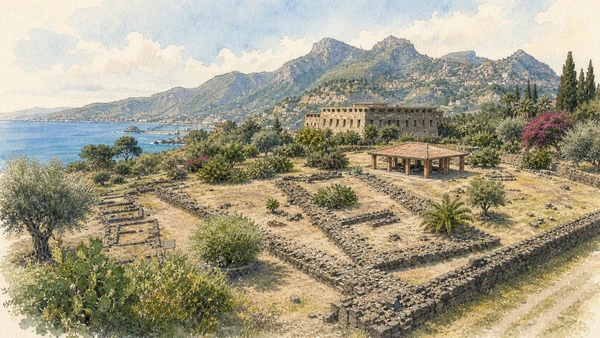
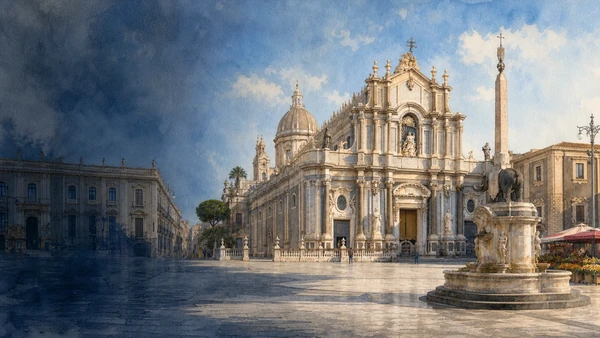
Ancient Naxos, Hellenistic and Roman Tauromenion, Byzantine and medieval strongholds, the 1669 eruption, the earthquake of 1693 and Catania's Baroque reconstruction belong to one long history of settlement under pressure. The coast is not merely a foreground for the volcano: harbours, fishing villages, gardens, citrus terraces and railway towns shaped their own economies and identities.

The personal beginning at Taormina gives this journey its emotional point of entry. Family holidays and journeys with a father open the chapter, but the six guides widen that memory into a shared geography of archaeology, risk, work, devotion and everyday life.

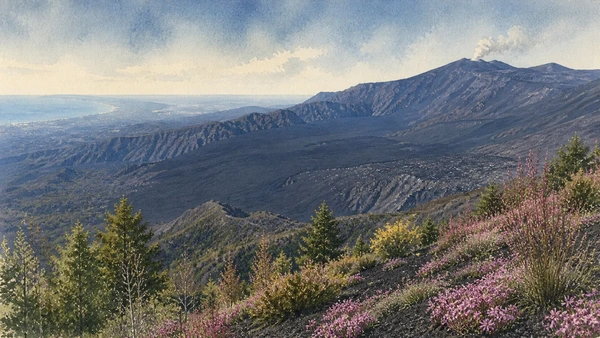
Documentary watercolour of Mount Etna from the eastern slopes, with a quiet summit plume, the dark floor of Valle del Bove, birch woodland and cultivated terraces

Reading the landscape

Lava, water and the inhabited slope

The route changes altitude constantly. Coastal basalt and marine terraces rise towards vineyards, orchards and chestnut woods before reaching the exposed volcanic desert. North of Etna, the Alcantara carries water through gorges and agricultural towns; south of it, Catania occupies a plain repeatedly transformed by lava, earthquake and rebuilding.

Reading this territory means distinguishing spectacular geology from the communities that live with it. Craters, gorges and sea stacks matter because they redirect roads, agriculture, building traditions and settlement, not because they are isolated natural attractions.

Four connecting threads

What holds this journey together.

The chapter is organised by relationships between landscape, settlement and historical change. These four threads continue across the individual destination guides.

01

Lava as an archive

Flows, quarries, black façades and headlands preserve different moments in Etna's activity and in the human response to it.

02

The first Greek shore

Naxos and Tauromenion must be read together without confusing the colony on the coast with the later city above it.

03

Cities rebuilt

Catania and the smaller Aci centres show how eruption and earthquake became urban history rather than isolated catastrophes.

04

A lived Ionian coast

Fishing, citrus, gardens, railways, pilgrimage and tourism reveal a coast continually worked and inhabited.

How the guides connect

One eastern system, six different viewpoints

Taormina and Giardini Naxos establish the relationship between a high town and the first Greek shore. Etna explains the forces behind the landscape; Catania shows a city repeatedly rebuilt within them. The Alcantara follows water along the volcano's northern edge, while the Aci towns and Cyclops Coast return the journey to lava meeting the sea. The sequence is editorial rather than a compulsory day-by-day itinerary.