Italy · Regional journey 18

Sardinia

Nuragic stone, Phoenician ports, mountain interiors, living languages and Mediterranean island worlds.

6historic layers
4editorial journeys
8territorial gateways
Sardinia is not remote from history; it is one of the Mediterranean’s enduring centres.
The regional idea

The island’s nuraghi, sacred wells and giant sculpture precede Phoenician and Punic coastal cities, Roman networks, Byzantine and giudicati institutions, Aragonese-Catalan rule, mining landscapes, pastoral interiors and modern cultural renewal.

Time made visible

History in layers.

Sardinia’s past follows island-specific trajectories. Continental dynasties matter, but so do Nuragic societies, maritime colonies, the four giudicati and communities that maintained distinct languages and landscapes.

01

Prehistory and Nuragic civilisation

Towers, villages, tombs, wells and sculpture reveal complex island societies over many centuries.

02

Phoenician and Punic networks

Coastal cities such as Tharros, Nora and Sulky joined Sardinia to western Mediterranean trade.

03

Roman Sardinia

Roads, ports, baths, mines and grain production integrated the island while preserving local continuities.

04

Byzantines and the giudicati

Christian institutions and four indigenous kingdoms produced a distinctive medieval political landscape.

05

Pisan, Genoese, Aragonese and Spanish rule

Churches, towers, Catalan language and feudal systems marked coasts and cities differently.

06

Savoy kingdom and modern island

Mining, pastoral economies, war, autonomy, migration and tourism reshaped contemporary Sardinia.

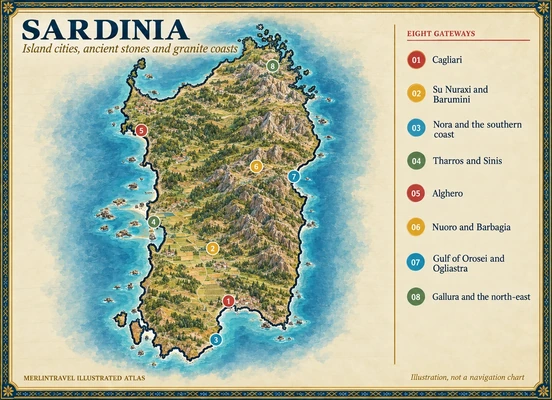
Illustrated map of Sardinia with eight numbered Merlintravel gateways
Merlintravel illustrated atlas · official ISTAT profile archived separately
The complete circuit

Coasts, stone landscapes and inland cultures form one island.

The atlas circles Cagliari, Sulcis, Oristano and Sinis, Alghero, Sassari and Gallura before turning inward to Barbagia, Gennargentu and Ogliastra.

Map markers identify editorial gateways, not a ranking.

Four ways through

Journeys, not checklists.

Four circuits make the interior as important as the coast and distinguish archaeological, linguistic, pastoral and maritime Sardinias.

01

Cagliari and the south

Phoenician Nora, Roman and medieval Cagliari, wetlands and the Sulcis mining coast open the island.

02

Oristano, Sinis and the nuragic west

Tharros, Mont’e Prama, sacred wells, giudicato memory and lagoons form a dense circuit.

03

Alghero, Sassari and the north

Catalan culture, Romanesque churches, nuragic sites and the Asinara coast define the north-west.

04

Barbagia, Ogliastra and Gallura

Mountain communities, pastoral culture, granite landscapes and eastern gulfs reveal several interiors and coasts.

Eight territorial doors

Places that open the story.

Each gateway is a future chapter: a city, landscape or cultural system large enough to deserve its own documented guide.

01

Cagliari

A layered capital of Punic and Roman archaeology, fortified quarters, museums, lagoons and a living port.

02

Su Nuraxi and Barumini

A major nuragic complex that opens the architecture, settlement and social history of Bronze Age Sardinia.

03

Nora and the southern coast

Phoenician, Punic and Roman layers on a peninsula linked to Cagliari and coastal wetlands.

04

Tharros and Sinis

Ancient city, Mont’e Prama sculpture, lagoons, quartz beaches and the history of the giudicato of Arborea.

05

Alghero

Catalan language, fortified seafront, coral craft and access to Nurra archaeology and Capo Caccia.

06

Nuoro and Barbagia

Mountain culture, literature, masks, museums and villages within the central Sardinian interior.

07

Gulf of Orosei and Ogliastra

Karst canyons, high plateaux, coastal cliffs and communities between Supramonte and sea.

08

Gallura and the north-east

Granite, stazzi, nuragic sites, islands and marine landscapes extending beyond resort imagery.

Living and monumental heritage

What the region keeps.

Monuments matter, but so do languages, crafts, routes, rituals and working landscapes.

01

Nuragic architecture

Thousands of sites form a distributed island landscape rather than a collection of isolated towers.

02

Languages of Sardinia

Sardinian varieties and other historic languages express different local histories and identities.

03

Pastoral and textile knowledge

Shepherding, cheese, weaving, basketry and bread are systems of skill embedded in community life.

04

Mining and industrial archaeology

Sulcis-Iglesiente landscapes preserve extraction, labour, settlement and environmental transformation.

Land and water

Nature is part of the archive.

Land, water and ecological systems are read together with the communities that have learned to inhabit them.

01

Gennargentu and Supramonte

Mountain and karst landscapes shelter endemic life, pastoral routes and deep canyons.

02

Asinara and La Maddalena

Island parks protect marine habitats while preserving prison, military and settlement histories.

03

Coastal wetlands

Molentargius, Cabras and other lagoons support flamingos, fishing and salt landscapes.

04

Granite and limestone coasts

Geology produces sharply different shorelines, islands, caves and ecological communities.

A documented journey, still open.

Nuragic monuments are described without invented mysteries. Sardinian, Catalan of Alghero, Gallurese, Sassarese and Tabarchino are located with care and not treated as folklore labels.

The journey continues.

Return to the Italy regional atlas