Marche
Adriatic ports, Renaissance courts, hill towns, pilgrimage and Apennine landscapes in the plural.
Even its name is plural: the Marche are many territories facing one sea.
The region is a sequence of valleys between the Apennines and Adriatic. Picene archaeology, Roman roads, medieval communes, Montefeltro culture, papal territories, pilgrimage and coastal trade created multiple local centres rather than one dominant capital.
History in layers.
The historical line crosses Picene and Roman worlds, Byzantine and Lombard frontiers, communes and signorie, Renaissance Urbino and the long papal period.
Picene and Roman worlds
Archaeological sites and museums document pre-Roman communities later integrated by roads and colonies.
Late antique frontier
Byzantine and Lombard territories met across a region of strategic valleys and coastal connections.
Communes and maritime towns
Ancona, Fano, Ascoli and many hill centres developed strong civic institutions and markets.
Montefeltro and Renaissance Urbino
A small court became an influential centre of architecture, painting, books and humanist culture.
Papal Marche
Long incorporation into the Papal States shaped administration, religious networks and urban development.
Modern region and reconstruction
Unification, rural change, industry, war and repeated earthquakes transformed communities and landscapes.

River valleys connect Apennine towns to the Adriatic.
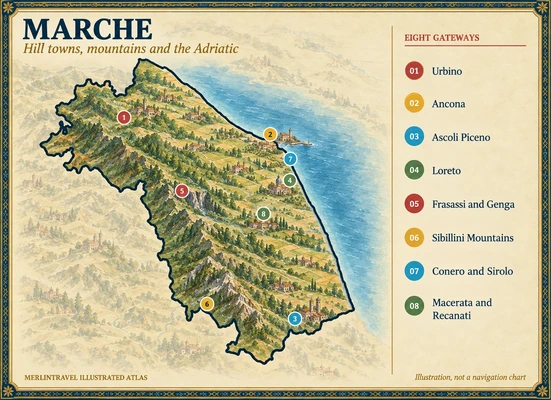
The atlas follows river valleys from mountain to sea, pairing Urbino and the north with Ancona, Loreto, Macerata and Ascoli Piceno.
Map markers identify editorial gateways, not a ranking.
Journeys, not checklists.
Four circuits show the region’s plural structure: court culture, Adriatic trade, pilgrimage and mountain interiors.
Urbino and the Montefeltro
Court architecture, Raphael’s city, libraries and hill fortresses open the northern interior.
Ancona and the Conero
A Greek-founded port, Adriatic routes, limestone cliffs and coastal towns share one maritime landscape.
Loreto, Macerata and the middle hills
Pilgrimage, opera, civic museums and farmed valleys structure the central region.
Ascoli and the Sibillini
Roman roads, travertine squares, Picene heritage and mountain communities define the south.
Places that open the story.
Each gateway is a future chapter: a city, landscape or cultural system large enough to deserve its own documented guide.
Urbino
A Renaissance court city whose palace, university and surrounding hills retain a powerful cultural unity.
Ancona
A Greek and Roman Adriatic port, papal city and modern harbour below Monte Conero.
Ascoli Piceno
Travertine civic spaces, Roman remains, medieval towers and access to southern mountain valleys.
Loreto
A major pilgrimage sanctuary whose architecture, collections and route networks shaped a hill town.
Frasassi and Genga
Karst caves, abbeys and archaeological landscapes within the Apennine gorge of the Sentino.
Sibillini Mountains
High plateaux, villages, pastoral memory and earthquake recovery across a shared national park.
Conero and Sirolo
A forested limestone promontory above Adriatic coves, villages and ancient routes.
Macerata and Recanati
Civic theatre, university culture, poetry and rolling farm landscapes between hills and sea.
What the region keeps.
Monuments matter, but so do languages, crafts, routes, rituals and working landscapes.
The Ducal Palace of Urbino
Architecture, collections and urban form preserve a Renaissance ideal of the learned court.
Pilgrimage and sacred art
Loreto and valley sanctuaries connect devotion to roads, hospitality and international exchange.
Theatre culture
Historic theatres in towns large and small record a dense tradition of civic performance.
Rural craft and food
Sharecropping memory, ceramics, paper, footwear and regional cuisines belong to working landscapes.
Nature is part of the archive.
Land, water and ecological systems are read together with the communities that have learned to inhabit them.
Sibillini
High plateaux, glacial forms and pastoral ecosystems cross the border with Umbria.
Conero
Mediterranean woodland descends abruptly to coves along an otherwise low Adriatic coast.
Frasassi
Caves and gorges reveal underground water systems and exceptional limestone geology.
River valleys
Parallel valleys organise towns, agriculture, roads and the movement from Apennines to sea.
A documented journey, still open.
The Hub uses the English name Marche while explaining the historic plural. It avoids presenting the region as a single chain of pretty hill towns detached from agriculture and seismic history.
The journey continues.
Return to the Italy regional atlas