Italy · Regional journey 12

Abruzzo

Apennine massifs, resilient stone towns, pastoral routes and an Adriatic coast of trabocchi.

6historic layers
4editorial journeys
8territorial gateways
Abruzzo is a mountain region that reaches the sea.
The regional idea

Gran Sasso, Majella and high plateaux structure a territory of ancient Italic peoples, Roman towns, medieval monasticism, transhumance, fortified settlements, earthquake reconstruction and a narrow but culturally distinct Adriatic coast.

Time made visible

History in layers.

Marrucini, Vestini, Paeligni and other Italic groups precede Rome; later abbeys, feudal towns, the Kingdom of Naples and modern migration shaped multiple Abruzzese landscapes.

01

Italic peoples

Distinct communities occupied valleys and uplands before Roman conquest, leaving sanctuaries, necropoleis and fortified sites.

02

Rome and the road network

Towns such as Amiternum and Corfinium linked Apennine routes to Adriatic and inland systems.

03

Abbeys and medieval settlement

Monastic foundations, castles and walled towns organised land, pilgrimage and local authority.

04

Kingdom of Naples

Feudal estates, sheep customs and long-distance pastoral economies tied Abruzzo to southern political structures.

05

Transhumance and mountain life

Seasonal movement between high pasture and Apulian plains shaped roads, markets, ritual and food.

06

Earthquakes, migration and renewal

Seismic disasters, emigration, industrialisation and rebuilding transformed the modern region.

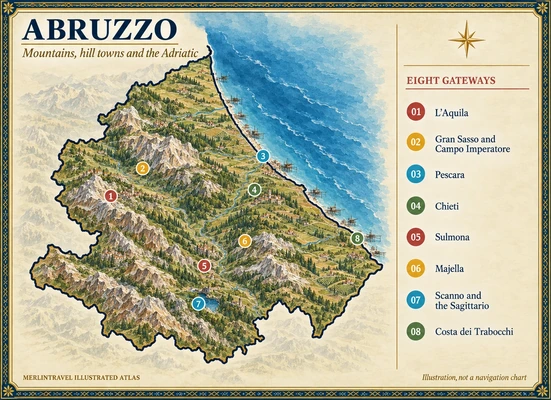
Illustrated map of Abruzzo with eight numbered Merlintravel gateways
Merlintravel illustrated atlas · official ISTAT profile archived separately
The complete circuit

From the Apennines to the Trabocchi coast.

The atlas crosses from L’Aquila and Gran Sasso through Sulmona and Majella to Chieti, Pescara and the Costa dei Trabocchi.

Map markers identify editorial gateways, not a ranking.

Four ways through

Journeys, not checklists.

The four routes connect archaeological and religious history to mountain ecology, pastoral movement and coastal work.

01

L’Aquila and Gran Sasso

A planned medieval city, mountain villages, castles and high plateaux reveal resilience and long settlement.

02

Sulmona and Majella

Roman memory, medieval goldsmithing, hermitages and national-park landscapes define the central valleys.

03

Chieti, Pescara and the Adriatic

Italic museums, modern urban culture and coastal transformation lead south along the shore.

04

Trabocchi and southern Abruzzo

Fishing structures, abbeys, vineyards and hill towns connect land and sea towards Vasto.

Eight territorial doors

Places that open the story.

Each gateway is a future chapter: a city, landscape or cultural system large enough to deserve its own documented guide.

01

L’Aquila

A medieval civic foundation rebuilt through repeated earthquakes, rich in churches, fountains and mountain identity.

02

Gran Sasso and Campo Imperatore

Italy’s highest Apennine landscapes, pastoral plateaux, villages and a major protected area.

03

Pescara

A modern Adriatic city at a river mouth, linked to literature, architecture and a transformed coast.

04

Chieti

Ancient Teate, Italic collections, Roman remains and a hill city overlooking coast and Majella.

05

Sulmona

Roman Sulmo, medieval urban culture, confetti craft and a valley framed by high mountains.

06

Majella

Canyons, beech forests, hermitages, pastoral memory and villages across a national park massif.

07

Scanno and the Sagittario

A stone town, mountain lake, costume traditions and a dramatic protected gorge.

08

Costa dei Trabocchi

Wooden fishing platforms, abbeys, coves and cultivated hills along the southern Adriatic.

Living and monumental heritage

What the region keeps.

Monuments matter, but so do languages, crafts, routes, rituals and working landscapes.

01

Transhumance

Seasonal livestock routes link Abruzzo to a UNESCO-recognised Mediterranean and Alpine pastoral practice.

02

Mountain sacred landscapes

Hermitages, abbeys and sanctuaries place devotion within caves, forests and high valleys.

03

Stone towns and craft

Masonry, metalwork, lace and food production preserve local knowledge across many small centres.

04

Reconstruction memory

Restoration after earthquakes raises questions of safety, identity, continuity and changed communities.

Land and water

Nature is part of the archive.

Land, water and ecological systems are read together with the communities that have learned to inhabit them.

01

Gran Sasso

High peaks, glacial forms and plateaux sustain rare habitats and centuries of pastoral use.

02

Majella

Deep valleys, old-growth beech woods and extensive wilderness support rich biodiversity.

03

Abruzzo, Lazio and Molise Park

Forests and villages form a core habitat for Apennine wildlife across regional borders.

04

Adriatic coast

Dunes, river mouths and the Trabocchi shore contrast sharply with the mountain interior.

A documented journey, still open.

Earthquakes are treated as historical and human realities, not atmospheric ruin. Park information and reconstruction access will be rechecked for every destination guide.

The journey continues.

Return to the Italy regional atlas