Italy · Regional journey 02

Piedmont

Royal Turin, vineyard hills, sacred mountains and lakes at the foot of the western Alps.

6historic layers
4editorial journeys
8territorial gateways
Piedmont is a meeting of court, mountain and cultivated hill.
The regional idea

The region extends from Alpine passes to the Po plain and from Savoy’s capital to Langhe, Roero and Monferrato. Its identity is built through Roman cities, communes, dynastic statecraft, industry, wine landscapes and minority Alpine cultures.

Time made visible

History in layers.

Piedmont cannot be explained only through Turin. Its historical fabric connects Celtic and Roman territories, medieval marquisates, Savoy residences, sacred landscapes and modern industrial transformation.

01

Celts, Ligurians and Rome

Pre-Roman communities and Roman roads established a dense network between the Alps, Po and Ligurian approaches.

02

Communes and marquisates

Asti, Saluzzo, Monferrato and other centres developed distinct medieval powers and urban cultures.

03

The House of Savoy

From a transalpine dynasty grew a territorial state whose residences, fortifications and administration reshaped the region.

04

Baroque capital

Turin became a planned court city of axes, squares, churches and palaces with European ambitions.

05

Risorgimento and unification

Piedmont-Sardinia provided institutions, armies and political leadership central to Italian unification.

06

Industry and reinvention

Automotive Turin, design, migration and post-industrial culture added a modern layer to the royal city.

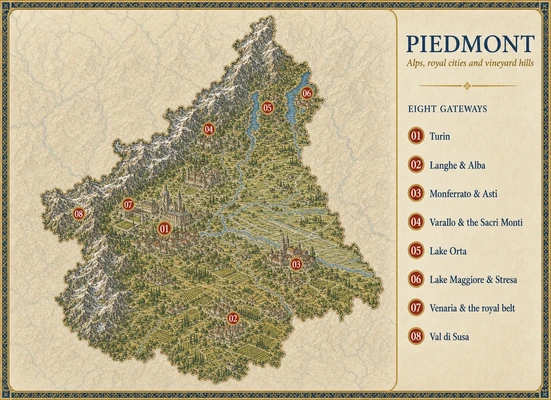
Illustrated map of Piedmont with eight numbered Merlintravel gateways
Merlintravel illustrated atlas · official ISTAT profile archived separately
The complete circuit

Turin opens onto Alps, lakes and vineyard hills.

The route begins in Turin but radiates towards the western valleys, Monte Rosa, the lake country, rice plains and UNESCO vineyard hills.

Map markers identify the main places covered by the guides.

Four ways through

Journeys, not checklists.

Each circuit follows a territorial logic: dynastic power, Alpine passage, waters and gardens, or working agricultural landscapes.

01

The Crown and its residences

Turin, Venaria, Stupinigi, Rivoli and Racconigi form a dispersed map of Savoy ceremony and government.

02

Alpine thresholds

Val di Susa, Walser valleys and Occitan communities reveal pilgrimage, fortification and transalpine exchange.

03

Lakes and sacred mountains

Orta, Maggiore and the Sacri Monti connect gardens, devotional theatre and views towards the Alps.

04

Vineyards and market towns

Langhe, Roero and Monferrato join hill settlement, cellars, seasonal labour and internationally recognised landscapes.

Eight territorial doors

Eight open chapters. The regional atlas is complete.

Every gateway now leads to a complete guide; Turin opens first as an independent ten-guide city atlas.

01
10-guide city atlas

Turin

Roman grid, Savoy capital, Baroque institutions, the Po, museums and the industrial metropolis across ten complete guides.

Open Turin
02
complete guide

Langhe, Roero and Alba

Roman Alba, medieval towers, vineyard ridges, castles, Pollenzo, working agriculture and literary memory.

Open Langhe and Alba
03
complete guide

Monferrato, Asti and Alessandria

Communal cities, Canelli’s underground architecture, infernot, sacred hills and a fortified river corridor.

Open Monferrato and Asti
04
complete guide

Lake Maggiore, Orta and the Sacri Monti

Lake transport, Borromean islands, monastic memory and chapel routes staged across water and mountain terrain.

Open the lakes and Sacri Monti
05
complete guide

Novara, Vercelli and the Rice Plain

Romanesque and civic architecture meet canals, flooded fields, cascine and the working ecology of the eastern plain.

Open Novara and Vercelli
06
complete guide

Ivrea, Biella and the Canavese

Roman and medieval Ivrea, Olivetti’s industrial city, textile water, Oropa and the long Serra moraine.

Open Ivrea and Biella
07
complete guide

Cuneo, Saluzzo and the Occitan Valleys

Arcaded Cuneo, a marquisate city, abbeys and royal estates open toward Monviso and inhabited Occitan valleys.

Open Cuneo and Saluzzo
08
complete guide

Val di Susa, Pinerolo and the Olympic Valleys

Roman routes, abbeys, frontier forts, rail engineering, Waldensian memory and post-2006 mountain infrastructure.

Open Val di Susa and Pinerolo
Living and monumental heritage

What the region keeps.

Monuments matter, but so do languages, crafts, routes, rituals and working landscapes.

01

Savoy residences

A serial UNESCO property makes dynastic power visible across palaces, hunting lodges and gardens.

02

Sacri Monti

Chapels, sculpture and natural settings form carefully staged routes of devotion.

03

Languages of the valleys

Occitan, Francoprovençal and Walser traditions complicate any single image of Piedmontese identity.

04

Food as landscape

Rice, hazelnuts, cheese, truffles and wine emerge from specific soils, labour systems and market towns.

Land and water

Nature is part of the archive.

Land, water and ecological systems are read together with the communities that have learned to inhabit them.

01

Western Alps

Gran Paradiso, Monviso and the high valleys feed rivers and shape cultural borders.

02

Po and rice plain

Water management turns the eastern lowlands into a geometric agricultural environment.

03

Lake country

Maggiore and Orta create distinct microclimates, gardens and historic travel routes.

04

Vineyard hills

Langhe, Roero and Monferrato are cultivated ecosystems maintained through continuous work.

A documented journey, still open.

The Hub distinguishes UNESCO serial properties from single monuments and treats Langhe-Roero-Monferrato as a living productive landscape rather than a wine-themed backdrop.

The journey continues.

Return to the Italy regional atlas