Italy · Regional journey 06

Veneto

Lagoon and Dolomites, Roman cities, Palladian landscapes and the long memory of Venice.

6historic layers
4editorial journeys
8territorial gateways
Veneto stretches from water-built cities to the highest pale mountains.
The regional idea

Venice is essential but not sufficient. The region includes Roman Verona, Padua’s university and fresco traditions, Palladian Vicenza, walled towns, Prosecco hills, the Po Delta and Dolomite valleys shaped by distinctive communities.

Time made visible

History in layers.

Venetic and Roman foundations, mainland communes, the Venetian Republic, Habsburg rule, unification and twentieth-century war landscapes created a region of strong local identities.

01

Veneti and Roman cities

Aquileian routes, Verona, Padua and other centres integrated the region into northern Italy and the Adriatic.

02

Lagoon settlement

Communities developed new forms of defence, trade and government across islands and tidal waters.

03

The Venetian Republic

A maritime state expanded onto the mainland, reshaping cities, villas, fortifications and agricultural systems.

04

Renaissance art and architecture

Bellini, Titian, Tintoretto, Palladio and others transformed European visual and architectural culture.

05

Napoleonic and Habsburg Veneto

The fall of the Republic and nineteenth-century rule altered institutions, monuments and political identity.

06

War, industry and mass tourism

The Piave front, post-war growth and modern visitor economies left powerful marks on coast, cities and mountains.

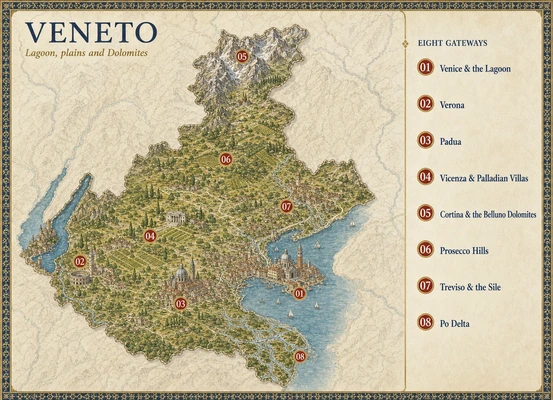
Illustrated map of Veneto with eight numbered Merlintravel gateways
Merlintravel illustrated atlas · official ISTAT profile archived separately
The complete circuit

From lagoon to Dolomites, the landscape keeps changing.

The atlas moves between lagoon, plain, vineyard hills, lake shore and mountain valleys to resist a Venice-only itinerary.

Map markers identify editorial gateways, not a ranking.

Four ways through

Journeys, not checklists.

The circuits pair major cities with water systems and rural or mountain landscapes that made their wealth possible.

01

Venice and the lagoon

The city, minor islands, fishing communities, salt marshes and port histories belong to one tidal system.

02

Verona, Garda and the west

Roman monuments, medieval rule, opera, lake towns and vineyard landscapes open the western region.

03

Padua, Vicenza and villas

Fresco cycles, university science, Palladian architecture and Brenta estates trace urban and rural patronage.

04

Treviso, Prosecco and the Dolomites

Canals, foothill towns, cultivated hills and Belluno’s mountain valleys create a north-eastern arc.

Eight territorial doors

Places that open the story.

Each gateway is a future chapter: a city, landscape or cultural system large enough to deserve its own documented guide.

01

Venice and its lagoon

A city and ecosystem of islands, canals, maritime power, art, work and environmental fragility.

02

Verona

Roman urbanism, medieval signorie, Venetian rule and a remarkably legible two-thousand-year city.

03

Padua

Giotto’s frescoes, a historic university, pilgrimage, scientific collections and broad civic spaces.

04

Vicenza and Palladian villas

An architectural system that joined urban palaces to productive country estates.

05

Cortina and the Belluno Dolomites

Ampezzo culture, pale peaks, wartime memory and a long history of mountain tourism.

06

Prosecco Hills

Steep cultivated slopes, villages and viticulture between Conegliano and Valdobbiadene.

07

Treviso and the Sile

A water-shaped city leading to abbeys, walled towns, villas and the foothills.

08

Po Delta

Wetlands, fishing, reclamation and bird habitats across a river landscape shared with Emilia-Romagna.

Living and monumental heritage

What the region keeps.

Monuments matter, but so do languages, crafts, routes, rituals and working landscapes.

01

Venice and the lagoon

Architecture, boat culture, tides and island communities form an indivisible heritage system.

02

Fresco and colour

Padua and Venetian painting altered the history of European image-making across centuries.

03

Palladian proportion

Villas and city buildings joined classical language to agriculture, status and territorial control.

04

Walled towns and river routes

Cittadella, Montagnana, Asolo and other centres preserve the geography of defence and exchange.

Land and water

Nature is part of the archive.

Land, water and ecological systems are read together with the communities that have learned to inhabit them.

01

Lagoon waters

Salt marshes, channels and islands are dynamic habitats requiring continual care and informed visitation.

02

Dolomite systems

High plateaux and rock towers connect geology, forests, pasture, climbing and winter economies.

03

Lake Garda

The Veneto shore combines olive microclimates, mountain slopes, castles and lake navigation.

04

Po Delta

Fresh and salt water meet in an internationally important landscape of wetlands and human engineering.

A documented journey, still open.

Venice and its lagoon are treated as one fragile cultural ecosystem; Dolomite and Prosecco landscapes are described as lived territories, not scenery detached from communities.

The journey continues.

Return to the Italy regional atlas