Italy · Second regional chapter
SicilyThe island of my roots
Civilisations, volcanoes and the sea: an island read through family journeys, ancient cities, living cultures and landscapes shaped by fire and water.
Begin the journeyA personal beginning
The region
before the itinerary.
After Umbria, the region that became home, the journey continues towards Sicily: the land of my father and my grandfather, and therefore the land of my roots.
For me Sicily has never been a single place on a map. Relatives lived in different parts of the island and, from childhood, travelling there meant setting out with my father to meet them, before returning to Taormina for the time of the family holiday.
This is why Sicily must be crossed slowly: not as one destination, but as a world accumulated over millennia.
Sicily in bloom
Colour is part
of the journey.
The visual language of this chapter grows from the island itself: blossom and cultivated gardens, flowers against lava and limestone, saturated ceramics, coastal blue and the bright interruptions of spring.
Citrus light
White blossom, green leaves and yellow carried through gardens and cultivated landscapes.
Poppies and stone
Red interruptions beside ruins, terraces and fields in the clear light of spring.
Lava and broom
Living green and intense flowering colour set against dark volcanic ground.
Mediterranean blue
Ionian brightness, island channels, deep harbour water and marine horizons.
Streets in colour
Bougainvillea, painted carts and glazed ceramics carrying colour into towns and courtyards.
One island, many histories
Layers that never
fully disappear.
Sicily is not a simple procession of rulers. Communities, languages, faiths, economies and artistic techniques overlapped, collided and changed one another. The journey begins before the Greek cities and continues beyond the monumental past.
Before the colonies
Sicani, Sicels, Elymi, rock-cut necropolises and early Mediterranean exchange.
Phoenician and Punic West
Ports, commercial routes and Carthaginian power in western Sicily.
Greek cities
Independent poleis, sanctuaries, theatres, alliances and long conflicts.
Roman Sicily
Province, agriculture, cities, roads, transformed theatres and great estates.
Byzantine island
Eastern Roman rule, Christianity and enduring Greek cultural continuities.
Islamic Sicily
Political centres, Mediterranean networks, agriculture, language and urban change.
Normans and Frederick II
A kingdom that reworked Western, Islamic and Byzantine forms.
Aragon and Spain
Dynasties, ports, fortifications and transformations of the early modern island.
Earthquake and Baroque
The catastrophe of 1693 and the different urban responses of the south-east.
Modern island
Unification, migration, autonomy, social struggles, reconstruction and contemporary art.
The complete journey
Coasts, interior,
volcanoes and islands.
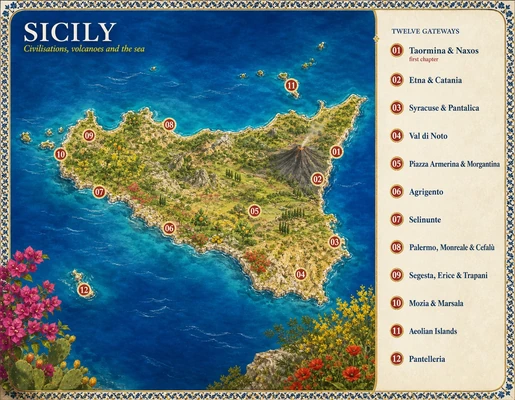
The map will not reduce Sicily to a coastal circuit. It will connect archaeological landscapes, Baroque towns, mountain parks, marine protected areas and the smaller islands that extend Sicily far into the Mediterranean.
Six ways into the island
A journey wide enough
for Sicily.
Each chapter follows both geography and history. Together they prevent the island from being reduced to a handful of famous monuments or beaches.
Roots and the Ionian coast
Taormina, Naxos, Etna, Catania, Alcantara and the Riviera of the Cyclops.
02Syracuse and the south-east
Pantalica, Ortygia, Greek power, the 1693 earthquake and the Baroque towns.
03The interior and Roman Sicily
Piazza Armerina, Morgantina, Enna, Caltagirone and landscapes far from the coast.
04The Greek south
Agrigento, Gela, Selinunte and the relationship between ancient cities and cultivated land.
05Western crossroads
Palermo, Monreale, Cefalù, Segesta, Erice, Mozia, Marsala and the Belìce valley.
06Islands, sea and mountains
Eolie, Egadi, Pantelleria, Ustica, Pelagie, Zingaro, Madonie and Nebrodi.
Quick guide index
All 37 guides, at a glance.
The six chapter pages above are the main route. This compact index keeps direct access to every complete guide without repeating the full card catalogue.
How to read Sicily
Six threads through
every destination.
Archaeology
Cities, necropolises, sanctuaries, theatres, villas, ports and quarries.
Art and architecture
Doric temples, Roman mosaics, Arab-Norman spaces, Baroque cities and contemporary memory.
Living cultures
Puppet theatre, craftsmanship, agriculture, festivals, languages and community knowledge.
Volcanoes
Etna, Stromboli, Vulcano and Pantelleria as physical landscapes and cultural presences.
Sea
Ports, islands, protected areas, fishing traditions and routes between Europe and Africa.
Interior
Mountains, plateaus, mining landscapes and towns beyond the coastal image of Sicily.
Sources
The historical framework is checked against UNESCO, the Sicilian Region’s archaeological and natural-heritage systems, institutional site managers and authoritative historical references. Personal memories are identified as such and kept distinct from documentary claims.
- UNESCO · Archaeological Area of Agrigento
- UNESCO · Syracuse and Pantalica
- UNESCO · Arab-Norman Palermo, Cefalù and Monreale
- UNESCO · Mount Etna
- Sicilian Region · Archaeological Parks
- Visit Sicily · Official tourism portal
Planning note. Opening hours, tickets, paths, volcanic access and marine conditions change. Every practical detail will be checked again immediately before publication and before travel.
